Análisis completo de inversión en IOST: averigua si IOST es una opción adecuada mediante el historial de precios, la tokenómica, los riesgos y las previsiones de precios para 2026-2031. Conoce estrategias de inversión y gestiona los riesgos en Gate.
Introducción: posición de inversión y perspectivas de mercado de IOST (IOST)
IOST es un activo relevante en el sector de las criptomonedas. Desde su lanzamiento en 2018, ha conseguido hitos notables en el ámbito de las plataformas de aplicaciones blockchain. A 19 de enero de 2026, IOST presenta una capitalización de mercado aproximada de 48,49 millones de dólares, con un suministro circulante de unos 30 750 millones de tokens y un precio actual en torno a 0,001577 $. Respaldada por instituciones como Sequoia y ZhenFund, IOST se ha consolidado progresivamente como un punto de atención para inversores que debaten si "IOST (IOST) es una buena inversión". Este artículo ofrece un análisis exhaustivo del valor de inversión de IOST, su evolución histórica, previsiones futuras y riesgos asociados, aportando una referencia objetiva para inversores.
I. Revisión histórica del precio y situación actual de inversión en IOST
Tendencias históricas del precio de IOST y rentabilidad
- 2018: Lanzamiento de la red principal de IOST. El precio experimentó una elevada volatilidad tras el entusiasmo inicial del mercado.
- 2018-2020: Periodo de ajuste de mercado. El precio fluctuó en un rango relativamente estrecho mientras el proyecto desarrollaba su ecosistema DApp.
- 2020-2021: Expansión del mercado de criptomonedas. La actividad de trading aumentó gracias al impulso general del mercado.
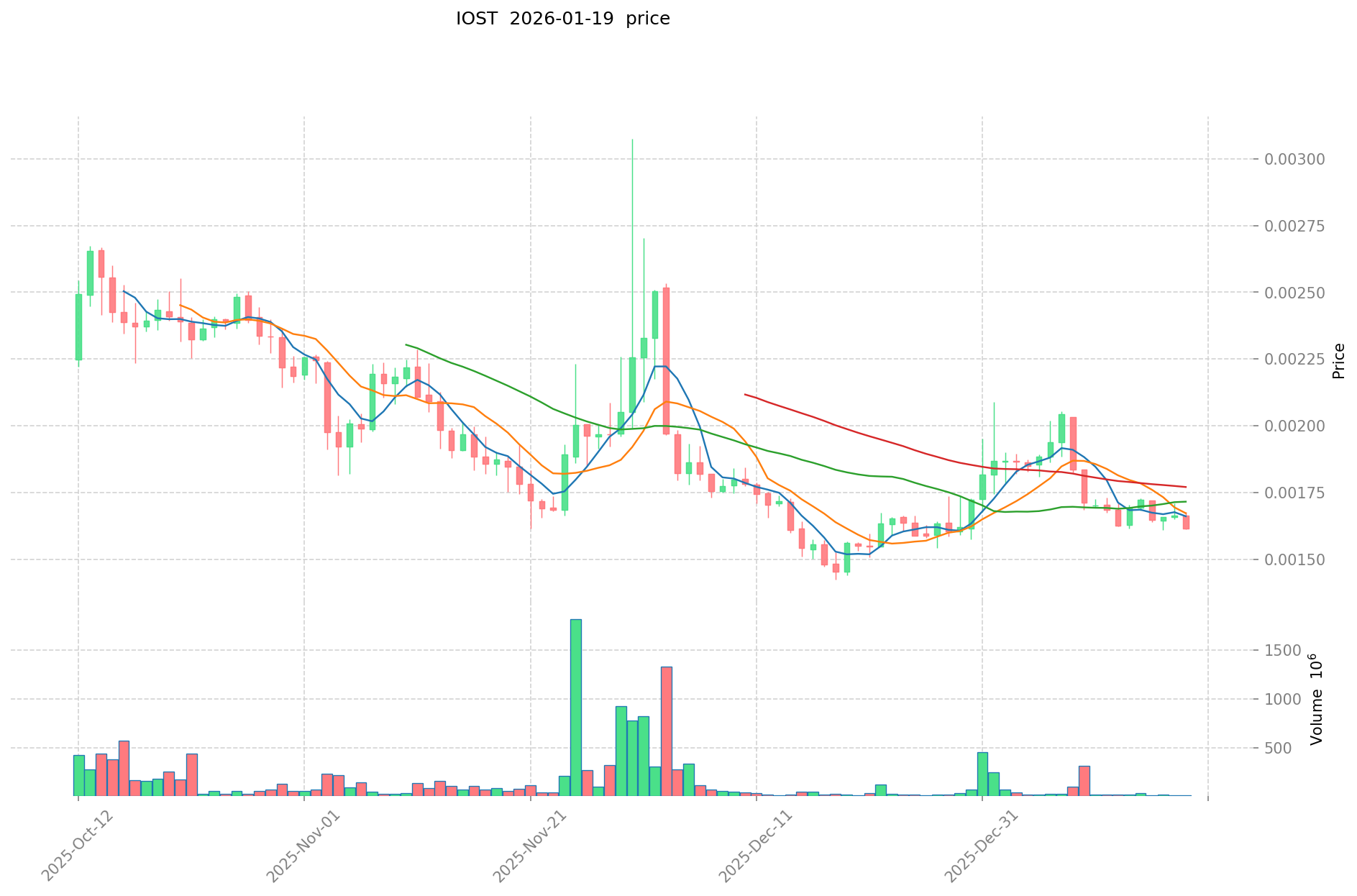
- 2025-2026: Fase de consolidación del mercado. El precio permaneció en rangos acotados mientras los participantes evaluaban el posicionamiento a largo plazo.
Situación actual del mercado de inversión en IOST (enero de 2026)
- Precio actual de IOST: 0,001577 $
- Volumen de trading en 24 horas: 28 825,52 $
- Capitalización de mercado: aproximadamente 48,49 millones de dólares
- Suministro circulante: 30 750 millones de IOST (34,17 % del suministro máximo)
- Cambio de precio en 24 horas: -4,19 %
- Cambio de precio en 7 días: -6,25 %
Haz clic para ver el precio de mercado de IOST en tiempo real
En enero de 2026, IOST registraba actividad de trading en 25 exchanges y alrededor de 38 477 titulares de tokens. El precio reflejaba las condiciones generales del mercado, mostrando recientemente una volatilidad moderada. Para evaluar estrategias de posicionamiento, los participantes deben considerar factores como el desarrollo tecnológico, la expansión del ecosistema y las tendencias globales del mercado de criptoactivos.
II. Factores clave que determinan si IOST es una buena inversión
Mecanismo de suministro y escasez (escasez de inversión en IOST)
- Estructura de suministro: IOST cuenta con un suministro máximo de 90 000 millones de tokens, de los cuales aproximadamente 30 750 millones estaban en circulación al 19 de enero de 2026, lo que supone una ratio de circulación del 34,17 %. El mecanismo de suministro condiciona la dinámica potencial de precios y la propuesta de valor para el inversor.
- Comportamiento histórico del precio: IOST alcanzó un nivel destacado de 0,129829 $ en enero de 2018, mientras que en diciembre de 2025 cotizaba a 0,00142755 $. Estas oscilaciones reflejan cambios en las condiciones de mercado y el sentimiento inversor.
- Consideración de inversión: La relación entre el suministro circulante y el máximo puede ser relevante para valorar la escasez a largo plazo y la economía del token.
Inversión institucional y adopción generalizada (inversión institucional en IOST)
- Respaldo institucional: IOST recibió el apoyo de inversores como Sequoia y Zhenge en su fase de desarrollo, lo que favoreció su posicionamiento inicial en el segmento de plataformas de aplicaciones blockchain.
- Iniciativa I Foundation: Lanzada en julio de 2025, la I Foundation está dedicada a la inversión en proyectos Real World Asset (RWA) en IOST y BNB Chain, con un modelo de distribución de beneficios para quienes hacen staking de IOST. Esta iniciativa busca ampliar el alcance inversor del ecosistema.
- Posicionamiento de mercado: Tras el lanzamiento de su mainnet, IOST se situó entre plataformas como Ethereum, EOS y Tron en el sector de cadenas públicas para DApp, aunque las condiciones actuales y la competencia evolucionan continuamente.
Impacto del entorno macroeconómico en la inversión en IOST
- Condiciones de mercado: A 19 de enero de 2026, IOST cotizaba a 0,001577 $ con un volumen de trading en 24 horas de 28 825,52 $. Los últimos movimientos muestran un cambio del -4,19 % en 24 horas, -6,25 % en 7 días y +1,94 % en 30 días, reflejando su sensibilidad ante el contexto global.
- Capitalización de mercado: Con una capitalización de aproximadamente 48,49 millones de dólares y una cuota de mercado del 0,0014 %, IOST ocupa una posición modesta en el universo de las criptomonedas.
- Consideraciones de volatilidad: El rendimiento anual evidencia un cambio del -76,98 %, lo que señala una volatilidad elevada que debe tenerse en cuenta en la gestión del riesgo.
Desarrollo tecnológico y del ecosistema (tecnología y ecosistema para la inversión en IOST)
- Arquitectura técnica: IOST emplea el mecanismo de consenso Proof-of-Believability (PoB), junto con soluciones de escalado de segunda capa, diseñado para soportar escalabilidad horizontal y alto rendimiento en aplicaciones descentralizadas.
- Estrategia multichain: IOST se ha convertido en un ecosistema multichain, enfocado en infraestructura Real World Asset (RWA), como reflejan los avances de septiembre de 2025 y el enfoque cross-chain de la I Foundation.
- Ecosistema de desarrolladores: La plataforma proporciona infraestructura para desarrolladores externos, creadores y empresas, con desarrollo activo visible en sus repositorios de GitHub (go-iost, explorer, iost-webapp).
- Base de titulares: Según los datos más recientes, IOST cuenta con unos 38 477 titulares de tokens, reflejando el nivel de participación comunitaria y distribución de tokens.
III. Predicciones de inversión y proyección de precio de IOST (¿vale la pena invertir en IOST(IOST) en 2026-2030?)
Predicción de inversión a corto plazo (2026, perspectivas a corto plazo para IOST)
- Escenario conservador: 0,001012 - 0,001364 $
- Escenario neutral: 0,001581 - 0,001684 $
- Escenario optimista: 0,001787 - 0,003002 $
Perspectiva de inversión a medio plazo (2027-2029, previsión de inversión en IOST(IOST))
- Fase de mercado prevista: el token podría entrar en una etapa de crecimiento gradual conforme evoluciona la infraestructura blockchain y las plataformas DApp aumentan su presencia.
- Previsión de rentabilidad:
- 2027: 0,001364 - 0,001785 $
- 2028: 0,001301 - 0,001838 $
- 2029: 0,001036 - 0,002590 $
- Catalizadores clave: posible expansión del ecosistema DApp, mayor adopción del consenso PoB y dinamismo competitivo entre plataformas blockchain.
Perspectiva de inversión a largo plazo (¿es IOST una buena inversión a largo plazo?)
- Escenario base: 0,001663 - 0,002188 $ (si se mantiene el desarrollo estable del ecosistema y la presencia en el mercado)
- Escenario optimista: 0,003195 - 0,005288 $ (con una adopción acelerada de DApp y condiciones favorables en el sector blockchain)
- Escenario de riesgo: por debajo de 0,001036 $ (en caso de condiciones adversas o presión competitiva elevada)
Haz clic para consultar la previsión de inversión y precio a largo plazo de IOST: Predicción de precio
Perspectiva a largo plazo 2026-01-19 - 2031
- Escenario base: 0,001663 - 0,002691 USD (si se mantiene un progreso constante y una mejora gradual de la adopción generalizada)
- Escenario optimista: 0,003195 - 0,003607 USD (si se produce una adopción masiva y el entorno de mercado es favorable)
- Escenario transformador: por encima de 0,005288 USD (si el ecosistema logra avances disruptivos y popularización generalizada)
- Pico previsto para el 31-12-2031: 0,003607 USD (bajo supuestos de desarrollo optimista)
Descargo de responsabilidad: Las previsiones anteriores se basan en análisis de datos históricos y materiales de investigación de mercado. Los mercados de criptomonedas son altamente volátiles e imprevisibles. Estas estimaciones no constituyen asesoramiento de inversión. El inversor debe realizar su propia investigación y considerar su tolerancia al riesgo antes de tomar cualquier decisión.
| Año |
Precio máximo estimado |
Precio promedio estimado |
Precio mínimo estimado |
Variación de precio |
| 2026 |
0,00178653 |
0,001581 |
0,00101184 |
0 |
| 2027 |
0,0017847909 |
0,001683765 |
0,00136384965 |
6 |
| 2028 |
0,001838334627 |
0,00173427795 |
0,0013007084625 |
9 |
| 2029 |
0,002590144118325 |
0,0017863062885 |
0,00103605764733 |
13 |
| 2030 |
0,003194808796982 |
0,002188225203412 |
0,001663051154593 |
38 |
| 2031 |
0,003606632780264 |
0,002691517000197 |
0,001857146730136 |
70 |
IV. Estrategia de inversión y gestión de riesgos en IOST (cómo invertir en IOST)
Estrategia de inversión (estrategia de inversión en IOST)
Acumulación a largo plazo (HODL IOST)
Para inversores conservadores interesados en plataformas de infraestructura blockchain, la acumulación a largo plazo puede ser una opción. Este enfoque implica adquirir tokens IOST y mantener las posiciones a través de los ciclos de mercado, prestando atención al desarrollo fundamental del proyecto más que a las variaciones de precio a corto plazo. Dado el posicionamiento de IOST como plataforma pública de DApp y su consenso PoB, los holders a largo plazo suelen enfocarse en la adopción, crecimiento del ecosistema y avances tecnológicos en periodos extensos.
Trading activo
Las estrategias de trading activo se basan en análisis técnico y técnicas de swing trading. Los traders monitorizan los movimientos del precio de IOST, con datos recientes de un volumen en 24 horas de 28 825 $ y fluctuaciones entre 0,001481 $ y 0,001676 $. Los operadores técnicos suelen utilizar patrones de gráficos, indicadores de volumen y señales de impulso para identificar entradas y salidas. La volatilidad histórica del token, incluida una caída anual de cerca del 76,98 %, indica que el trading activo requiere una gestión rigurosa del tamaño de posición y disciplina en la ejecución.
Gestión de riesgos (gestión de riesgos en la inversión en IOST)
Ratios de asignación de activos
- Inversores conservadores: pueden asignar entre un 1 y un 3 % de su cartera de criptomonedas a IOST, manteniendo la mayor parte en activos consolidados.
- Inversores agresivos: pueden asignar entre un 5 y un 10 % de su cartera, asumiendo mayor riesgo a cambio de posibles oportunidades de crecimiento.
- Inversores profesionales: pueden aplicar estrategias de asignación dinámica en función de las condiciones de mercado y los indicadores técnicos.
Estrategias de cobertura de riesgo
La diversificación entre múltiples activos sigue siendo una estrategia básica de gestión de riesgos. Los inversores pueden considerar:
- Mantener una cartera equilibrada que combine criptomonedas consolidadas con plataformas emergentes.
- Implantar órdenes stop-loss para limitar el riesgo de caídas.
- Rebalancear la cartera regularmente para mantener los porcentajes de asignación objetivo.
- Monitorizar la correlación con el mercado general de criptomonedas.
Almacenamiento seguro
Soluciones de billetera fría y caliente: Los tokens IOST pueden almacenarse en diferentes tipos de billetera según la frecuencia de uso:
- Billeteras calientes: adecuadas para trading activo y transacciones frecuentes, aunque presentan mayor riesgo de seguridad por conexión a internet.
- Billeteras frías: recomendadas para acumulación a largo plazo, ya que ofrecen almacenamiento offline y mayor seguridad.
- Billeteras hardware: dispositivos físicos que proporcionan un nivel de seguridad reforzado para grandes tenencias.
Dado que IOST dispone de una dirección de contrato en Ethereum (0xfa1a856cfa3409cfa145fa4e20eb270df3eb21ab), los inversores deben asegurarse de que la billetera elegida sea compatible con tokens ERC-20 y aplique medidas como autenticación en dos pasos y copias de seguridad seguras.
V. Riesgos y desafíos de invertir en IOST (riesgos de invertir en IOST)
Riesgos de mercado
Alta volatilidad: El historial de precios de IOST evidencia una volatilidad significativa. El valor del token ha oscilado notablemente, con un descenso del 6,25 % en 7 días y del 4,19 % en 24 horas, según los datos más recientes. El rango histórico de precios va de 0,001428 $ a 0,129829 $, lo que muestra fluctuaciones importantes que el inversor debe anticipar.
Consideraciones de liquidez: Con un volumen de trading diario de 28 825 $ y cotización en 25 exchanges, es fundamental evaluar si la liquidez disponible cubre las necesidades de operativa. Un entorno de baja liquidez puede traducirse en spreads amplios y dificultades para ejecutar órdenes de gran volumen sin afectar el precio.
Riesgos regulatorios
Incertidumbre normativa: La regulación de criptomonedas varía según jurisdicción y está en constante evolución. Los países mantienen posturas distintas respecto a plataformas blockchain y clasificación de tokens, lo que puede suponer desafíos de cumplimiento. Los cambios regulatorios en mercados clave pueden repercutir en la accesibilidad y condiciones de trading de IOST.
Requisitos de cumplimiento: Con el desarrollo de marcos regulatorios, las plataformas blockchain pueden afrontar requisitos relacionados con verificación de usuarios, reporte de transacciones y licencias. Los cambios en las expectativas regulatorias pueden influir en el modelo operativo y el posicionamiento de IOST.
Riesgos técnicos
Seguridad de red: Las plataformas blockchain están expuestas a riesgos de seguridad, como vulnerabilidades en contratos inteligentes, mecanismos de consenso o la propia infraestructura de red. Aunque IOST implementa el consenso PoB para escalabilidad y descentralización, los sistemas requieren mantenimiento y auditoría continuos.
Riesgos de desarrollo tecnológico: El sector blockchain evoluciona de forma acelerada. La capacidad de IOST para mantener ventajas competitivas depende de la ejecución de actualizaciones, desarrollo del ecosistema y adaptación a estándares emergentes. Los problemas técnicos durante actualizaciones pueden afectar temporalmente el rendimiento o la experiencia del usuario.
Vulnerabilidades en contratos inteligentes: Los proyectos construidos sobre la plataforma IOST pueden presentar errores de código o fallos de seguridad en contratos inteligentes, afectando la estabilidad del ecosistema y la confianza de los usuarios.
VI. Conclusión: ¿es IOST una buena inversión?
Resumen del valor de inversión
IOST es una plataforma de aplicaciones blockchain centrada en ofrecer infraestructura para proveedores de servicios online, mediante el consenso PoB y soluciones de escalabilidad de segunda capa. Su presencia en el segmento de cadenas públicas de DApp y el respaldo institucional son elementos fundacionales. No obstante, el token ha experimentado un descenso de precio significativo (alrededor del 76,98 % en el último año), reflejo de los desafíos del mercado.
La capitalización de mercado de casi 48,49 millones de dólares y un suministro circulante equivalente al 34,17 % del máximo definen sus características de inversión. El precio actual (0,001577 $) se sitúa muy por debajo de su máximo histórico, lo que responde a la nueva situación de mercado y la evolución competitiva.
Recomendaciones para inversores
✅ Principiantes:
- Considerar la compra periódica para mitigar el riesgo de mercado
- Priorizar el almacenamiento seguro mediante billeteras hardware o servicios de custodia de confianza
- Invertir solo capital que pueda asumir una pérdida total
- Realizar un análisis profundo de la tecnología y el desarrollo del ecosistema de IOST
✅ Inversores experimentados:
- Explorar el swing trading sobre la base del análisis técnico
- Diversificar la cartera en varias plataformas blockchain
- Monitorizar el desarrollo del ecosistema y los anuncios de alianzas
- Mantener una gestión disciplinada del tamaño de posición en relación con la cartera total
✅ Inversores institucionales:
- Evaluar IOST dentro de estrategias globales de infraestructura blockchain
- Realizar due diligence sobre la gobernanza y la hoja de ruta del proyecto
- Considerar la correlación con activos digitales consolidados
- Valorar la liquidez disponible frente a sus necesidades operativas
⚠️ Descargo de responsabilidad: La inversión en criptomonedas implica riesgos elevados, incluida la pérdida total del capital. Este contenido es un análisis informativo y no constituye asesoramiento de inversión. Las condiciones de mercado, los entornos regulatorios y los factores tecnológicos pueden variar rápidamente. El inversor debe realizar su propia investigación y, en su caso, consultar a asesores financieros cualificados antes de tomar decisiones. El rendimiento pasado no garantiza resultados futuros.
VII. Preguntas frecuentes
P1: ¿Qué es IOST y en qué se diferencia de otras plataformas blockchain?
IOST es una plataforma de aplicaciones blockchain que emplea el mecanismo Proof-of-Believability (PoB) y soluciones de escalado de segunda capa. Se diferencia por su foco en ofrecer infraestructura a proveedores de servicios online y desarrolladores externos. A diferencia de Proof-of-Work o Proof-of-Stake tradicionales, PoB busca escalabilidad horizontal y alto rendimiento para aplicaciones descentralizadas. El ecosistema ha evolucionado hacia un modelo multichain con énfasis en infraestructura Real World Asset (RWA), como demuestra la iniciativa de inversión de la I Foundation lanzada en julio de 2025.
P2: ¿Es IOST adecuada para inversión a largo plazo en 2026?
La conveniencia de IOST como inversión a largo plazo depende de la tolerancia al riesgo y los objetivos de cada inversor. En enero de 2026, IOST cotiza en torno a 0,001577 $ y tiene una capitalización de 48,49 millones de dólares, tras caer un 76,98 % en el último año. Las previsiones a largo plazo sitúan el rango de precios entre 0,001663 $ y 0,003607 $ hasta 2031, según el escenario. Los inversores más conservadores pueden considerar una asignación del 1-3 % de su cartera, asumiendo la volatilidad. El respaldo institucional de Sequoia y ZhenFund y la evolución del ecosistema son factores estructurales, aunque las condiciones de mercado siguen siendo imprevisibles y requieren análisis detallado.
P3: ¿Dónde se pueden comprar y almacenar tokens IOST de forma segura?
Los tokens IOST están disponibles en unas 25 plataformas de trading de criptomonedas en enero de 2026. Para almacenamiento seguro existen varias opciones según el uso: las billeteras calientes permiten acceso rápido pero conllevan más riesgo, mientras que las billeteras frías o hardware ofrecen mayor seguridad al estar desconectadas. Dado que IOST tiene dirección de contrato en Ethereum (0xfa1a856cfa3409cfa145fa4e20eb270df3eb21ab), la billetera debe ser compatible con ERC-20 y aplicar medidas como autenticación en dos pasos y copias de seguridad seguras.
P4: ¿Cuáles son los principales riesgos de invertir en IOST?
Invertir en IOST implica riesgos diversos que deben valorarse: riesgos de mercado (alta volatilidad, con un -4,19 % en 24 horas y -6,25 % en 7 días; liquidez modesta de 28 825 $ diarios), riesgos regulatorios por entornos legales cambiantes, y riesgos técnicos como posibles vulnerabilidades en contratos inteligentes, seguridad de red y capacidad del proyecto para mantener ventaja competitiva. Además, la caída anual del 76,98 % subraya la importancia de una gestión rigurosa del riesgo y el tamaño de posición.
P5: ¿Cómo afectan los tokenomics de IOST a su potencial de inversión?
IOST cuenta con un suministro máximo de 90 000 millones de tokens, de los cuales unos 30 750 millones estaban en circulación en enero de 2026 (34,17 %). Esta estructura influye en la dinámica de precio y la percepción de escasez. El token alcanzó 0,129829 $ en enero de 2018 y actualmente cotiza en 0,001577 $, reflejando ajustes de mercado. La relación entre suministro circulante y máximo es relevante para analizar la economía del token, especialmente con el desarrollo del ecosistema y el modelo de reparto de beneficios de la I Foundation para stakers. Aun así, los tokenomics son solo uno de los factores que afectan a la inversión.
P6: ¿Qué previsiones de precio existen para IOST hasta 2030?
Las proyecciones de precio de IOST abarcan varios escenarios según el desarrollo del ecosistema y el mercado. Para 2026, el rango conservador es 0,001012-0,001364 $ y el optimista 0,001787-0,003002 $. Para 2027-2029, el rango va de 0,001036-0,002590 $ según la expansión de DApp y el contexto blockchain. A largo plazo, hasta 2031, el escenario base es 0,001663-0,002691 $ y el optimista 0,003195-0,005288 $. Estas proyecciones suponen desarrollo tecnológico y participación de mercado, pero pueden variar por volatilidad, cambios regulatorios y competencia. Se deben tomar solo como referencia.
P7: ¿Qué estrategias de inversión son apropiadas para los tokens IOST?
Las estrategias dependen del perfil de riesgo y visión del inversor. La acumulación a largo plazo es para perfiles conservadores que priorizan desarrollo y adopción, mientras que el trading activo se basa en análisis técnico y gestión disciplinada de posiciones. La compra periódica ayuda a principiantes a reducir el riesgo, y los experimentados pueden diversificar en varias plataformas y controlar el peso relativo en la cartera.
P8: ¿Cómo afecta la iniciativa I Foundation a la perspectiva de inversión de IOST?
La I Foundation, lanzada en julio de 2025, busca ampliar el ecosistema IOST mediante inversión en proyectos Real World Asset (RWA) sobre IOST y BNB Chain. El modelo de reparto de beneficios para stakers de IOST aporta utilidad adicional al ecosistema. Este enfoque multichain puede incrementar el valor conectando activos tradicionales y blockchain, pero su impacto dependerá de la eficacia en la implementación, la adopción y la aceptación del mercado de la tokenización RWA. Los inversores deben monitorizar el desarrollo de la Foundation y su impacto en el ecosistema como parte de su análisis.
* La información no pretende ser ni constituye un consejo financiero ni ninguna otra recomendación de ningún tipo ofrecida o respaldada por Gate.