In cryptocurrency tokenomics, burn mechanisms are a key tool for regulating supply and demand and limiting inflation. As a pioneer in the transition from platform token to public chain asset, BNB has seen its burn mechanism evolve from early “manual operations” into a system now driven entirely by algorithms.
Understanding how BNB’s burn logic works is essential for studying value capture in blockchain networks. It affects not only the scarcity of the token, but also the most direct feedback loop between BNB Chain’s ecosystem activity and the asset’s value. As competition among multiple chains grows more intense, this highly automated deflationary model has become an important pillar supporting BNB’s core competitiveness and market position.
The Evolution of BNB’s Burn Mechanism
BNB burns were originally based on quarterly buybacks and burns funded by exchange profits. To further decentralize the process and make it more predictable, the system introduced the Auto-Burn algorithm, separating the burn logic from centralized exchange decisions. This evolution marked BNB’s formal entry into an era of “objective deflation” driven by code and on-chain data.
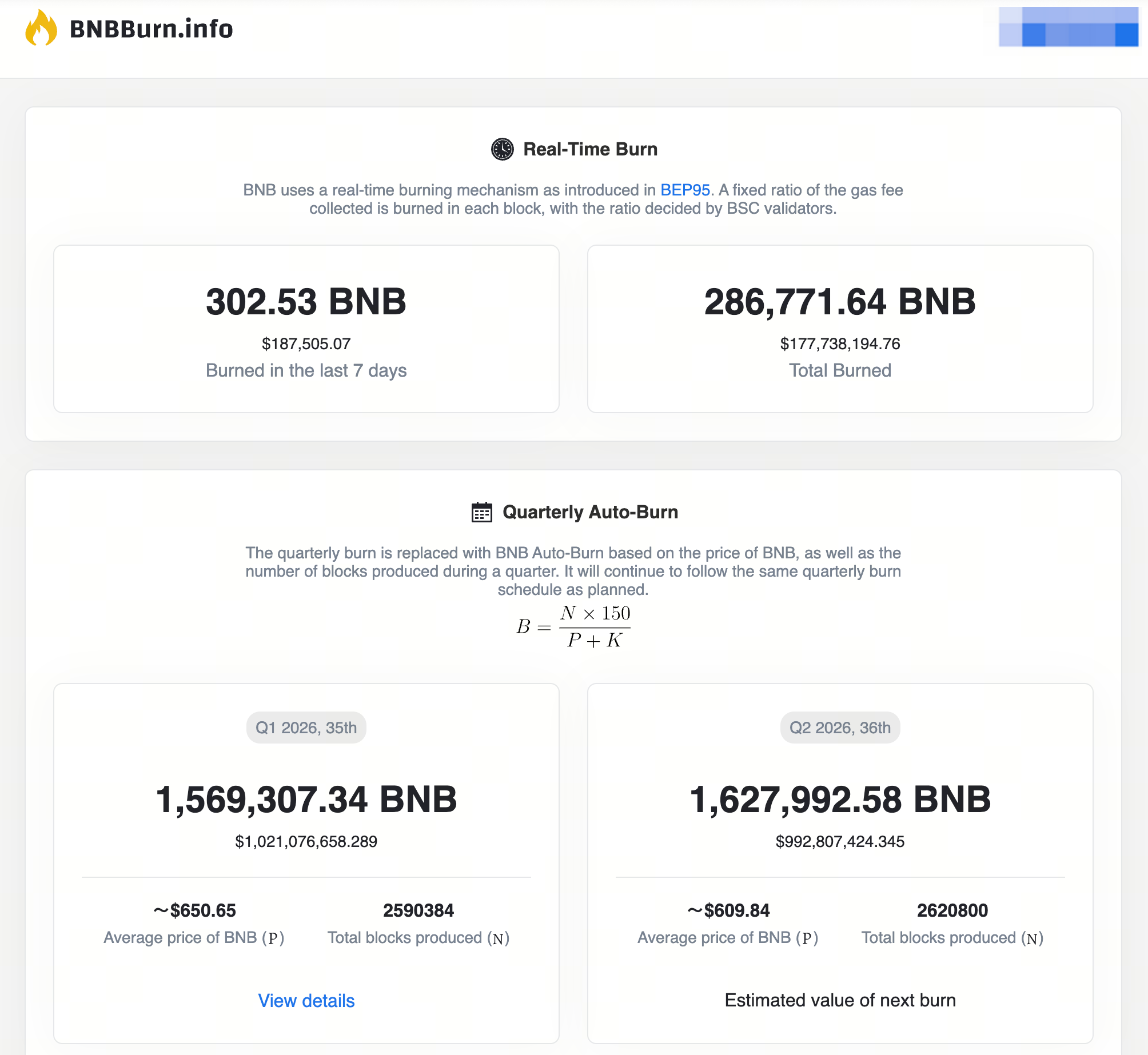
Source: BNBBurn
Real-Time Burn Mechanism: A Breakdown of BEP-95
Real-Time Burn is implemented through the BEP-95 proposal and works in a way similar to Ethereum’s EIP-1559.
-
How it works: Every transaction on BNB Smart Chain generates a Gas fee. Under BEP-95, a fixed percentage of that Gas fee, usually 10%, is immediately sent to a black hole address and permanently burned.
-
Core function: This mechanism directly links the pace of BNB burns to network usage. The busier the network becomes, the more BNB is burned, which helps ease the potential inflationary pressure created by network expansion in real time.
How Is Quarterly Auto-Burn Calculated?
Unlike early quarterly burns, Auto-Burn no longer refers to exchange profits. Instead, it uses a transparent mathematical formula.
-
Formula variables: The formula mainly considers BNB’s average price and the number of blocks produced on BSC during the quarter.
-
Reverse adjustment mechanism: When BNB’s price falls, the burn amount automatically increases. When the price rises, the burn amount decreases moderately. This design ensures that, regardless of market fluctuations, the value of burned tokens stays within a reasonable range and continues moving toward the target supply of 100 million.
Comparing the Two Burn Mechanisms
To understand these two parallel mechanisms more clearly, the table below compares them side by side:
| Dimension |
Real-Time Burn (BEP-95) |
Quarterly Auto-Burn |
| Trigger frequency |
Triggered by each transaction |
Executed once per quarter |
| Driving factor |
On-chain transaction activity, Gas fees |
Token price and block production |
| Transparency |
Verifiable on-chain in real time |
Algorithm preset and executed on-chain |
| Main purpose |
Offset network inflation |
Achieve the long-term total supply deflation target |
Long-Term Impact of the Burn Mechanism on the BNB Ecosystem
Through continuous token removal, BNB has created an expectation of a “deflationary premium.” This can strengthen token holders’ confidence while using BEP-95 to feed the benefits of ecosystem growth directly back into the token itself. By reducing circulating supply, the mechanism theoretically provides solid economic support for the asset’s long-term value. It also encourages developers to build on a deflationary network that is efficient and low cost.
Conclusion
Through BEP-95’s real-time adjustment and Auto-Burn’s broader supply control, BNB’s burn mechanism creates a precise and decentralized deflationary loop. This system ensures that BNB supply continues to decline and deeply ties its scarcity to the activity of the underlying public blockchain. It is one of the most representative token economic models in today’s crypto market.
FAQs
Can Burned BNB Be Recovered?
No. Burning means sending tokens to a “black hole address” whose private key cannot be recovered, which permanently removes those tokens from circulating supply.
Why Is the Total Supply Target Set at 100 Million?
This was the economic white paper goal set when BNB was created. It is designed to ensure token scarcity and long-term value appreciation by cutting the supply in half.
Does the Burn Mechanism Directly Cause the Price to Rise?
The burn mechanism improves the supply-demand relationship by reducing supply, making it a potential positive factor for price. However, price is still affected by many factors, including overall market conditions, the macroeconomic environment, and user demand.
No. Real-time burn is taken from Gas fees already paid to the network, so it does not increase transaction costs for ordinary users.







