What Is Drift Protocol?
 (Image source: Drift Protocol)
Drift Protocol is a decentralized exchange (DEX) built on Solana that primarily offers perpetual futures, spot trading, and lending and borrowing. Unlike traditional exchanges, Drift operates on a non-custodial model—users trade directly through their wallets, keeping their assets under their own control at all times. Its goal is to deliver a trading experience on-chain that rivals centralized exchanges (CEX) while preserving the advantages of decentralization.
Core Features of Drift Protocol
- Hybrid Liquidity Mechanism
Drift's standout feature is its liquidity triangle model, which combines multiple liquidity sources:
- vAMM (Virtual Automated Market Maker): Provides baseline liquidity using mathematical models
- DLP (Liquidity Provider): Users can supply capital and earn returns
- Order Book (JIT Liquidity): Works like order matching on traditional exchanges
This hybrid architecture is designed to optimize trading depth, price efficiency, and slippage control simultaneously.
- Multi-Asset Trading and Financial Functions
Drift is not just a single trading platform—it integrates a variety of DeFi functions:
- Perpetual Futures Trading
- Spot Trading
- Asset Lending & Borrowing
- Staking
Users can manage multiple asset operations on a single platform.
- Cross Margin
Drift supports cross margin, which means:
- All assets share the same margin pool
- Multiple leveraged positions can be opened at once
- Capital efficiency is improved
However, it also means risk is concentrated and requires more careful management.
- High-Speed, Low-Cost Trading
Since it's built on Solana, Drift offers:
- High transaction speeds
- Low trading fees
- Fully on-chain execution
This makes the experience feel much closer to that of a centralized exchange.
How Does Drift Protocol Work?
Drift is a non-custodial trading platform. Here’s how it works:
- Users connect a Web3 wallet
- Deposit assets as collateral
- Select a trading type (spot or perpetual)
- Open a position (long or short)
- Profit or lose based on market movements
No third party ever takes custody of the assets.
Core Trading Mechanisms Explained
Perpetual Futures
Perpetual futures are derivatives with no expiration date, allowing users to go long (bullish) or short (bearish).
For example:
- Buy BTC-PERP → Betting the price will rise
- Short BTC-PERP → Betting the price will fall
Leverage can amplify both returns and risks.
Spot Trading
Similar to regular exchanges, users can directly buy or sell crypto assets at market price. Drift uses a modified AMM (DAMM) to minimize slippage.
Dynamic Automated Market Maker (DAMM)
To optimize the trading experience, Drift designed the DAMM mechanism with three layers of protection:
- Just-In-Time (JIT) Liquidity: Market makers provide real-time quotes
- AMM Liquidity: Ensures baseline trading depth
- Order Matching: Fills in when liquidity is insufficient
This design effectively reduces slippage and improves price stability.
Drift v3: Major Upgrade Changes
 (Image source: Drift Protocol)
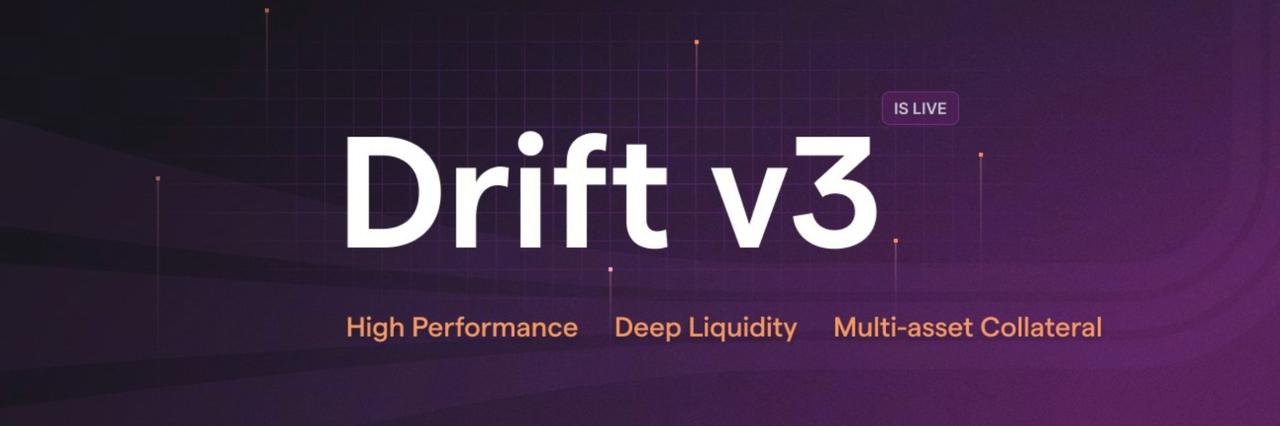
Drift v3, a major upgrade to the protocol, focuses on simultaneously boosting trading speed, liquidity depth, and product functionality. In terms of execution efficiency, around 85% of orders are matched within half a second, with overall response times approaching the millisecond range. Additionally, thanks to the new just-in-time (JIT) liquidity engine, slippage can be kept to roughly 0.02% even on large trades, effectively addressing the liquidity shortages that have historically plagued on-chain trading.
Drift v3 also expands trading capabilities by supporting up to 100x leverage and offering a wider range of order types and strategy tools for advanced traders. On the liquidity front, users can not only participate in the spot market but also provide liquidity for perpetual futures, creating additional sources of return and improving capital efficiency.
Advantages and Risks: The Dual Nature of Efficiency Gains
From a design perspective, Drift's key advantage is combining non-custodial asset management with high-performance trading, allowing users to retain control of their assets while enjoying a smooth experience similar to centralized exchanges. The platform also integrates multiple DeFi features and enhances market depth and capital efficiency through innovative liquidity mechanisms. However, this high-efficiency, high-leverage design comes with risks, including the inherent volatility of leveraged trading, potential losses from sharp market moves, and the significant smart contract risks in DeFi. Under extreme market conditions, liquidity may also become scarce, further amplifying trading risk.
Conclusion
Drift Protocol has gradually evolved beyond a traditional decentralized exchange into an efficient on-chain trading infrastructure. Its development is focused on achieving high efficiency, low slippage, and a user experience on par with centralized exchanges (CEX). Through its hybrid liquidity model and continuous technical upgrades, Drift is narrowing the gap between DeFi and traditional finance, pushing the on-chain derivatives market toward a more mature phase.







