Users are drawn to Space because it merges trading markets with prediction mechanisms, allowing participants to both express their views and profit from price movements. While traditional prediction markets tend to centralize information on a few platforms, on-chain protocols like Space aim to boost transparency and participation through open access.
This challenge typically covers three areas: prediction market mechanisms, order matching logic, and token incentive structures. Together, these elements form the operational backbone of Space.
What Is Space (SPC)?
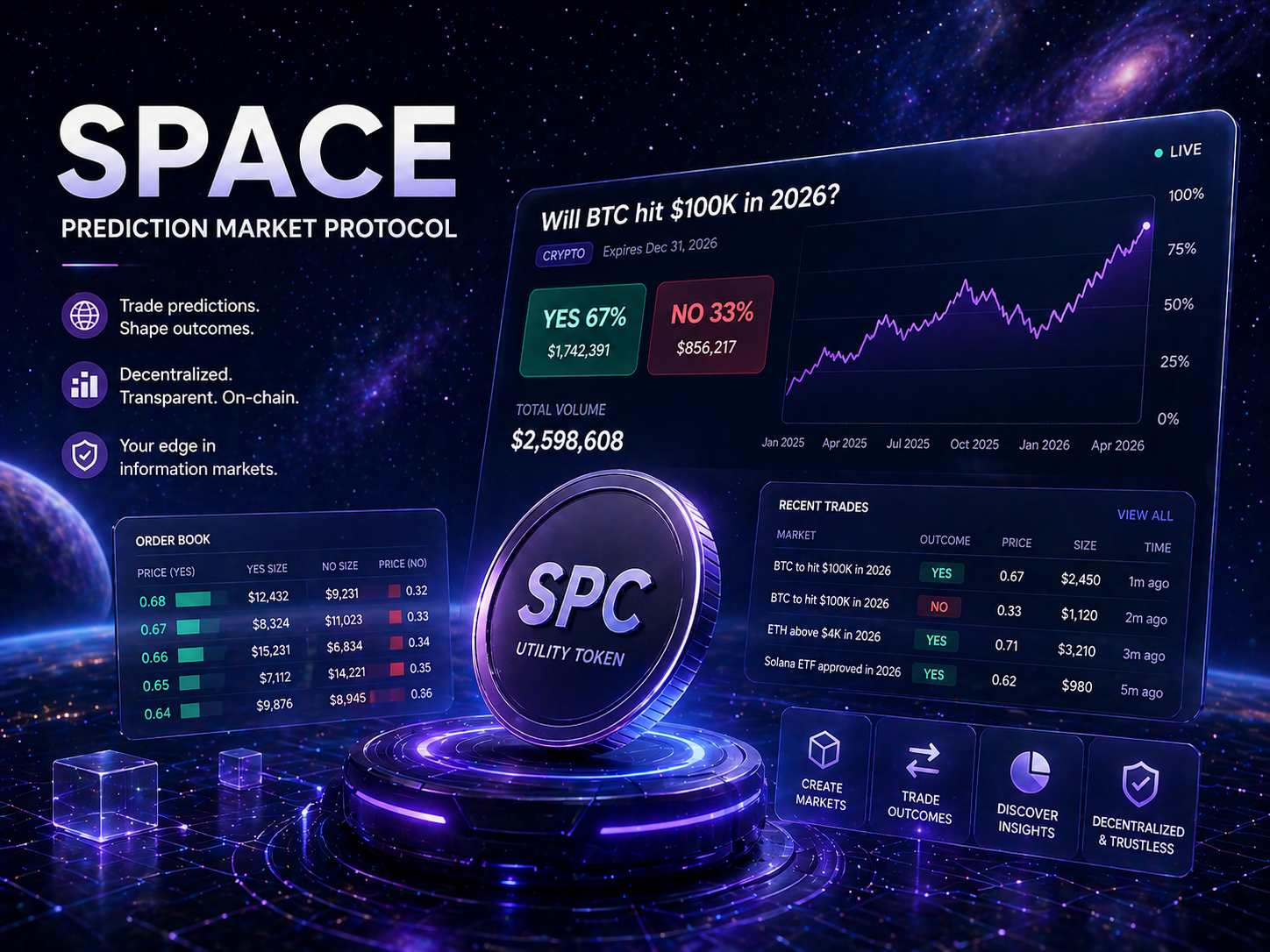
Space is a decentralized prediction market protocol that empowers users to create and trade markets centered around future events.
In essence, Space turns “event outcomes” into “tradable assets,” allowing users to express their outlooks by buying and selling positions tied to different results. Structurally, Space operates on-chain, using smart contracts to handle all transactions, orders, and settlements.
The process starts with the user selecting or creating a prediction event. The market then generates tradable assets for each possible outcome. Participants signal their expectations by buying or selling these positions. Once the result is known, the system settles accordingly.
This structure transforms information-based judgments into market behavior, making prices a reflection of probability and enhancing the efficiency of information discovery.
How Space’s Core Mechanism Works
Space’s core mechanism revolves around prediction market trading, price discovery, and settlement logic.
Fundamentally, Space is a marketplace that translates “probabilities” into “prices.” Users continually influence pricing through trading, and those prices reflect the market’s expectations for event outcomes.
Users first enter a specific prediction market. Based on their outlook, they buy or sell positions on a particular outcome. Orders are processed through the matching system to generate transaction prices. In the end, price movements capture market consensus, and settlement occurs after the event concludes.
This mechanism allows Space to aggregate information efficiently—the more participants involved, the closer prices align with true probabilities, enhancing market efficiency.
SPC Token’s Role and Function in the Ecosystem
SPC is the cornerstone token of the Space ecosystem, powering trading, incentives, and ecosystem participation.
SPC functions both as a payment instrument and as a crucial medium for market operations. It enables users to trade, pay fees, and receive rewards.
Users use SPC to trade in prediction markets. The system charges a fee on transactions, part of which is distributed as incentives to market participants or liquidity providers. Ultimately, SPC circulates throughout the ecosystem.
The value of SPC depends on activity and trading demand within the market—greater trading volume fuels higher SPC usage and demand.
Order Matching and Settlement Logic in Prediction Markets
Order matching and settlement logic are central to Space’s trading system.
Similar to traditional exchanges—but trading “event outcomes”—Space’s order matching sets prices, while the settlement mechanism determines final returns.
Users submit buy or sell orders, which are then matched by the system according to price and quantity. These trades establish market prices. Once the event outcome is confirmed, the system settles all positions based on the result.
The matching engine is responsible for price discovery, while the settlement system allocates value. This clear separation ensures both trading efficiency and robust settlement.
By standardizing these processes, Space turns complex prediction activities into streamlined trading and settlement logic.
Market Creation and Participation in Space
Space allows users to create their own prediction markets—a hallmark of its decentralized design.
Anyone—not just platform operators—can launch a market, which enables continuous expansion of market types through open participation.
A user creates a prediction event and sets the rules. The system generates the corresponding market. Other users can then enter and trade within that market. Once the event resolves, the market is settled accordingly.
This user-driven model increases market diversity, while also demanding robust rule design for each market.
Space vs Polymarket: Mechanism and Architectural Differences
Space and Polymarket are both on-chain prediction markets but differ in architecture, trading mechanisms, and incentive models.
While they share similar goals, their approaches diverge: Space emphasizes on-chain trading and order matching, while Polymarket employs a pool-based market model.
| Dimension |
Space |
Polymarket |
| Architecture |
Order Matching Model |
Liquidity Pool Model |
| Price Formation |
Order Matching |
Automated Market Maker |
| Trading Method |
Order Book–Based Trading |
Pool-Based Swaps |
| Incentives |
Trade-Driven Rewards |
Liquidity Provision Rewards |
| Use Cases |
High-Frequency Trading & Price Discovery |
Simplified Participation & Liquidity |
Space’s structure is closer to a traditional order book exchange, while Polymarket more closely resembles a decentralized exchange protocol. These differences create distinct trade-offs in user experience and market efficiency.
Participants and Value Flow in the Space Ecosystem
The Space ecosystem involves market creators, traders, and liquidity providers.
Each participant adds value at a different stage and receives corresponding rewards. Market creators supply events, traders contribute liquidity and price discovery, and the system manages matching and settlement.
The creator establishes the market. Traders engage in buying and selling. The system records trades, updates prices, and ultimately distributes returns based on event outcomes.
This value flow creates a self-sustaining economic system, keeping the market active and efficient.
Space’s Advantages and Potential Limitations
Space’s strengths are its on-chain transparency and market-driven structure.
All trades and settlements are verifiable, which enhances trust. The order matching mechanism also supports efficient price discovery.
However, Space faces challenges—low market liquidity can hamper trading, and complex mechanisms may raise barriers for users.
Ultimately, Space’s long-term potential depends on participant numbers, the quality of market design, and the structure of token economics.
Summary
Space unifies information pricing, asset trading, and value distribution by integrating prediction markets with on-chain trading mechanisms. Its foundation is the synergy between order matching, market creation, and token incentives. The differences between Space and protocols like Polymarket highlight their unique design paths and market positions.
FAQ
What is Space
Space is a blockchain-based prediction market protocol that lets users trade on future events and express their expectations through prices.
What is the function of the SPC token
SPC enables trading, fee payments, and participation in ecosystem incentives; it’s a key tool for running prediction markets.
How does Space facilitate prediction trading
Users trade assets tied to different outcomes, with price changes reflecting the market’s expectations for event results.
What is the difference between Space and Polymarket
Space uses order matching, while Polymarket utilizes a liquidity pool model. Their trading and price formation mechanisms differ.
What are the risks of Space
Key risks include insufficient liquidity, suboptimal market design, and uncertainty in resolving event outcomes.







