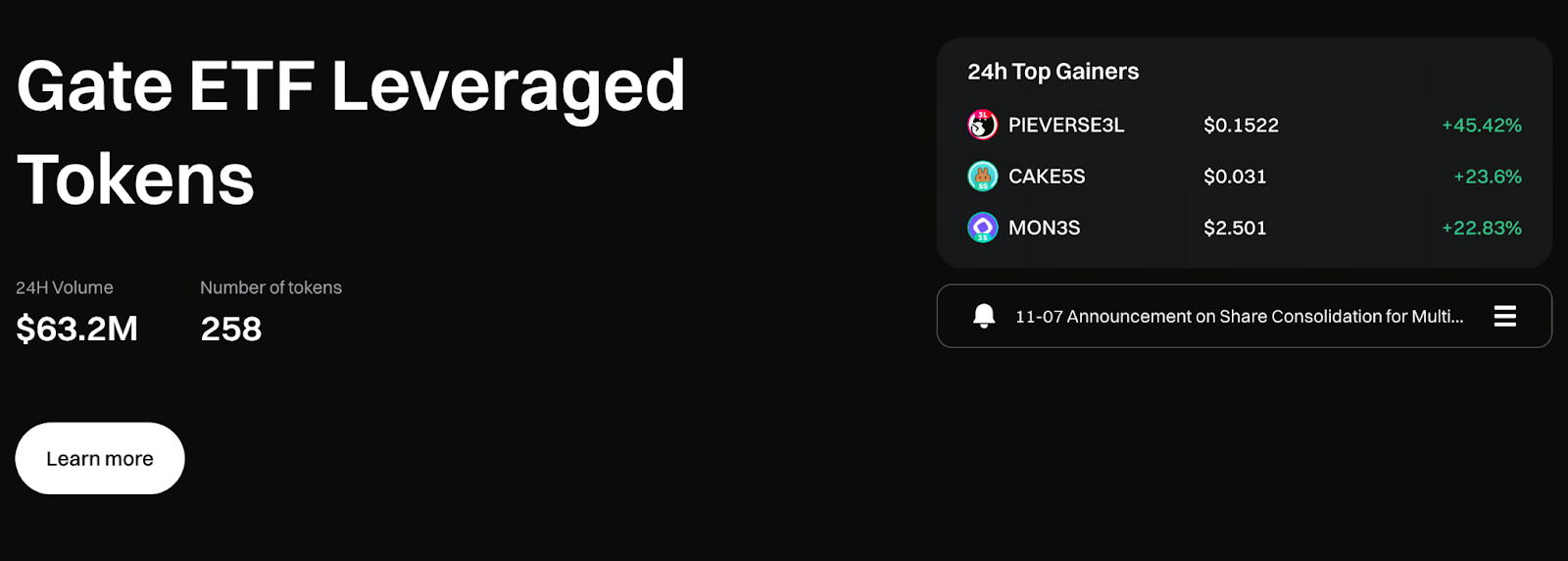
Gate Leveraged ETFs offer investors a more flexible approach to market volatility, allowing you to access magnified price movements through spot trading. This article delivers a concise and friendly overview of leveraged ETF fundamentals, operational mechanics, product benefits, and potential risks. With a solid grasp of these mechanisms, you can employ leverage more efficiently and elevate the quality of your trading strategies.
The Evolution and Positioning of Leveraged ETFs
Exchange-Traded Funds (ETFs) were initially created to give investors a straightforward way to access a diversified basket of assets, reducing the volatility risk tied to individual securities. As demand for strategy-driven products has surged, traditional index ETFs have become less effective for users seeking greater efficiency. In response, leveraged ETFs have emerged, allowing investors to amplify market movements by a fixed multiple—without dealing with derivatives—thereby maximizing capital efficiency.
What Are Gate Leveraged ETF Tokens?
Gate’s leveraged ETF tokens are built on perpetual contract positions and managed by an automated system to maintain a stable leverage ratio, such as 3x or 5x. Users can buy or sell these tokens directly on the spot market to gain leveraged exposure—no need for borrowing or margin management. Because the system centrally manages contract positions, investors avoid the liquidation risks common in traditional contract trading. This lowers the psychological barrier to using leverage.
Gate uses several coordinated mechanisms to keep leverage ratios stable. First, the perpetual contract positions backing each token are set according to the target leverage, minimizing deviations from market volatility. Next, the system automatically rebalances based on price changes to keep leverage within the designated range. Most importantly, users only need to trade on the spot market to establish leveraged positions. Additionally, the platform charges a daily management fee of 0.1% to cover contract adjustments, hedging, and system operations, ensuring long-term product stability.
Advantages and Use Cases of Leveraged ETFs
The biggest advantage of leveraged ETFs is their ability to amplify profits in strong market trends, especially when the underlying asset experiences sustained gains or losses. The leverage ratio significantly increases capital efficiency. Since there’s no risk of forced liquidation from insufficient margin, trading pressure is lower. The rebalancing mechanism can also create a compounding effect during favorable trends, allowing returns to build up over time. With a simple and intuitive interface, leveraged ETFs are accessible to both new strategy users and short-term traders.
Risks and Cost Structure to Know Before Trading
While leveraged ETFs are easy to use, their volatility is magnified. This means sideways markets can lead to rebalancing decay, which may reduce long-term returns. Also, leveraged price movements are not perfectly linear, so actual returns may not exactly match the underlying asset’s multiple. The platform’s daily 0.1% management fee covers contract costs, funding rates, hedging, and slippage management, and can impact long-term pricing as it accumulates. In general, leveraged ETFs are best suited for short-term strategies or strong trending markets.
Conclusion
Leveraged ETFs offer the simplest way to access market leverage—no contracts, no borrowing, and no risk of liquidation. However, traders still need to understand market cycles, risk sources, and the effects of rebalancing to maximize gains during trends and avoid losses from sideways markets. Only with a thorough understanding of product rules can leveraged ETFs become a powerful tool for boosting trading efficiency.
Author: Allen
Disclaimer
* The information is not intended to be and does not constitute financial advice or any other recommendation of any sort offered or endorsed by Gate.
* This article may not be reproduced, transmitted or copied without referencing Gate. Contravention is an infringement of Copyright Act and may be subject to legal action.
Stablecoins were originally designed as dollar substitutes within exchanges, primarily used for asset pricing and trade settlement. As on-chain financial ecosystems have matured, their role has expanded beyond simple payments to include collateral assets, cross-chain liquidity mediums, and unified settlement units. In particular, as AI systems and automated agents begin to participate directly in economic activity, demand has risen sharply for programmable value units capable of instant settlement. This shift is pushing stablecoins toward the role of foundational financial infrastructure.
In the competition for DeFi liquidity, high-inflation mining alone is no longer enough to build lasting advantages. Aerodrome applies the ve(3,3) economic model to redesign token emissions, voting mechanisms, and revenue distribution, creating a liquidity flywheel centered on governance and cash flow. This article examines AERO tokenomics, the veAERO locking mechanism, and protocol revenue models to explain how Aerodrome builds a sustainable DeFi economic system.
AERO is the native token of Aerodrome Finance, a core decentralized exchange and liquidity protocol in the Base ecosystem. It is primarily used for liquidity incentives and ecosystem operations. veAERO is a governance NFT that users receive by locking AERO, representing both voting power and the right to share protocol revenue. Through a dual track structure of AERO as a utility token and veAERO as a governance credential, Aerodrome separates liquidity usage value from long term governance power, allowing participants to act as liquidity providers, governance decision makers, and revenue sharers within the same system.
PAXG (Pax Gold) is a tokenized asset backed by physical gold, issued by the fintech company Paxos and traded on the Ethereum blockchain as an ERC-20 token. The core concept is to tokenize physical gold on-chain, with each PAXG token representing ownership of a certain amount of gold. This structure enables investors to hold and trade gold in the form of a digital asset.
PAXG (Pax Gold) is a tokenized asset backed by physical gold reserves, launched by fintech firm Paxos and issued as an ERC-20 token on the Ethereum blockchain. The core concept is to digitally represent real-world gold assets, allowing investors to hold and trade gold via the blockchain network. Because each PAXG token corresponds to a specific quantity of physical gold, its price is theoretically expected to closely track the global gold market.
Most Web3 identity systems remain confined to on-chain environments and struggle to achieve meaningful adoption in real world settings. Through a DePIN architecture and physical verification hardware, Humanity Protocol aims to bring decentralized identity into access control systems, hospitality, public services, and offline events, allowing on-chain identity to function not just as a digital credential, but as foundational infrastructure for real world access.