With the rise of Web3 gaming and the Metaverse, the market has seen the emergence of diverse ecosystem models. Some projects prioritize open creation and virtual land economies, while others focus on entertainment IP, community culture, and interactive gameplay.
BabyShark and Sandbox exemplify these two distinct development paths, highlighting the Web3 Metaverse’s evolution from a single model to a multifaceted ecosystem.
BabyShark vs Sandbox: Overview and Core Differences
BabyShark is a Web3 gaming ecosystem built around the Baby Shark Universe, leveraging NFTs, an open world, user-generated content (UGC), and a digital asset system to create an on-chain interactive platform. By integrating entertainment IP with blockchain technology, BabyShark enables users to own, use, and trade digital assets in a virtual environment.
Given Baby Shark’s widespread brand recognition, BabyShark Universe is positioned as a blend of “entertainment IP + Web3 gaming.”
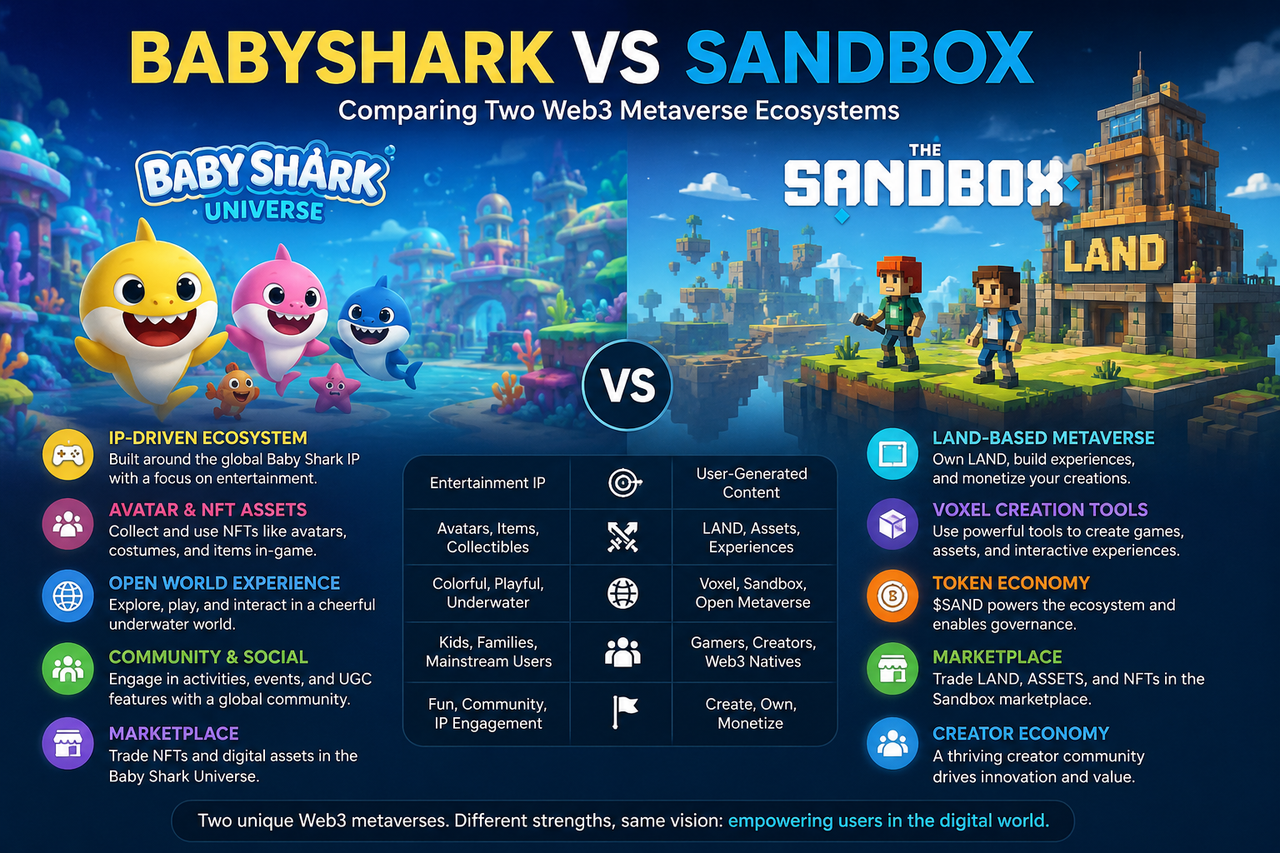
The Sandbox, as one of the earliest entrants to the Web3 Metaverse, centers on an open virtual world and a robust creator ecosystem. Sandbox enables users to purchase virtual land, develop game content, and build a digital economy through NFT and token systems.
| Comparison Dimension |
BabyShark |
Sandbox |
| Core Side |
Entertainment IP + Web3 Gaming |
Open Metaverse Platform |
| NFT Focus |
Avatars, Props, Interactive Assets |
LAND, Creator Assets |
| Open World Structure |
Entertainment & Interaction |
Virtual Land-Based |
| User Group |
Mass Entertainment Users |
Web3 Creators |
| Core Ecosystem |
Community Interaction & Game Experience |
Creator Economy |
| Main Feature |
IP-Driven |
LAND-Driven |
How Do BabyShark and Sandbox Differ in Core Positioning?
While both are Web3 Metaverse projects, their core positioning is distinctly different.
BabyShark prioritizes entertainment, interactive experiences, and an IP-driven ecosystem—aiming to lower the entry barrier for mainstream users through familiar characters and community culture. The emphasis is on digital entertainment, user engagement, and an immersive open world.
Sandbox, in contrast, is designed as an open Metaverse platform, focusing on a creator-driven ecosystem and virtual land economy. Users can not only participate but also build their own virtual spaces and develop independent content systems.
As a result, each project’s ecosystem targets different objectives: BabyShark is more entertainment-oriented, while Sandbox is positioned as an open digital creation platform.
How Do BabyShark and Sandbox NFT Systems Compare?
NFTs are central to both ecosystems, but their implementation differs.
In BabyShark, NFTs are primarily associated with avatars, in-game props, community interaction, and digital identity. They serve to enhance interactive gameplay and establish users’ on-chain asset portfolios.
Sandbox’s NFT framework, meanwhile, focuses on LAND, virtual spaces, and creator assets. Users can acquire LAND to build their own virtual zones, deploying content and interactive experiences within them.
Additionally, Sandbox’s NFTs underpin its creator economy, while BabyShark’s NFTs are geared more toward entertainment IP and community engagement.
How Do Their Open World Structures Differ?
Both projects feature open world designs, but with distinct structural priorities.
Sandbox is built around the “virtual land” concept—its open world consists of numerous LAND units where users can create, host events, or collaborate commercially. This structure closely resembles a decentralized digital real estate system.
BabyShark’s open world, on the other hand, is tailored to gaming interaction and user experience. The focus is on avatars, social engagement, and entertainment content, rather than constructing an economy centered on virtual land.
From a user perspective, Sandbox functions more as a creator platform, while BabyShark delivers an entertainment-focused Web3 gaming world.
How Do Their User Bases Differ?
Sandbox attracts Web3-native players, NFT collectors, content creators, and virtual real estate participants. Its open ecosystem appeals to users interested in building content and managing digital spaces.
BabyShark targets a broader, more mainstream audience. Leveraging entertainment IP and community culture, it aims to lower the Web3 adoption barrier and attract traditional gamers through familiar characters and interactive features.
How Do Their Economic Models Differ?
Sandbox’s economy is deeply tied to its LAND system. Virtual land is a core resource, and the scarcity of LAND—combined with a thriving creator economy—drives its value proposition.
BabyShark, by contrast, emphasizes NFTs, community interaction, and gaming experience. Its economic model revolves around digital entertainment content and user participation, rather than relying solely on virtual real estate.
Moreover, Sandbox prioritizes open marketplaces and creator monetization, while BabyShark is more focused on its IP ecosystem and community engagement.
Despite ongoing advancements in the Metaverse, each Web3 project faces unique challenges.
Sandbox must continuously foster an active creator ecosystem and a vibrant LAND economy. Without ongoing user-generated content, its open platform model may struggle with user retention.
BabyShark relies more heavily on entertainment content and community operations. For IP-driven Web3 projects, sustaining user engagement and community momentum is critical for long-term growth.
Both projects also face the broader challenges of Web3 gaming, such as Wallet management, Gas fees, and the complexity of NFT transactions.
Summary
BabyShark and Sandbox are both leading players in the Web3 Metaverse, yet their trajectories differ significantly. Sandbox is focused on building an open creator platform and virtual land economy, while BabyShark centers on entertainment IP, community interaction, and the Web3 gaming experience.
As the Metaverse and NFT ecosystem evolve, Web3 projects are carving out increasingly distinct identities. BabyShark exemplifies the IP-driven Web3 gaming model, while Sandbox represents the open creator platform—together illustrating the digital world’s shift toward greater diversity.
FAQs
What is the biggest difference between BabyShark and Sandbox?
BabyShark is centered on entertainment IP and interactive gameplay, while Sandbox is focused on virtual land and a creator-driven ecosystem.
Why is LAND so important in Sandbox?
LAND is the core asset in the Sandbox ecosystem, enabling users to create content and build virtual spaces.
Does BabyShark support user-generated content?
Yes. BabyShark’s ecosystem features UGC (user-generated content), allowing the community to participate in content creation.
Do both projects use NFTs?
Yes. Both leverage NFTs to manage digital assets, but their use cases and ecosystem priorities differ.
Which is more GameFi-oriented: BabyShark or Sandbox?
Both are part of the Web3 gaming ecosystem. BabyShark is more entertainment- and interaction-focused GameFi, while Sandbox is oriented toward creators and the broader Metaverse platform.