Could Dogecoin Rebound to $0.27–$0.29? Falling Wedge Pattern Suggests 80%–90% Upside Potential

Last Updated 2026-03-27 07:24:34
Reading Time: 1m
Dogecoin is now in a Falling Wedge consolidation pattern. Analysts project DOGE could rally by 80%–90% if it breaks out, with price targets between $0.27 and $0.29. This article offers an in-depth look at the technical setup and critical support and resistance levels. It also examines the next potential market trend.

What Is a Falling Wedge?
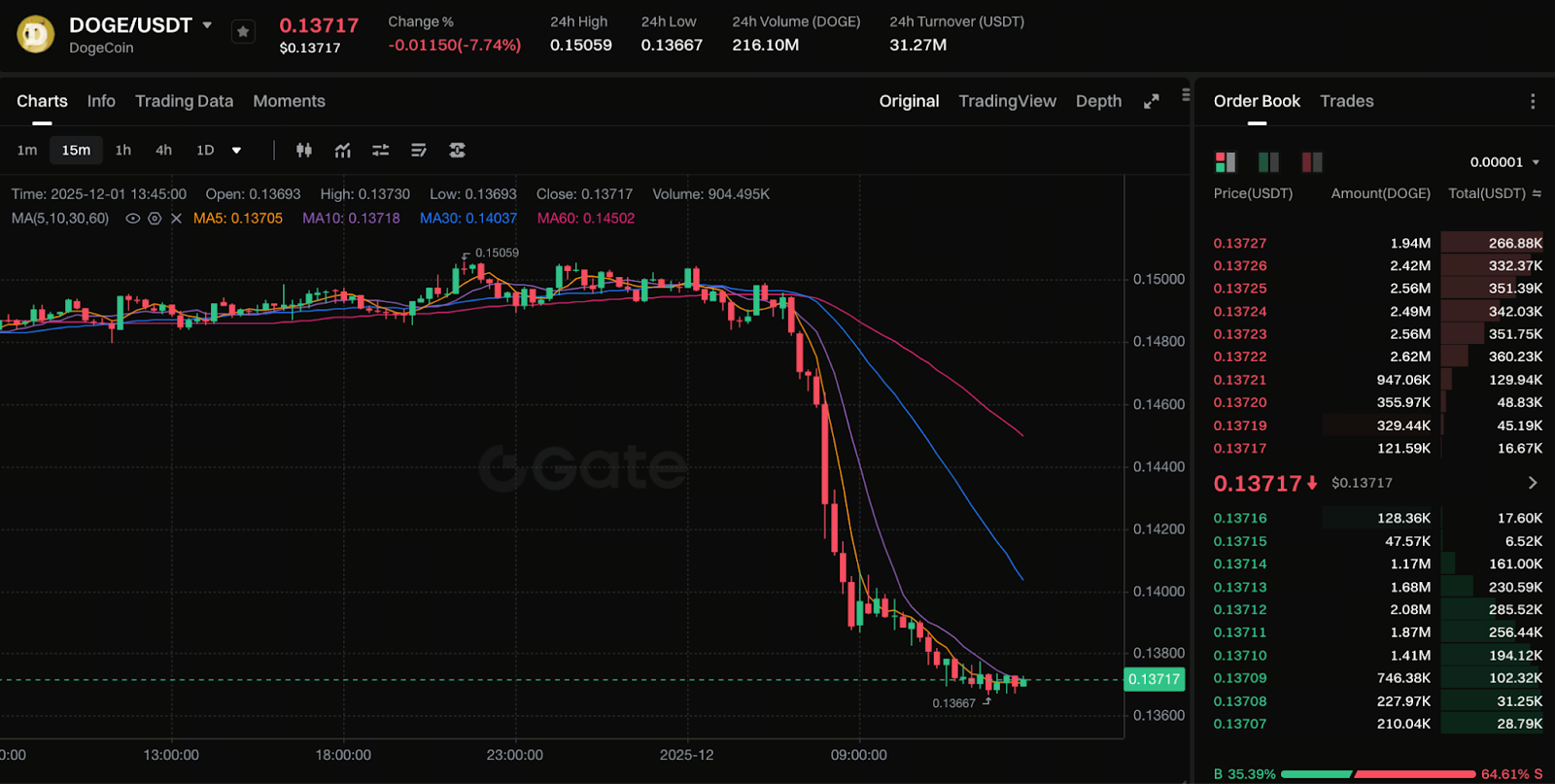

Chart: https://www.gate.com/trade/DOGE_USDT

In technical analysis, a Falling Wedge is a widely recognized consolidation or reversal pattern. It is defined by two downward-sloping, converging trendlines, where both highs and lows progressively decrease and price volatility narrows. This structure signals diminishing selling pressure and gradual accumulation by buyers. A breakout above the upper trendline, especially with a surge in trading volume, typically indicates a potential bullish reversal. Analysts frequently interpret this as a sign of “bottoming out and building momentum.”

Dogecoin: Current Price and Technical Structure Analysis

Recently, DOGE has traded within the $0.14–$0.16 range. According to the latest market analysis, a classic falling wedge pattern is developing on the 12-hour and daily charts. If the price closes above the wedge’s upper boundary with increased trading volume, this would likely confirm a valid breakout.

Moreover, some analysts suggest that a successful breakout could drive DOGE higher, extending gains beyond a short-term rebound. Shifting institutional and market sentiment may further fuel the rally.

Potential Targets and Upside in the Event of a Breakout

Given the current wedge pattern and major resistance/support levels, if DOGE breaks out above the upper trendline and reclaims the $0.16–$0.162 zone—or pushes toward $0.173—analysts estimate the upside could reach 80%–90%, with target prices between $0.27 and $0.29.

If achieved, this rally would represent not just a short-term rebound after consolidation, but potentially a reestablishment of the medium-term uptrend—making it a compelling prospect for holders.

Risk Considerations and Key Watchpoints

It’s important to note that no technical pattern offers certainty. If DOGE fails to hold above the breakout level or if volume does not increase, the wedge setup may be invalidated. More concerning, a drop below critical support—such as $0.14–$0.15—could send Dogecoin back into a downward channel or even lower.

Broader factors, including the overall crypto market environment, macroeconomic conditions, institutional capital flows, and shifts in sentiment, all play a significant role in DOGE’s price action. Relying solely on chart patterns while overlooking fundamentals exposes investors to additional risk.

Before entering or holding a position, it’s advisable to closely monitor:

  • Confirmation of a breakout and close above the wedge’s upper boundary
  • Significant increases in trading volume
  • Stability above key support zones
  • Macro market sentiment and broader crypto market trends

Summary

If confirmed, Dogecoin’s current falling wedge pattern could trigger a strong rally, with potential gains of 80%–90% and target prices in the $0.27–$0.29 range. For investors seeking technical opportunities, this is a scenario to watch closely.

However, remember that technical patterns never guarantee future performance, and all investments carry risk. The most prudent approach combines trend confirmation, trading volume, support and resistance analysis, market direction, and your own risk tolerance for informed, cautious decision-making.

Author: Max
Disclaimer
* The information is not intended to be and does not constitute financial advice or any other recommendation of any sort offered or endorsed by Gate.
* This article may not be reproduced, transmitted or copied without referencing Gate. Contravention is an infringement of Copyright Act and may be subject to legal action.

Related Articles

AI-Native Settlement Layers: How United Stables Is Building the Next Financial Rail
Beginner

AI-Native Settlement Layers: How United Stables Is Building the Next Financial Rail

Stablecoins were originally designed as dollar substitutes within exchanges, primarily used for asset pricing and trade settlement. As on-chain financial ecosystems have matured, their role has expanded beyond simple payments to include collateral assets, cross-chain liquidity mediums, and unified settlement units. In particular, as AI systems and automated agents begin to participate directly in economic activity, demand has risen sharply for programmable value units capable of instant settlement. This shift is pushing stablecoins toward the role of foundational financial infrastructure.
2026-03-25 03:16:17
The ve(3,3) Flywheel Explained: How AERO Tokenomics Powers Aerodrome’s DeFi Economy
Beginner

The ve(3,3) Flywheel Explained: How AERO Tokenomics Powers Aerodrome’s DeFi Economy

In the competition for DeFi liquidity, high-inflation mining alone is no longer enough to build lasting advantages. Aerodrome applies the ve(3,3) economic model to redesign token emissions, voting mechanisms, and revenue distribution, creating a liquidity flywheel centered on governance and cash flow. This article examines AERO tokenomics, the veAERO locking mechanism, and protocol revenue models to explain how Aerodrome builds a sustainable DeFi economic system.
2026-03-25 06:41:58
Aerodrome Tokenomics: How ve(3,3) Powers Base's Most Profitable DEX
Beginner

Aerodrome Tokenomics: How ve(3,3) Powers Base's Most Profitable DEX

AERO is the native token of Aerodrome Finance, a core decentralized exchange and liquidity protocol in the Base ecosystem. It is primarily used for liquidity incentives and ecosystem operations. veAERO is a governance NFT that users receive by locking AERO, representing both voting power and the right to share protocol revenue. Through a dual track structure of AERO as a utility token and veAERO as a governance credential, Aerodrome separates liquidity usage value from long term governance power, allowing participants to act as liquidity providers, governance decision makers, and revenue sharers within the same system.
2026-03-25 06:40:31
How Does PAXG Work? In-Depth Overview of the Physical Gold Tokenization Mechanism
Beginner

How Does PAXG Work? In-Depth Overview of the Physical Gold Tokenization Mechanism

PAXG (Pax Gold) is a tokenized asset backed by physical gold, issued by the fintech company Paxos and traded on the Ethereum blockchain as an ERC-20 token. The core concept is to tokenize physical gold on-chain, with each PAXG token representing ownership of a certain amount of gold. This structure enables investors to hold and trade gold in the form of a digital asset.
2026-03-24 19:12:51
How is the price of PAXG determined? Pegging mechanism, trading depth, and influencing factors
Beginner

How is the price of PAXG determined? Pegging mechanism, trading depth, and influencing factors

PAXG (Pax Gold) is a tokenized asset backed by physical gold reserves, launched by fintech firm Paxos and issued as an ERC-20 token on the Ethereum blockchain. The core concept is to digitally represent real-world gold assets, allowing investors to hold and trade gold via the blockchain network. Because each PAXG token corresponds to a specific quantity of physical gold, its price is theoretically expected to closely track the global gold market.
2026-03-24 19:11:40
DePIN Identity Network and Real World Applications: How Humanity Protocol Brings on-chain Identity Into the Physical World
Beginner

DePIN Identity Network and Real World Applications: How Humanity Protocol Brings on-chain Identity Into the Physical World

Most Web3 identity systems remain confined to on-chain environments and struggle to achieve meaningful adoption in real world settings. Through a DePIN architecture and physical verification hardware, Humanity Protocol aims to bring decentralized identity into access control systems, hospitality, public services, and offline events, allowing on-chain identity to function not just as a digital credential, but as foundational infrastructure for real world access.
2026-03-25 07:40:53





