Deep Dive into Sentient: What Is Sentient? Latest Developments, Price, and Future Outlook

Beginner
Quick Reads
Last Updated 2026-03-25 19:09:51
Reading Time: 1m
Discover what Sentient is as we examine the technical vision, recent progress, and price movement of this open-source AI and blockchain project. This article offers an objective assessment of Sentient's value proposition and associated risks.

I. What Is Sentient? Core Concepts and Objectives


Image: https://www.sentient.xyz/

Sentient is an open platform that integrates blockchain technology with artificial intelligence (AI), aiming to build a decentralized, open, and incentivized economic system for AI. The platform enables global developers, model creators, and users to collaboratively create value. Sentient supports AI model ownership representation, on-chain governance, and collaborative development. Its foundational theory is the OML (Open, Monetizable, Loyal) model—principles designed to drive a shared AGI economy.

II. Project Backers and Team Strength

Since its launch, Sentient has drawn significant attention across the industry. In 2024, it secured $85 million in seed funding, led by Peter Thiel’s Founders Fund, Pantera Capital, and Framework Ventures. Other prominent investors—including Ethereal Ventures and Delphi Ventures—also participated, highlighting Sentient’s strong financial backing and industry validation.

The team at Sentient includes leading experts and members with distinguished academic backgrounds, such as the co-founder of Polygon, the founder of EigenLayer, and professors from top-tier universities. This combination reinforces Sentient’s technical capabilities at the intersection of AI and blockchain.

III. Latest Developments: Tokenomics and Presale Updates

As of early 2026, Sentient has officially released its tokenomics framework. SENT tokens have a total supply of approximately 3.436 billion, with 44% allocated for community incentives and airdrops, 19.55% for ecosystem and R&D, 22% for the project team, 12.45% for investors, and just 2% for public sale.

Sentient is also conducting airdrops and community incentive programs to grow its user base and boost engagement.

IV. Sentient Price Performance Analysis
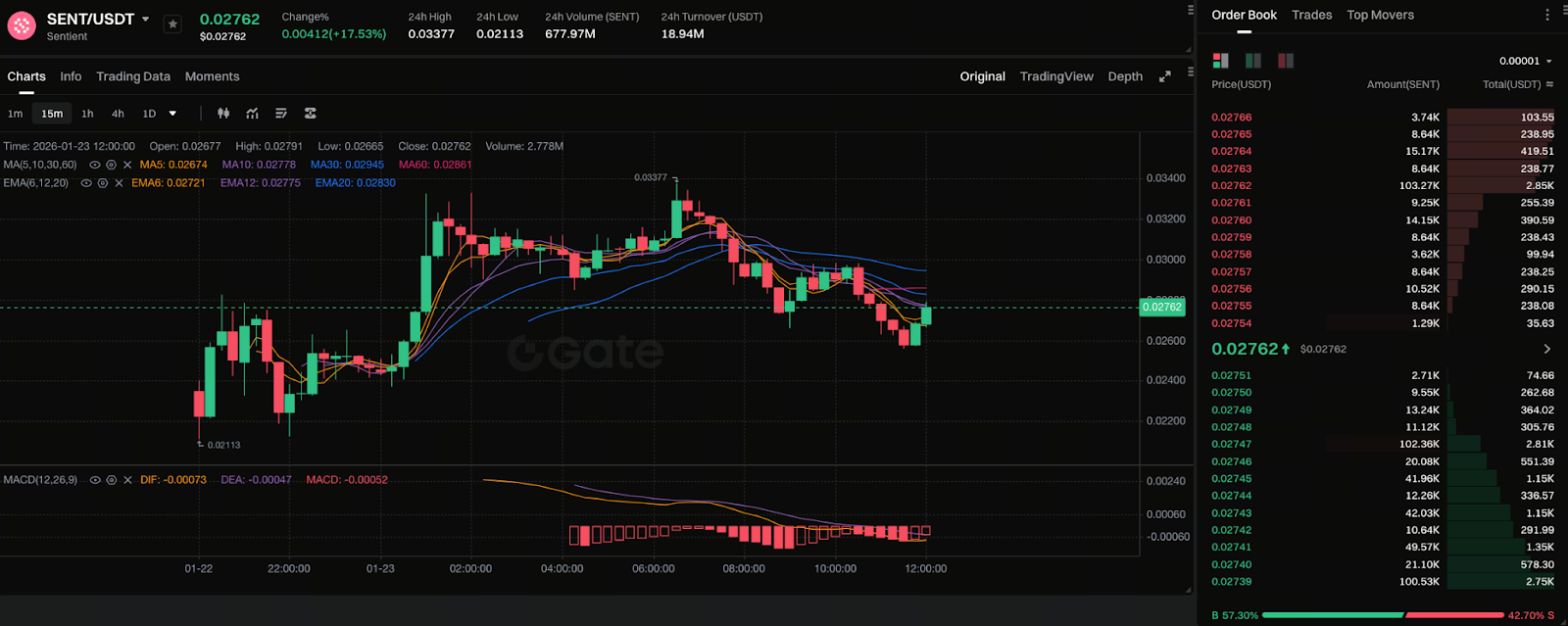

Image: https://www.gate.com/trade/SENT_USDT

Recent market data shows that Sentient token prices have experienced significant volatility around the presale period. As of January 23, 2026, prices ranged from $0.02 to $0.03, with notable gains in the past 24 hours. After reaching a peak in 2025, prices have since pulled back from their historical highs.

This price action underscores the instability of trading during the presale phase. Investors should recognize that these price levels reflect pre-listing activity and do not indicate long-term value.

V. Sentient’s Practical Use Cases

Sentient is more than a token project; its broader vision is to build a decentralized AI ecosystem with the following applications:

  • Open AGI model incentive mechanisms: Developers earn token rewards by contributing data, models, or training tasks.
  • On-chain governance and DAO voting: Token holders participate in protocol upgrades and decisions on fund allocation.
  • AI model ownership and revenue distribution: Blockchain technology ensures transparent attribution and revenue sharing for models and outputs.

VI. Risk Disclosure and Investor Advisory

Although Sentient has institutional backing, it remains in an early development stage and faces considerable market risks:

  • High price volatility: Presale prices are highly sensitive to short-term trading and market sentiment.
  • Long project timeline: Advancing from R&D to mature products will require time.
  • Regulatory and technical challenges: Integrating AI and crypto may encounter legal and ethical hurdles.

Readers should make independent assessments and only invest after fully understanding the risks involved.

VII. Summary and Outlook

In summary, Sentient is an ambitious open-source AI and blockchain project aiming to build a new open AGI economy. With robust funding, a strong technical team, and well-structured tokenomics, it also faces market uncertainty and elevated risks. Future success will depend on its ability to deliver technology, foster a vibrant community ecosystem, and achieve market acceptance.

Author: Max
Disclaimer
* The information is not intended to be and does not constitute financial advice or any other recommendation of any sort offered or endorsed by Gate.
* This article may not be reproduced, transmitted or copied without referencing Gate. Contravention is an infringement of Copyright Act and may be subject to legal action.

Related Articles

AI-Native Settlement Layers: How United Stables Is Building the Next Financial Rail
Beginner

AI-Native Settlement Layers: How United Stables Is Building the Next Financial Rail

Stablecoins were originally designed as dollar substitutes within exchanges, primarily used for asset pricing and trade settlement. As on-chain financial ecosystems have matured, their role has expanded beyond simple payments to include collateral assets, cross-chain liquidity mediums, and unified settlement units. In particular, as AI systems and automated agents begin to participate directly in economic activity, demand has risen sharply for programmable value units capable of instant settlement. This shift is pushing stablecoins toward the role of foundational financial infrastructure.
2026-03-25 03:16:17
The ve(3,3) Flywheel Explained: How AERO Tokenomics Powers Aerodrome’s DeFi Economy
Beginner

The ve(3,3) Flywheel Explained: How AERO Tokenomics Powers Aerodrome’s DeFi Economy

In the competition for DeFi liquidity, high-inflation mining alone is no longer enough to build lasting advantages. Aerodrome applies the ve(3,3) economic model to redesign token emissions, voting mechanisms, and revenue distribution, creating a liquidity flywheel centered on governance and cash flow. This article examines AERO tokenomics, the veAERO locking mechanism, and protocol revenue models to explain how Aerodrome builds a sustainable DeFi economic system.
2026-03-25 06:41:58
Aerodrome Tokenomics: How ve(3,3) Powers Base's Most Profitable DEX
Beginner

Aerodrome Tokenomics: How ve(3,3) Powers Base's Most Profitable DEX

AERO is the native token of Aerodrome Finance, a core decentralized exchange and liquidity protocol in the Base ecosystem. It is primarily used for liquidity incentives and ecosystem operations. veAERO is a governance NFT that users receive by locking AERO, representing both voting power and the right to share protocol revenue. Through a dual track structure of AERO as a utility token and veAERO as a governance credential, Aerodrome separates liquidity usage value from long term governance power, allowing participants to act as liquidity providers, governance decision makers, and revenue sharers within the same system.
2026-03-25 06:40:31
How Does PAXG Work? In-Depth Overview of the Physical Gold Tokenization Mechanism
Beginner

How Does PAXG Work? In-Depth Overview of the Physical Gold Tokenization Mechanism

PAXG (Pax Gold) is a tokenized asset backed by physical gold, issued by the fintech company Paxos and traded on the Ethereum blockchain as an ERC-20 token. The core concept is to tokenize physical gold on-chain, with each PAXG token representing ownership of a certain amount of gold. This structure enables investors to hold and trade gold in the form of a digital asset.
2026-03-24 19:12:51
How is the price of PAXG determined? Pegging mechanism, trading depth, and influencing factors
Beginner

How is the price of PAXG determined? Pegging mechanism, trading depth, and influencing factors

PAXG (Pax Gold) is a tokenized asset backed by physical gold reserves, launched by fintech firm Paxos and issued as an ERC-20 token on the Ethereum blockchain. The core concept is to digitally represent real-world gold assets, allowing investors to hold and trade gold via the blockchain network. Because each PAXG token corresponds to a specific quantity of physical gold, its price is theoretically expected to closely track the global gold market.
2026-03-24 19:11:40
Aster vs Hyperliquid: Which Perp DEX Will Prevail?
Beginner

Aster vs Hyperliquid: Which Perp DEX Will Prevail?

Aster and Hyperliquid are the two representative protocols of the "purpose-built L1 path" within the current decentralized perpetual exchange (Perp DEX) sector. As a pioneer in the field, Hyperliquid has built a deep liquidity moat through its highly mature order book architecture and strong community consensus. Conversely, Aster, as a rising challenger, seeks to leapfrog the competition in high-performance trading through more aggressive multi-chain aggregation logic, private transaction modules, and an underlying execution environment optimized for 2026 market demands.
2026-03-24 11:58:33





