As the RWA track rapidly expands and competition among yield-bearing stablecoins intensifies, a large number of project tokens remain weakly correlated or even completely disconnected from the cash flows of their underlying assets. What EDEN seeks to establish is an auditable value transmission path: real-world yield enters the protocol → on-chain reserves trigger EDEN buybacks or xEDEN locking → holder interests align with product adoption → TVL and institutional partnerships accelerate → the flywheel reinforces itself again. For participants focused on "on-chain U.S. Treasuries + tokenomics," understanding EDEN is the key to unlocking the growth logic of OpenEden.
The following sections will sequentially outline EDEN's functional positioning, allocation and incentive design, governance role, connection with RWA/DeFi, price drivers, underlying USDO yield engine, major investment risks, and long-term potential within the context of credit-based RWA expansion, illustrating how EDEN functions as the hub of OpenEden's ecosystem growth.
Core Functions and Uses of the EDEN Token
EDEN plays three roles simultaneously within the OpenEden system.
-
Utility Token: Holding EDEN qualifies users for fee reductions on management and transaction fees for products such as TBILL, USDO, and PRISM, and grants priority access to subscriptions and liquidity plans for new tokenized products, reducing friction costs for institutions and DeFi users entering the compliant RWA market.
-
Staking and Compounding Vehicle: Staking EDEN yields xEDEN. xEDEN is an auto-compounding governance token requiring no manual claims within the contract; the amount of EDEN redeemable per xEDEN increases over time. As protocol RWA revenue is injected, xEDEN is expected to transition from early emission-driven to gradually becoming a compounding asset backed by real yields.
-
Value Alignment Tool: OpenEden plans to allocate a portion of protocol fees and yields from treasury-held RWAs to open market EDEN buybacks. Bought-back tokens can be retained in the treasury, re-staked into xEDEN, or deployed in liquidity and market stabilization programs, creating structural rewards for long-term participants.
The official summary describes the above mechanism as the RWA Flywheel: Real-World Yield → On-Chain Value Capture → Holder Alignment → Adoption Increase → Scale Compounding. EDEN sits at the center, not as a peripheral accessory.
EDEN Token Distribution and Incentive Mechanism
EDEN has a total supply of 1,000,000,000 tokens, with an allocation that balances community, builders, and capital providers:
| Category |
Percentage |
Release Highlights |
| Ecosystem & Community |
41.22% |
Approximately 34.75% unlocked at TGE; used for staking, liquidity, exchange listings, etc. |
| Team & Advisors |
20.00% |
6-month cliff + 24-month linear vesting |
| Investors |
15.28% |
Same as above |
| Foundation |
10.00% |
20% unlocked on day one; remainder released per schedule |
| Bills Airdrop |
7.50% |
Participants in the Bills Campaign |
| Early Adopters |
6.00% |
Users who contributed to the ecosystem since 2023 |
At TGE, approximately 40.5% enters circulation, with a full distribution period of about three years.
Incentive tools include: EDEN Hodlers Bonus (EHBM) — within 120 days from TGE, 20% can be claimed at any time; claiming 80% early results in forfeiture and entry into a shared pool; holders who persist until the window ends receive additional allocations. The Bills Campaign links early TBILL/USDO users with token allocation. Cross-chain staking and liquidity plans cover Ethereum, BNB Chain, Solana, Base, XRPL, and others, consolidating activity value across chains into the core economy.
In March 2026, OpenEden announced an extension of team and advisor token vesting by nine months (deferred to January 2027) to reduce medium-to-long-term selling pressure and signal a long-term building commitment — a key variable to incorporate when assessing the supply side.
EDEN's Role in the Governance System
OpenEden governance follows the principle of "on-chain coordination + off-chain compliance": governance can adjust incentive and product parameters but does not replace licensed entities or regulatory obligations.
The process is: discussion in the Discord governance forum → xEDEN holders vote on Tally (delegation required first to activate voting power; weight proportional to xEDEN holdings). Currently in the launch phase, proposals are primarily initiated by the OpenEden Foundation; proposal rights will later be opened to the community.
Governance scope includes: token emission pace, reserve and buyback strategies, treasury utilization, new product launches, regional cooperation priorities, etc. The protocol plans to introduce proposal-linked performance — if decisions drive TVL or RWA yield increases, voters may receive additional emissions; results are publicly reported quarterly.
The first governance proposal has been approved: using 30,000 USDC to buy back EDEN on the open market, marking the mechanism of transmitting RWA revenue to the token layer entering the operational phase. The bought-back EDEN can be used for treasury accumulation, re-staking into xEDEN, or liquidity programs, rather than simple airdrop dilution.
How EDEN Connects RWA and DeFi Ecosystems
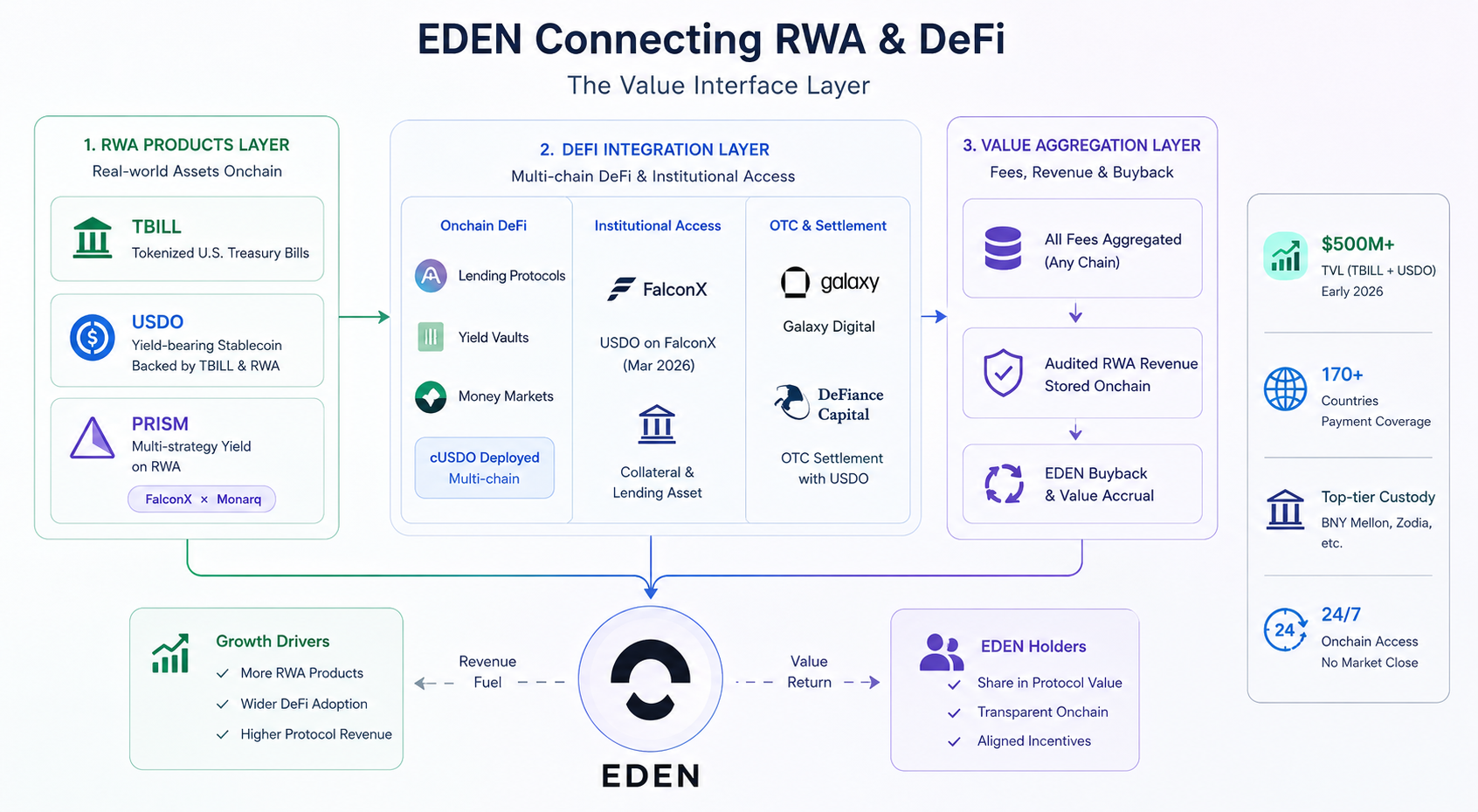
EDEN serves as OpenEden's "value interface layer" connecting TradFi and DeFi.
-
RWA Product Layer: TBILL represents tokenized short-term U.S. Treasuries; USDO is a yield-bearing stablecoin issued with TBILL and other collateral; PRISM (launched in January 2026 in partnership with FalconX and Monarq) layers multi-strategy quantitative yields on top of RWAs. Product expansion directly increases protocol fees and RWA spreads, fueling EDEN buybacks.
-
DeFi Integration Layer: cUSDO is deployed on multiple chains, integrated into lending and yield vaults; USDO landed on FalconX in March 2026, serving as institutional collateral and lending asset; it has also been used as a settlement currency for OTC transactions by institutions such as Galaxy Digital and DeFiance Capital, breaking through the "savings tool" boundary.
-
Value Aggregation Layer: The official documentation clearly states that regardless of which chain activity occurs, transaction fees and platform service fees are aggregated into the OpenEden core economy; audited RWA revenue enters the on-chain reserve contract, which periodically executes EDEN buybacks, forming a fundamentals transmission mechanism traceable on-chain.
Therefore, EDEN holders are essentially betting on: the breadth of adoption of the tokenized U.S. Treasury ecosystem plus the execution strength of revenue buybacks — not isolated concept hype.
Key Factors Influencing EDEN Token Value
Positive Drivers:
-
TBILL/USDO Scale: The combined TVL of the two exceeds $500 million (as of early 2026 data). The larger the scale, the thicker the fees and spreads, and the greater the buyback capacity.
-
Buybacks and Lockups: The frequency and size of on-chain reserve buybacks, along with the xEDEN staking rate, jointly determine circulating selling pressure and scarcity.
-
Institutional Endorsement: Strategic investments from Ripple, Lightspeed Faction, Gate Ventures, FalconX, etc., at the end of 2025; increased institutional channels and settlement cases in 2026.
-
Team Vesting Extension: The nine-month vesting delay alleviates expectations of team selling pressure during 2026–2027.
Suppressive Factors:
-
Continuous Unlocking: Approximately 58% of tokens remain in vesting contracts (as of April 2026), with 25 unlock events still scheduled before April 2028.
-
Macro Interest Rates: Fed rate cuts compress U.S. Treasury yields, weakening the attractiveness of USDO/TBILL relative to high-yield stablecoins.
-
Crypto Beta: As a newly listed RWA token, EDEN's short-term price remains influenced by broader market sentiment.
Trackable Core Metrics: TVL growth rate, on-chain buyback records, xEDEN lockup ratio, governance proposal passage rate — rather than just market cap ranking.
Analysis of OpenEden's Yield-Bearing Stablecoin Logic
The underlying engine of the EDEN flywheel is the yield-bearing stablecoin system, with USDO at its core.
USDO is issued by OpenEden Digital Limited, licensed by the Bermuda Monetary Authority (BMA), pegged to 1 USD, fully collateralized by tokenized U.S. Treasuries such as TBILL, with a target annualized yield of approximately 3.25%. Yield is reflected daily through rebasing: USDO balance = shares × bonus multiplier, automatically increasing the holder's wallet balance.
cUSDO is the non-rebasing version: the quantity remains constant while the unit price increases with yield, facilitating integration with DeFi protocols; it is interchangeable with USDO through a permissionless wrapper, with equivalent yield, and has been extended to networks such as Ethereum, Base, BSC, and Solana.
The logical chain is clear: U.S. Treasury interest → TBILL NAV increase → USDO collateral pool expands → rebasing/cUSDO price rises → user and institutional adoption of USDO → management fees and scale effects → RWA revenue buys back EDEN → incentivizes more EDEN holding for fee discounts. USDO is the "fuel," EDEN is the "transmission."
In May 2026, OpenEden introduced the "Credit-First" strategy at Consensus Miami, arguing that tokenized credit is more likely to achieve short-term institutional adoption compared to equities. TBILL, USDO, and subsequent credit tokens will together form a product matrix — meaning EDEN's value basis may expand from U.S. Treasuries alone to broader fixed-income and credit RWAs.
Key Risks to Consider When Investing in EDEN
-
Token Supply: High percentage unlocked at TGE combined with a 3-year linear release; airdrop participants may also create periodic selling pressure after the EHBM expires. Although the team extended lockups, investor share cliff expiry will increase circulating supply.
-
Fundamentals Fulfillment: If buyback scale remains persistently small or TVL growth stagnates, EDEN may diverge from RWA revenue over the long term.
-
Governance Maturity: Proposal rights are currently concentrated in the Foundation, with limited community substantive influence, posing a risk of "governance in form but not in substance."
-
Regulation and Products: Changes in legislation on RWAs, stablecoins, and cross-border sales restrictions may affect USDO/TBILL revenue and the EDEN narrative.
-
Technology and Market: Smart contract vulnerabilities, extreme volatility due to insufficient EDEN liquidity, and TVL diversion by competitors such as Ondo and Ethena.
-
Strategic Execution: New credit-type products are still in planning or early stages, with uncertainties regarding rollout pace and revenue contribution.
The above risks mean that EDEN is more suitable for participants who already understand OpenEden's business model and can tolerate volatility and unlock cycles for their own research, and does not constitute any investment advice.
Long-Term Development Potential of the EDEN Ecosystem
Short Term (2026): Consolidate USDO institutionalization (FalconX and other channels), PRISM multi-chain expansion, normalization of governance buybacks; BNY's expansion of crypto custody to Abu Dhabi in May 2026 helps strengthen the TBILL underlying custody narrative.
Medium Term: Advance the "Credit-First" product launch, expand EDEN utility scenarios (priority for new products, more fee pools); open community governance proposals, introduce proposal-linked incentives, enhance xEDEN stickiness.
Long Term: If the tokenized real-world asset market reaches trillions of dollars, OpenEden, with its S&P AA+, Moody's A ratings and direct custody by BNY, is well-positioned to hold infrastructure seats in the on-chain U.S. Treasury and compliant yield stablecoin track. EDEN then has the opportunity to become one of the few governance tokens consistently linked to RWA cash flows.
The dividing line for success remains constant: whether RWA revenue can be steadily and auditably converted into on-chain buybacks and xEDEN compounding. If the flywheel turns, EDEN carries a structural premium; if it stalls, the token remains primarily an ecosystem chip driven by emissions and airdrops.
Summary
The essence of EDEN's tokenomics is to transmit the real cash flows generated by OpenEden's tokenized U.S. Treasuries and yield-bearing stablecoin to on-chain holders through fee discounts, xEDEN auto-compounding, governance buybacks, and multi-chain value aggregation. The team vesting extension in 2026, FalconX integration, governance buyback implementation, and the "Credit-First" strategy all provide new dimensions for observing the flywheel.
When evaluating EDEN, it is recommended to simultaneously track TBILL/USDO TVL, on-chain buyback and xEDEN lockup data, governance proposal execution, and credit product progress — these indicators better reflect whether the ecosystem is truly growing than short-term token prices. As RWA infrastructure competition intensifies, whether EDEN can stably convert U.S. Treasury and credit yields into token returns will determine the long-term ceiling of the OpenEden ecosystem.