Ethereum, as one of the world’s leading Smart Contract networks, has long relied on the Gas Market for on-chain transaction resource allocation. Every time a user initiates a transaction, they must pay Gas to compete with other transactions for limited block space. While this mechanism ensures network efficiency, it can also result in higher trading fees and unstable confirmation times during periods of congestion.
With the rapid rise of DeFi, blockchain gaming, and real-time on-chain applications, the traditional Ethereum Gas Market’s instant bidding model is facing increasing real-time performance challenges. ETHGas was introduced in this context as a new direction for real-time Ethereum infrastructure. Compared to the traditional Gas Market, ETHGas places greater emphasis on block space coordination, pre-confirmation, and real-time execution, aiming to optimize on-chain interactions through innovative resource scheduling logic.
Overview of the Traditional Ethereum Gas Market vs. ETHGas
The traditional Ethereum Gas Market is the mechanism the Ethereum network uses to allocate block space resources.
In the Ethereum network, every transaction requires the payment of Gas. Gas serves as a measure of on-chain computational resources and determines the priority a transaction receives.
After a user submits a transaction, it enters the pending pool (Mempool). Validators or Builders typically prioritize transactions with higher Gas bids, so users often need to raise Gas fees to achieve faster confirmations.
The core logic behind this mechanism includes:
-
Limited block space
-
Users compete for resources through bidding
-
Higher Gas typically means higher transaction priority
-
Network congestion can lead to increased trading fees
ETHGas, as an Ethereum infrastructure protocol built around Realtime Blockspace, aims to enhance transaction execution efficiency and optimize on-chain resource coordination.
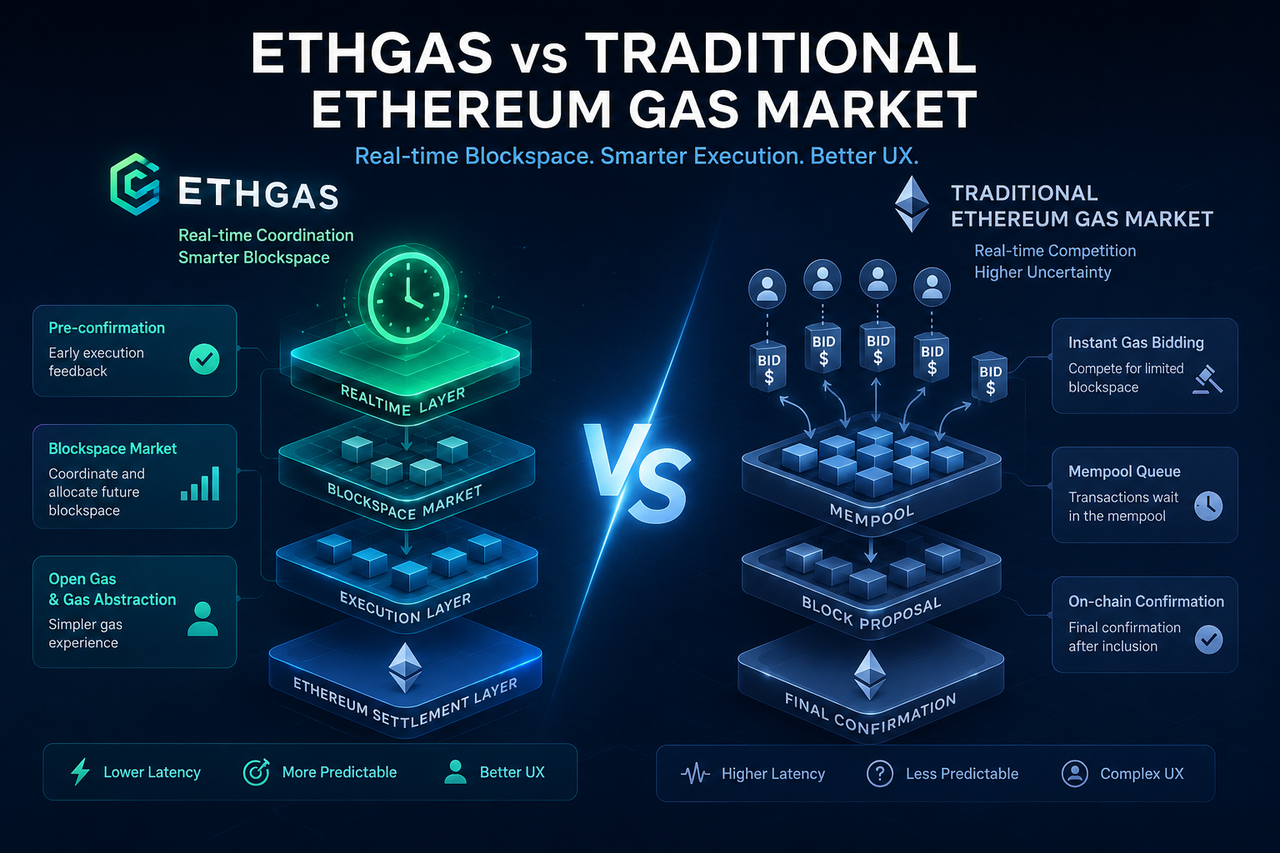
Unlike the traditional Ethereum Gas Market, ETHGas focuses on future block space coordination, pre-confirmation, and real-time execution. The traditional model is more about “instant resource competition.”
What Are the Key Differences Between ETHGas and the Traditional Gas Market?
The fundamental distinction between ETHGas and the traditional Ethereum Gas Market lies in their approach to “block space.”
Traditional Ethereum treats block space as a resource for immediate competition, requiring users to bid in real time for transaction priority. ETHGas, in contrast, treats block space as a resource that can be coordinated and scheduled in advance, aiming to improve execution efficiency through a real-time block space marketplace.
This difference also impacts transaction confirmation logic.
Traditional Ethereum emphasizes final on-chain confirmation, whereas ETHGas introduces a pre-confirmation mechanism, allowing some transactions to receive early execution feedback before being officially included on-chain.
There are also differences in user experience and application layer support. ETHGas prioritizes simplifying Gas management for retail users and supports Gas abstraction and real-time interaction.
How Do Gas Pricing Mechanisms Differ?
The traditional Ethereum Gas Market mainly relies on instant bidding.
During periods of network congestion, users must continuously increase their Gas bids to secure faster transaction ordering. While this market-driven approach dynamically allocates resources, it can also result in volatile trading fees.
ETHGas, on the other hand, focuses on block space coordination and real-time resource scheduling. Its goal is not simply to compete for resources by raising Gas fees, but to optimize transaction execution paths through a block space marketplace.
Compared to the traditional Gas Market, ETHGas emphasizes:
-
Reducing the impact of real-time congestion
-
Improving execution certainty
-
Optimizing the real-time trading experience
-
Pre-coordinating block resources
This approach means ETHGas functions more as a “resource coordination layer” rather than merely a Gas bidding system.
How Do Transaction Confirmation Mechanisms Differ?
The traditional Ethereum network mainly relies on final on-chain confirmation.
Once a user submits a transaction, they must wait for it to be included in a block and confirmed by the network to receive a final status. While this ensures security, confirmation speeds can be affected by network congestion.
ETHGas introduces a pre-confirmation mechanism.
In ETHGas, some transactions can receive early execution feedback before being formally written into a block. This allows users to obtain transaction status information sooner, enhancing the real-time interaction experience.
The differences between the two models are summarized below:
| Comparison Dimension |
ETHGas |
Traditional Ethereum |
| Block Space Model |
Real-time coordination |
Instant competition |
| Transaction Confirmation |
Supports pre-confirmation |
Final on-chain confirmation |
| Gas Management |
Supports Gas abstraction |
User-managed |
| User Experience |
Focuses on real-time interaction |
Focuses on final settlement |
| Execution Logic |
Block space scheduling |
Gas bid sorting |
ETHGas does not replace Ethereum mainnet confirmation but adds a real-time execution layer before final settlement.
Why Does ETHGas Emphasize Realtime Blockspace?
As on-chain applications become more complex, demand for low latency and real-time execution environments is rising.
In scenarios such as blockchain gaming, on-chain Order Books, and High Frequency trading, transaction confirmation times can directly affect user experience and execution outcomes. While the traditional Ethereum instant bidding model enables open resource competition, it may face efficiency constraints in real-time interaction scenarios.
ETHGas’s realtime blockspace approach aims to pre-coordinate block resources, reduce uncertainty during congestion, and provide applications with a more stable execution environment.
This direction also aligns with Ethereum’s modular infrastructure, the MEV market, and the account abstraction ecosystem.
Will ETHGas Replace the Traditional Ethereum Gas Market?
Currently, ETHGas is an extension of Ethereum infrastructure rather than a direct replacement for the traditional Gas Market.
The Ethereum mainnet Gas Market remains a core component of the network, with its instant bidding model supporting open resource competition and network security.
ETHGas serves as an additional real-time resource coordination layer built on top of existing infrastructure to meet the needs of High Frequency interactions and real-time applications.
Going forward, both models are likely to coexist:
This structure is consistent with Ethereum’s ongoing modularization.
Summary
Both ETHGas and the traditional Ethereum Gas Market revolve around block space resources, but they differ significantly in resource allocation, transaction confirmation, and execution logic.
Traditional Ethereum emphasizes instant Gas bidding and final on-chain confirmation, while ETHGas focuses on real-time block space coordination, pre-confirmation, and Gas abstraction, aiming to boost on-chain interaction efficiency with a real-time execution layer.
As Ethereum infrastructure evolves toward real-time and modularization, the Realtime Ethereum concept represented by ETHGas is becoming a key area of exploration for on-chain resource scheduling.
FAQs
Will ETHGas Replace the Original Ethereum Gas Market?
Not for now. ETHGas is focused on real-time execution and resource coordination, while the Ethereum mainnet still handles final settlement.
What Is the Key Difference Between ETHGas and Traditional Ethereum?
The main difference lies in block space resource allocation. Traditional Ethereum relies on instant Gas bidding, while ETHGas emphasizes real-time block space coordination.
Does ETHGas Change the Ethereum Consensus Mechanism?
No. ETHGas operates on Ethereum’s existing infrastructure and does not replace mainnet consensus.
What Is Realtime Blockspace?
Realtime blockspace refers to a block resource structure that can be coordinated, scheduled, and optimized in advance for execution.
Why Does ETHGas Support Pre-confirmation?
Pre-confirmation reduces transaction waiting times and enhances the real-time on-chain interaction experience.
Is ETHGas Related to MEV?
Yes, to a certain extent. Block space coordination, Builder ordering, and transaction execution mechanisms are connected to Ethereum’s MEV ecosystem.







