GateRouter: Optimizing AI Model Selection and Costs Through Intelligent Routing

Beginner
Quick Reads
Last Updated 2026-03-24 10:53:58
Reading Time: 1m
GateRouter is Gate's intelligent AI model routing platform. By leveraging a unified API, it enables seamless multi-model integration and automatically selects the most effective model. This helps developers cut inference costs by up to 80% and significantly enhance AI application development efficiency.

GateRouter: Redefining AI Model Invocation Standards

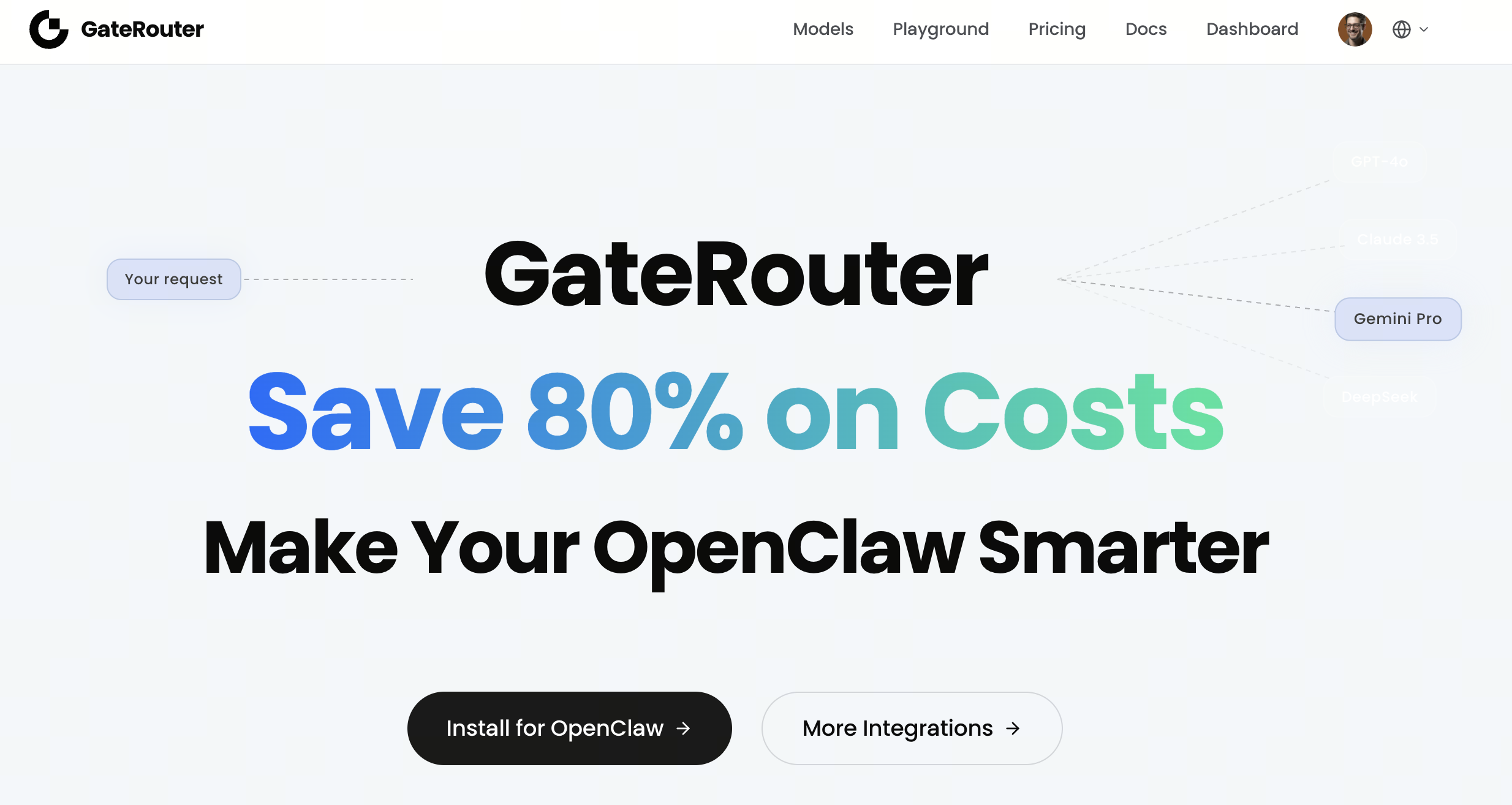
GateRouter Exploration Image source: GateRouter Page

Gate’s GateRouter platform introduces a groundbreaking solution for developers, leveraging Smart Routing to automatically optimize AI model calls. This approach helps users select the most suitable AI model for complex tasks at the lowest possible cost. GateRouter delivers a unified API interface and streamlines AI task selection, dramatically improving the efficiency of AI model invocation.

Why GateRouter?

In an era of rapid AI innovation, developers face the challenge of efficiently invoking multiple AI models to handle diverse tasks. Traditional integration methods are not only cumbersome but can also result in substantial costs. GateRouter’s Smart Routing feature automatically matches models, offering developers several key advantages:

  • Unified API Interface: Developers can access multiple mainstream AI models through a single API, eliminating the need to manage multiple API keys.
  • Automated Task Allocation: The system selects the most appropriate AI model based on task complexity, avoiding errors and unnecessary expenses from manual selection.
  • Significant Cost Reduction: Official data shows Smart Routing can save developers up to 80% on inference costs.

Smart Routing: How GateRouter Selects the Optimal Model

GateRouter’s core strength lies in its intelligent model matching capabilities. In the AI market, performance differences often come with significant price disparities—for instance, GPT-5 Pro can cost up to 450 times more than GPT-5 Nano. Without Smart Routing, developers may default to the most powerful model, incurring excessive costs. GateRouter’s Smart Routing automatically selects the best value model based on task requirements.

  • Simple Tasks: The system favors models with lower performance but greater cost efficiency.
  • Complex Tasks: For demanding tasks, it automatically switches to higher-performance models.

This intelligent selection process ensures high processing efficiency while effectively reducing development costs.

Platform Advantages: 30-Second Fast Integration and Flexible Payments

Fast Integration Streamlines Development

GateRouter is designed for rapid integration, enabling developers to access the required AI models in just 30 seconds with a single command—no complicated setup needed. The platform’s Playground feature lets developers instantly compare the performance and costs of different models, ensuring tasks are completed using the optimal solution.

Multiple Payment Options Lower Entry Barriers

The platform currently offers limited-time free usage, with plans to implement a pay-as-you-go model that helps developers optimize costs based on actual usage. GateRouter supports direct USDT deductions via Gate Pay and will gradually add support for fiat payments, credit cards, and more, further enhancing flexibility.

GateRouter Use Cases

GateRouter is ideal for a range of technical scenarios, especially those requiring efficient, low-cost AI model invocation:

  • AI Agent Developers: Supports developers building AI agents, whether for autonomous invocation or application integration, enabling task completion through a single API.
  • Web3 Developers: Allows seamless AI model integration in decentralized applications, fully supporting stablecoin payments with no credit card required.
  • Large-Scale Enterprise Users: Designed for enterprises needing large-scale AI model invocation, such as quantitative firms and trading platforms, with exclusive rates and compliance auditing services.

Looking Ahead: Advancing AI and Digital Asset Integration

GateRouter is a key part of the Gate for AI ecosystem and embodies the deep integration of AI and digital assets. Going forward, GateRouter will continue to expand its AI model ecosystem, providing developers with powerful tools and driving widespread adoption of AI agents in digital asset trading and automation.

Conclusion

GateRouter’s Smart Routing, rapid integration, and diverse payment options are reshaping traditional AI model invocation, offering developers an efficient, cost-effective solution. Whether for AI agent or Web3 development, the platform enables optimal AI model selection, streamlines workflows, and delivers substantial cost savings.

Author:  Max
Disclaimer
* The information is not intended to be and does not constitute financial advice or any other recommendation of any sort offered or endorsed by Gate.
* This article may not be reproduced, transmitted or copied without referencing Gate. Contravention is an infringement of Copyright Act and may be subject to legal action.

Related Articles

AI-Native Settlement Layers: How United Stables Is Building the Next Financial Rail
Beginner

AI-Native Settlement Layers: How United Stables Is Building the Next Financial Rail

Stablecoins were originally designed as dollar substitutes within exchanges, primarily used for asset pricing and trade settlement. As on-chain financial ecosystems have matured, their role has expanded beyond simple payments to include collateral assets, cross-chain liquidity mediums, and unified settlement units. In particular, as AI systems and automated agents begin to participate directly in economic activity, demand has risen sharply for programmable value units capable of instant settlement. This shift is pushing stablecoins toward the role of foundational financial infrastructure.
2026-03-25 03:16:17
The ve(3,3) Flywheel Explained: How AERO Tokenomics Powers Aerodrome’s DeFi Economy
Beginner

The ve(3,3) Flywheel Explained: How AERO Tokenomics Powers Aerodrome’s DeFi Economy

In the competition for DeFi liquidity, high-inflation mining alone is no longer enough to build lasting advantages. Aerodrome applies the ve(3,3) economic model to redesign token emissions, voting mechanisms, and revenue distribution, creating a liquidity flywheel centered on governance and cash flow. This article examines AERO tokenomics, the veAERO locking mechanism, and protocol revenue models to explain how Aerodrome builds a sustainable DeFi economic system.
2026-03-25 06:41:58
How is the price of PAXG determined? Pegging mechanism, trading depth, and influencing factors
Beginner

How is the price of PAXG determined? Pegging mechanism, trading depth, and influencing factors

PAXG (Pax Gold) is a tokenized asset backed by physical gold reserves, launched by fintech firm Paxos and issued as an ERC-20 token on the Ethereum blockchain. The core concept is to digitally represent real-world gold assets, allowing investors to hold and trade gold via the blockchain network. Because each PAXG token corresponds to a specific quantity of physical gold, its price is theoretically expected to closely track the global gold market.
2026-03-24 19:11:40
Aerodrome Tokenomics: How ve(3,3) Powers Base's Most Profitable DEX
Beginner

Aerodrome Tokenomics: How ve(3,3) Powers Base's Most Profitable DEX

AERO is the native token of Aerodrome Finance, a core decentralized exchange and liquidity protocol in the Base ecosystem. It is primarily used for liquidity incentives and ecosystem operations. veAERO is a governance NFT that users receive by locking AERO, representing both voting power and the right to share protocol revenue. Through a dual track structure of AERO as a utility token and veAERO as a governance credential, Aerodrome separates liquidity usage value from long term governance power, allowing participants to act as liquidity providers, governance decision makers, and revenue sharers within the same system.
2026-03-25 06:40:31
How Does PAXG Work? In-Depth Overview of the Physical Gold Tokenization Mechanism
Beginner

How Does PAXG Work? In-Depth Overview of the Physical Gold Tokenization Mechanism

PAXG (Pax Gold) is a tokenized asset backed by physical gold, issued by the fintech company Paxos and traded on the Ethereum blockchain as an ERC-20 token. The core concept is to tokenize physical gold on-chain, with each PAXG token representing ownership of a certain amount of gold. This structure enables investors to hold and trade gold in the form of a digital asset.
2026-03-24 19:12:51
Aster vs Hyperliquid: Which Perp DEX Will Prevail?
Beginner

Aster vs Hyperliquid: Which Perp DEX Will Prevail?

Aster and Hyperliquid are the two representative protocols of the "purpose-built L1 path" within the current decentralized perpetual exchange (Perp DEX) sector. As a pioneer in the field, Hyperliquid has built a deep liquidity moat through its highly mature order book architecture and strong community consensus. Conversely, Aster, as a rising challenger, seeks to leapfrog the competition in high-performance trading through more aggressive multi-chain aggregation logic, private transaction modules, and an underlying execution environment optimized for 2026 market demands.
2026-03-24 11:58:33