The Challenge of the AI Era: Real and Fake Images Are Harder Than Ever to Tell Apart
As generative AI technology advances, the cost of faking photos and videos has plummeted, eroding the old adage that "seeing is believing." Research firms like Deloitte note that losses from related scams could surge in the coming years, highlighting that image authenticity is no longer just a technical issue—it also impacts financial systems and social trust.
What Is ZCAM?
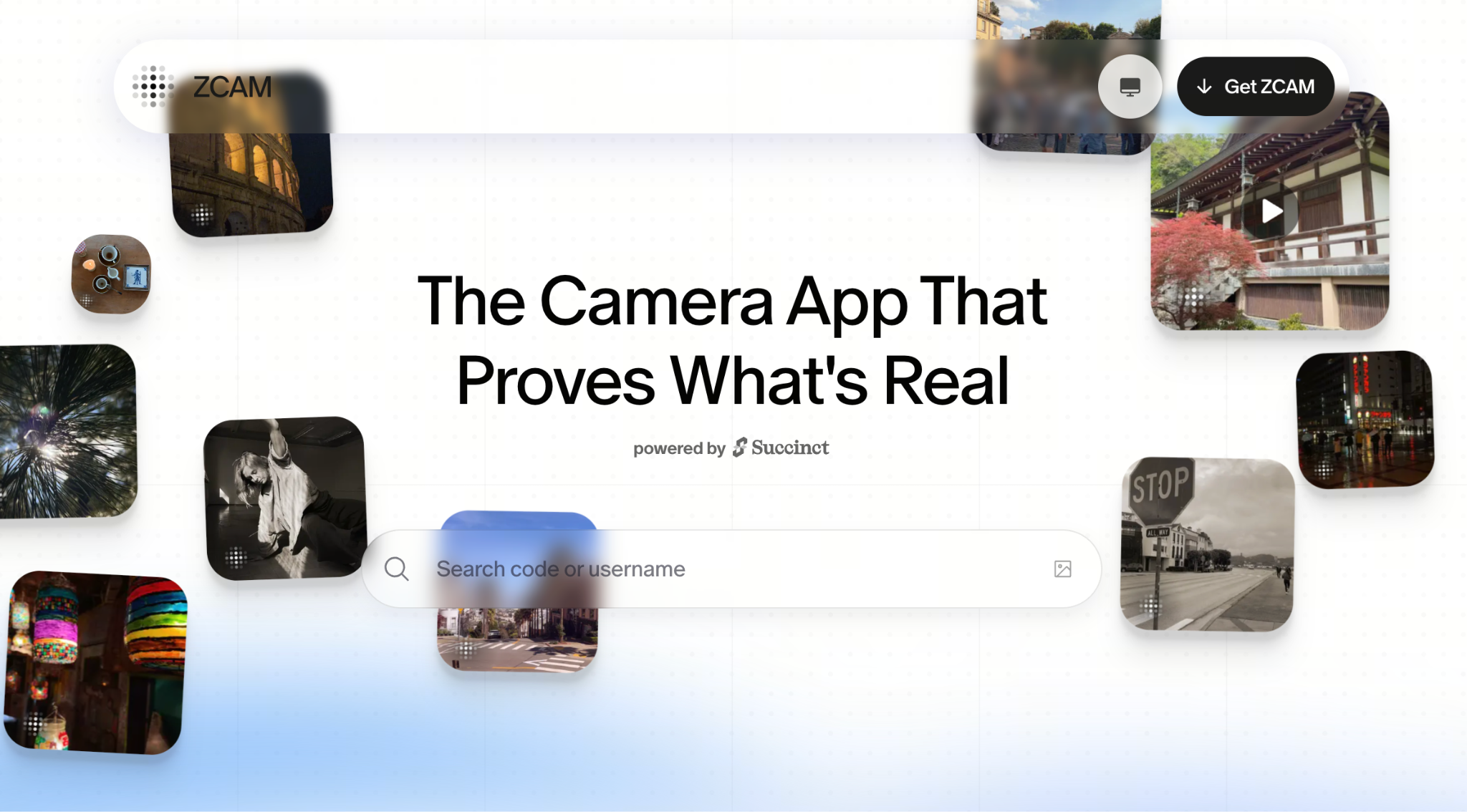 (Source: zcam.succinct)
To address this challenge, Succinct Labs has launched an app called ZCAM. ZCAM's core concept is to generate an immutable digital fingerprint for images at the moment they are captured.
In practice, ZCAM:
-
Encrypts and signs images or videos the instant they're captured
-
Links the content to the specific capturing device
-
Creates verifiable digital records
This design allows users to prove whether an image originated from an authentic device.
Technical Principle: Verifying Authenticity at the Source
 (Source: SuccinctLabs)
Instead of trying to detect what’s fake, ZCAM takes a different approach—proving what’s real.
How it works:
-
Converts image pixels into cryptographic hashes
-
Uses device hardware to generate a unique signature
-
Creates tamper-proof records
This makes it possible to detect any subsequent modification or forgery.
How Is It Different from Other Solutions?
Other anti-AI solutions exist in the Marketplace, such as the identity verification system launched by World, which distinguishes AI by confirming human identity. ZCAM, however, takes a different path—it verifies the origin of the content, not the identity of the person. Rather than relying on post-production detection, it establishes proof at the point of capture. These two strategies address the same challenge from different angles.
ZCAM Use Cases
ZCAM’s potential applications are extensive, including:
- News Media
Ensuring the authenticity of photos and videos to prevent fake news
- Enterprises and Financial Institutions
Mitigating risks of fraud and forgery
- General Users
Providing trustworthy content sources on Group media platforms
Challenges Facing ZCAM
Despite its technical promise, adoption faces hurdles. Users must proactively use a dedicated app to capture images, and the ecosystem is not yet widespread. The verification system is still under development. Ultimately, the value of tools like ZCAM depends on widespread adoption.
Zero-Knowledge Proof and Blockchain Applications
Succinct Labs’ technology is built on zero-knowledge proofs (ZK) and provides a validation mechanism through its Prover Network.
Key technologies include:
-
zkVM (zero-knowledge virtual machine)
-
Decentralized validation Marketplace
-
Establishing trustworthy data proofs
These technologies are already securing digital Assets valued in the billions of dollars.
Investment and Development Background
Succinct Labs has received funding led by Paradigm and attracted investment from several blockchain project founders, signaling the Marketplace’s growing focus on reliable data and content verification.
Conclusion
As AI-generated content becomes more widespread, distinguishing real information is an increasingly critical challenge. ZCAM offers a way to build trust at the source—using encryption and device verification to make images traceable. Whether this technology gains broad adoption will shape the foundation of trust in the digital world.







