Over the past few years, Web3 wallets have gradually become a key entry point into the blockchain ecosystem. Whether users are managing assets, trading NFTs, or interacting with DeFi, they usually need a wallet to sign transactions and grant onchain approvals. Among them, MetaMask has long been one of the most representative traditional wallets, while Infinex represents a newer direction for Account Abstraction, or AA, wallets.
As the multichain ecosystem continues to expand, the user experience limitations of traditional wallets have become more visible. Managing seed phrases, preparing gas tokens, and frequently switching networks remain major barriers for many ordinary users entering Web3. Infinex therefore attempts to redesign the onchain account experience through Passkey and Account Abstraction mechanisms. This shift not only changes how users interact with wallets, but also reflects a broader evolution in Web3 infrastructure from “private key logic” toward “account logic.”
As a non-custodial DeFi super app based on Account Abstraction, Infinex helps users manage onchain assets, execute cross-chain transactions, and access DeFi protocols through Passkey login, a unified account system, and multichain aggregation logic.
Unlike traditional wallets, Infinex places greater emphasis on the “account experience.” Users do not need to manually store a seed phrase. Instead, they can log in and sign transactions through Face ID, Touch ID, or device verification.
As one of the most widely used Web3 wallets today, MetaMask was originally built mainly around the Ethereum ecosystem. Users create wallets through a seed phrase and use private keys to sign onchain transactions. MetaMask is a typical EOA, Externally Owned Account, wallet, meaning the account is fully controlled by the private key. As long as users have the seed phrase, they can restore the account and manage their assets.
What Is the Difference Between Account Abstraction Wallets and EOA Wallets
EOA, Externally Owned Account, wallets are currently the most common wallet structure. Their defining feature is that the account is fully controlled by a private key. MetaMask belongs to this model.
Account Abstraction, or AA, wallets manage accounts through smart contract logic, allowing accounts to support more complex permissions and execution rules. For example, AA wallets can support:
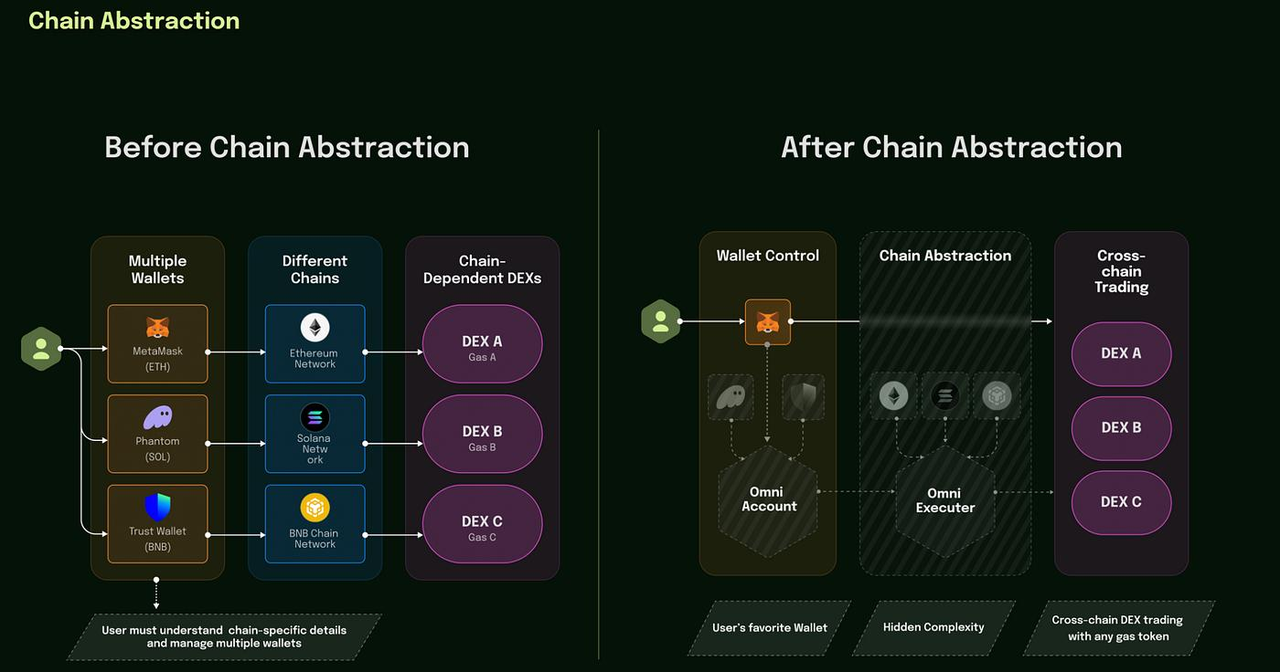
This model makes a wallet feel more like a “smart account,” rather than just a simple blockchain address.
Infinex’s account system is built on Account Abstraction logic, which is why its user experience differs clearly from traditional wallets.
How Is Gas Management Different
In traditional wallets, users usually need to prepare the gas token for each corresponding chain. For example, transactions on Ethereum require ETH, and transactions on Arbitrum also require ETH for gas.
Although this model follows how blockchains operate, it can be complicated for ordinary users. In many cases, even when users already hold assets, they may still be unable to complete an operation because they lack a small amount of gas token.
After introducing gas abstraction, Infinex can handle part of the fee logic in a more unified way, reducing the need for users to frequently swap for gas tokens. Users do not need to constantly track fee differences across chains or switch networks repeatedly.
Gas abstraction does not eliminate onchain fees. It reduces how much complexity users have to deal with.
Why Is the Multichain Experience Different
MetaMask’s multichain logic is still essentially a “single-chain switching” model. Users need to manually switch networks before they can view assets and transaction records on the corresponding chain.
As the blockchain ecosystem continues to expand, this model has started to show clear limitations. User assets may be spread across multiple chains, and frequent network switching adds operational complexity.
Infinex instead tries to aggregate multichain assets through a unified account system. Users can view assets, yields, and transaction activity across different chains in the same interface, while the system handles the underlying chain switching.
This model is closer to the experience of an internet account than traditional wallet logic.
MetaMask has long been regarded as an important tool for native Web3 users. For users who are familiar with private key management, chain switching, and DeFi interactions, MetaMask still offers strong flexibility and broad ecosystem compatibility.
Infinex is better suited for users who want to reduce the complexity of onchain usage. Passkey login, multichain aggregation, and unified account logic make it easier for ordinary internet users to understand.
The two are not simply substitutes for each other. They are better seen as representatives of different stages in the Web3 user experience.
| Comparison Dimension |
Infinex |
MetaMask |
| Login Method |
Passkey |
Seed phrase |
| Account Structure |
Account Abstraction |
EOA |
| Multichain Experience |
Aggregated account |
Manual network switching |
| Gas Management |
Gas abstraction |
User prepares gas manually |
| User Positioning |
Ordinary users + multichain users |
Native Web3 users |
What Challenges Do Account Abstraction Wallets Face
Although account abstraction wallets can improve user experience, the related ecosystem is still in an early stage of development.
First, compatibility between AA wallets and different protocols or infrastructure is still being improved. Many DeFi protocols were originally designed around EOA wallets, so some functions may still require adaptation.
Second, Account Abstraction usually relies on smart contract logic, meaning its security model differs from that of traditional wallets. Account recovery, permission management, and device security can all affect the overall user experience.
In addition, Passkey support varies across devices and browsers. Account migration and recovery mechanisms also remain important areas for ongoing industry improvement.
Summary
The difference between Infinex and MetaMask essentially reflects the evolution of Web3 wallets from “private key management” toward “account experience.” MetaMask represents the traditional EOA wallet model, with greater emphasis on private key control and open compatibility. Infinex, by contrast, uses Account Abstraction, Passkey, and multichain aggregation logic to reduce users’ dependence on complex blockchain operations.
However, traditional wallets and AA wallets are likely to coexist for a long time in the near term, serving different types of user needs.
FAQs
MetaMask operates on a traditional EOA wallet structure, while Infinex uses Account Abstraction and Passkey login, with a stronger focus on unified accounts and multichain experience.
Will Passkey Replace Seed Phrases?
Passkey provides a login experience closer to internet applications, but seed phrases and private key models are likely to remain in use for a long time in the near term.
Is Infinex a Non-Custodial Wallet?
Infinex emphasizes users’ self-custodial control over their assets, so it is generally viewed as a non-custodial account system.
Why Are Account Abstraction Wallets Getting Attention?
Account Abstraction can reduce the complexity of onchain interactions and support more flexible account permissions and gas management mechanisms, which is why it is considered helpful for improving the Web3 user experience.
Some EOA wallets may gradually integrate Account Abstraction-related features in the future, but their underlying structure will still differ from AA-first products such as Infinex.