PI Coin to PHP Exchange Rate: Latest Market Analysis & Beginner’s Guide

Beginner
Quick Reads
Last Updated 2026-03-28 05:23:14
Reading Time: 1m
According to the latest data, 1 Pi Network (PI) ≈ ₱15.8 PHP. This article offers an in-depth analysis of the PI token’s exchange rate trends against the Philippine Peso (PHP), key points for newcomers, and potential investment risks.

What Is PI Coin? A Quick Guide for Beginners

If you’re new to cryptocurrency, PI Coin may still be unfamiliar. Pi Network (PI) is a blockchain project designed to allow everyday users to mine coins directly from their smartphones. The project was launched in 2019 by a team of Stanford University PhD graduates. PI has a maximum supply of 100 billion coins, with approximately 8.3 billion currently in circulation.

In essence, PI Coin lowers the entry barrier, enabling regular smartphone users to mine and participate in the ecosystem. Although its real-world applications are still developing, its approach—starting from the mobile user side—is straightforward for beginners to grasp.

Current PI to PHP Exchange Rate & Latest Trends
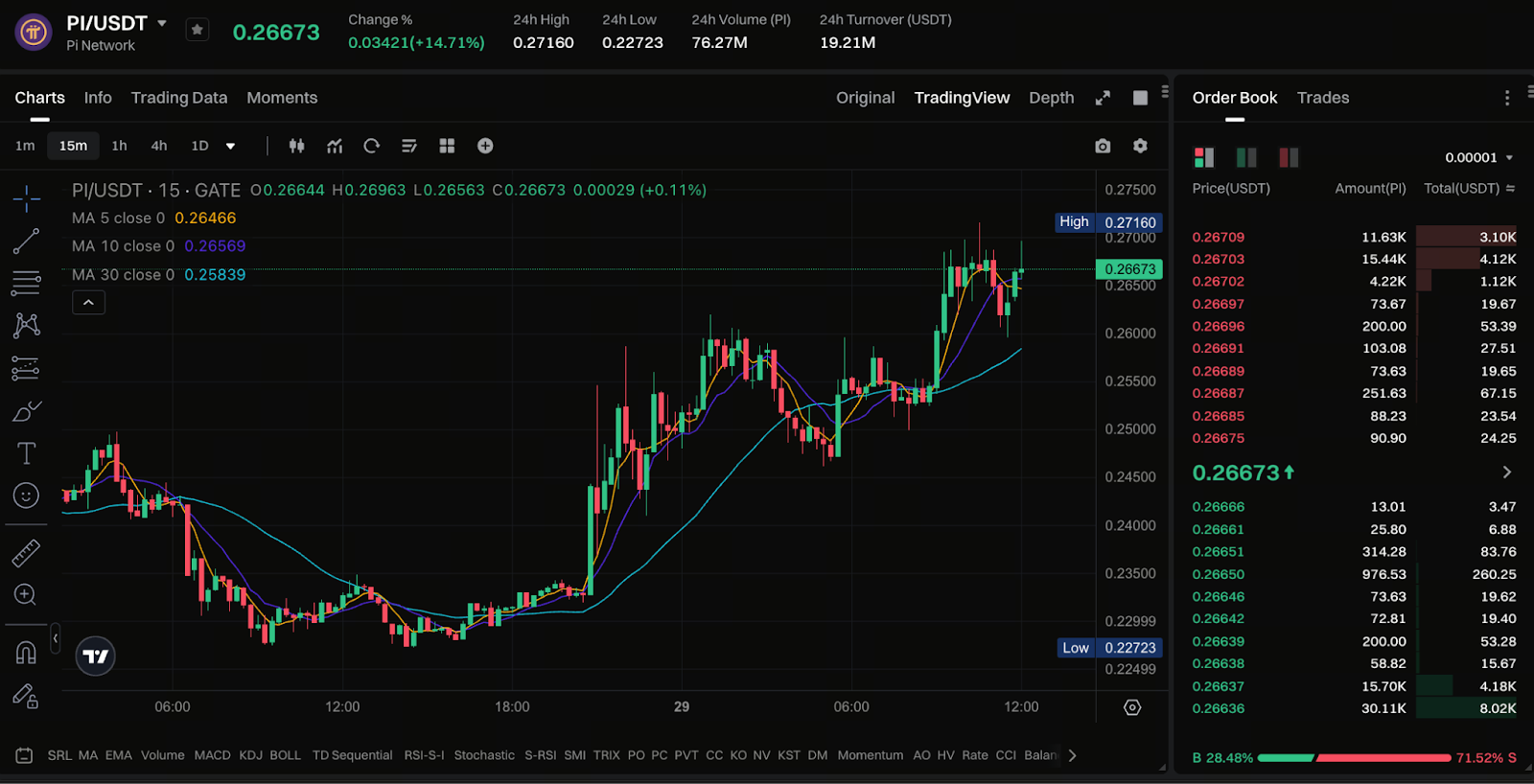

Chart: https://www.gate.com/trade/PI_USDT

According to the latest data, 1 PI ≈ ₱15.83 Philippine Peso (PHP). Over the past 24 hours, PI has gained approximately 16% against PHP. Reviewing the past week, from October 23 to 29, the PI/PHP rate climbed from about ₱11.98 to roughly ₱15.83—a notable increase. For newcomers, this means that early PI accumulation has recently shown substantial appreciation in peso terms. However, remember: past performance does not guarantee future results.

Three Key Factors Driving Exchange Rate Fluctuations

  • Overall Market Sentiment: When the broader cryptocurrency market rises, projects like PI often follow suit. PI has surged about 30.7% in the past seven days.
  • Exchange Channels and Liquidity: Converting PI to PHP requires platform support for the trading pair. If liquidity is low, price spreads may widen or trading may be restricted.
  • Project Developments & News: Major announcements—such as PI Network launching its mainnet, securing strategic partnerships, or activating large nodes—can attract attention and drive prices higher. Conversely, delays or negative news can trigger declines.

How Can Beginners Get Started with PI Investment? What to Watch For

  • Download the official app and complete KYC: Only verified accounts can migrate PI to the mainnet and be eligible for future exchanges.
  • Calculate your peso value: For example, if you hold 100 PI, at the current rate of ₱15.83, that’s about ₱1,583—a small-scale transaction in the Philippine market.
  • Set goals and stop-losses: Given the high price volatility, set realistic targets and never invest more than you can afford to lose.
  • Check exchange channels: Make sure your chosen platform supports PI->PHP conversion, and review fees and withdrawal limits.
  • Learn blockchain basics: Understanding the supply model (100 billion PI maximum), team credentials, and ecosystem development helps you assess the project’s long-term potential.

Risk Notice & Summary

While the market outlook is positive, proceed with caution:

  • The project is still evolving, and its use cases are not yet fully mature.
  • The crypto market is highly volatile, and peso valuations are affected by PHP exchange rates and local economic conditions.
  • Not all countries or exchanges support PI-to-Peso conversions.

In summary, PI to PHP has performed strongly in recent days, and newcomers may want to keep an eye on it. However, prioritize learning and invest carefully. If you already hold PI, monitor exchange channels and mainnet progress closely, and be prepared for “PI → PHP” conversion.

Author: Max
Disclaimer
* The information is not intended to be and does not constitute financial advice or any other recommendation of any sort offered or endorsed by Gate.
* This article may not be reproduced, transmitted or copied without referencing Gate. Contravention is an infringement of Copyright Act and may be subject to legal action.

Related Articles

AI-Native Settlement Layers: How United Stables Is Building the Next Financial Rail
Beginner

AI-Native Settlement Layers: How United Stables Is Building the Next Financial Rail

Stablecoins were originally designed as dollar substitutes within exchanges, primarily used for asset pricing and trade settlement. As on-chain financial ecosystems have matured, their role has expanded beyond simple payments to include collateral assets, cross-chain liquidity mediums, and unified settlement units. In particular, as AI systems and automated agents begin to participate directly in economic activity, demand has risen sharply for programmable value units capable of instant settlement. This shift is pushing stablecoins toward the role of foundational financial infrastructure.
2026-03-25 03:16:17
The ve(3,3) Flywheel Explained: How AERO Tokenomics Powers Aerodrome’s DeFi Economy
Beginner

The ve(3,3) Flywheel Explained: How AERO Tokenomics Powers Aerodrome’s DeFi Economy

In the competition for DeFi liquidity, high-inflation mining alone is no longer enough to build lasting advantages. Aerodrome applies the ve(3,3) economic model to redesign token emissions, voting mechanisms, and revenue distribution, creating a liquidity flywheel centered on governance and cash flow. This article examines AERO tokenomics, the veAERO locking mechanism, and protocol revenue models to explain how Aerodrome builds a sustainable DeFi economic system.
2026-03-25 06:41:58
Aerodrome Tokenomics: How ve(3,3) Powers Base's Most Profitable DEX
Beginner

Aerodrome Tokenomics: How ve(3,3) Powers Base's Most Profitable DEX

AERO is the native token of Aerodrome Finance, a core decentralized exchange and liquidity protocol in the Base ecosystem. It is primarily used for liquidity incentives and ecosystem operations. veAERO is a governance NFT that users receive by locking AERO, representing both voting power and the right to share protocol revenue. Through a dual track structure of AERO as a utility token and veAERO as a governance credential, Aerodrome separates liquidity usage value from long term governance power, allowing participants to act as liquidity providers, governance decision makers, and revenue sharers within the same system.
2026-03-25 06:40:31
How Does PAXG Work? In-Depth Overview of the Physical Gold Tokenization Mechanism
Beginner

How Does PAXG Work? In-Depth Overview of the Physical Gold Tokenization Mechanism

PAXG (Pax Gold) is a tokenized asset backed by physical gold, issued by the fintech company Paxos and traded on the Ethereum blockchain as an ERC-20 token. The core concept is to tokenize physical gold on-chain, with each PAXG token representing ownership of a certain amount of gold. This structure enables investors to hold and trade gold in the form of a digital asset.
2026-03-24 19:12:51
How is the price of PAXG determined? Pegging mechanism, trading depth, and influencing factors
Beginner

How is the price of PAXG determined? Pegging mechanism, trading depth, and influencing factors

PAXG (Pax Gold) is a tokenized asset backed by physical gold reserves, launched by fintech firm Paxos and issued as an ERC-20 token on the Ethereum blockchain. The core concept is to digitally represent real-world gold assets, allowing investors to hold and trade gold via the blockchain network. Because each PAXG token corresponds to a specific quantity of physical gold, its price is theoretically expected to closely track the global gold market.
2026-03-24 19:11:40
Aster vs Hyperliquid: Which Perp DEX Will Prevail?
Beginner

Aster vs Hyperliquid: Which Perp DEX Will Prevail?

Aster and Hyperliquid are the two representative protocols of the "purpose-built L1 path" within the current decentralized perpetual exchange (Perp DEX) sector. As a pioneer in the field, Hyperliquid has built a deep liquidity moat through its highly mature order book architecture and strong community consensus. Conversely, Aster, as a rising challenger, seeks to leapfrog the competition in high-performance trading through more aggressive multi-chain aggregation logic, private transaction modules, and an underlying execution environment optimized for 2026 market demands.
2026-03-24 11:58:33





