As the RWA and multi-chain marketplaces rapidly evolve, traditional DAO governance is gradually revealing its limitations in permission management, cross-chain coordination, and Auto Execution. Quack AI introduces an AI Governance Layer that empowers AI Agent to participate in governance analysis, risk identification, and on-chain execution under preset rules—significantly reducing manual coordination costs in multi-chain governance.
With the continued expansion of the AI Agent Economy, Quack AI’s governance architecture is well-suited not only for DAO management but also for Treasury Coordination, RWA Governance, and on-chain automated operations.
What Is RWA Governance?
RWA Governance refers to the on-chain governance and management processes centered around Real World Assets.
RWAs generally comprise on-chain representations of bonds, real estate, notes, fund shares, or other tangible assets. Managing these assets on-chain demands more complex governance rules, such as asset custody, permission approvals, Return distribution, and compliance reviews.
Compared to standard DeFi protocols, RWA Governance places a stronger focus on transparency, rule enforcement, and collaborative decision-making. As a result, DAOs managing RWAs require more robust governance infrastructure and advanced automation capabilities.
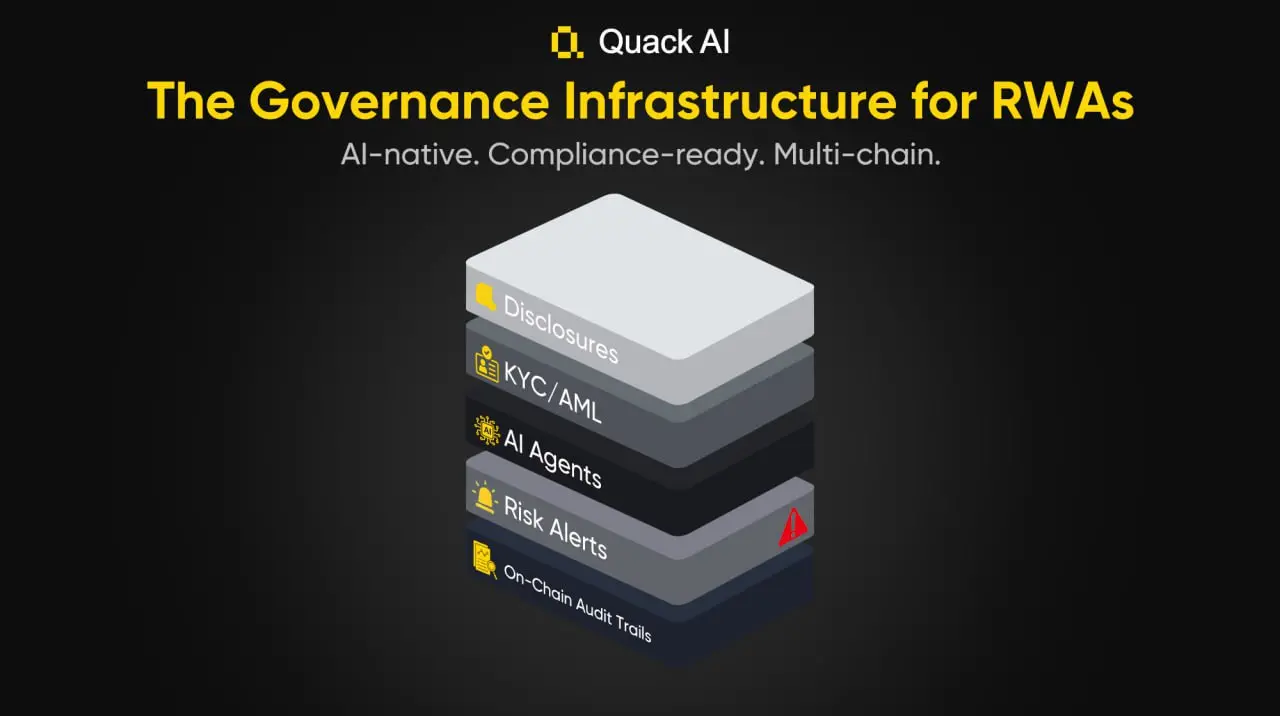
How Does Quack AI Support Multi-Chain Governance?
One of Quack AI’s key strengths lies in its support for cross-chain governance and multi-chain execution.
In a multi-chain marketplace, DAOs often manage assets and protocols across networks like Ethereum, BNB Chain, Arbitrum, and Polygon. While traditional governance tools are typically confined to single-chain environments, Quack AI is engineered for seamless cross-chain collaboration.
Leveraging the AI Governance Layer, AI Agent can synchronize governance processes across multiple blockchains. For example, when a DAO completes proposal voting on its primary chain, the Execution Agent can automatically update parameters or coordinate funds on other chains.
This approach minimizes the complexity of manual cross-chain operations and enhances consistency in governance execution.
What Is the Role of the Policy Engine in RWA Governance?
The Policy Engine is a foundational element of Quack AI’s governance framework, designed to define the permission scope and execution rules for AI Agent.
In RWA contexts, asset management typically demands rigorous rule enforcement. For instance, a DAO might establish restrictions on asset transfers, set approval workflows, or specify Return distribution conditions to ensure automated governance aligns with established requirements.
The Policy Engine ensures that AI Agent operate strictly within defined parameters, rather than engaging in unrestricted on-chain activity.
This structure mitigates potential risks of automation and enhances the transparency and verifiability of RWA Governance.
How Do AI Agent Participate in RWA and Multi-Chain Governance?
Within the Quack AI governance system, AI Agent are engaged throughout multiple stages of governance.
The Proposal Agent generates governance abstracts and analyzes proposals, enabling community members to rapidly grasp essential governance information.
The Risk Agent monitors governance risks, including anomalies in fund permissions, asset management issues, or on-chain execution conflicts.
During the execution phase, the Execution Agent autonomously performs cross-chain operations per DAO-defined rules. For example, when a Treasury Proposal is approved, the AI Agent can coordinate assets and update parameters across several chains automatically.
This model boosts governance efficiency and reduces manual intervention costs in multi-chain environments.
How Does Quack AI Optimize Treasury Coordination?
Treasury Coordination is a critical aspect of DAO and RWA management.
As DAOs’ AUM (Assets Under Management) grows, Treasuries are often distributed across multiple chains and protocols. Conventional management typically requires manual asset allocation and Return distribution, increasing the complexity of governance.
Quack AI, through its AI Governance Layer and automated execution system, enables partial automation of Treasury management processes.
For example, a DAO can configure Treasury management rules via the Policy Engine, and AI Agent will execute fund allocation or Return distribution operations based on preset conditions.
This automated governance framework reduces coordination costs and increases Treasury management efficiency.
Traditional multi-chain governance tools generally focus on vote synchronization and basic cross-chain actions, while Quack AI prioritizes AI Agent integration and automated governance logic.
In conventional systems, governance analysis and execution largely depend on manual processes. Quack AI leverages Governance Intelligence and the Policy Engine to enable AI Agent to manage proposal analysis, risk detection, and automated execution.
The primary distinction lies in the level of governance automation and the collaborative capabilities of AI.
| Dimension |
Traditional Multi-Chain Governance Tools |
Quack AI |
| Proposal Analysis |
Manual |
AI Agent |
| Risk Identification |
Manual Review |
AI Risk Agent |
| Execution Method |
Manual Coordination |
Auto Execution |
| Permission Control |
Multisig-Based |
Policy Engine |
| Cross-Chain Collaboration |
Basic Synchronization |
AI Collaborative Governance |
What Is the Significance of Quack AI in the Agent Economy?
As the AI Agent Economy evolves, more AI Agent engage in on-chain analysis, trading, and governance.
However, without structured rule enforcement and governance infrastructure, large-scale AI Agent collaboration may pose challenges for permission management and execution security.
Quack AI aims to provide foundational governance infrastructure for the Agent Economy, enabling AI Agent to collaborate on-chain within verifiable rules.
This model is applicable not only to DAO and RWA management but also may shape the future of AI and blockchain synergy.
Summary
Quack AI is an AI Governance Infrastructure platform that integrates AI Agent, the Policy Engine, and automated execution mechanisms, serving RWA Governance, multi-chain collaboration, and Treasury Coordination use cases.
As multi-chain marketplaces and real-world assets transition into Web3, traditional governance models face growing challenges in execution efficiency, permission management, and cross-chain coordination. Through its AI Governance Layer, Quack AI enables partial automation of governance processes, ensuring transparency and compliance with established rules.
Looking ahead, AI Governance is poised to become a cornerstone of multi-chain marketplaces and the Agent Economy, with Quack AI’s automated governance architecture playing a vital role in the Web3 infrastructure landscape.
FAQs
How Does Quack AI Support RWA Governance?
Quack AI leverages its AI Governance Layer, Policy Engine, and automated execution framework to help DAOs manage on-chain governance processes related to real-world assets.
What Is Multi-Chain Governance?
Multi-chain governance refers to the mechanisms that enable DAOs or protocols to coordinate governance, asset management, and execution processes across multiple blockchains.
What Role Does the Policy Engine Play in RWA Management?
The Policy Engine imposes restrictions on AI Agent execution permissions and ensures automated governance adheres to preset rules.
Can AI Agent Automatically Execute Cross-Chain Operations?
When permissions and rules permit, AI Agent can autonomously perform certain cross-chain governance and on-chain coordination tasks.
How Does Quack AI Enhance Treasury Coordination?
Quack AI streamlines Treasury management by automating processes through rules-based workflows and AI Agent collaboration, thereby improving multi-chain asset management efficiency.
What Sets Quack AI Apart From Traditional DAO Tools?
Quack AI emphasizes AI Governance, Auto Execution, and AI Agent collaboration, while traditional DAO tools largely rely on manual governance processes.
Risk Disclaimer:
Cryptocurrency assets are highly volatile. RWA and AI-themed projects may be impacted by market conditions, technological advancements, regulatory policies, and ecosystem adoption. This content is for informational purposes only and does not constitute investment advice.







