Tether Investments Merger Strategy Explained: Building an Integrated Bitcoin Ecosystem Across Mining, Finance, and Capital Markets

Last Updated 2026-05-08 10:00:15
Reading Time: 1m
Tether's investment arm has unveiled a comprehensive M&A strategy focused on building a Bitcoin platform that unifies mining, financial services, and capital markets. This article offers a clear, informative breakdown of the strategy’s structure, the key participants involved, and its potential implications for the cryptocurrency industry.

What Is Tether Investments’ Acquisition Plan?
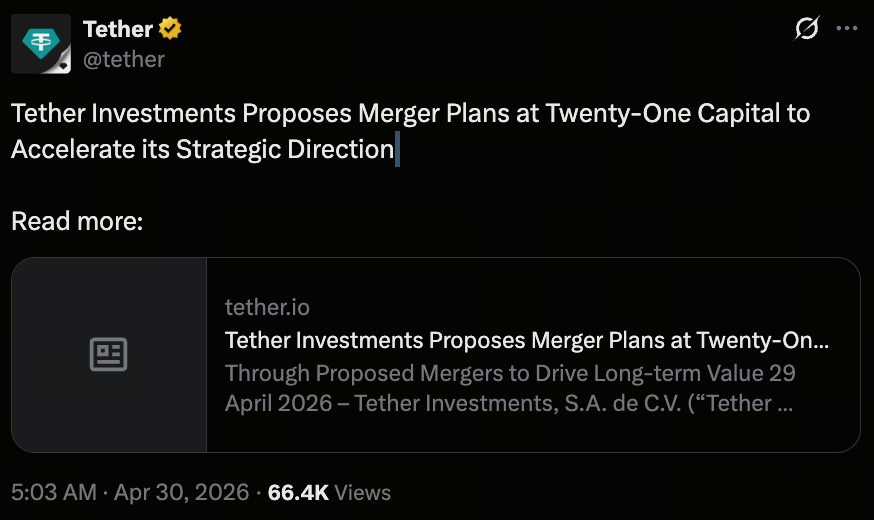
What Is Tether Investments’ Acquisition Plan

(Source: tether)

Tether Investments has recently introduced a multi-phase acquisition strategy focused on the future development of Twenty-One Capital. The core objective is to create a comprehensive, long-term competitive industry platform by integrating a range of Bitcoin-related businesses.

Acquisition Structure: The Key to Three-Party Integration

The proposed structure involves two primary merger steps:

Phase One
Twenty-One Capital will merge with Strike

Phase Two
The merged entity will then integrate with Elektron Energy

This approach will ultimately result in a conglomerate spanning multiple business sectors.

Roles of Each Participant

This plan leverages the complementary strengths of each company:

  1. Strike: Financial Services Layer

    • Provides Bitcoin trading, payments, and lending
    • Maintains a global user base and strong compliance foundation
    • Focuses on simple, user-friendly financial products
  2. Elektron: Mining and Infrastructure

    • Large-scale Bitcoin mining capabilities
    • Stable operations and cash flow
    • Advantages in cost control and operational efficiency
  3. Twenty-One Capital: Integration Platform

    • Serves as the publicly listed entity
    • Responsible for capital allocation and overall strategy

Why Pursue This Integration?

Historically, different segments of the Bitcoin industry—such as mining, trading, and financial services—have operated independently. This acquisition seeks to integrate these segments into a unified system, offering potential advantages like more stable revenue streams (not solely reliant on Bitcoin price), greater capital efficiency, and a more complete suite of products and services.

Leadership and Strategic Direction

The management team for this plan is also notable:

  • Jack Mallers, founder of Strike: Responsible for product and market strategy
  • Raphael Zagury, head of Elektron: Responsible for operations and capital execution

This combination aims to merge user-oriented product expertise with robust infrastructure operations.

Long-Term Goal: Building an Integrated Bitcoin Company

Upon completion of the acquisition, Twenty-One Capital will transform into a diversified enterprise, including:

  • Bitcoin asset management (Treasury)
  • Mining operations
  • Financial services (payments, lending)
  • Capital markets operations

In short, it will evolve from a single-line business into a comprehensive Bitcoin economic platform.

Tether Investments’ Role

Tether’s investment division acts as the driving force behind this plan, with a strategic focus on investing in infrastructure with long-term value, supporting companies that expand crypto applications, and advancing the practical adoption of Decentralized Finance (DeFi).

Summary

Tether Investments’ acquisition strategy reflects a broader industry shift from single-line businesses to integrated platforms. By bringing together mining, financial services, and capital markets, this model could shape the future for Bitcoin enterprises—not just as asset holders, but as builders of complete economic ecosystems.

Author:  Allen
Disclaimer
* The information is not intended to be and does not constitute financial advice or any other recommendation of any sort offered or endorsed by Gate.
* This article may not be reproduced, transmitted or copied without referencing Gate. Contravention is an infringement of Copyright Act and may be subject to legal action.

Related Articles

In-depth Explanation of Yala: Building a Modular DeFi Yield Aggregator with $YU Stablecoin as a Medium
Beginner

In-depth Explanation of Yala: Building a Modular DeFi Yield Aggregator with $YU Stablecoin as a Medium

Yala inherits the security and decentralization of Bitcoin while using a modular protocol framework with the $YU stablecoin as a medium of exchange and store of value. It seamlessly connects Bitcoin with major ecosystems, allowing Bitcoin holders to earn yield from various DeFi protocols.
2026-03-24 11:55:44
The Future of Cross-Chain Bridges: Full-Chain Interoperability Becomes Inevitable, Liquidity Bridges Will Decline
Beginner

The Future of Cross-Chain Bridges: Full-Chain Interoperability Becomes Inevitable, Liquidity Bridges Will Decline

This article explores the development trends, applications, and prospects of cross-chain bridges.
2026-04-08 17:11:27
Solana Need L2s And Appchains?
Advanced

Solana Need L2s And Appchains?

Solana faces both opportunities and challenges in its development. Recently, severe network congestion has led to a high transaction failure rate and increased fees. Consequently, some have suggested using Layer 2 and appchain technologies to address this issue. This article explores the feasibility of this strategy.
2026-04-06 23:31:03
Sui: How are users leveraging its speed, security, & scalability?
Intermediate

Sui: How are users leveraging its speed, security, & scalability?

Sui is a PoS L1 blockchain with a novel architecture whose object-centric model enables parallelization of transactions through verifier level scaling. In this research paper the unique features of the Sui blockchain will be introduced, the economic prospects of SUI tokens will be presented, and it will be explained how investors can learn about which dApps are driving the use of the chain through the Sui application campaign.
2026-04-07 01:11:45
Navigating the Zero Knowledge Landscape
Advanced

Navigating the Zero Knowledge Landscape

This article introduces the technical principles, framework, and applications of Zero-Knowledge (ZK) technology, covering aspects from privacy, identity (ID), decentralized exchanges (DEX), to oracles.
2026-04-08 15:08:18
What is Tronscan and How Can You Use it in 2025?
Beginner

What is Tronscan and How Can You Use it in 2025?

Tronscan is a blockchain explorer that goes beyond the basics, offering wallet management, token tracking, smart contract insights, and governance participation. By 2025, it has evolved with enhanced security features, expanded analytics, cross-chain integration, and improved mobile experience. The platform now includes advanced biometric authentication, real-time transaction monitoring, and a comprehensive DeFi dashboard. Developers benefit from AI-powered smart contract analysis and improved testing environments, while users enjoy a unified multi-chain portfolio view and gesture-based navigation on mobile devices.
2026-03-24 11:52:42





