As competition among Layer 1 public blockchains continues to intensify, Avalanche has gradually become an important part of Web3 infrastructure because of its Subnet mechanism and EVM compatibility. Unlike blockchain networks that rely on single chain scaling, Avalanche uses multi chain coordination and modular design to support independent operating environments for different applications, reducing network congestion while improving customization.
As the blockchain industry’s demand for performance, low costs, and application specific chains continues to grow, Avalanche is widely used in DeFi, GameFi, enterprise blockchain, asset issuance, and other scenarios.
The Origins and Development Background of Avalanche
Avalanche was launched by Ava Labs to address the balance among scalability, decentralization, and security in traditional blockchains. The Avalanche mainnet went live in 2020. Its core design goal is to improve transaction processing efficiency and confirmation speed without sacrificing network security or decentralization.
Avalanche’s technical foundation comes from research into Avalanche Consensus. This mechanism achieves fast transaction confirmation through random sampling and repeated voting. Compared with traditional PoW networks or some PoS networks that require longer confirmation times, Avalanche can reach transaction finality within a shorter period.
How Avalanche’s Multi Chain Architecture Works
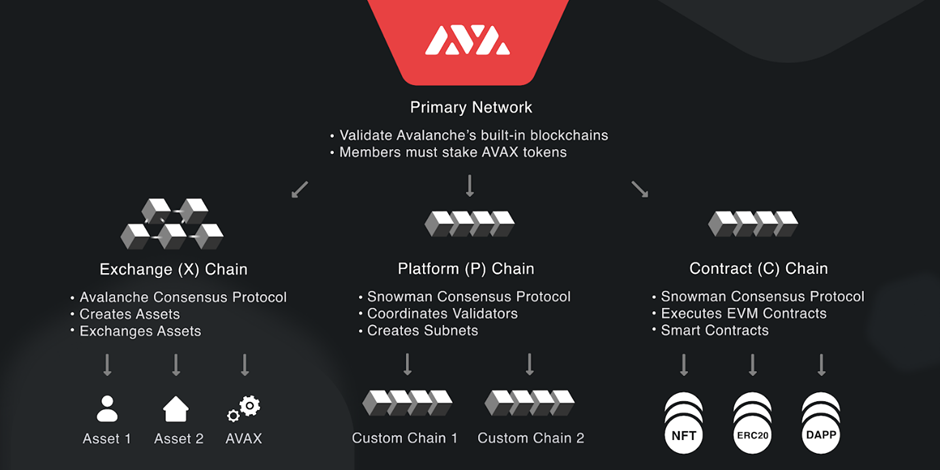
Avalanche uses multi-chain architecture. The network is mainly composed of the X-Chain, C-Chain, and P-Chain, with each chain responsible for different functions.
| Chain |
Main Use |
Function |
| X-Chain |
Creating and transferring digital assets |
Asset management |
| C-Chain |
Executing smart contracts |
EVM compatibility |
| P-Chain |
Coordinating validators and Subnets |
Network management |
X-Chain: Asset Issuance and Transfers
The X-Chain, or Exchange Chain, is mainly responsible for creating and transferring digital assets. Avalanche’s native asset model allows users to create custom tokens and complete asset validation through the Avalanche consensus mechanism.
C-Chain: Smart Contract Execution
The C-Chain, or Contract Chain, is the part of Avalanche most commonly used by developers. Because it is compatible with the Ethereum Virtual Machine, or EVM, developers can migrate Solidity contracts to the Avalanche network at relatively low cost.
P-Chain: Validator and Subnet Coordination
The P-Chain, or Platform Chain, manages Avalanche’s validator system and Subnet structure, while also recording relationships between validators and blockchains.
This multi chain structure allows Avalanche to separate asset processing, smart contracts, and network coordination, reducing competition for resources across different types of activity.
What Is Avalanche Consensus?
One of Avalanche’s core technologies is Avalanche Consensus. This mechanism does not rely on a traditional block production race. Instead, it reaches network consensus through random sampling and voting among nodes.
$$P(A)=\frac{k}{n}$$
In Avalanche consensus, nodes randomly query other validators and gradually form a consistent result based on multiple rounds of feedback. This mechanism reduces network waiting time while improving transaction confirmation efficiency.
The Avalanche network also uses the Snowman protocol. Snowman is the linear version of Avalanche Consensus and is better suited to smart contract chain structures, so it is used by the C-Chain and P-Chain.
Compared with traditional PoW networks that depend on large scale computational competition, Avalanche’s consensus mechanism is more energy efficient and can support higher transaction throughput.
What Is an Avalanche Subnet?
A Subnet is a set of validators in the Avalanche network used to validate one or more blockchains. Different Subnets can have independent rules, independent validators, and customized Gas models.
| Comparison |
Avalanche Subnet |
Traditional Single Chain Public Blockchain |
| Validator set |
Can be configured independently |
Shared across the entire network |
| Network congestion |
Isolated from other Subnets |
Shared across the entire network |
| Gas model |
Customizable |
Usually fixed |
| Chain rules |
Customizable |
Usually unified |
Through Subnets, developers can deploy blockchains designed for specific use cases. For example, a gaming project can build a dedicated chain to prevent high frequency game transactions from affecting other applications.
Avalanche later proposed the Avalanche L1 structure, aiming to further reduce the complexity of creating dedicated chains and improve the efficiency of Subnet deployment.
The Role and Economic Model of AVAX
AVAX is the native token of the Avalanche network, and it plays multiple roles across the ecosystem.
Paying Transaction Fees
Users need to pay AVAX as Gas fees when transferring assets or executing smart contracts on the Avalanche network.
Staking and Network Security
Avalanche uses a PoS, or proof of stake, model. Validators must stake AVAX to participate in network validation. The staking mechanism helps improve network security and uses economic incentives to encourage validators to keep the network running reliably.
Transaction Fee Burn Mechanism
A portion of transaction fees on the Avalanche network is burned, reducing the circulating supply of AVAX. This mechanism is used to control long term supply growth.
Subnet Creation
Creating a Subnet also requires AVAX, linking AVAX directly to the expansion of the Avalanche network.
What Applications Are in the Avalanche Ecosystem?
Avalanche’s ecosystem covers DeFi, GameFi, NFTs, enterprise blockchain, and several other areas.
DeFi
Because Avalanche offers relatively fast transaction confirmation and low Gas costs, it has become an important deployment network for some DeFi protocols. Decentralized exchanges, lending protocols, and liquidity protocols have all developed on Avalanche.
GameFi
Some blockchain gaming projects use Avalanche Subnets to build dedicated gaming chains, reducing the pressure that high frequency game transactions can place on public networks.
Enterprise and Institutional Applications
Avalanche’s Subnet structure is also used in enterprise blockchain and RWA, or real world asset, exploration. Institutions can use customized chain structures to meet compliance or permission management needs.
NFTs and Digital Assets
Avalanche also supports NFT creation and digital asset issuance, while remaining compatible with the EVM tooling ecosystem.
How Is Avalanche Different from Ethereum?
Avalanche and Ethereum are both smart contract platforms, but they differ significantly in architecture and scaling approach.
| Comparison |
Avalanche |
Ethereum |
| Network structure |
Multi chain architecture |
Single chain mainnet |
| Scaling approach |
Subnets |
Layer 2 Rollups |
| Consensus mechanism |
Avalanche Consensus |
PoS |
| EVM support |
Supported |
Native support |
Ethereum relies more on Layer 2 networks to scale performance, while Avalanche tends to use Subnets for application isolation and chain level scaling.
In addition, Avalanche’s transaction confirmation time is usually shorter, while Ethereum still has strong influence in developer ecosystem and on chain asset scale.
Avalanche’s Advantages and Limitations
Avalanche’s main advantages include high throughput, fast transaction confirmation, and strong customization. Its EVM compatible structure lowers migration costs for developers, while the Subnet mechanism supports application specific chains.
However, Avalanche also faces challenges such as ecosystem competition and validator entry barriers. As Layer 2 networks and modular blockchains continue to develop, competition among public blockchains remains ongoing.
In addition, although the independent operating model of Subnets improves isolation, it may also lead to fragmented liquidity and greater complexity in cross chain coordination.
Conclusion
Avalanche (AVAX) provides a blockchain network design that balances performance, scalability, and customization through its multi chain architecture, Avalanche consensus mechanism, and Subnet model. Its X-Chain, C-Chain, and P-Chain each have clearly defined roles, while Subnets support the deployment of application specific chains.
AVAX not only supports transaction fee payments and staking, but also forms an important foundation for Avalanche’s network security and expansion.
FAQs
What Is an Avalanche Subnet?
A Subnet is a set of validators in Avalanche responsible for validating specific blockchains. It can support custom rules and an independent operating environment.
What Is AVAX Used For?
AVAX is used to pay transaction fees, stake validators, create Subnets, and maintain network security.
Why Does Avalanche Use a Multi Chain Architecture?
Avalanche separates asset management, smart contracts, and network coordination across different chains to reduce resource competition and improve efficiency.
What Is the Main Difference Between Avalanche and Ethereum?
Avalanche uses a multi chain architecture and Subnet based scaling, while Ethereum relies more on Layer 2 Rollups for scaling.
Is Avalanche Compatible with Ethereum Applications?
Yes. Avalanche’s C-Chain supports the EVM, so Solidity smart contracts can be migrated to and run on the Avalanche network.







