One of the central challenges in blockchain development has always been "how to make crypto assets truly usable for payments." Early networks achieved major advances in security and decentralization, but continued to face constraints in performance and user experience—such as long confirmation times or volatile trading fees. In this context, eCash has made "availability" its core priority, aiming to build on-chain infrastructure that closely mirrors real-world payment systems.
From a Web3 infrastructure standpoint, eCash is more than just a value transfer tool—it is a payment network designed for high-frequency trading and mass adoption. By introducing a hybrid consensus mechanism and scalable architecture, its vision is to evolve from a "blockchain asset" into a "global digital cash system."
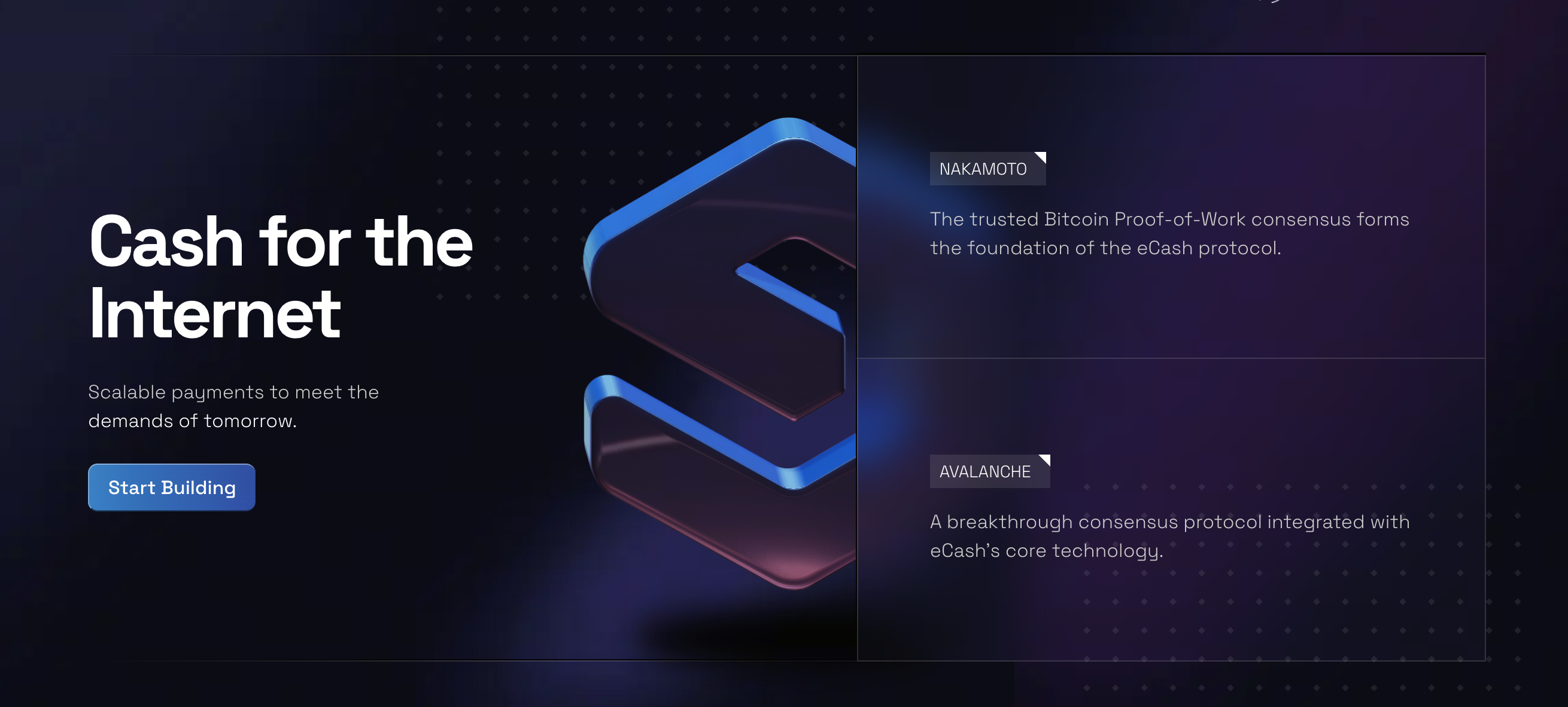
Source: e.cash
What Is eCash (XEC)
eCash is engineered for rapid confirmation, low transaction costs, and high-throughput payments. The network is secured by Proof of Work (PoW) as its foundational mechanism, and further leverages Avalanche Consensus to optimize transaction confirmation speed—striking a new balance between security and performance.
Unlike many cryptocurrencies focused on being a "store of value," eCash is explicitly built for "spendability." Its goal is to enable on-chain transactions to settle as quickly as real-world electronic payments, with a predictable fee structure that lowers barriers to adoption.
Technically, eCash maintains the UTXO model, supporting parallel transaction processing and boosting throughput through protocol-level optimizations. This makes it ideal for high-frequency, small-value payment scenarios.
In summary, eCash functions as "payment infrastructure" rather than just a digital asset, positioning itself as a distinctly "transaction-oriented network" within the blockchain ecosystem.
The Origin and Evolution of eCash: From Bitcoin Cash ABC to XEC
eCash's development traces back to the series of forks sparked by the Bitcoin scaling debate. Within the Bitcoin ecosystem, disagreements over block size and scaling approaches intensified, prompting different communities to pursue divergent technical paths.
In 2017, Bitcoin Cash addressed scaling by increasing block capacity, emphasizing on-chain expansion to support higher transaction volumes. This set the stage for the next generation of "payment-focused blockchains."
In 2020, the Bitcoin Cash community split again, with the Bitcoin Cash ABC branch evolving into eCash, accompanied by a rebranding and new technical direction.
This evolution represents more than a chain fork—it marks a shift from "scaling debates" to the "real-world implementation of payments." eCash has moved beyond technical arguments, aiming to build a practical, global payment network.
The Core Mission of eCash: Building a Scalable Electronic Cash System
eCash's central mission is to become a globally usable electronic cash system, with its architecture focused on performance, user experience, and sustainable upgrades.
First, it seeks to increase transaction throughput. Through scaling and optimization, the network aims to handle high transaction volumes to meet the demands of real-world, high-frequency payments.
Second, it prioritizes payment experience. eCash emphasizes "instantaneity," using rapid confirmation mechanisms to minimize wait times and make the user experience comparable to traditional electronic payments—crucial for daily usage.
Third, it pursues a structured upgrade path. Instead of frequent forks, eCash favors systematic upgrades for long-term evolution, reducing system uncertainty and providing stability for both developers and users.
Together, these pillars shape eCash's "digital cash vision": balancing performance, experience, and stability.
eCash Consensus Mechanism: Avalanche + PoW Hybrid Model
At the consensus layer, eCash utilizes a hybrid model that combines PoW and Avalanche, delivering both security and efficiency.
PoW secures the network and handles block production, much like the traditional Bitcoin network, using hash power competition to deter attacks. Avalanche Consensus, meanwhile, accelerates transaction confirmation through rapid, multi-round node voting—boosting both speed and finality.
This structure allows transactions to achieve high-confidence confirmation before being formally added to a block, sharply reducing user wait times. For payment use cases, this "confirmation speed" is far more relevant than block production time.
Architecturally, this hybrid model adds a "fast confirmation layer" atop the PoW security base, enabling both robust security and near real-time transaction experiences.
eCash's scaling strategy centers on "on-chain scaling"—directly increasing mainchain capacity to support more transactions, rather than relying on complex off-chain solutions. This approach ensures scalability at the protocol layer, maintaining a unified system structure.
Specifically, eCash optimizes block size and transaction formats to handle greater transaction volumes. Thanks to the UTXO model's parallel processing, multiple transactions can be validated simultaneously, increasing overall throughput.
At the network level, eCash also improves data propagation and node communication efficiency, reducing delays in transaction broadcasting and confirmation. This is vital for delivering the "transaction speed" users expect.
Overall, this architecture is designed to deliver ongoing performance improvements without compromising protocol consistency, allowing the network to scale with growing payment demand.
XEC Token Utility: Payments, Incentives, and Network Operations
XEC is the native token of the eCash network, serving as the core medium connecting user needs and network resources across the entire system.
For users, XEC is used to pay transaction fees—each transfer or data write consumes tokens to access network resources, driving fundamental demand.
For miners, block rewards and trading fees provide returns, ensuring continuous hash power participation and network security.
At a macro level, XEC acts as a "medium of value transfer": payment demand → trading fees → miner incentives → network security, forming a self-sustaining economic loop.
eCash Use Cases: Payments, Micropayments, and On-Chain Applications
eCash's design makes it highly adaptable for payment scenarios, especially where rapid confirmation and low transaction costs are essential.
At the payment layer, its low fees and fast confirmations are ideal for daily transfers and cross-border payments, reducing the time and cost friction of legacy payment systems.
For micropayments, eCash supports content monetization, in-game transactions, and other high-frequency, small-value use cases where fees and confirmation speed are critical.
Within the Web3 ecosystem, eCash can also serve as a foundational payment tool, integrating with other protocols and applications to enable more complex on-chain economic activity—such as subscriptions, data payments, or automated settlements.
How eCash Differs from Bitcoin and Bitcoin Cash
Comparing Bitcoin, Bitcoin Cash, and eCash, two key dimensions stand out: "scaling strategy" and "consensus mechanism."
Bitcoin prioritizes security and decentralization, enforcing strict block size limits; Bitcoin Cash and eCash expand block sizes to boost on-chain capacity.
In terms of consensus, eCash introduces Avalanche Consensus, allowing transactions to achieve high-confidence confirmation before block inclusion—a clear departure from traditional PoW networks.
Overall, eCash is designed for "payment efficiency first," while Bitcoin emphasizes "security and stability first."
Advantages, Limitations, and Common Misconceptions About eCash
eCash's strengths are its performance and user experience. Its fast confirmation and on-chain scaling meet high-frequency payment demands.
The hybrid consensus structure accelerates transaction confirmation, significantly enhancing usability—especially in payment scenarios.
However, this approach brings challenges. Scaling may increase node operating costs, raising questions about decentralization; the consensus model's complexity also raises the learning curve.
A common misconception is that eCash is simply a "Bitcoin fork continuation," when in reality, its goals (digital cash) and technical approach (Avalanche + scaling) set it on an independent path.
Summary
eCash integrates the digital cash concept, hybrid consensus, and on-chain scaling to create a payment-centric blockchain model. Its key innovation is leveraging Avalanche for rapid confirmation and scaling to boost network throughput—delivering an optimized payment experience.
While debates remain over scaling and network structure, eCash's pursuit of "high-performance on-chain payments" offers a distinct alternative to traditional blockchain development.
FAQ
What is eCash (XEC)?
eCash is a blockchain network designed as digital cash, prioritizing fast confirmation and low-cost payments.
What consensus mechanism does eCash use?
It employs a hybrid consensus model combining PoW and Avalanche.
How is eCash different from Bitcoin?
The main differences are in scaling strategy and transaction confirmation—eCash is more focused on payment efficiency.
What are the primary uses of XEC?
To pay transaction fees, incentivize miners, and support network operations.
Is eCash suitable for payment scenarios?
Supporting high-frequency, low-cost global payments is one of its core design goals.