As the blockchain industry expands from simple transfers to complex applications like DeFi, blockchain gaming, SocialFi, and on-chain trading, public blockchain performance is coming under increasing scrutiny. More applications now require faster confirmation speeds, higher throughput, and a more consistent user experience, yet traditional blockchains often face network congestion and transaction delays under high-concurrency conditions.
EVM, as one of the most widely adopted environments for Smart Contracts, faces similar hurdles. Traditional EVMs have long relied on sequential execution, which becomes a bottleneck as transaction volume rises. In response, Parallelized EVM has emerged as a key innovation for high-performance public blockchains, with Sei standing out as a leading project in this field.
What Is Parallelized EVM
Parallelized EVM is an EVM architecture that enables multiple transactions to be executed at the same time. Unlike traditional EVMs, which process transactions one after another, parallelized execution identifies transactions without state conflicts and runs them concurrently.
The main goal is to boost blockchain throughput in high-concurrency scenarios. For instance, when two transactions affect separate accounts, Smart Contracts, or state data, they can be processed simultaneously rather than waiting for one another. Parallelized EVM leverages this to execute multiple tasks in parallel.
Parallelization does not eliminate the need for sequential logic. If several transactions attempt to modify the same state data, the system must still perform conflict detection and reorder execution to prevent inconsistencies. In essence, parallel execution introduces a more sophisticated scheduling mechanism.
Traditional EVMs execute transactions sequentially, following the order in which they enter the block. After each transaction, the on-chain state is updated.
While this approach ensures network consistency, it also means that even independent transactions cannot be processed concurrently. As transaction volume surges, the network faces growing queues, resulting in congestion and higher Gas fees.
This issue is especially prominent in DeFi and high-frequency on-chain trading. When many users simultaneously Swap, trade, or mint NFTs, the sequential model can struggle to deliver a stable experience.
How Does Parallelized EVM Enable Parallel Execution
The foundation of Parallelized EVM is state conflict detection.
The system analyzes which state data each transaction may access and determines which transactions do not overlap. Transactions that do not touch the same state can be assigned to separate execution threads and processed in parallel.
Some Parallelized EVMs utilize an Optimistic Execution model, presuming transactions are non-conflicting and verifying state consistency after execution. If conflicts are found, affected transactions are reordered or re-executed.
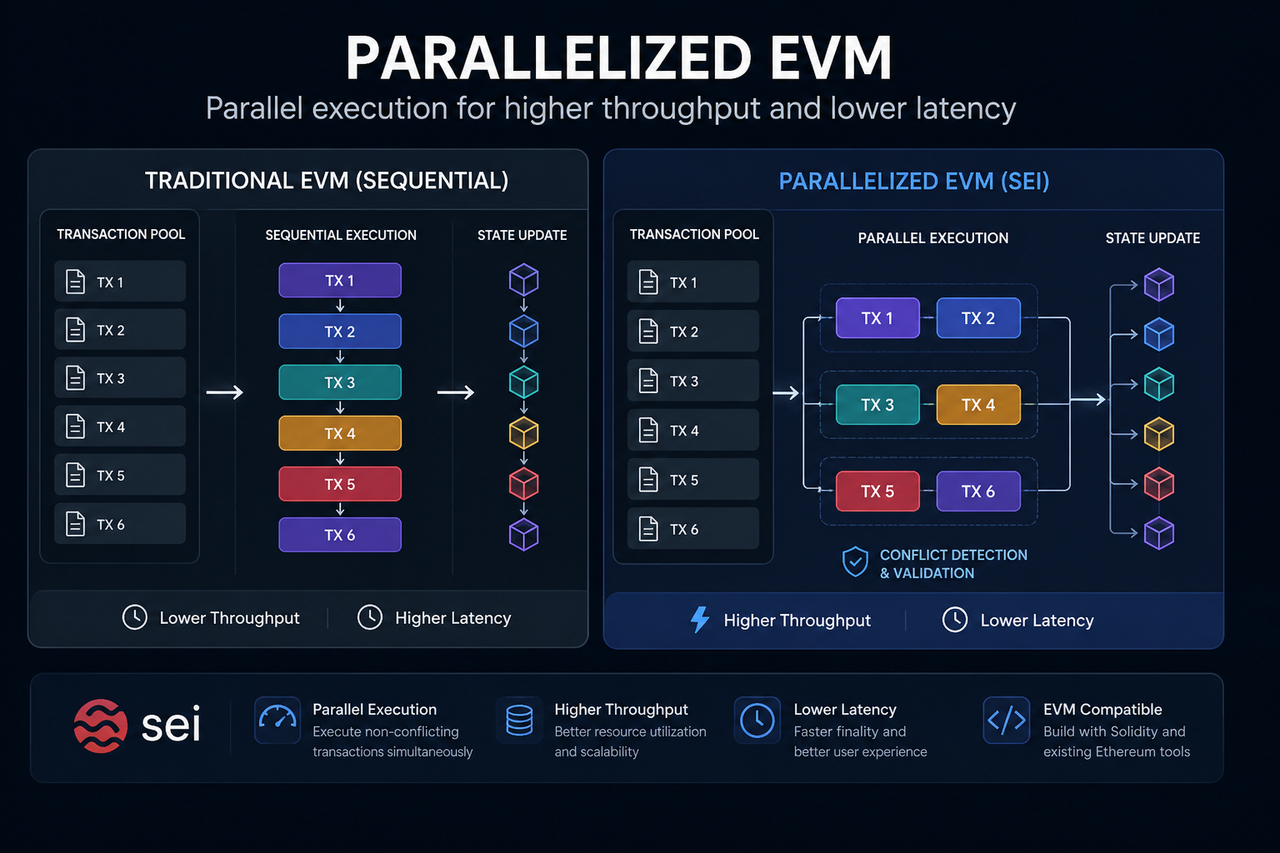
This architecture makes full use of modern CPUs’ multi-core capabilities, significantly improving transaction processing efficiency.
However, parallelization increases system complexity. Nodes must handle state synchronization, conflict rollbacks, and advanced scheduling, requiring a more robust underlying architecture.
Why Does Sei Emphasize Parallelized EVM
Sei is positioned as a high-performance EVM public blockchain.
Compared to traditional EVM networks, Sei prioritizes real-time on-chain interactions, including high-frequency trading, on-chain Order Books, Perpetual Futures, and real-time blockchain games. These use cases demand lower latency and higher throughput, making sequential execution a limiting factor.
Sei’s Parallelized EVM allows independent transactions to run in parallel, increasing overall execution efficiency. Additionally, features like Twin-Turbo Consensus, SeiDB, and low-latency Finality further enhance network responsiveness.
For Developers, Sei’s compatibility with the Ethereum toolchain is a major advantage. Developers can continue to Use Solidity, MetaMask, and existing EVM infrastructure without adapting to a completely new environment.
What Are the Advantages of Parallelized EVM
Parallelized EVM’s key advantage is its ability to improve transaction processing efficiency in high-concurrency environments.
By executing many transactions at once, overall network throughput increases and transaction wait times decrease—crucial for on-chain trading, real-time finance, and complex interactive applications.
Parallel execution also maximizes the use of modern server hardware. While traditional sequential models underutilize multi-core CPUs, Parallelized EVM aligns with today’s computing architectures.
From a user perspective, parallel execution helps reduce network congestion and Gas volatility, resulting in a more stable on-chain experience.
What Challenges Does Parallelized EVM Face
While parallel execution offers clear performance gains, it introduces greater technical complexity.
State conflict detection adds to system overhead, requiring nodes to assess transaction conflicts in Real Time and manage scheduling and state synchronization.
Parallel execution can also increase development complexity. Some applications must be designed to handle concurrent state access, or risk inconsistent results and resource contention.
Achieving stable, parallel execution while maintaining EVM compatibility demands significant architectural optimization. Striking the right balance between performance, compatibility, and decentralization remains an ongoing challenge for Parallelized EVM.
How Will Parallelized EVM Shape the Future of Public Blockchains
As blockchain applications become more sophisticated, performance is emerging as a key differentiator.
Future on-chain applications will extend beyond asset transfers to include real-time gaming, AI Agent, on-chain social, and complex financial systems. These scenarios require lower latency and higher throughput, which sequential execution models may not deliver.
Parallelized EVM marks a shift in the EVM ecosystem—from “compatibility first” to a focus on both performance and scalability.
Summary
Parallelized EVM is an EVM architecture that enables transactions to be executed in parallel, overcoming the performance limitations of traditional sequential models.
With rising demand for DeFi, blockchain gaming, and high-frequency on-chain interactions, parallel execution is becoming essential for high-performance public blockchains. Parallelized EVM better leverages modern hardware and boosts network throughput and real-time capabilities compared to traditional EVMs.
Sei is a prominent project in the Parallelized EVM space, aiming to optimize on-chain performance through parallel execution and low-latency architecture, all while maintaining compatibility with Ethereum development tools.
FAQs
What differentiates Parallelized EVM from traditional EVM?
Traditional EVMs execute transactions sequentially, while Parallelized EVMs allow independent transactions to run in parallel.
Why is Parallelized EVM ideal for high-frequency applications?
High-frequency trading and Real Time interactions require higher throughput and lower latency. Parallel execution reduces transaction wait times.
Why does Sei focus on Parallelized EVM?
Sei targets high-performance on-chain interactions, aiming to boost execution efficiency while remaining compatible with Ethereum tools.
Does Parallelized EVM eliminate sequential execution entirely?
No. When transactions have state conflicts, the system still processes them sequentially or re-executes as needed.
What are the main challenges for Parallelized EVM?
Key challenges include state conflict detection, complex execution scheduling, and balancing compatibility with stability.







