The entire Ronin ecosystem is centered on Web3 gaming. Its design focuses on lowering the barrier to entry for blockchain games while improving the efficiency of on-chain asset transactions. In addition to supporting flagship blockchain games such as Axie Infinity , Ronin has gradually developed an infrastructure stack that includes wallets, NFTs, payments, and token systems.
What Is Ronin Network
Unlike traditional general-purpose public blockchains, Ronin is positioned more as gaming infrastructure. The network was first launched by Sky Mavis to support Axie Infinity’s on-chain transactions and asset management needs. Its core goal was to address the high fees and slow transaction confirmations that users faced on Ethereum in its earlier stages.
Structurally, Ronin is an Ethereum-compatible sidechain network. Users can manage assets through Ronin Wallet and complete NFT trades, token transfers, and on-chain interactions within games. Because many operations are moved onto the Ronin network itself, user costs are significantly reduced.
This mechanism allows blockchain games to preserve on-chain asset ownership while offering an experience closer to that of traditional games. According to official materials, Ronin has long been designed around gaming use cases, which makes its ecosystem structure clearly different from general-purpose Layer1 blockchains.
How Ronin Operates as a Gaming-Focused Sidechain
The Ronin network is mainly built around the movement of blockchain gaming assets. Compared with ordinary blockchains, its design does not focus on supporting a wide range of general DeFi protocols. Instead, it pays closer attention to high-frequency in-game transactions, NFT transfers, and user account interactions.
Ronin processes transactions through independent validator nodes and moves many gaming-related activities onto the sidechain. The main purpose is to reduce pressure on the main chain while lowering users’ Gas costs. For blockchain game players, frequent item purchases, NFT upgrades, and reward claims all require a lighter and more efficient transaction environment.
Ronin can be understood as an application chain built around a gaming economy. Its ecosystem revolves around core modules such as:
-
Game assets
-
NFT transactions
-
On-chain payments
-
Player accounts
This structure gives Ronin a strong focus in the blockchain gaming sector, but it also means its ecosystem is usually less broad than that of comprehensive public blockchains. Some complex financial applications and multichain protocols are still more commonly deployed on general-purpose networks such as Ethereum.
How Ronin’s Consensus Mechanism and Validator Nodes Work
Ronin operates through validator nodes that jointly maintain the state of the network. Its core mechanism relies on a limited number of nodes to confirm transactions, which helps improve overall processing efficiency.
Unlike fully open public blockchains, Ronin adopted a relatively limited validator structure in its early stages. This design focused on improving the responsiveness of the gaming network and reducing the system load caused by high-frequency transactions. In gaming scenarios, transaction confirmation time often has a direct impact on user experience, so Ronin places more emphasis on stability and execution efficiency.
From a technical perspective, validator nodes are responsible for:
-
Block production
-
Transaction confirmation
-
Network synchronization
-
Data validation
The entire system is built around coordination among nodes, while the RON token plays an important role in staking and network incentives.
However, this structure also means that Ronin differs from traditional public blockchains in its degree of decentralization. Ronin previously drew market attention because of a cross-chain bridge security incident. Since then, the official team has gradually expanded the number of validator nodes and strengthened network security mechanisms. Related security systems and bridge mechanisms have also become important parts of the Ronin ecosystem.
How Ronin Wallet Lowers the Barrier to Blockchain Gaming
Blockchain game users often need to manage NFTs, game tokens, and account assets frequently, so the wallet system plays an important role in the entire ecosystem. Ronin Wallet is designed to make it easier for ordinary users to enter the Web3 gaming environment.
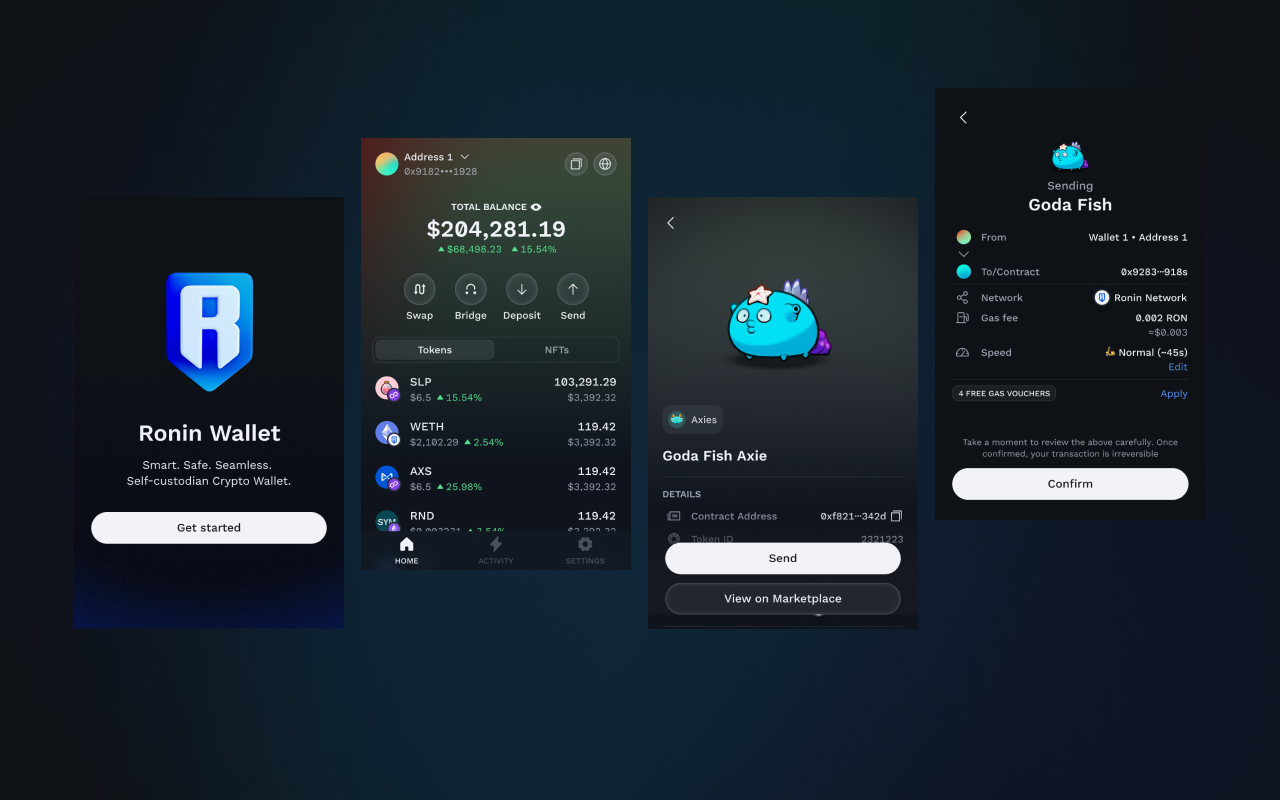
Compared with traditional crypto wallets, Ronin Wallet is more oriented toward gaming interactions. Users can connect their wallet directly to game accounts and manage NFTs, trade assets, and make on-chain payments. The overall process feels closer to an account system on a traditional gaming platform than to a complex on-chain tool.
This means that even users with little blockchain experience can create accounts and manage assets relatively quickly. Official documentation notes that Ronin Wallet also integrates certain payment gateway functions to make funding accounts easier for users.
Structurally, Ronin Wallet is not only an asset management tool but also a key entry point into the Ronin ecosystem. Game logins, NFT marketplace transactions, and some on-chain applications are usually built around the wallet system.
What Role Does the RON Token Play in the Ronin Ecosystem
The operating costs of the Ronin network are mainly centered on RON. As the core token of the ecosystem, RON is mainly used to pay transaction fees, participate in network staking, and maintain the incentive mechanism for validator nodes.
Like most public blockchain tokens, RON serves a basic Gas function within the network. When users transfer NFTs, make game-related transactions, or interact on-chain, they need to use RON to pay the relevant fees. Because Ronin emphasizes a low-cost experience, its fee structure is usually lower than that of the Ethereum mainnet.
Beyond its Gas function, RON is also connected to the validator node system. Some node operations and network security mechanisms rely on token staking to distribute incentives. The overall system creates a linked relationship between token economics and network operations.
The table below shows the main roles of RON in the Ronin ecosystem:
| Functional Module |
Role of RON |
| Network fees |
Pays on-chain transaction costs |
| Node incentives |
Supports validator operations |
| Staking mechanism |
Participates in network security maintenance |
| Ecosystem circulation |
Supports parts of the blockchain gaming economy |
| Governance function |
Participates in certain governance mechanisms |
This structure means that RON is not only a medium of exchange but also an important foundational component of the Ronin network. However, a more complete economic model and governance mechanism are usually discussed in more detail in separate dedicated topics.
How Ronin Supports Axie Infinity and the Expansion of the Blockchain Gaming Ecosystem
One of Ronin’s original key purposes was to support Axie Infinity’s on-chain needs. As the number of Axie Infinity users grew, the high fees on the Ethereum mainnet gradually began to affect the gaming experience, so Sky Mavis started building an independent sidechain system.
Structurally, Ronin’s relationship with Axie Infinity is closer to that of a game and its dedicated infrastructure. NFTs, character assets, and token systems within the game can all circulate inside the Ronin network. This helps reduce transaction waiting times and lowers users’ operating costs.
This mechanism also helped Ronin gradually evolve from a single-game blockchain network into a broader gaming ecosystem. Some third-party projects have begun exploring integrations with Ronin and building applications around NFTs, game assets, and on-chain transactions.
However, Ronin’s overall ecosystem is still centered on gaming. Compared with comprehensive public blockchains, its application structure is more concentrated, so its ecosystem expansion is also more focused on Web3 games.
How Ronin Differs From Ethereum, Polygon, and Immutable
Different blockchain networks vary significantly in their positioning and architecture. Ronin places greater emphasis on the blockchain gaming experience, while Ethereum, Polygon, and Immutable each represent different expansion paths and ecosystem structures.
The table below shows some of the differences among these networks:
| Network |
Core Positioning |
Main Use Cases |
Fee Characteristics |
Ecosystem Direction |
| Ronin |
Gaming-focused sidechain |
Blockchain games and NFTs |
Relatively low |
Gaming ecosystem |
| Ethereum |
General-purpose public blockchain |
DeFi and infrastructure |
Relatively high |
Comprehensive ecosystem |
| Polygon |
Scaling network |
Multiple application scenarios |
Low |
Multichain expansion |
| Immutable |
Gaming infrastructure |
NFTs and blockchain games |
Low |
Gaming and NFTs |
Looking at the overall structure, Ronin’s defining feature is its strong focus on gaming use cases. By contrast, Ethereum is more general-purpose, while Polygon and Immutable focus respectively on scalability and gaming asset infrastructure.
These differences mean that each network is suited to different application directions. For projects that emphasize high-frequency NFT and game-related transactions, Ronin’s structure is usually more targeted.
What Are Ronin’s Advantages, Limitations, and Security Risks
Ronin’s main advantages come from its optimization for gaming use cases. Low fees, relatively fast transaction confirmations, and a wallet system designed around blockchain games allow it to provide an experience closer to that of traditional gaming platforms.
From an ecosystem perspective, Ronin’s specialization also enables it to support NFT and game asset circulation in a more focused way. For blockchain game developers, this structure can reduce a significant amount of infrastructure integration work.
However, a dedicated-chain structure also means that the ecosystem scope is relatively limited. Compared with comprehensive public blockchains, Ronin has weaker expansion capacity in areas such as DeFi, multichain protocols, and complex financial applications.
In addition, Ronin has experienced a cross-chain bridge security incident, which brought renewed market attention to the validator mechanisms and bridge security of sidechain networks. Since then, the official team has gradually adjusted the validator node structure and strengthened its security systems. The security design of cross-chain bridges and validator mechanisms has also become an important research direction for gaming blockchains.
Conclusion
Ronin Network is a dedicated blockchain network built around Web3 gaming. Its core goal is to reduce blockchain game transaction costs and improve the efficiency of user interactions. The entire ecosystem is built around game assets, NFTs, wallet systems, and the RON token, creating clear differences from traditional general-purpose public blockchains.
Compared with comprehensive blockchains, Ronin places greater emphasis on gaming experience and high-frequency asset circulation. As blockchain gaming infrastructure continues to evolve, Ronin has gradually formed its own independent ecosystem structure and now holds an important position in the Web3 gaming sector.
FAQs
Is Ronin Network a Layer2
Ronin is generally regarded as an Ethereum-compatible sidechain network, and its operating model differs in some ways from traditional Layer2 networks.
What Is Ronin Wallet Mainly Used For
Ronin Wallet is mainly used to manage NFTs, game assets, and on-chain tokens on the Ronin network. It is also an important entry point for connecting to the blockchain gaming ecosystem.
What Is the RON Token Used For
RON is mainly used to pay network fees, participate in staking, and support the validator node incentive mechanism.
What Is the Difference Between Ronin and Polygon
Ronin is more focused on blockchain gaming, while Polygon is more of a multi-application scaling network. The two differ in ecosystem direction and structural positioning.
Why Is Ronin Closely Connected to Axie Infinity
Ronin was originally launched by Sky Mavis, mainly to support Axie Infinity’s on-chain asset transactions and game operations.