As the DeFi marketplace evolves, decentralized trading protocols have shifted from serving as basic trading tools to becoming foundational on-chain financial infrastructure. In the early days, DEXs primarily addressed on-chain asset swaps, but as demand grew for liquidity management, yield strategies, and on-chain derivatives, the market began to require protocols with greater programmability and scalability. Against this backdrop, Uniswap has continued to advance protocol upgrades, introducing Uniswap v4—a version that emphasizes modularity and developer extensibility.
As one of DeFi’s most influential DEX protocols, Uniswap’s design has long shaped the trajectory of on-chain liquidity markets. While v3 centered on concentrated liquidity, Uniswap v4 takes a significant step forward, boosting protocol flexibility and Gas efficiency through innovations like Hooks, custom pools, and Singleton architecture. These changes not only enhance the trading experience but also move Uniswap closer to an open liquidity operating system, providing a robust foundation for developers to build sophisticated DeFi applications.
What Is Uniswap v4?
Uniswap v4 is the next-generation upgrade of the Uniswap protocol, with a focus on scalability and developer customization. Unlike earlier versions, v4 isn’t just an AMM trading protocol—it’s evolving into open infrastructure that supports a wide range of liquidity mechanisms.
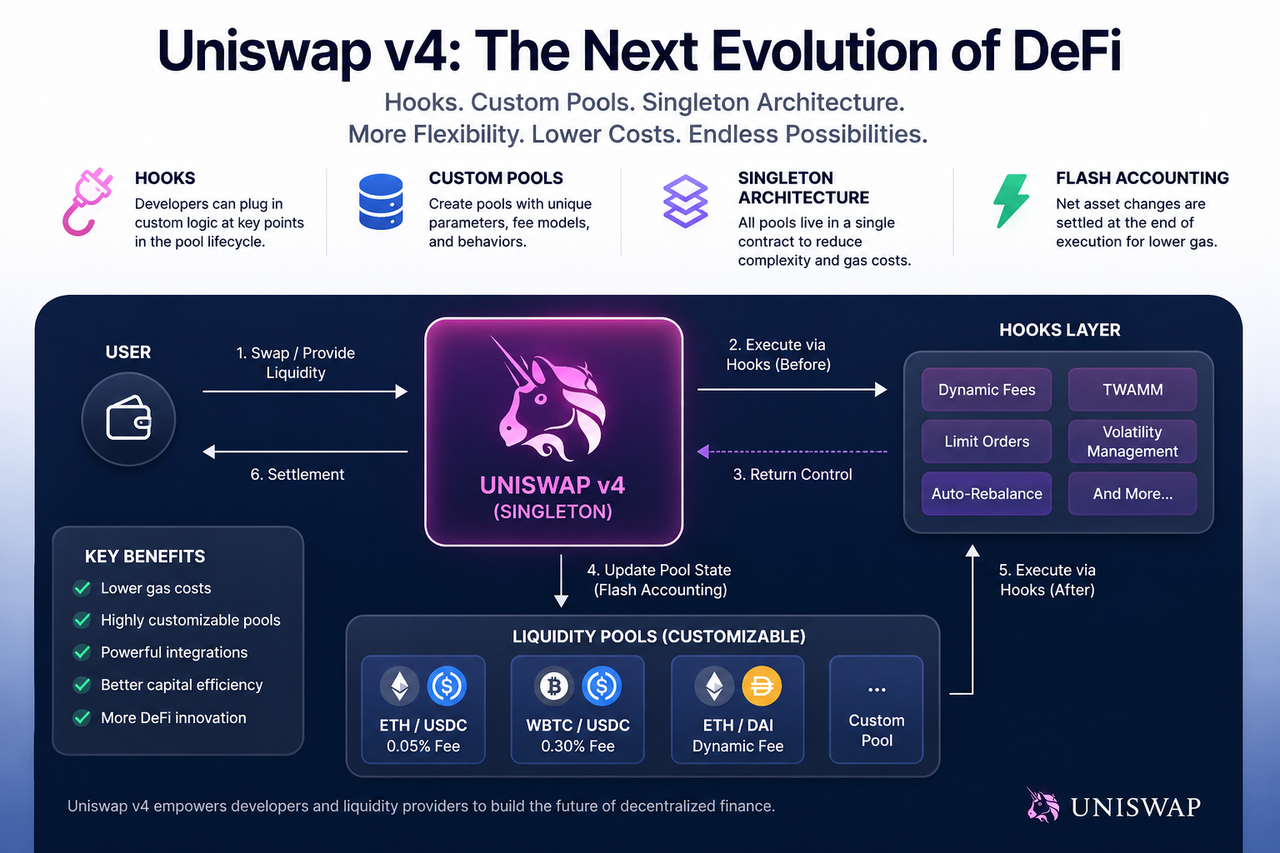
v4 preserves the core AMM and liquidity pool architecture, while enabling developers to insert custom logic into liquidity pool operations via Hooks. This allows each liquidity pool to be tailored with flexible features, moving beyond reliance on default protocol rules.
What Are Hooks?
Hooks are among the most significant upgrades in Uniswap v4. Essentially, Hooks are pluggable Smart Contract modules that let developers execute custom logic at various points in the trading or liquidity process.
For example, Hooks can be used to:
- Dynamically adjust trading fees
- Auto-reinvest LP returns
- Create on-chain limit orders
- Manage volatility
- Implement TWAMM (Time-Weighted Automated Market Making)
- Automatically rebalance liquidity
Hooks transform Uniswap from a standardized DEX into a developer framework capable of supporting diverse financial logic.
How Does Singleton Architecture Work?
In previous versions, each liquidity pool typically corresponded to a separate contract. Uniswap v4 introduces the Singleton architecture, consolidating all liquidity pools into a single core contract.
Key advantages of this design include:
- Lower Gas costs for cross-pool trading
- Greater efficiency for interactions between pools
- Reduced redundant contract deployments
- Enhanced overall protocol scalability
For trade aggregation and complex DeFi strategies, Singleton architecture minimizes on-chain state transitions, optimizing overall trading efficiency.
How Does Flash Accounting Reduce Gas Costs?
Flash Accounting is a major Gas optimization feature in Uniswap v4. Its core principle is to settle asset changes collectively at the end of a transaction, rather than transferring assets at every step.
This reduces the number of on-chain state updates, cutting trading costs. For complex trade paths spanning multiple pools, the Gas savings are even more significant.
As DeFi protocol interactions become more frequent, Flash Accounting helps maximize on-chain capital efficiency.
How Does Uniswap v4 Differ from v3?
Unlike v3, which focused on concentrated liquidity, v4 emphasizes programmability at the protocol level.
v3’s breakthrough was allowing LPs to allocate capital within specific price ranges to boost capital efficiency. v4 takes this further, empowering developers to customize liquidity pool logic so each pool can deliver unique features tailored to different scenarios.
Additionally, v4 leverages Singleton architecture and Flash Accounting to optimize Gas costs and improve execution efficiency for complex trading paths.
In summary, v3 is oriented towards optimizing liquidity efficiency, while v4 is designed for open, modular protocol architecture.
What Impact Does Uniswap v4 Have on DeFi?
Uniswap v4’s upgrade could reshape how DeFi protocols are developed. Previously, many projects had to build their own DEX or liquidity systems from scratch. With Hooks, developers can now build custom financial logic directly on top of Uniswap.
This approach lowers the barrier to DeFi development and may accelerate the emergence of new on-chain financial products, such as automated market making, structured yield strategies, and dynamic risk management systems.
Meanwhile, v4’s modular design further solidifies Uniswap’s position as core on-chain liquidity infrastructure.
Summary
Uniswap v4 is more than a DEX protocol upgrade—it signals a shift in DeFi infrastructure toward modularity and programmability. With features like Hooks, customizable liquidity pools, Singleton architecture, and Flash Accounting, Uniswap is evolving from a simple trading protocol to an open, on-chain liquidity platform.
As DeFi applications become more complex, the flexibility and extensibility of Uniswap v4 are poised to drive further innovation in on-chain financial products and set the direction for the next generation of decentralized trading protocols.
FAQs
What is the biggest difference between Uniswap v4 and v3?
v3 mainly optimizes concentrated liquidity, while v4 focuses on Hooks, custom logic, and protocol programmability.
What can Hooks be used for?
Hooks support dynamic trading fees, auto-reinvest, on-chain limit orders, volatility management, and automated market making.
What is the function of Singleton Architecture?
Singleton architecture unifies multiple liquidity pools into a single contract, reducing Gas costs and improving interaction efficiency.
Will Uniswap v4 reduce trading fees?
v4 uses Flash Accounting and Singleton architecture to optimize on-chain state updates, which helps lower certain trading costs.
Does Uniswap v4 still use AMM?
Yes. v4 still operates on the AMM model, but with enhanced extensibility and customization.
Why is Uniswap v4 important for DeFi?
v4 increases protocol flexibility and developer extensibility, positioning Uniswap as a leading open liquidity infrastructure.