


Ethereum is no longer a dark forest: How real-time blocks reshape execution fairness.
Author: Kevin Lepsoe Source: X, @lepsoe Translation: Shan Ouba, Golden Finance
When you finish reading this paragraph, an average Ethereum user may have completed a payment, a token exchange, an NFT purchase, a transaction, or registered a decentralized domain name… The key words are “or” and “may.”
At the same time, users who use Ethereum real-time nodes can complete all of the following operations:
- A payment,
- Token Swap,
- Purchase of an NFT,
- A transaction,
- A decentralized domain name registration,
- and more than 200 other operations…
All operations are completed in order, the results are completely determined, and are implemented directly on the Ethereum mainnet without relying on L2.
How is all of this possible?
12 seconds, a dark age in the financial sector
A few years ago, Ethereum was likened to a dark forest. Looking back now, I can still understand why this analogy resonated with so many developers and users. In Ethereum's memory pool, every transaction is a signal, every signal is closely monitored, and every action requires the assumption that there is an opponent on the other side.
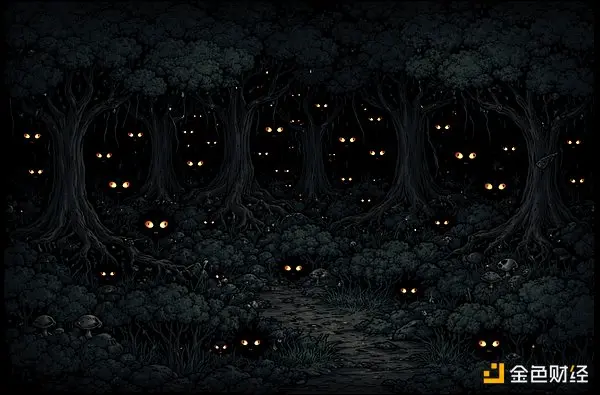
This is precisely the inherent flaw of this execution model, where the state exists only in the form of discrete snapshots taken every 12 seconds. During this 12-second interval, everything is opaque and highly susceptible to exploitation — and the prevalence of the maximum extractable value thus becomes an inevitable result of market equilibrium, which seemed reasonable at the time.
What users feel is that they have publicly disclosed their trading intentions but cannot guarantee the trading results. If this is just a game operation or a post on a social platform, it is not a big deal; however, if it involves highly time-sensitive bidding or urgent operations on the brink of liquidation, and they are outpaced by robots in the trade, the situation is entirely different. In these scenarios, a 12-second dark wait is indeed too long.
Although we are already accustomed to this state, we must never be complacent—especially in the current environment where industry risks are continuously rising and traditional finance is accelerating onto the blockchain.
Illuminate the Dark Forest
Ethereum is the most decentralized and economically significant settlement layer globally, but the allocation of block space has not kept pace with the development speed of upper-layer applications. When users, developers, and the market have adapted to real-time operations, blocks no longer need to be limited to discrete events occurring every 12 seconds.
This is exactly the core insight derived by the ETHGas team: we can split Ethereum blocks just like Rutherford split atoms - without changing any underlying mechanisms of Ethereum, nor affecting its security assurances.
There is no need to wait for the final confirmation of blocks; we can split each block into 120-240 sub-blocks and treat them as a continuously generated update stream, with intervals of 50-100 milliseconds, for trading in the block space market. The pre-confirmation mechanism provides economic guarantees for transaction ordering and inclusion before the block is proposed. Although this guarantee is not absolute finality, it ensures execution certainty and economic security — users will gradually become accustomed to this soft confirmation becoming the norm in the industry.
In fact, we can create a real-time Ethereum.
The transformation towards real-time Ethereum illuminates this dark forest by narrowing the gap between trading intentions and execution results. It converts the hidden value plundered within 12 seconds into normalized market behavior; competition no longer occurs in the memory pool but shifts upstream—sorting rights are assigned clear prices, and block space allocation is made transparent. This forest now has a clear map, allowing everyone to navigate safely.
This is not a theoretical concept. On November 13, 2025, the Ethereum mainnet produced its first real-time block. Below is a representative block of data:
- Block number: 23788705
- Available build window: 6703 milliseconds
- Number of real-time sub-blocks generated: 44
- Average sub-block interval: 152 milliseconds
- Total number of transactions: 71
For users, this means that transactions can achieve immediacy, certainty, and fairness; for applications, it only requires pointing the application to an RPC endpoint that supports real-time functionality, and real-time Ethereum can fundamentally expand its design space.
From the protocol level, the core mechanism has not changed: the final blocks are still proposed and validated through the standard proposer-builder separation (PBS) process. What has truly changed is the way execution generation and result presentation occur before the final confirmation of the block.
Currently, more than 4% of Ethereum validators have joined the block space market alongside block builders and wholesale network participants. By the end of 2026, real-time execution is set to become a fundamental configuration for applications.
Ethereum was once a dark forest, and ETHGas has illuminated it.
Related Articles
"Maji" ETH long position increased to 6,050 tokens, now with an unrealized profit of $670,000.
Matrixport's whale-associated ETH and BTC long positions have a floating profit of over $22 million
ETH 15-minute increase of 1.09%: Whales' on-chain buying and ETF capital inflows drive price rebound
Iran strongly denies secret negotiations with the United States! The US-Iran conflict may escalate for a long time, Bitcoin breaks through $73,000, and Ethereum surpasses $2100
ETH short-term increase reaches 2.38%: Macroeconomic safe-haven capital inflows and ETF institutional funds resonate to drive prices higher