Bitcoin (BTC) often receives negative perceptions from some investors due to sharp two-digit declines, causing heavy losses for late buyers. However, historical data shows that investment outcomes can vary significantly over time if investors hold long-term.
Long-term Investment Performance of Bitcoin: Lessons from Historical Data
Since 2017, investors who bought Bitcoin near market cycle peaks faced losses of 40%–50% within the following two years. However, extending the holding period beyond three years often turned initial losses into gains.
Conversely, investors who bought near market bottoms during downturns reaped substantial profits, often achieving triple-digit growth over two to three years. On-chain valuation metrics also play a key role in identifying potential accumulation zones.
Impact of Investment Timing on Returns
Bitcoin cycle data shows that investment performance varies greatly depending on when you buy and how long you hold. Over a two-year period, Bitcoin’s performance tends to be highly volatile, especially if purchased near cycle peaks. However, extending the holding period to three years generally improves returns.
For example, investors who bought BTC at the 2017 market peak experienced a 48.6% loss after two years amid the 2018 bear market. But, holding for three years turned this position into a 108.7% profit.
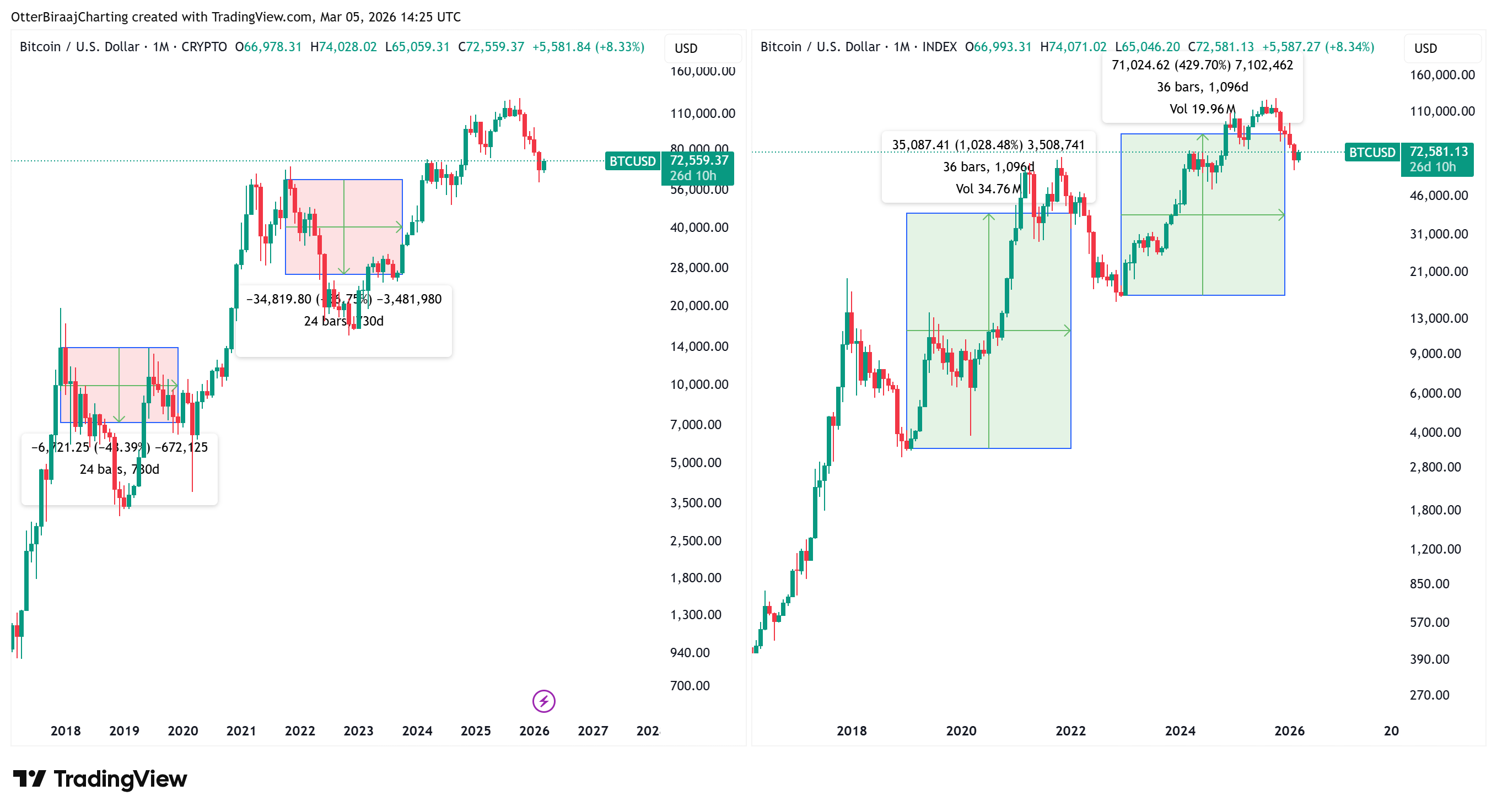 Bitcoin’s decline and gains over two and three years | Source: Cointelegraph/TradingView A similar trend appears in the next cycle. Investors who bought near the 2021 peak faced a 43.5% loss after two years, but by the third year, their investment yielded a 14.5% profit.
Meanwhile, those who bought near market bottoms achieved remarkable gains. Buying close to the 2019 bottom resulted in an 871% profit after two years and 1,028% after three. Similarly, positions bought near the 2022 cycle bottom saw about 465% growth after two years and 429% after three.
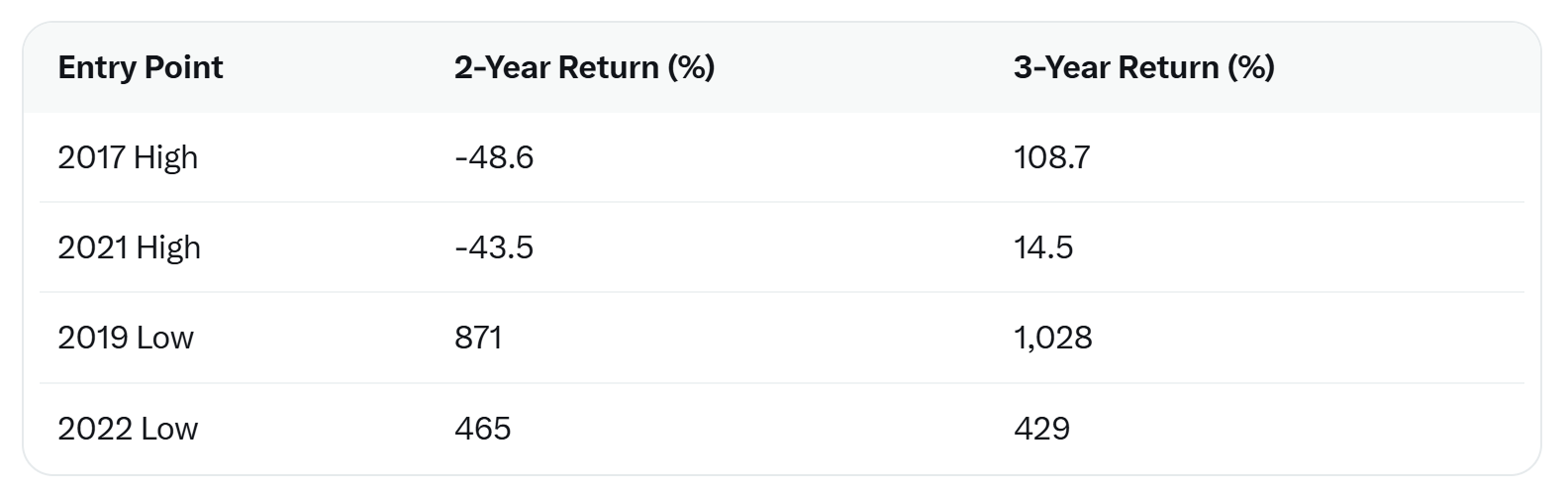 Bitcoin purchase timing and net returns over two to three years | Source: Cointelegraph Overall, historical data reveals a consistent pattern: two-year holding periods often lead to significant losses if bought near cycle peaks. However, extending the holding period to three years generally results in profitable outcomes. Notably, investments made near market bottoms tend to see the strongest growth in both two- and three-year periods.
Real Price Index of BTC and Buying Opportunities at the Bottom
On-chain valuation metrics, especially the realized price, offer important clues about optimal accumulation zones. The realized price measures the average price at which Bitcoin was last moved on-chain. Historically, deep price dips often bring Bitcoin’s price close to or below this level, creating attractive accumulation zones.
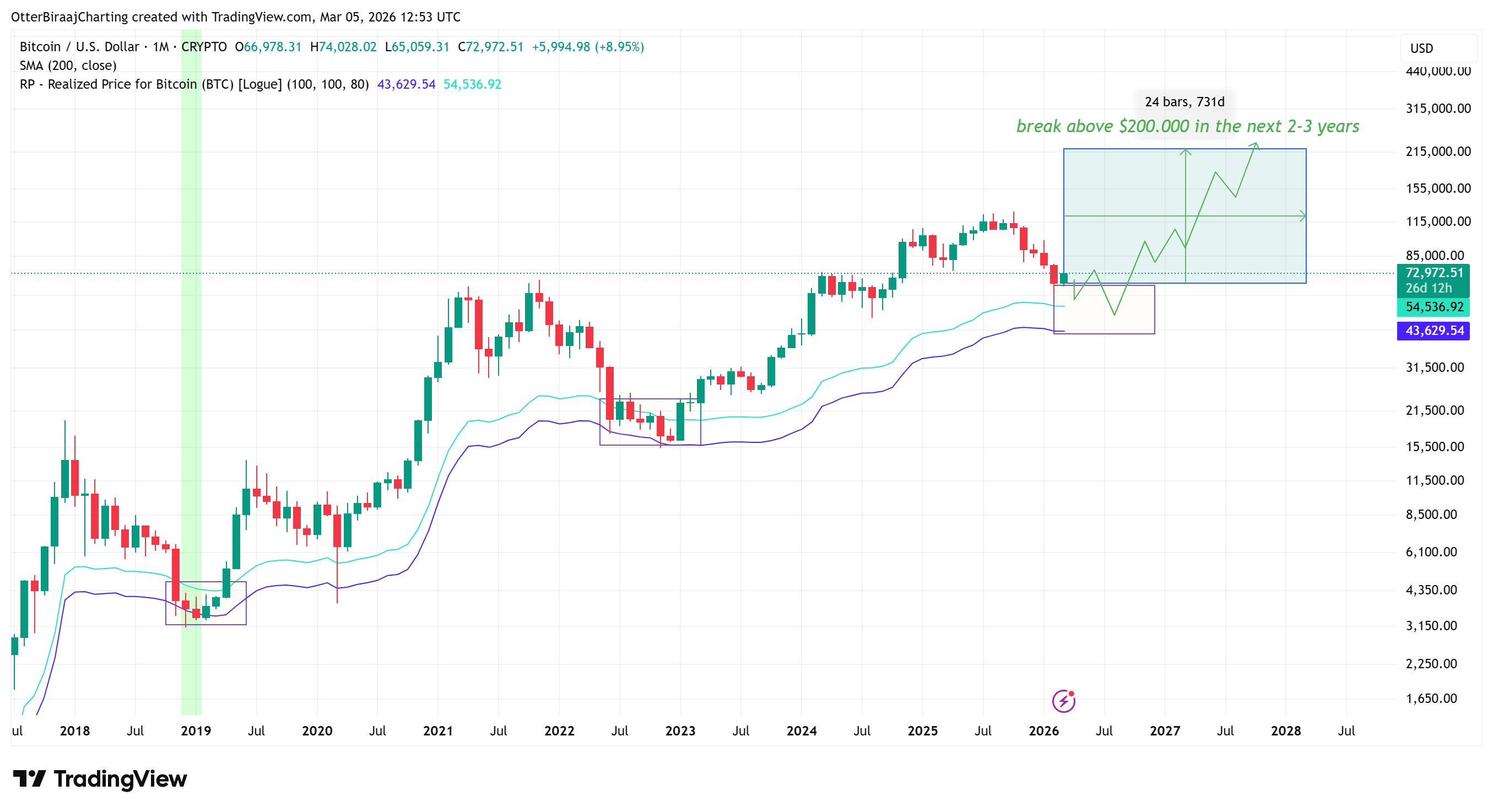 Bitcoin’s realized price range | Source: Cointelegraph/TradingView Since 2015, realized price bands have repeatedly aligned with cycle bottoms, and Bitcoin’s price has often rebounded strongly from these levels, sparking multi-year bull runs. Currently, Bitcoin’s realized price hovers around $55,000, while the shifted realized price is approximately $42,000.
Historical data also shows that investors accumulating near market bottoms tend to buy when prices are around or below these valuation bands. This presents an opportunity to optimize long-term profits.
Long-term Holding: The Key to Risk Reduction
Many studies emphasize the importance of long-term holding. According to Matt Hougan, Chief Investment Officer at Bitwise, adding Bitcoin to a traditional 60/40 portfolio improved both cumulative returns and risk-adjusted returns across all three-year periods studied. The win rate reached 93% over two-year holds, with a 5% allocation providing optimal balance.
Another Bitwise study, based on data from July 2010 to February 2026, shows the probability of loss drops to just 0.7% when holding Bitcoin for three years. The risk further decreases to 0.2% over five years and disappears entirely over ten years.
In contrast, short-term trading strategies carry higher risks. Day traders face potential losses of up to 47.1%, and even one-year holding periods have a 24.3% chance of loss.
Conclusion
Historical data indicates that Bitcoin is highly volatile in the short term but offers significant profit potential for patient investors. Choosing the right entry points, especially during market downturns, combined with long-term holding strategies, can help minimize risks and maximize gains. In an ever-changing financial landscape, Bitcoin remains a compelling asset for long-term investors.
Disclaimer: The information on this page may come from third parties and does not represent the views or opinions of Gate. The content displayed on this page is for reference only and does not constitute any financial, investment, or legal advice. Gate does not guarantee the accuracy or completeness of the information and shall not be liable for any losses arising from the use of this information. Virtual asset investments carry high risks and are subject to significant price volatility. You may lose all of your invested principal. Please fully understand the relevant risks and make prudent decisions based on your own financial situation and risk tolerance. For details, please refer to
Disclaimer.


