


Metaverse ambitions, patents, and inescapable risks
Author: Shi Yuan; Source: IPRdaily Chinese Network
When it comes to it, some people think of Neil Stephenson’s novel “Snow Crash”, and some people think of Spielberg’s movie “Ready Player One”.
In 2021, Facebook founder Mark Zuckerberg changed the name of “Facebook” to Meta, announcing a full foray into the metaverse. The popularity of the metaverse has been pushed to a climax. Now, Meta investor Brad Gerstner said: “The public is confused about what exactly the concept of the metaverse means.” "In fact, we can roughly tell the origins of the metaverse, its theories, and even some of the hot events, but what exactly can it bring us? No one has an answer.
It is undeniable that in the time of the rise of the metaverse, industries based on immersive computing, WEB3.0, and new infrastructure technologies have taken advantage of the momentum, and the industry has continuously exported patents to help make the concept of the metaverse clearer, and the relevant policy construction of the metaverse has emerged in an endless stream. Although the intellectual property war that the metaverse cannot avoid is also burning at the same time. But we are worth believing that the metaverse will have broad development prospects and potential in the future.
PART 01 The ambition of the metaverse is hidden in diversified applications
Although the development of the metaverse is still in its infancy, in the tide of innovation to rejuvenate the country with science and technology and hard work, the metaverse also has many positive landing scenarios in different industrial fields such as industrial production, medical and health, finance and banking, entertainment and education.
1.1 Industrial Metaverse
In fact, many domestic and foreign companies have actively tried to use metaverse technology to reduce costs and increase efficiency. Midea Group makes full use of simulation systems and digital twin technology to build a one-to-one virtual digital factory. With this system, they are able to simulate the production process in a virtual environment, which greatly improves the efficiency of new product piloting and shortens the time to market. Microsoft has set up an “Industrial Metaverse Core Team” to power industrial control systems for applications such as industrial robots, and Microsoft’s move has injected new technological vitality into the industrial metaverse. In addition, BMW is also actively using the virtual collaboration platform Omniverse to plan the construction of virtual factories to bring greater economic benefits to the enterprise.
1.2 Health Metaverse
When “health preservation” has become a topic of conversation after dinner, the metaverse has decoded the infinite possibilities of health care. The UAE NHS has opened a new chapter in the health metaverse, establishing the world’s first metaverse healthcare platform. There are also AR penetrating optics that project a 3D image of the patient’s spine onto the surgeon’s retina to assist in surgery. In China, Huashan Hospital’s neurosurgery metaverse mixed reality medical solution is at the forefront of application. In January 2022, the first “Metaverse” high-difficulty keyhole skull base surgery hand in China was successfully implemented at the National Medical Center for Neurological Diseases, marking the official launch of the neurosurgery metaverse technology of Huashan Hospital.
1.3 Financial Metaverse
In the financial sector, metaverse technology is becoming an important tool to drive innovation and enhance the user experience. First of all, trading digital assets in the form of NFTs enriches the operation of the financial metaverse. Agricultural Bank of China, Postal Savings Bank, Everbright Bank, Huaxia Bank, Bank of Beijing, Bank of Xi’an and other financial institutions have entered the NFT digital collection. Second, financial institutions have launched digital avatars to optimize services and business processes, and use metaverse technology to improve user experience. Foreign financial institutions such as the United States, South Korea, and France provide services to customers in the virtual space, and domestic Baixin Bank has also launched a virtual digital employee, AIYA, to conduct immersive communication and interaction with users.

Source: Bacera Bank’s official website
1.4 Entertainment Education Metaverse
For a wide audience, Ready Player One is the beginning of learning about the metaverse. The metaverse is especially used in entertainment education. There are not only Zhangjiajie Planet, which uses XR fusion interactive technology to immerse yourself in the thousands of strange peaks of the metaverse, but also the China Grand Canal Immersive Museum that reproduces the past and present life of China’s Grand Canal. There is not only the online and offline full-scene integration of the smart learning center metaverse built by Shanghai Open University, but also the international Chinese education metaverse jointly developed by East China Normal University and Shanghai Sanda University. In addition, some institutions in Japan and the United States can hold classes remotely in virtual campuses through VR headsets.
From the concept of the metaverse to the attempt to implement scene applications, the metaverse has provided unlimited imagination for industrial innovation and development. So, what exactly is the metaverse technology supporting the landing of the scene?
PART 02 Entering the Metaverse, Multi-dimensional Technology Supports Patent Innovation Behind the Scenes
According to the “2023 China Metaverse Industry Research Report”, as of July 2023, the total number of authorized patents of metaverse enterprises in China is 23,851, including 16,003 invention patents, 6,259 utility model patents, and 1,589 design patents.
As a product of the integration of multiple technologies, the metaverse also has multiple branches in the patent type. In the latest “Patent Classification System for Key Digital Technologies (2023)” released by the State Intellectual Property Office, the metaverse technology is divided into three first-level technology branches, with 13 second-level technology branches, 45 third-level technology branches, 79 fourth-level technology branches, and 54 fifth-level technology branches, for a total of 194.
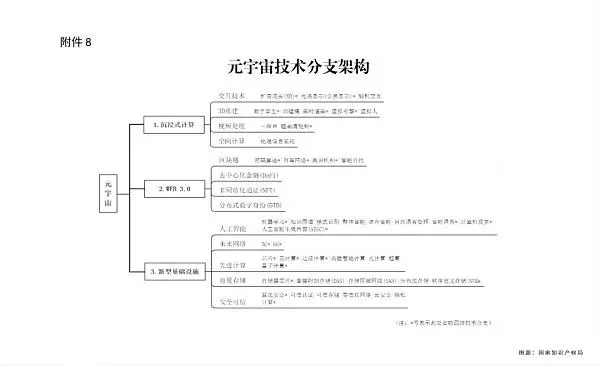
In order to understand more concisely, the patented technology of the metaverse can be roughly divided into two levels: the software level and the hardware level.
2.1 Software Layer
In the metaverse, software-level technologies such as computing power, algorithms, and communications can provide technical guarantees for users to access the metaverse. At present, blockchain technology and cloud computing technology account for the largest proportion of patents in the metaverse environment.
In different industrial fields, enterprises will apply for patents for metaverse technology suitable for their own scenarios. For example, Bank of China Co., Ltd. applied for a patent for “mobile payment method and device in the metaverse environment”, and China United Network Communications Group Co., Ltd. applied for a patent for “credit inquiry method, node, and system based on the metaverse network”.
In addition, scientific research universities are also one of the important sources of applying for metaverse patents. A total of 86 universities across the country have deployed metaverse-related patents, such as “Privacy-preserving Mobile Edge Computing Method for Metaverse” applied by Beijing Jiaotong University, and “Distributed Rendering Microservice Toolchain and Running Middleware for Unity Applications” applied by Harbin Institute of Technology.
2.2 Hardware Level
From the virtual to the real, from the concept to the real. Only by immersive experience can we have a personal understanding of the metaverse, and AR&VR&MR technology is the cornerstone of experiencing the metaverse.
In the 2020~2021 VR/AR Global Invention Patent Ranking TOP100 released by IPRDaily, Internet companies, university research institutes, and high-tech enterprises form three camps. Among them, Samsung, Tencent, Baidu, Sony, OPPO, etc. are on the list.
Since 2021, patent applications for AR&VR&MR have continued unabated. For example, BOE Technology Group Co., Ltd. has recently obtained the patent authorization of “AR/VR contact lenses and their production methods and electronic devices”. Beijing Xiaomi Mobile Software Co., Ltd. announced the patent authorization of “mobile payment method and device in virtual reality environment”, and the “‘human-machine-XR-cloud’ equipment operation and maintenance planning method for the metaverse” announced by Taiyuan University of Technology, among others.
It is worth mentioning that the proposal for a metaverse patent pool has also been put on the agenda. Launched in January 2022, the IPwe Metaverse Patent Pool, the Sensor Innovation Center, is dedicated to driving technology adoption and innovation in the metaverse space while protecting SMEs and other participants in the metaverse ecosystem. As of March 2022, more than 1,200 related patents have been added to the pool and continue to increase. In 2023, the first patent pool for the metaverse industry in China will be launched. The patent pool is led by Beijing IP and Baidu, and the first batch of 4 founding enterprise members including Rely Wisdom, as you see, nickname technology, and Lingyu Intelligent Control, the first batch of more than 170 patents in the pool, of which 53 patents are the first to be opened.
PART 03 Intellectual Property Risks That Cannot Be Avoided in the Development of the Metaverse
As one of the hottest topics at the moment, the metaverse brings not only unlimited business opportunities, but also different intellectual property issues in the metaverse world.
Since Facebook changed its name to Meta to deploy the metaverse, patent disputes have been endless. First, Meta’s haptic gloves have come under fire from HaptX, arguing that their gloves “appear to be substantially identical to their patented technology.” Later, Immersion, a haptic technology development company, filed a lawsuit against Meta, accusing Meta of creating an industry-leading virtual reality headset by infringing its patents.
As a specific virtual item that accompanies the metaverse, NFT copyright issues have also been discussed a lot.
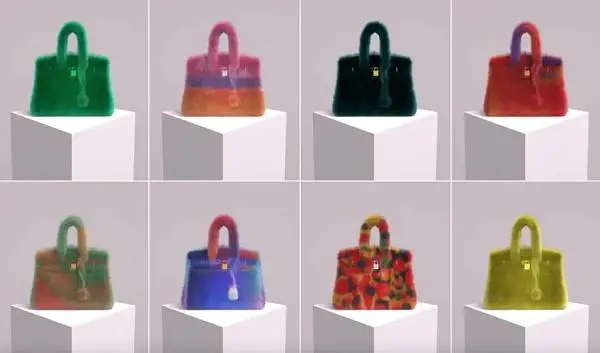
In 2021, digital collectible artist Mason Rothschild created 100 “MetaBirkins” NFTs that were unveiled at Art Basel Miami and sold on social platforms such as Twitter. The Hermès Group took the Hermès Group to court for infringement of the Hermès trademark and dilution of the brand, and finally ordered the artist to pay $133,000 in damages to the Hermès Group.
In May 2022, the term metaverse officially appeared in the judgment, and the so-called “first case of metaverse infringement” in China was officially announced. Holding the popular IP “I’m Not a Fat Tiger”, Qice Company found that there were users selling related NFTs on the metaverse platform operated by a technology company, so it sued a technology company to the court. The Hangzhou Internet Court ordered the defendant to immediately delete the NFT work of “Fat Tiger Vaccination” published on the platform involved in the case, and at the same time compensate Qice Company for economic losses and reasonable expenses totaling 4,000 yuan.
The concept of the metaverse has become more and more hyped, and the infringement of digital works has also become the focus of heated discussions.
Roblox is an online platform for virtual worlds and user-generated content, and its metaverse concept became an instant hit in 2021. But in June of the same year, the National Music Publishers Association filed a lawsuit against Roblox for infringement of digital works. Several music publishers claimed that the music used by Roblox in the game was not licensed, and the copyright demanded more than $200 million in compensation from Roblox. In the end, the two sides reached a settlement to resolve the disagreement.
In fact, when business enters the metaverse, issues such as the use and protection of metaverse patents, the operation and protection of trademarks and copyrights in the metaverse field, digital copyrights in the metaverse, the intellectual property layout and litigation rights protection of wearable devices have become hot topics in the intellectual property industry. To put it bluntly, the operation of the metaverse requires intellectual property rights to shelter all this.
In the face of such a variety of intellectual property problems, service agencies are also adapting to the changes and actively seeking solutions. The China Copyright Protection Center held the “Metaverse Copyright Protection Webinar”, and Wuhan established the first Metaverse Digital Industry Intellectual Property Service Center in Hubei Province. The relevant person in charge of the Metaverse Digital Industry Intellectual Property Service Center said frankly that in the future, it will do a good job in the creation, application and protection of intellectual property rights, management services and other aspects for enterprises in the exploration.
PART 04 Intellectual property rights in the era of the metaverse are worth looking forward to
From 2021 to 2023, the metaverse seems to have come to a fork in the road. On the one hand, many places have introduced support policies and special plans for the metaverse, and five departments including the Ministry of Industry and Information Technology have issued the “Three-Year Action Plan for the Innovation and Development of the Metaverse Industry (2023-2025)” to support the development of the metaverse from multiple perspectives such as technological innovation, industrial application, and intellectual property protection. On the one hand, the market is cold, and companies are withdrawing from the metaverse track, such as the recent rumors that PICO, a subsidiary of Byte, plans to lay off employees, or will abandon the metaverse.
Regarding the future of the metaverse, the website of the Central Commission for Discipline Inspection published an article saying that it looks at the metaverse rationally and does not underestimate the opportunities in 5-10 years, nor does it overestimate the evolution and changes in 1-2 years**[4] **。 And different people have different opinions about the future of intellectual property in the metaverse.
Some people believe that the metaverse will bring a series of problems, such as the ownership and protection of intellectual property rights of user-generated content, the risk of infringement of digital twins of streets and buildings in the real world, the infringement risk of the use and adaptation of works in the real world, the trademark protection that may extend from the real world to the virtual world, the licensing and authorization of cross-border use of metaverse content, and the difficulty of intellectual property owners to protect their rights against infringement in the metaverse.
Some people believe that the decentralized global operation of the metaverse also brings certain challenges to the copyright ownership of works, global cross-border licensing or transfer, and copyright infringement remedies, but through the basic principles of copyright, the appropriate interpretation of rules such as the Berne Convention, and technical solutions, these new problems can still be properly solved, and it is not enough to say that the metaverse will subvert traditional copyright law.
Some people believe that the metaverse is a cross-border virtual world, involving multiple countries and regions, and the protection and supervision of intellectual property rights requires the joint efforts of all parties, followed by the conflict between technological innovation and legal regulation. Technological innovation in the metaverse is rapid, and the traditional legal framework for intellectual property may not be able to fully adapt to the needs of the metaverse, requiring corresponding legal and policy innovations.
In general, no matter what people say, there is always optimism about intellectual property in the metaverse. It may take decades for the real arrival of the metaverse, but we clearly know that intellectual property rights will be supported by it, and we look forward to the protection of intellectual property rights in the development of the metaverse to realize a new world of virtual and real integration.