As decentralized exchange protocols, or DEXs, have continued to evolve, automated market maker, or AMM, models have become a core mechanism for onchain asset trading. Traditional order books rely on matching buyers and sellers, while AMMs use liquidity pools to provide prices automatically, making decentralized asset swaps more efficient. Through this evolution, different AMM models have developed along separate paths based on the needs of different asset types.
Curve and Uniswap are two of the most representative AMM protocols in DeFi. They represent two different directions, “general purpose liquidity” and “stable liquidity optimization,” and both hold important infrastructure value within the DeFi ecosystem.
What Is Uniswap’s AMM Model?
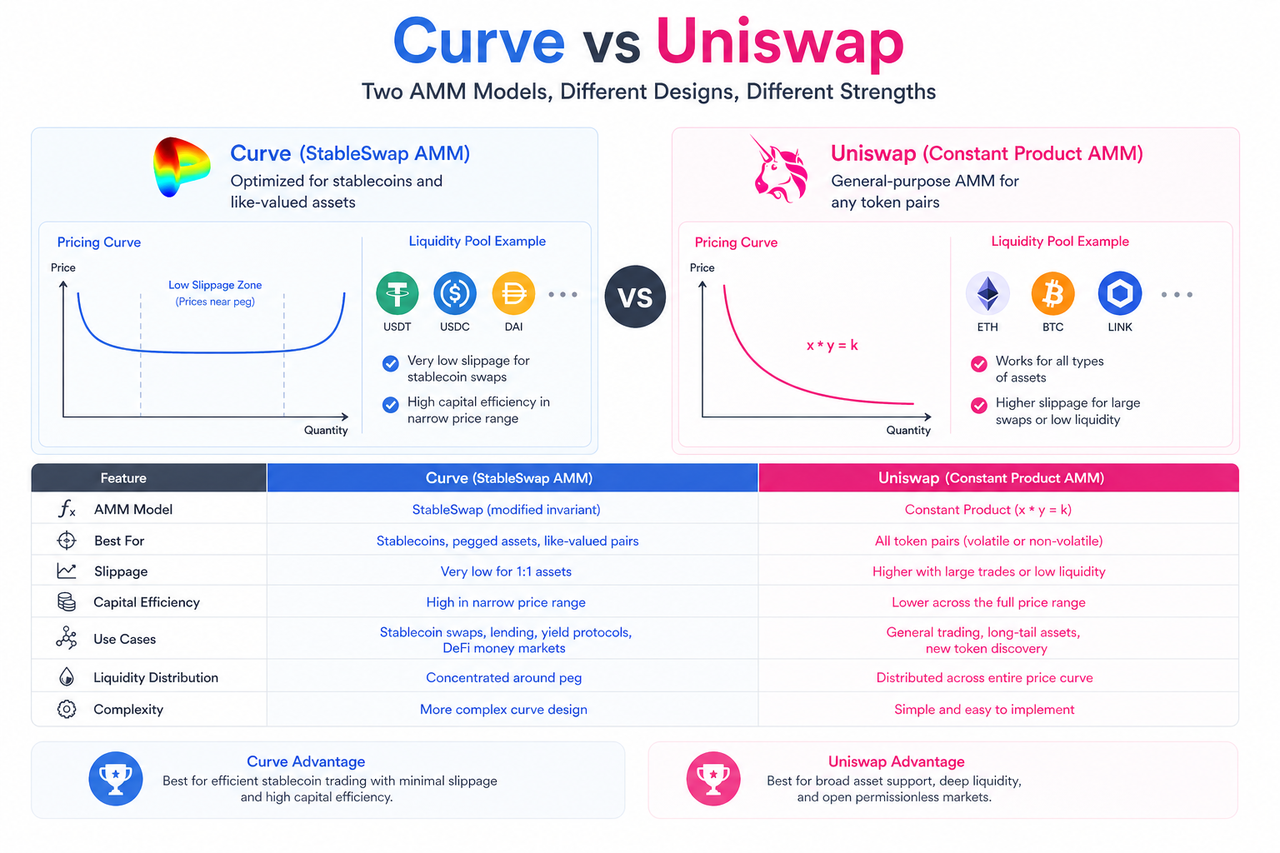
Uniswap uses the Constant Product Market Maker model. Its core formula is: x × y = k
This model determines price by keeping the product of two assets constant. When a user buys one asset, the amount of that asset in the pool decreases, the amount of the other asset increases, and the price changes accordingly.
The advantage of this mechanism is its simple structure and suitability for trading any asset pair, which is why it became the foundational model for general purpose DEXs. However, because the price curve changes continuously, it can produce higher slippage when liquidity is limited or trade sizes are large.
What Is Curve’s AMM Model?
Curve uses the StableSwap model, an AMM curve optimized for stablecoins and similar assets. It combines features of the constant product model and the constant sum model, allowing prices to remain flatter when assets stay close to their peg.
This design allows stablecoin trades to maintain low slippage even at larger trade sizes, making it especially suitable for swaps between similarly priced assets such as USDT, USDC, and DAI.
Differences Between Curve and Uniswap Pricing Mechanisms
The most important difference between the two lies in the design of their price curves.
Uniswap’s constant product model keeps the same curve structure across all price ranges, so price deviation can increase quickly as trade size grows. Curve’s StableSwap curve remains flat when prices are close to their peg and only gradually steepens when prices move further away.
This means:
Differences in Liquidity Efficiency Between Curve and Uniswap
Curve has a clear advantage in liquidity efficiency when it comes to stable assets.
Because stablecoin prices usually fluctuate within a narrow range, Curve concentrates a large amount of liquidity near the pegged price range, improving capital utilization. By contrast, Uniswap distributes liquidity across the full price range, which can lead to lower capital efficiency in stable asset trading.
As a result, Curve can usually offer a lower cost trading experience for stablecoin swaps.
Differences in Slippage Between Curve and Uniswap
Slippage is an important measure of trading cost.
With the same amount of liquidity, Curve’s flatter curve can significantly reduce slippage in stable asset trades. Uniswap, on the other hand, tends to show more noticeable price movement during large trades, resulting in higher slippage.
For this reason, Curve’s slippage performance is usually better than Uniswap’s in scenarios with strong demand for stablecoin trading.
Differences in Use Cases Between Curve and Uniswap
Although both are DEXs, they are suited to different use cases:
| Comparison Dimension |
Curve |
Uniswap |
| Core Model |
StableSwap |
Constant product AMM |
| Main Assets |
Stablecoins / pegged assets |
Any asset |
| Slippage Performance |
Low |
Relatively high |
| Capital Efficiency |
High for stable assets |
General purpose |
| Main Use |
Stablecoin swaps |
General token trading |
Uniswap is better suited as a general asset swap market, while Curve is better suited as liquidity infrastructure for stable assets.
Curve and Uniswap’s Roles in DeFi
Uniswap is general trading infrastructure in DeFi. It provides an open trading environment for a wide range of assets and is one of the main sources of onchain liquidity.
Curve plays a key role in stablecoin liquidity, providing efficient swap routes for lending protocols, yield aggregators, and stablecoin systems.
Put simply:
Together, they form an important foundation for DeFi’s liquidity system.
Conclusion
The core difference between Curve and Uniswap lies in the design goals behind their AMM models. Uniswap uses the constant product model to support general asset trading, while Curve uses the StableSwap model to improve stablecoin trading efficiency. The former emphasizes universal access to trading markets, while the latter emphasizes capital efficiency in stable asset swaps. Understanding the difference between these two models helps build a more complete framework for understanding DeFi liquidity structure.
FAQs
What is the biggest difference between Curve and Uniswap?
The biggest difference is their AMM pricing models. Uniswap uses the constant product model, while Curve uses the StableSwap model optimized for stablecoins.
Why is slippage lower for stablecoin trades on Curve?
Because Curve concentrates liquidity around the price range where stablecoins stay close to their peg, making the price curve flatter and reducing slippage.
Is Uniswap suitable for stablecoin trading?
It can be used for stablecoin trading, but it is generally less optimized than Curve in terms of slippage and capital efficiency.
Can Curve trade all assets?
Curve is mainly optimized for trading stablecoins and similar assets. It is not designed for arbitrary asset pairs in the same way as Uniswap.
What roles do Curve and Uniswap play in DeFi?
Uniswap is a general purpose DEX liquidity market, while Curve is liquidity optimization infrastructure for stablecoins.







