Enhancing Long-Term Holding Efficiency with GTBTC Across Bitcoin’s Volatility Cycles

Beginner
Quick Reads
Last Updated 2026-03-25 07:09:50
Reading Time: 1m
As the BTC market moves into a consolidation phase, long-term holders are turning their attention to asset efficiency. GTBTC’s yield accumulation mechanism allows BTC to generate ongoing returns throughout the holding period, establishing sop as a key solution for optimizing asset allocation during periods of market volatility.

Market Enters Volatility as Holding Strategies Diverge
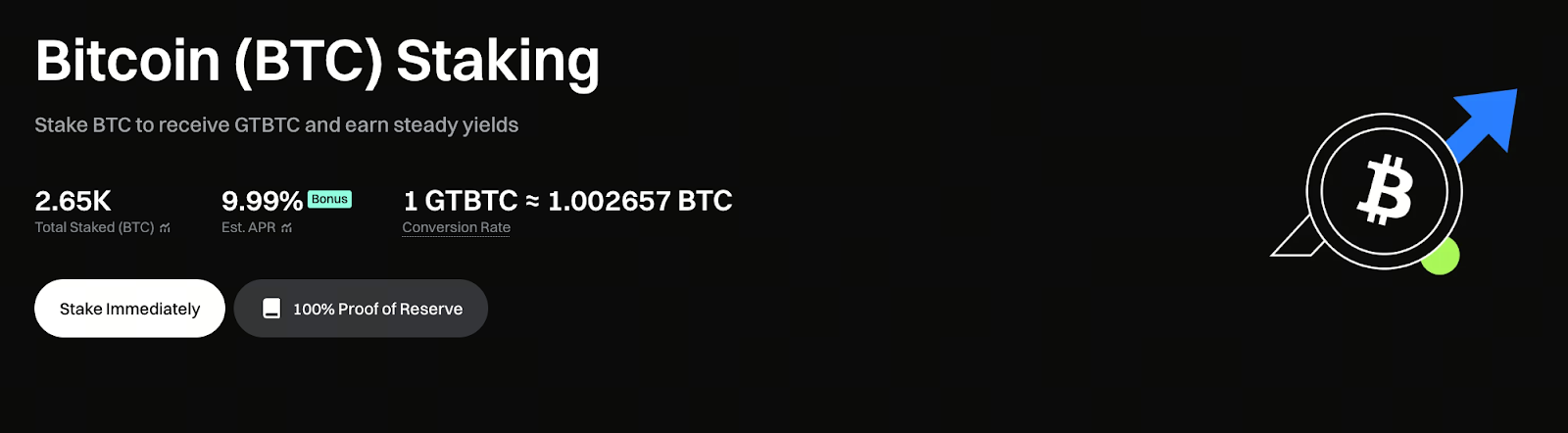

Image: https://www.gate.com/staking/BTC

Following a strong rally, BTC has shifted into a correction phase, prompting market sentiment to move from chasing gains to a wait-and-see approach. While long-term holders are familiar with this environment, each period of volatility brings the same question:

Is waiting for another price surge the only path forward?

Traditionally, the answer was yes. Holding BTC meant relying solely on price appreciation for returns, so when the market stalled, asset growth also stopped.

Today, however, the market offers new alternatives.

From Holding to Managing Assets

As the crypto market matures, investors are increasingly focused on asset efficiency. Instead of just holding, more users are considering how to generate yield on their funds while keeping assets secure during market lulls.

GTBTC has emerged as a solution to address this need.

Through Gate’s on-chain earning system, users can convert BTC into GTBTC, maintaining BTC’s value peg while participating in yield-generation mechanisms that allow assets to grow over time.

Why Yield Support Is Essential in Volatile Markets

During bull runs, price appreciation can mask issues with yield efficiency. In sideways or volatile markets, however, the opportunity cost of time becomes much clearer.

If assets only fluctuate in price for months without producing additional yield, overall capital efficiency drops sharply.

With GTBTC, users can accumulate returns even while the market is flat, keeping assets productive and reducing the drag of sideways movement.

How the Yield Model Works

GTBTC is fundamentally a yield-bearing asset based on BTC. By participating in BTC staking or on-chain earning plans via Gate, users receive returns that are automatically reflected in their net asset value.

This approach requires no active management or complex strategies—returns accrue automatically within asset holdings.

This model is ideal for users who prefer not to monitor the market constantly but still want their assets working for them.

What the Current Annualized Yield Means

The current comprehensive annualized yield for BTC staking is about 9.99% (refer to the platform page for the latest rate). This yield isn’t driven by high-risk arbitrage but comes from long-term strategies and platform operations.

For users already planning to hold BTC long-term, generating steady returns over time is often more sustainable than frequent trading.

GTBTC’s Role in a Portfolio

GTBTC doesn’t need to replace all BTC holdings. Instead, it works best as part of a diversified portfolio.

Some BTC can remain as spot holdings, while a portion is converted to GTBTC to earn yield. This approach maintains liquidity while boosting overall asset efficiency.

Such allocation tends to provide greater stability during volatile markets.

Market Volatility Is Constant, but Asset Strategies Can Evolve

The BTC market is always cyclical—bull runs, corrections, and unpredictable price swings are constant features.

Rather than repeatedly chasing short-term moves, keeping assets productive in any market environment aligns better with long-term investment logic.

GTBTC is transforming BTC from a simple store of value into a yield-generating, long-term portfolio asset.

Summary

When the market turns volatile, the importance of holding strategies surpasses market timing. GTBTC provides long-term BTC holders with a new asset management approach, allowing them to continue earning returns while waiting for the next market cycle.

Author: Max
Disclaimer
* The information is not intended to be and does not constitute financial advice or any other recommendation of any sort offered or endorsed by Gate.
* This article may not be reproduced, transmitted or copied without referencing Gate. Contravention is an infringement of Copyright Act and may be subject to legal action.

Related Articles

The ve(3,3) Flywheel Explained: How AERO Tokenomics Powers Aerodrome’s DeFi Economy
Beginner

The ve(3,3) Flywheel Explained: How AERO Tokenomics Powers Aerodrome’s DeFi Economy

In the competition for DeFi liquidity, high-inflation mining alone is no longer enough to build lasting advantages. Aerodrome applies the ve(3,3) economic model to redesign token emissions, voting mechanisms, and revenue distribution, creating a liquidity flywheel centered on governance and cash flow. This article examines AERO tokenomics, the veAERO locking mechanism, and protocol revenue models to explain how Aerodrome builds a sustainable DeFi economic system.
2026-03-25 06:41:58
AI-Native Settlement Layers: How United Stables Is Building the Next Financial Rail
Beginner

AI-Native Settlement Layers: How United Stables Is Building the Next Financial Rail

Stablecoins were originally designed as dollar substitutes within exchanges, primarily used for asset pricing and trade settlement. As on-chain financial ecosystems have matured, their role has expanded beyond simple payments to include collateral assets, cross-chain liquidity mediums, and unified settlement units. In particular, as AI systems and automated agents begin to participate directly in economic activity, demand has risen sharply for programmable value units capable of instant settlement. This shift is pushing stablecoins toward the role of foundational financial infrastructure.
2026-03-25 03:16:17
Aerodrome Tokenomics: How ve(3,3) Powers Base's Most Profitable DEX
Beginner

Aerodrome Tokenomics: How ve(3,3) Powers Base's Most Profitable DEX

AERO is the native token of Aerodrome Finance, a core decentralized exchange and liquidity protocol in the Base ecosystem. It is primarily used for liquidity incentives and ecosystem operations. veAERO is a governance NFT that users receive by locking AERO, representing both voting power and the right to share protocol revenue. Through a dual track structure of AERO as a utility token and veAERO as a governance credential, Aerodrome separates liquidity usage value from long term governance power, allowing participants to act as liquidity providers, governance decision makers, and revenue sharers within the same system.
2026-03-25 06:40:31
How Does PAXG Work? In-Depth Overview of the Physical Gold Tokenization Mechanism
Beginner

How Does PAXG Work? In-Depth Overview of the Physical Gold Tokenization Mechanism

PAXG (Pax Gold) is a tokenized asset backed by physical gold, issued by the fintech company Paxos and traded on the Ethereum blockchain as an ERC-20 token. The core concept is to tokenize physical gold on-chain, with each PAXG token representing ownership of a certain amount of gold. This structure enables investors to hold and trade gold in the form of a digital asset.
2026-03-24 19:12:51
How is the price of PAXG determined? Pegging mechanism, trading depth, and influencing factors
Beginner

How is the price of PAXG determined? Pegging mechanism, trading depth, and influencing factors

PAXG (Pax Gold) is a tokenized asset backed by physical gold reserves, launched by fintech firm Paxos and issued as an ERC-20 token on the Ethereum blockchain. The core concept is to digitally represent real-world gold assets, allowing investors to hold and trade gold via the blockchain network. Because each PAXG token corresponds to a specific quantity of physical gold, its price is theoretically expected to closely track the global gold market.
2026-03-24 19:11:40
DePIN Identity Network and Real World Applications: How Humanity Protocol Brings on-chain Identity Into the Physical World
Beginner

DePIN Identity Network and Real World Applications: How Humanity Protocol Brings on-chain Identity Into the Physical World

Most Web3 identity systems remain confined to on-chain environments and struggle to achieve meaningful adoption in real world settings. Through a DePIN architecture and physical verification hardware, Humanity Protocol aims to bring decentralized identity into access control systems, hospitality, public services, and offline events, allowing on-chain identity to function not just as a digital credential, but as foundational infrastructure for real world access.
2026-03-25 07:40:53





