Ethereum’s Adoption Paradox: Record Network Activity but Weak ETH Price

Beginner
Quick Reads
Last Updated 2026-03-24 15:19:30
Reading Time: 1m
On-chain analytics providers have observed an unusual trend in the Ethereum market: while network usage is steadily rising, the price of ETH is simultaneously declining. The surge in smart contract and DeFi activity has pushed on-chain interactions to record levels. Nevertheless, capital outflows and persistent selling pressure may subject ETH to additional short-term downside risk.

Ethereum’s Adoption Paradox Emerges

Ethereum’s Adoption Paradox Emerges (Source: ethereum)

On-chain analytics firm CryptoQuant reports that Ethereum is experiencing a market phenomenon known as the “Adoption Paradox.”

This paradox describes a situation where blockchain usage is rising, yet asset prices fail to follow suit. In other words, real network activity is surging, but market demand for Ether investment is not increasing in parallel.

ETH Price Could See Further Downside

CryptoQuant Head of Research Julio Moreno notes that if the crypto market’s bearish trend continues, ETH could fall further in the coming months. He forecasts that, without a clear improvement in market conditions, ETH could drop to around $1,500 between late Q3 and early Q4. This underscores that the market remains in an uncertain phase, with price direction largely driven by overall sentiment.

On-Chain Activity Hits Record Highs
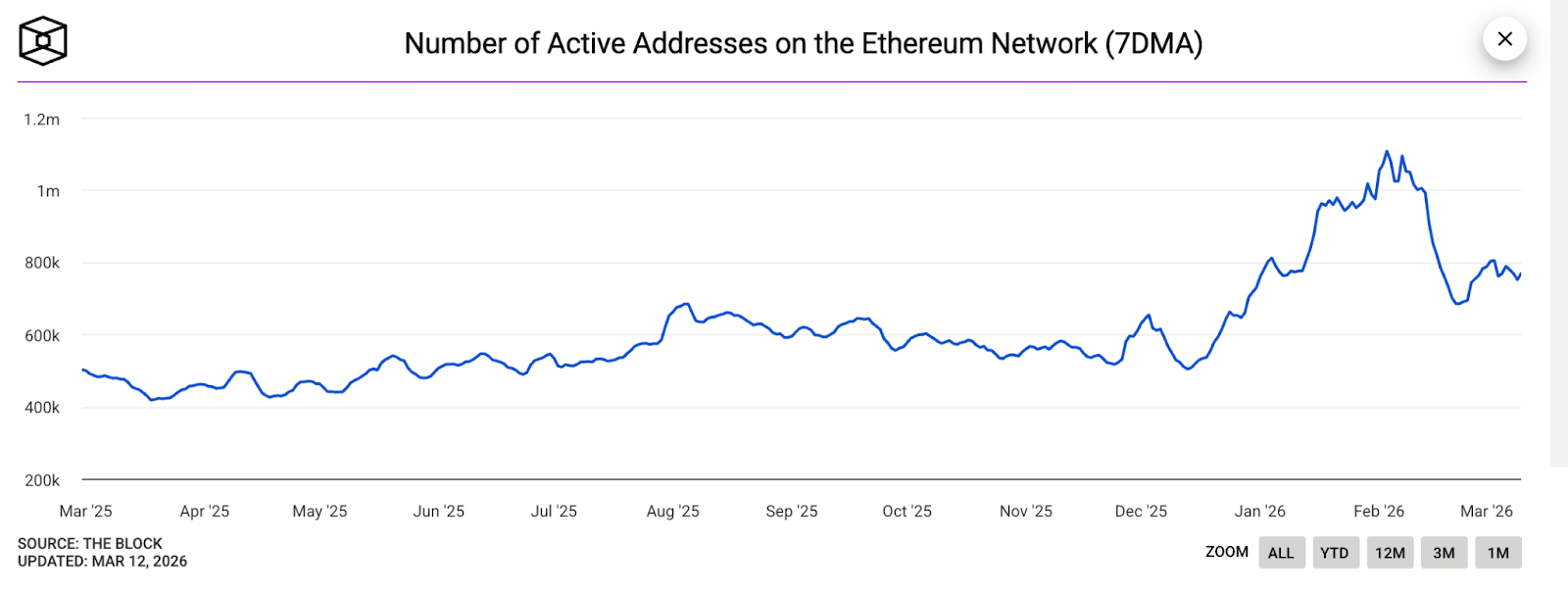
On-Chain Activity Hits Record Highs

Despite weak price action, Ethereum network usage continues to climb.

CryptoQuant data shows:

  • Daily active addresses reached an all-time high last month

  • This figure even surpassed levels seen during the 2021 bull market

Historically, rising user numbers have typically driven price gains, but the current market is showing a clear divergence from this pattern.

ETH has dropped more than 50% from its recent cycle high, signaling a shift in the relationship between usage and price.

Smart Contract Activity Surges

Beyond user growth, on-chain application activity is expanding rapidly. CryptoQuant highlights that last month, Ethereum’s internal contract calls also reached a record high.

These transactions typically occur in the following scenarios:

  • Decentralized finance (DeFi) applications

  • Stablecoin transactions

  • Layer 2 ecosystems

When smart contracts automatically execute transactions within decentralized applications, these internal calls are generated. As the ecosystem grows, this activity is increasing as well.

CryptoQuant observes that the correlation between ETH price and smart contract activity is fading.

In previous market cycles:

  • Contract transaction counts increased

  • ETH prices tended to rise in tandem

In today’s market, however, this positive relationship has weakened significantly.

Even with increased on-chain activity, prices may remain subdued.

Exchange Flows Now a Key Indicator

In the current environment, CryptoQuant believes that exchange inflows may be a more accurate indicator of price trends than on-chain activity.

The reasoning:

  • Exchange inflows often signal potential selling pressure

  • Investors may be preparing to offload assets

  • Current data shows ETH’s exchange inflow ratio is higher than Bitcoin’s.

This suggests that ETH may face greater selling pressure, helping explain its relative underperformance in recent markets.

Investment Inflows Also Show Weakness

Another key metric is Realized Capitalization, which tracks whether capital is entering or leaving an asset.

CryptoQuant notes that Ethereum’s one-year realized capitalization growth rate has turned negative, indicating that overall capital is flowing out of the network—even as on-chain activity increases.

What Could Help ETH Escape the Bear Market?

Looking ahead, Julio Moreno identifies two critical conditions:

  • New capital returning to the market

  • A decline in exchange inflows

ETH is only likely to break out of the current bear market if both of these conditions are met.

Summary

Ethereum’s current adoption paradox highlights a shifting market structure: on-chain activity and ecosystem growth remain strong, but capital flows and sentiment have not kept pace to support ETH’s price. As DeFi, stablecoins, and Layer 2 applications continue to expand, real demand for Ethereum usage is still climbing; however, short-term price action will depend on capital inflows and changes in exchange selling pressure. If capital returns and selling pressure diminishes, ETH may gradually emerge from the current bear market.

Author:  Allen
Disclaimer
* The information is not intended to be and does not constitute financial advice or any other recommendation of any sort offered or endorsed by Gate.
* This article may not be reproduced, transmitted or copied without referencing Gate. Contravention is an infringement of Copyright Act and may be subject to legal action.

Related Articles

AI-Native Settlement Layers: How United Stables Is Building the Next Financial Rail
Beginner

AI-Native Settlement Layers: How United Stables Is Building the Next Financial Rail

Stablecoins were originally designed as dollar substitutes within exchanges, primarily used for asset pricing and trade settlement. As on-chain financial ecosystems have matured, their role has expanded beyond simple payments to include collateral assets, cross-chain liquidity mediums, and unified settlement units. In particular, as AI systems and automated agents begin to participate directly in economic activity, demand has risen sharply for programmable value units capable of instant settlement. This shift is pushing stablecoins toward the role of foundational financial infrastructure.
2026-03-25 03:16:17
The ve(3,3) Flywheel Explained: How AERO Tokenomics Powers Aerodrome’s DeFi Economy
Beginner

The ve(3,3) Flywheel Explained: How AERO Tokenomics Powers Aerodrome’s DeFi Economy

In the competition for DeFi liquidity, high-inflation mining alone is no longer enough to build lasting advantages. Aerodrome applies the ve(3,3) economic model to redesign token emissions, voting mechanisms, and revenue distribution, creating a liquidity flywheel centered on governance and cash flow. This article examines AERO tokenomics, the veAERO locking mechanism, and protocol revenue models to explain how Aerodrome builds a sustainable DeFi economic system.
2026-03-25 06:41:58
Aerodrome Tokenomics: How ve(3,3) Powers Base's Most Profitable DEX
Beginner

Aerodrome Tokenomics: How ve(3,3) Powers Base's Most Profitable DEX

AERO is the native token of Aerodrome Finance, a core decentralized exchange and liquidity protocol in the Base ecosystem. It is primarily used for liquidity incentives and ecosystem operations. veAERO is a governance NFT that users receive by locking AERO, representing both voting power and the right to share protocol revenue. Through a dual track structure of AERO as a utility token and veAERO as a governance credential, Aerodrome separates liquidity usage value from long term governance power, allowing participants to act as liquidity providers, governance decision makers, and revenue sharers within the same system.
2026-03-25 06:40:31
How Does PAXG Work? In-Depth Overview of the Physical Gold Tokenization Mechanism
Beginner

How Does PAXG Work? In-Depth Overview of the Physical Gold Tokenization Mechanism

PAXG (Pax Gold) is a tokenized asset backed by physical gold, issued by the fintech company Paxos and traded on the Ethereum blockchain as an ERC-20 token. The core concept is to tokenize physical gold on-chain, with each PAXG token representing ownership of a certain amount of gold. This structure enables investors to hold and trade gold in the form of a digital asset.
2026-03-24 19:12:51
How is the price of PAXG determined? Pegging mechanism, trading depth, and influencing factors
Beginner

How is the price of PAXG determined? Pegging mechanism, trading depth, and influencing factors

PAXG (Pax Gold) is a tokenized asset backed by physical gold reserves, launched by fintech firm Paxos and issued as an ERC-20 token on the Ethereum blockchain. The core concept is to digitally represent real-world gold assets, allowing investors to hold and trade gold via the blockchain network. Because each PAXG token corresponds to a specific quantity of physical gold, its price is theoretically expected to closely track the global gold market.
2026-03-24 19:11:40
DePIN Identity Network and Real World Applications: How Humanity Protocol Brings on-chain Identity Into the Physical World
Beginner

DePIN Identity Network and Real World Applications: How Humanity Protocol Brings on-chain Identity Into the Physical World

Most Web3 identity systems remain confined to on-chain environments and struggle to achieve meaningful adoption in real world settings. Through a DePIN architecture and physical verification hardware, Humanity Protocol aims to bring decentralized identity into access control systems, hospitality, public services, and offline events, allowing on-chain identity to function not just as a digital credential, but as foundational infrastructure for real world access.
2026-03-25 07:40:53





