Over the past few years, stablecoins have evolved from a trading medium within crypto markets into a vehicle for global payments and cross-border fund flows. More businesses are now using stablecoins like USDC and USDT for international settlements, while payment platforms and fintech companies are exploring how stablecoins can reduce costs and delays in traditional cross-border payments.
Yet stablecoins alone can't solve all global payment challenges. Real-world international payments often involve currency conversion, making foreign exchange (FX) a critical part of the cross-border financial system. The "stablecoin-native FX network" model, represented by Codex FX, is driving global payments away from traditional bank clearing and toward on-chain real-time settlement.
What Is Codex FX?
Codex FX is the on-chain FX system within the Codex network. It enables fund swaps and payment settlements between stablecoins, as well as between stablecoins and fiat currencies. Its core goal is to boost the efficiency of global fund flows using on-chain liquidity and real-time settlement mechanisms.
Traditional forex systems typically rely on multiple banks and clearinghouses to process payments. In contrast, Codex FX focuses on using stablecoins to transfer value directly. In this framework, stablecoins act not only as a payment method but also as the core settlement asset for global fund flows.
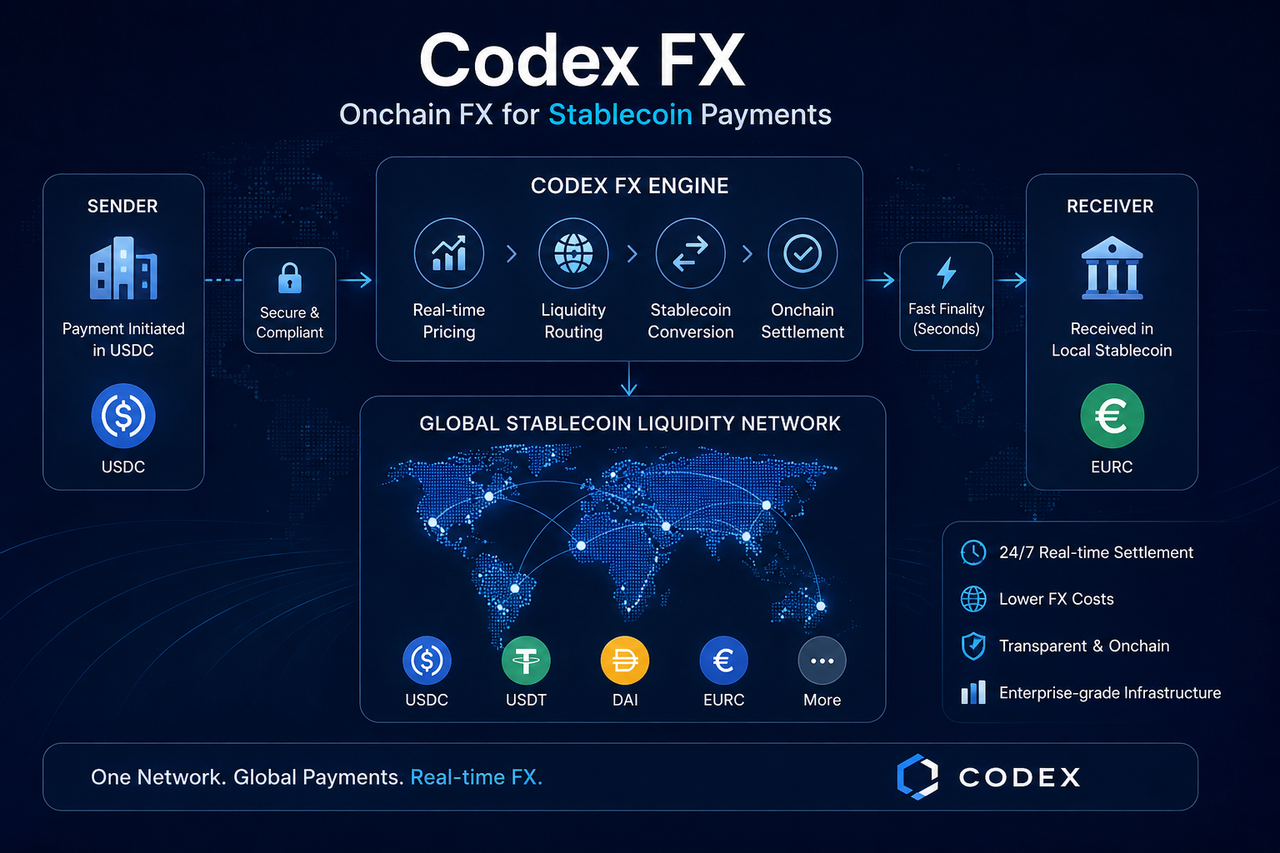
Compared to traditional forex networks, Codex FX emphasizes the following areas:
- Real-time cross-border settlement
- Stablecoin liquidity routing
- Lower FX spreads
- 24/7 payment capability
- Global payment support for emerging Marketplaces
This structure positions Codex FX as a true "stablecoin-native foreign exchange network."
How Does Codex FX's Stablecoin Swap Process Work?
Codex FX's operation centers on stablecoin liquidity and payment routing. When a user or payment platform initiates an international payment, the system searches for the optimal swap route through on-chain liquidity networks.
For example, if a business wants to convert a USD stablecoin into a stablecoin usable in the European market, the system first obtains a real-time offer from on-chain LPs, completes the stablecoin conversion, and then directs the funds to the target market's payment network.
Throughout this process, Codex FX minimizes intermediaries found in traditional payment systems, reducing:
- Exchange rate losses
- Payment delays
- Intermediary fees
- Liquidity fragmentation
Because the entire process runs on-chain, fund flows and settlement routes offer greater transparency.
How Does Codex FX Enable On-Chain Liquidity Routing?
Liquidity is one of the most critical components of any on-chain FX system. Traditional banking systems depend on large financial institutions to maintain global FX liquidity, whereas Codex FX uses stablecoin networks for global capital allocation.
In practice, Codex FX routes funds based on stablecoin supply and demand across different markets. For instance, when a regional market sees high stablecoin demand, the system quickly allocates funds via on-chain LPs, improving payment efficiency.
The key advantage of on-chain liquidity routing over traditional forex systems is its real-time capability and global accessibility. Since blockchain networks run 24/7, stablecoin liquidity can support continuous global settlement without being limited by bank operating hours.
Why Does Codex FX Focus on Emerging Markets?
Emerging markets have long struggled with inefficient international payments. In many regions, cross-border remittances come with high fees, limited liquidity, and slow settlement times.
Stablecoin payment networks can bypass the complex intermediary chains of traditional banking, making international fund flows more efficient. For emerging markets, this means lower barriers to global payments.
Codex FX specifically prioritizes global payment networks and stablecoin liquidity, partly because emerging markets need a low-cost, 24/7, and highly transparent international settlement system. This makes on-chain FX networks a key development direction for the stablecoin financial ecosystem.
How Does Codex FX Differ From Traditional Forex Systems?
Traditional forex systems rely on bank and correspondent clearing networks, while Codex FX emphasizes stablecoins and on-chain settlement.
| Comparison Dimension |
Codex FX |
Traditional Forex System |
| Settlement Method |
On-chain stablecoin settlement |
Bank clearing |
| Operating Hours |
24/7 |
Business days primarily |
| Intermediaries |
Few |
Multiple layers of banks |
| Fund Transparency |
High |
Relatively limited |
| Settlement Speed |
Minutes |
Hours to days |
| Global Accessibility |
High |
Regionally restricted |
These differences position on-chain FX as a vital component of future stablecoin payment networks.
Summary
Codex FX is the core infrastructure within the Codex stablecoin payment network. Its goal is to optimize global fund flow efficiency through on-chain liquidity and stablecoin settlement. Unlike traditional forex systems that depend on banks and correspondent networks, Codex FX prioritizes real-time settlement, 24/7 operation, and stablecoin-native payment capabilities.
FAQs
What is the difference between Codex FX and traditional forex systems?
Traditional forex systems rely on bank clearing, while Codex FX enables real-time payment and settlement through stablecoins and on-chain liquidity.
Does Codex FX support cross-border payments?
Yes, one of Codex FX's core functions is facilitating stablecoin cross-border payments and international fund flows.
Why are stablecoins suitable for FX settlement?
Stablecoins provide low-cost, fast, and 24/7 settlement, making them an ideal medium for on-chain forex networks.
Does Codex FX rely on traditional banks?
The on-chain settlement part is handled through stablecoin networks, but fiat deposit and withdrawal channels still require support from banks and payment providers.
What is the difference between Codex FX and a regular DEX?
Regular DEXs focus on on-chain asset trading, while Codex FX specializes in stablecoin payments, global liquidity routing, and international settlement.







