Artificial intelligence is quickly entering a new stage. From ChatGPT to AI Agents, and then to AGI, or artificial general intelligence, the global technology industry is competing for control over the next generation of AI infrastructure. Yet most AI models, computing power, and data resources are still held by large technology companies, leaving the AI industry with a clear trend toward centralization.
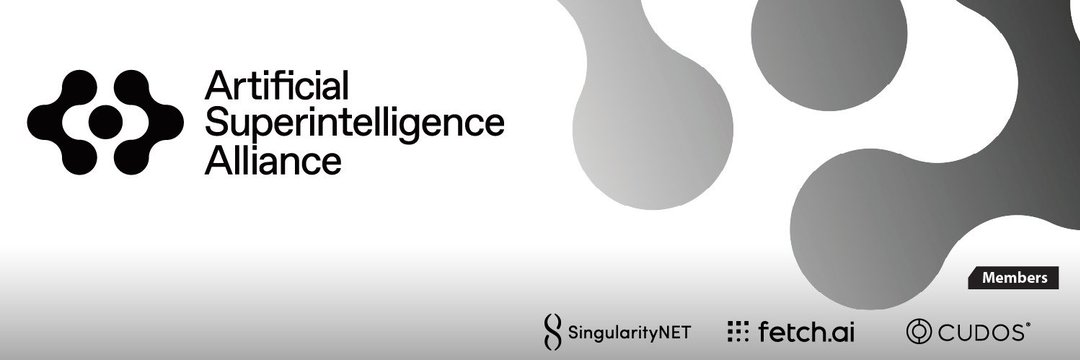
Against this backdrop, the Artificial Superintelligence Alliance (ASI) officially emerged. Jointly advanced by Fetch.ai, SingularityNET, and CUDOS, it aims to build the world’s largest open source decentralized AGI network. By combining blockchain with AI technology, ASI seeks to make AI resources, models, and computing power more open and shareable.
The Background and Goals of the Artificial Superintelligence Alliance
The core vision of the Artificial Superintelligence Alliance is to create the world’s largest decentralized AGI ecosystem. The alliance has set out a very clear direction:
“The world’s largest open-source initiative dedicated to decentralized AGI.”
Put simply, ASI wants to move AI from a closed model toward an open one, so that AI is no longer controlled by a small number of technology giants, but built collectively by developers, businesses, and communities around the world.
The alliance is mainly made up of three projects: Fetch.ai, SingularityNET, and CUDOS. Each focuses on a different area, including AI Agents, an AI services marketplace, and decentralized computing power, together forming a complete AI infrastructure stack.
Fetch.ai’s Role in the ASI Ecosystem
Fetch.ai is one of the core technology projects within the ASI alliance, with a primary focus on Autonomous Agents, namely AI Agent networks.
AI Agents can be understood as software-based intelligent agents capable of completing tasks on their own. For example, they can automatically analyze data, execute trades, search for service resources, and even handle supply chain optimization and automated collaboration.
The Agentverse platform launched by Fetch.ai further lowers the barrier to developing AI Agents. Developers can quickly create Agents and deploy them to a decentralized network, enabling automated AI collaboration and intelligent economic systems.
As AI Automation becomes increasingly widespread, Fetch.ai has also gradually become an important infrastructure project in the Web3 AI Agent sector.
SingularityNET and the AI Marketplace
While Fetch.ai is responsible for AI Agents, SingularityNET is more focused on the AI services marketplace.
SingularityNET’s core goal is to build an open AI Marketplace. Developers can publish AI models, sell AI services, and share AI data resources on the platform.
This model means AI no longer has to rely on centralized platforms. Instead, it can form an open AI economic network.
In addition, SingularityNET founder Ben Goertzel has long promoted the concept of AGI, which gives the ASI alliance considerable influence in the narratives around superintelligence and AGI.
How CUDOS Provides AI Computing Power
One of the biggest bottlenecks in the AI industry is GPU computing power.
CUDOS’s role is to provide decentralized computing capabilities for ASI, including GPU networks, cloud computing resources, and AI inference capacity.
This means ASI does not only have AI Agents and an AI Marketplace. It also has support from the underlying computing layer.
As a result, the ecosystem is gradually forming a complete closed loop:
-
Fetch.ai is responsible for AI Agents
-
SingularityNET provides the AI services marketplace
-
CUDOS provides decentralized computing power
Together, these three projects make ASI one of the few projects in the AI Crypto sector with a complete AI infrastructure layout.
What Is the FET Token Used For?
FET is the core token of the Artificial Superintelligence Alliance ecosystem.
Its first function is network payment. Users need to pay FET when calling AI services, using Agents, or accessing data.
Second, FET also serves as the medium of interaction between AI Agents. In the future, AI Agents may collaborate and transact autonomously, while FET handles the value settlement within those interactions.
In addition, FET supports staking and governance. Users can help maintain network security through staking and vote on ecosystem proposals.
For developers and data contributors, FET is also an important tool for ecosystem incentives.
Core Advantages of the Artificial Superintelligence Alliance
The biggest feature of the Artificial Superintelligence Alliance is that it is not a single AI project, but a complete Web3 AI infrastructure ecosystem.
It brings together AI Agents, distributed computing power, decentralized data networks, and an AI Marketplace, while attempting to build an open AGI network.
Compared with traditional AI platforms, ASI places greater emphasis on openness, transparency, and community governance.
In the future AI economy, AI may no longer be merely a tool. It could become a digital economic entity capable of autonomous collaboration and transactions. ASI is building its ecosystem around this direction.
Use Cases of the Artificial Superintelligence Alliance
At present, ASI’s use cases are continuing to expand.
In DeFi, AI Agents can automatically execute trading strategies, optimize yields, and manage assets.
In enterprise settings, AI Agents can be used for supply chain management, automated customer service, data analysis, and automated procurement.
In smart cities, AI can help optimize transportation systems, logistics scheduling, and energy distribution.
At the same time, the AI data economy is another important direction. In the future, data owners may be able to sell data through decentralized networks and earn returns from it.
Challenges Facing the Artificial Superintelligence Alliance
Although ASI has a strong technical narrative, it still faces many challenges.
First, competition in the AI industry is extremely intense. In addition to traditional AI companies such as OpenAI and Google DeepMind, competing projects such as Bittensor and Render have also emerged in the Web3 AI sector.
Second, decentralized AI is still at an early stage. Most AI services today still rely on centralized cloud platforms, and market education will take time.
In addition, global AI regulation is changing rapidly, and future industry rules may affect AI Crypto projects.
Conclusion
The Artificial Superintelligence Alliance is one of the most representative projects in today’s AI Crypto sector. By combining Fetch.ai’s AI Agent technology, SingularityNET’s AI Marketplace, and CUDOS’s distributed computing network, it is attempting to build the world’s largest decentralized AGI ecosystem.
As the convergence of AI and Web3 continues to accelerate, ASI not only represents a direction for AI infrastructure, but may also become an important part of the future AI Economy.
FAQs
What Is FET?
FET is the native token of the Artificial Superintelligence Alliance ecosystem. It is mainly used for AI service payments, Agent interactions, ecosystem incentives, and network governance.
What Does the Artificial Superintelligence Alliance Do?
ASI is a decentralized AI alliance that aims to build open AGI infrastructure and promote the development of AI Agents, computing networks, and AI data markets.
What Is the Relationship Between Fetch.ai and ASI?
Fetch.ai is one of the important members of the ASI alliance and is mainly responsible for AI Agents and automation infrastructure.
Is the Artificial Superintelligence Alliance Part of AI Crypto?
Yes. ASI belongs to the AI Crypto sector and combines artificial intelligence with blockchain technology.
What Is an AI Agent?
An AI Agent is a software based intelligent agent that can execute tasks autonomously, including analysis, collaboration, transactions, and data processing.