The article provides an expert analysis and market forecast of BOOP, a meme token within the Solana ecosystem, detailing its price history and current market position. It examines factors affecting BOOP's price, supply mechanisms, and holdings distribution, highlighting market risks and challenges. Readers gain insights into BOOP's potential investment strategies and risk management. The article is structured to offer historical context, core influencing factors, expert price forecasts, and strategic recommendations, catering to both beginner and experienced cryptocurrency investors aiming to navigate BOOP's volatile market on Gate.
Introduction: BOOP's Market Position and Investment Value
BOOP, a meme token within the Solana ecosystem, has emerged as a community-driven asset since its launch in 2025. As of December 25, 2025, BOOP's market capitalization has reached $2,241,330 USD, with a circulating supply of 273 million tokens and a price maintaining around $0.00821. This token, designed to reward meme makers and adventurers in the Solana network, is playing an increasingly significant role in the ecosystem's social and cultural layer.
This article will provide a comprehensive analysis of BOOP's price trends and market dynamics, combining historical performance patterns, market supply and demand factors, and ecosystem developments to deliver professional price forecasts and practical investment strategies for investors navigating the cryptocurrency landscape.
I. BOOP Price History Review and Current Market Status
BOOP Historical Price Evolution
- May 5, 2025: BOOP reached its all-time high (ATH) of $0.3494, marking the peak of its initial market rally in the Solana ecosystem.
- November 25, 2025: BOOP hit its all-time low (ATL) of $0.006611, reflecting significant downward pressure in the market.
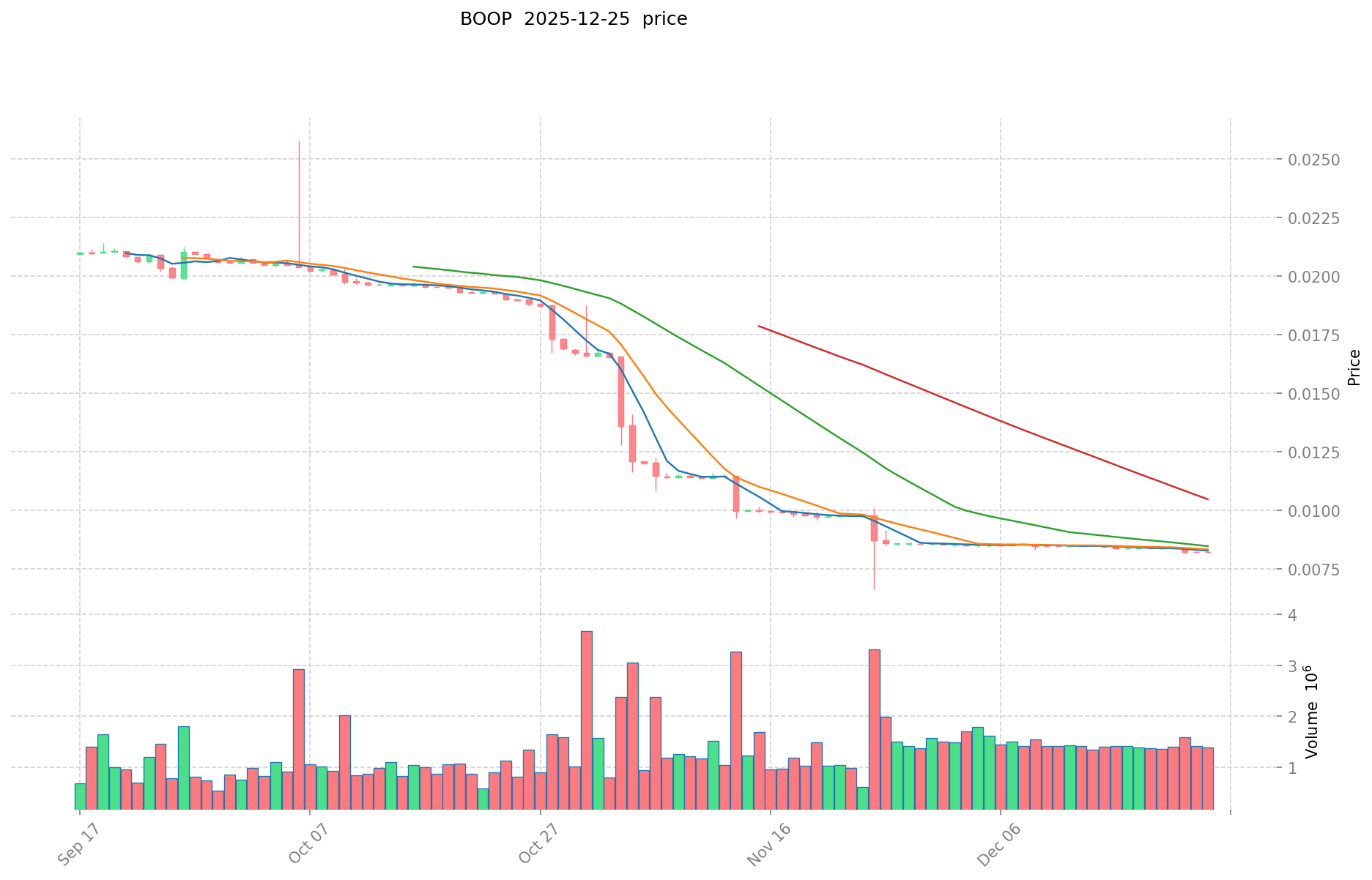
- December 25, 2025: BOOP is currently trading at $0.00821, showing continued weakness from its historical peaks.
BOOP Current Market Status
As of December 25, 2025, BOOP is trading at $0.00821 with a 24-hour trading volume of $11,737.22. The token's market capitalization stands at $2,241,330, with a fully diluted valuation (FDV) of $8,210,000.
The circulating supply is 273,000,000 BOOP tokens, representing 27.3% of the total supply of 1,000,000,000 tokens. The token maintains a market dominance of 0.00025%, ranking 2068th in the global cryptocurrency market.
Over various timeframes, BOOP has experienced notable declines: a 0.15% decrease in the past hour, a 2.22% drop over 7 days, a 15.06% decline in the past 30 days, and a substantial 52.74% decrease over the past year. With 5,989 token holders and availability on 7 exchanges, BOOP demonstrates moderate distribution across the Solana ecosystem.
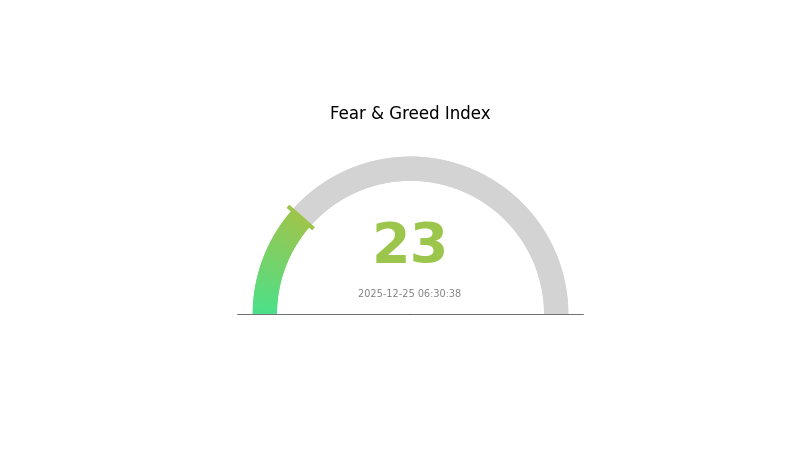
The current market sentiment indicator reflects extreme fear (VIX: 23), suggesting heightened market anxiety and volatility concerns.
Check the current BOOP market price
BOOP Market Sentiment Indicator
2025-12-25 Fear and Greed Index: 23 (Extreme Fear)
Click to view current Fear & Greed Index
The crypto market is currently experiencing extreme fear with an index reading of 23. This significant downturn reflects heightened investor anxiety and widespread bearish sentiment across digital asset markets. During periods of extreme fear, assets typically trade at substantial discounts, presenting potential opportunities for contrarian investors. However, extreme fear also signals elevated market volatility and risk. Traders should exercise caution and implement proper risk management strategies. Monitor market developments closely and consider your investment timeline and risk tolerance before making any trading decisions on Gate.com.
BOOP Holdings Distribution
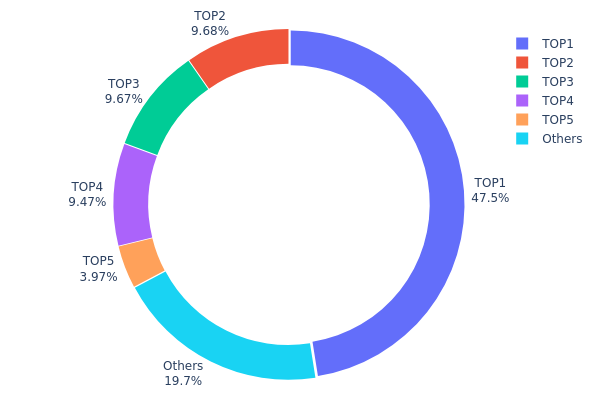
The address holdings distribution chart illustrates the concentration of token supply across blockchain addresses, serving as a critical indicator of decentralization and market structure. By analyzing the proportion of BOOP tokens held by the top addresses relative to total supply, investors and analysts can assess the level of wealth concentration, potential manipulation risks, and the overall health of the token's ecosystem. This metric reveals whether token distribution aligns with principles of decentralization or exhibits concerning centralization patterns.
BOOP currently demonstrates significant concentration risk within its holder base. The top address commands 47.49% of the total supply, while the combined top four addresses account for approximately 76.80% of all tokens in circulation. This extreme concentration, with nearly half of all tokens held by a single entity, represents a substantial departure from decentralized distribution ideals. The fifth-largest holder maintains 3.97% of supply, followed by a dispersed "Others" category comprising 19.73%, indicating that the remaining token supply is fragmented across numerous smaller addresses. Such pronounced centralization raises concerns regarding governance influence, market manipulation potential, and the vulnerability of price stability to coordinated actions by major holders.
The current distribution pattern suggests elevated systemic risks for BOOP. The dominance of the top four addresses creates an oligopolistic structure where a limited number of actors retain disproportionate control over token supply and voting mechanisms. This configuration increases exposure to potential "whale-driven" price volatility, as large liquidations or strategic accumulations by these major holders could substantially impact market dynamics. Furthermore, the minimal participation of smaller stakeholders in total supply allocation indicates a market structure that remains heavily dependent on institutional or early-stage investor sentiment rather than distributed community engagement.
Click to view current BOOP Holdings Distribution
| Top |
Address |
Holding Qty |
Holding (%) |
| 1 |
2THWjM...5XWxZj |
474975.00K |
47.49% |
| 2 |
AfafpH...AeRY2W |
96750.00K |
9.67% |
| 3 |
GUEcNE...4Jy64X |
96740.00K |
9.67% |
| 4 |
8QwU16...1YTauF |
94704.33K |
9.47% |
| 5 |
4KDdoC...F36Fgz |
39700.36K |
3.97% |
| - |
Others |
197122.01K |
19.73% |
Core Factors Influencing BOOP's Future Price
Supply Mechanism
-
Daily Emission Pool Distribution: BOOP distributes 1 million tokens daily through its Emission Pool, which is divided equally among all meme coins that successfully launch to external liquidity pools on the day. Participants who hold successful meme tokens receive airdrops without requiring BOOP staking.
-
Staking Rewards Structure: Users who stake over 10,000 BOOP tokens receive 5% of newly launched meme coin token supplies as airdrops. Successful token launches trigger trading activity with 1% fees, of which 60% is distributed to BOOP stakers, creating a passive income mechanism similar to shareholder dividends.
-
Historical Impact: The platform's innovative fee-sharing model differentiates BOOP from competing meme launch platforms like Pump.fun, which historically extracted fees without meaningful distribution to token holders. This distribution mechanism creates ongoing demand for BOOP staking and holding.
-
Current Supply Dynamics: As a newer competitor in the meme coin launch space (launched in 2025), BOOP's supply mechanics were designed to address "pump and dump" problems plaguing the meme market by incentivizing long-term holding through passive rewards rather than speculation-driven trading patterns.
Institutional and Major Holder Dynamics
-
Exchange Listings: BOOP was listed on major cryptocurrency trading platforms including Gate.com's Launchpool, providing institutional-grade liquidity and accessibility. The token also appeared on Alpha programs, indicating professional trader interest and validation.
-
Developer Background: BOOP was developed by Dingaling, a prominent PancakeSwap co-founder and noted NFT collector, lending credibility and industry experience to the project's development and governance.
Market Competition and Ecosystem Position
-
Competitive Landscape: BOOP operates within the meme token launch platform sector, competing against established platforms like Pump.fun, which has generated over $670 million in trading fees since launch and created over 8 million tokens. As of mid-2025, new entrants including LetsBonk, Believe, and BOOP were gaining market share from Pump.fun's previously unchallenged dominance.
-
Platform Innovation: BOOP integrated mechanisms from both Pump.fun and Believe platforms, offering dual token deployment pathways: direct creation through the platform interface or triggering chain deployment via X (formerly Twitter) posts tagged with @beeponboop. This dual-pathway approach provides flexible access for different user preferences.
-
Market Momentum: BOOP reached a $500 million market valuation within one day of launch, demonstrating strong community engagement and market receptivity. The platform's market position reflects growing demand for alternative launch platforms offering better fee distribution to participants compared to market incumbents.
Technical Architecture and Ecosystem Applications
-
Platform Mechanism: BOOP operates on Solana blockchain, leveraging the network's low transaction costs and high throughput. The platform uses bonding curve mechanics for initial token distribution, with automatic liquidity migration to external trading pools upon successful launch thresholds.
-
Community-Driven Narrative: BOOP builds community identity through subcultural labels including "online addicts" and "meme creators," combined with cult-like propagation mechanisms via KOL (Key Opinion Leader) partnerships and social media integration, particularly on X platform.
-
User Participation Pathways: The ecosystem supports three primary user strategies: token creators launching meme coins for Emission Pool rewards, token buyers attempting early-stage profits, and BOOP stakers capturing long-term passive revenue streams from platform trading fees and airdrop allocations.
III. BOOP Price Forecast 2025-2030
2025 Outlook
- Conservative forecast: $0.00534 - $0.00821
- Base case forecast: $0.00821
- Optimistic forecast: $0.00961
2026-2027 Medium-term Outlook
- Market phase expectation: Gradual consolidation with modest recovery trajectory
- Price range predictions:
- 2026: $0.00846 - $0.00927
- 2027: $0.00463 - $0.01227
- Key catalysts: Improved market sentiment, ecosystem development, and increased institutional adoption of BOOP tokens on platforms like Gate.com
2028-2030 Long-term Outlook
- Base case scenario: $0.01068 - $0.01420 (2028), progressing to $0.01468 average by 2030 with conservative growth assumptions
- Optimistic scenario: $0.01692 - $0.01420 (2029), reaching $0.01688 - $0.01420 range (2030) with sustained market recovery and positive regulatory environment
- Transformational scenario: $0.01688+ by 2030, contingent on breakthrough technological innovations, major partnership announcements, and widespread mainstream adoption driving cumulative gains of approximately 78% from 2025 baseline levels
Price forecasts are subject to market volatility and should be reviewed regularly. Investors are advised to conduct independent research and consider risk tolerance before making investment decisions on Gate.com or other platforms.
| 年份 |
预测最高价 |
预测平均价格 |
预测最低价 |
涨跌幅 |
| 2025 |
0.00961 |
0.00821 |
0.00534 |
0 |
| 2026 |
0.00927 |
0.00891 |
0.00846 |
8 |
| 2027 |
0.01227 |
0.00909 |
0.00463 |
10 |
| 2028 |
0.0142 |
0.01068 |
0.00694 |
30 |
| 2029 |
0.01692 |
0.01244 |
0.0092 |
51 |
| 2030 |
0.01688 |
0.01468 |
0.00822 |
78 |
BOOP Investment Strategy and Risk Management Report
IV. BOOP Professional Investment Strategy and Risk Management
BOOP Investment Methodology
(1) Long-term Holding Strategy
- Suitable for: Risk-averse investors and long-term believers in the Solana ecosystem meme culture
- Operational recommendations:
- Dollar-cost averaging (DCA): Purchase BOOP at regular intervals to reduce the impact of price volatility
- Hold through market cycles: Maintain positions during downturns, as meme tokens can experience significant recovery periods
- Reinvest gains strategically: Consider accumulating additional BOOP during price dips below the historical support level of $0.006611
(2) Active Trading Strategy
- Technical analysis considerations:
- Price action analysis: Monitor resistance at $0.008211 and support levels established during recent trading
- Volume tracking: Observe 24-hour volume patterns (current 24h volume: $11,737.22) to identify entry and exit signals
- Wave operation highlights:
- Capitalize on the -52.74% 1-year decline: Identify potential reversal patterns as the token trades significantly below its all-time high of $0.3494
- Monitor sentiment shifts: Track community engagement on social channels to anticipate momentum changes
BOOP Risk Management Framework
(1) Asset Allocation Principles
- Conservative investors: 0.5-1.5% of total crypto portfolio
- Active investors: 1.5-3% of total crypto portfolio
- Professional investors: 3-5% of total crypto portfolio (with hedging strategies)
(2) Risk Hedging Approaches
- Position sizing discipline: Limit single transactions to prevent excessive exposure to volatility
- Portfolio diversification: Balance BOOP holdings with established layer-1 blockchain tokens to mitigate concentration risk
(3) Secure Storage Solutions
- Self-custody approach: Store BOOP tokens on the Solana blockchain using secure wallet solutions
- Security best practices: Never share private keys, enable multi-signature verification when possible, and maintain backup recovery phrases in secure offline locations
V. BOOP Potential Risks and Challenges
BOOP Market Risk
- Extreme volatility exposure: BOOP has declined 52.74% over one year and 15.06% over 30 days, reflecting high price instability typical of meme tokens
- Liquidity risk: With a circulating supply of 273 million tokens and relatively modest 24-hour volume, sudden large trades could cause significant slippage
- Market concentration: Only 7 exchanges currently list BOOP, limiting diversified trading venues and potentially creating bottlenecks during high-demand periods
BOOP Regulatory Risk
- Evolving regulatory landscape: Meme tokens face increasing scrutiny from regulators examining speculative digital assets
- Compliance uncertainty: Changes in Solana ecosystem regulations could impact BOOP's operational viability
- Classification ambiguity: Potential reclassification of meme tokens as securities could create unforeseen legal constraints
BOOP Technical Risk
- Smart contract vulnerability: Any unaudited code or exploitable functions in the BOOP contract could lead to permanent loss of funds
- Blockchain network dependency: BOOP operates exclusively on Solana; any network outages or technical failures would directly impact token accessibility
- Token supply dilution: With only 27.3% of maximum supply currently circulating, future token releases could dramatically increase supply and depress prices
VI. Conclusion and Action Recommendations
BOOP Investment Value Assessment
BOOP represents a speculative meme token within the Solana ecosystem designed to reward creators and community participants. The project demonstrates community engagement with 5,989 active holders and a market cap of $2,241,330. However, the substantial 52.74% annual decline from its $0.3494 all-time high suggests significant risk factors. Investors should approach BOOP primarily as a high-risk, high-reward speculation rather than a core portfolio holding. The token's value is heavily dependent on community sentiment and Solana ecosystem momentum rather than fundamental utility.
BOOP Investment Recommendations
✅ Beginners: Start with minimal positions (0.25-0.5% of crypto allocation) through dollar-cost averaging on Gate.com, focusing on understanding meme token dynamics before increasing exposure
✅ Experienced investors: Employ technical analysis to identify accumulation zones near the $0.006611 historical low, while maintaining strict stop-losses at 20-30% below entry points
✅ Institutional investors: Conduct comprehensive smart contract audits and regulatory analysis before institutional participation; consider BOOP only as a diversification play within emerging asset class research portfolios
BOOP Trading Participation Methods
- Direct spot trading: Purchase BOOP directly on Gate.com using SOL or USDT trading pairs for immediate ownership
- Limit order strategies: Set buy orders at identified support levels to automate accumulation during downturns
- Staking and rewards: Monitor community announcements for BOOP holder incentive programs or ecosystem participation opportunities
Cryptocurrency investment carries extreme risk. This report does not constitute investment advice. Investors should make decisions based on their individual risk tolerance and consult professional financial advisors. Never invest more than you can afford to lose.
FAQ
What is BOOP token? What are its main uses and application scenarios?
BOOP is a decentralized platform token built on blockchain technology, primarily used for asset and transaction verification. It provides secure and transparent verification in decentralized transactions, enabling users to conduct trustless and efficient exchanges across the Web3 ecosystem.
What are the main factors affecting BOOP price?
BOOP price is primarily influenced by market sentiment, regulatory policies, trading volume, and overall crypto market conditions. Investor confidence and macroeconomic factors also play significant roles in price movements.
How to predict BOOP price? What are the analysis methods?
Use technical analysis methods including moving averages (50-day and 200-day SMA) and Relative Strength Index (RSI 14). Based on technical indicators, BOOP is predicted to reach $0.000033 in 2025, with long-term potential reaching $0.000175 by 2032.
BOOP's all-time high was BTC0.00002215, with an all-time low of BTC0.076949. Current price is 98.00% below the peak and 63.70% above the lowest point, showing significant historical volatility in the market.
What are the risks of investing in BOOP? What should I pay attention to?
BOOP investment carries high market volatility. Research the project whitepaper, team background, and tokenomics thoroughly. Understand current market conditions before investing. Diversify your portfolio and only invest capital you can afford to lose.
What are the advantages or disadvantages of BOOP compared to similar tokens?
BOOP offers unique incentive mechanisms for token holders and promoters through its innovative distribution model. However, it faces challenges with limited mainstream adoption compared to established tokens. Success depends on active community participation and network growth.
What are the prospects of BOOP in 2024 and beyond?
BOOP shows strong momentum with growing platform adoption and community engagement. The token's utility within the ecosystem continues to expand, supported by increasing transaction volume and developer interest. Future growth depends on sustained innovation and market dynamics.
* The information is not intended to be and does not constitute financial advice or any other recommendation of any sort offered or endorsed by Gate.