The article provides a detailed analysis of Dill (DL) price predictions through 2030, focusing on its market position, investment potential, and price trajectory influenced by macroeconomic factors. It explores DL's historical performance, current market status, risks, and strategic investment methods tailored for different investor types. Key topics include macroeconomic impacts, government policies, and DL's market risks, offering a professional forecast and investment strategy. Primarily targeting cryptocurrency investors, the article utilizes simplified structure and strategic keywords for enhanced readability and quick scanning.
Introduction: Market Position and Investment Value of DL
Dill (DL) is a next-generation blockchain with maximum decentralization and infinite scalability, empowering decentralized applications that demand high performance and sovereignty, particularly in gaming and agentic applications. Since its launch, Dill has gained significant traction backed by leading venture firms and ecosystem partners. As of December 2025, Dill's market capitalization stands at $13.46 million with a circulating supply of 1.185 billion tokens, currently trading at $0.002244. This innovative blockchain platform, characterized by its "modular architecture with permissionless validation," is playing an increasingly critical role in enabling scalable and decentralized application ecosystems.
This article will provide a comprehensive analysis of DL's price trajectory through 2030, integrating historical performance patterns, market supply and demand dynamics, ecosystem development milestones, and macroeconomic factors to deliver professional price forecasts and actionable investment strategies for cryptocurrency investors.
I. DL Price History Review and Current Market Status
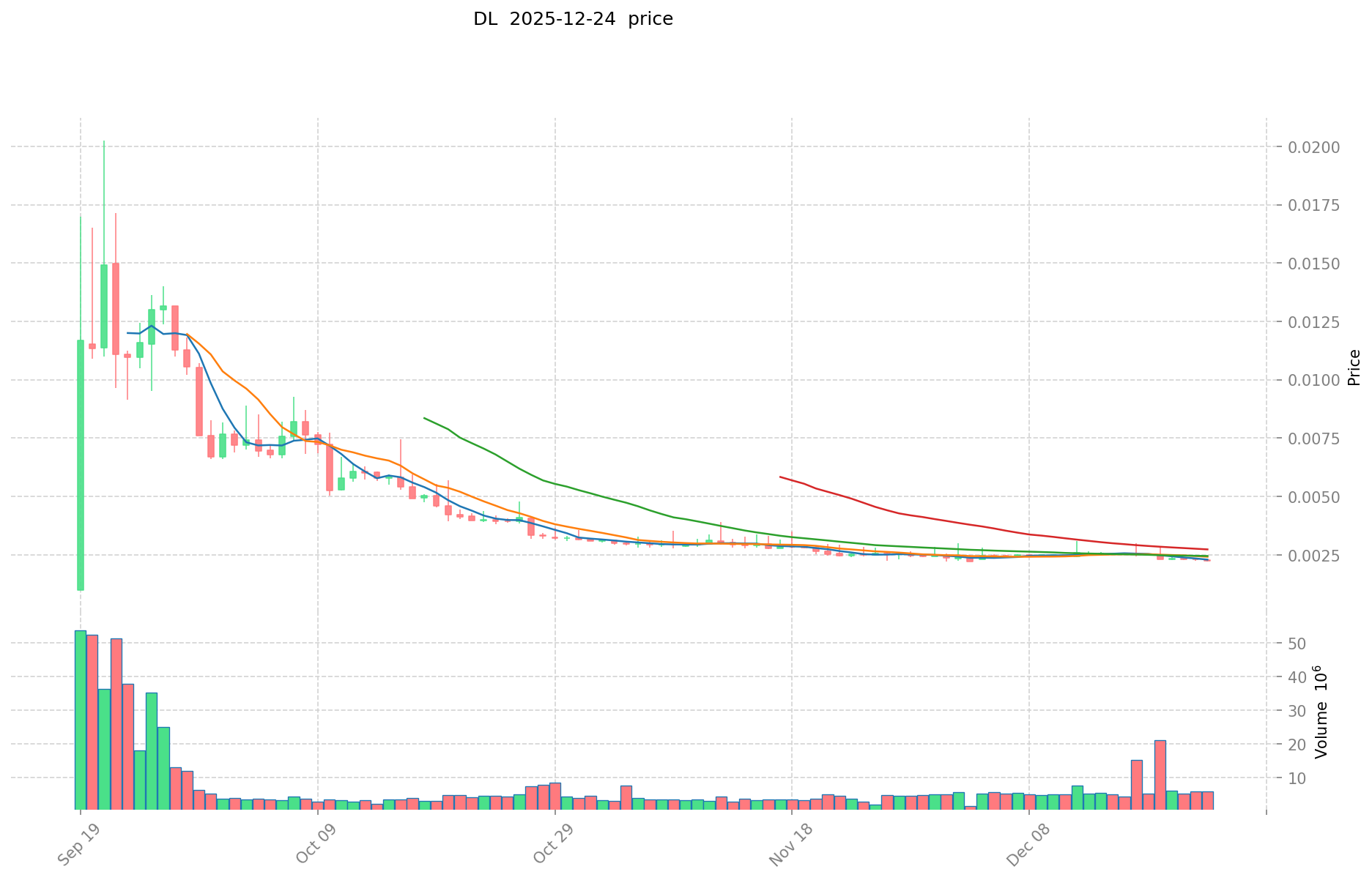
DL Historical Price Movement Trajectory
Based on available data, Dill (DL) reached its all-time high (ATH) of $0.02025 on September 21, 2025, followed by a sharp decline to its all-time low (ATL) of $0.001 on September 19, 2025, marking a significant volatility period in the token's early trading history.
DL Current Market Conditions
As of December 25, 2025, DL is trading at $0.002244, with a 24-hour trading volume of $11,995.84. The token has experienced a marginal 24-hour price decline of -0.17%, while showing modest hourly gains of +0.19%. Over the extended timeframe, DL has faced considerable selling pressure, declining -11.62% over the past 7 days and -10.95% over the past 30 days, with a year-to-date performance of -85.079%.
The token's market capitalization stands at $2,659,140 with a fully diluted valuation of $13,464,000, reflecting a circulating supply of 1,185,000,000 DL tokens out of a total supply of 6,000,000,000 tokens. Currently, DL holds a market ranking of 1,952, with a market dominance of 0.00042%. The token maintains presence across 6 exchanges and serves a holder base of 3,135 addresses, demonstrating active but limited market participation.
Click to view current DL market price
DL Market Sentiment Indicator
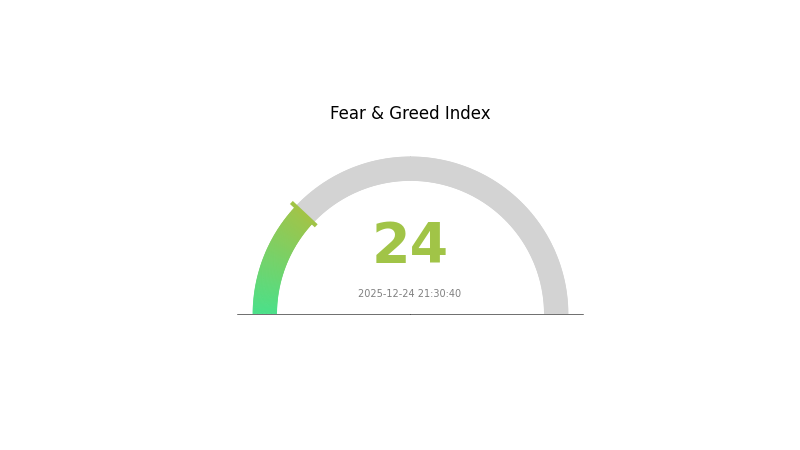
2025-12-24 Fear and Greed Index: 24 (Extreme Fear)
Click to view current Fear & Greed Index
The crypto market is currently experiencing extreme fear, with the Fear and Greed Index at 24. This significant drop indicates heightened market anxiety and risk aversion among investors. When fear reaches such extreme levels, opportunities may emerge for contrarian investors. However, caution is advised as market volatility remains elevated. Monitor key support levels closely and consider dollar-cost averaging strategies. On Gate.com, you can track real-time market sentiment data to make informed trading decisions during this uncertain period.
DL Holdings Distribution
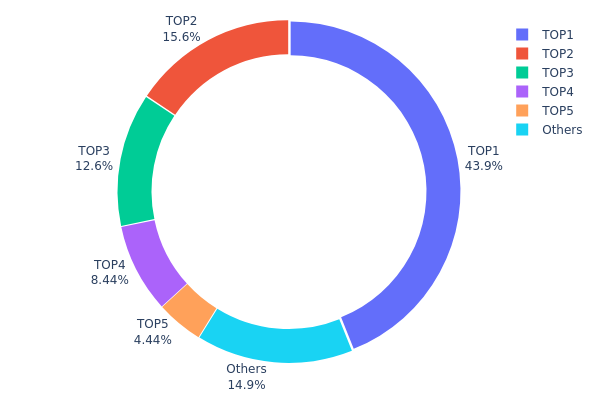
The address holdings distribution represents the concentration of token ownership across blockchain addresses, serving as a critical metric for evaluating decentralization levels and assessing potential market manipulation risks. By analyzing the top holders and their respective ownership percentages, market participants can gain insights into the token's distribution pattern and the degree of wealth concentration within the ecosystem.
The current DL holdings distribution exhibits pronounced concentration characteristics. The top address commands 43.94% of total holdings, while the combined top five addresses account for 85.09% of all circulating tokens. This distribution pattern indicates significant centralization, with the largest holder possessing nearly half of all DL tokens. The second and third-largest addresses hold 15.64% and 12.64% respectively, further reinforcing the concentration trend. The remaining 14.91% scattered across other addresses demonstrates a stark contrast, highlighting the asymmetric distribution of token ownership.
This level of concentration presents material implications for market dynamics and stability. The substantial holdings by a limited number of addresses elevate the potential for price volatility, as large-scale liquidation or accumulation by these major holders could trigger significant market movements. Furthermore, such centralization raises governance concerns and increases systemic risk, as coordinated actions by top holders could disproportionately influence protocol decisions or market sentiment. The minimal participation of smaller token holders suggests a two-tier market structure where price discovery and volatility are predominantly influenced by the actions of large stakeholders rather than broader market consensus.
For current DL holdings distribution data, please visit Gate.com.
| Top |
Address |
Holding Qty |
Holding (%) |
| 1 |
0x2f43...de5e4a |
520752.77K |
43.94% |
| 2 |
0x238a...d5e6c4 |
185357.84K |
15.64% |
| 3 |
0xbcc3...a9e684 |
149875.00K |
12.64% |
| 4 |
0xd57d...cd0711 |
99999.90K |
8.43% |
| 5 |
0xf4ce...4e1e45 |
52668.10K |
4.44% |
| - |
Others |
176346.38K |
14.91% |
II. Core Factors Influencing DL's Future Price
Macroeconomic Environment
-
Monetary Policy Impact: Central bank policy expectations represent a key driver of DL price movements. Major shifts in monetary policy from leading central banks directly influence market sentiment and asset valuations in the cryptocurrency space.
-
Inflation Hedge Properties: While current inflation levels remain relatively low, global supply chain adjustments and geopolitical risks create uncertainty regarding future inflation trajectories. Cryptocurrencies may serve as potential inflation hedges in scenarios where global demand cools or unexpected events impact import costs.
-
Geopolitical Factors: International tensions and trade dynamics significantly influence crypto market movements. Trade protectionism, supply chain reorganization, and regional economic shifts create both risks and opportunities for cryptocurrency valuations.
Government Policy Impact
-
National-Level Policies: Government policy changes at the national level have direct impacts on DL market capitalization. Regulatory frameworks and policy shifts shape investor confidence and market behavior.
-
Regulatory Environment: Supportive or restrictive regulatory approaches by governments influence institutional adoption and broader market participation in cryptocurrency ecosystems.
Three、2025-2030 DL Price Forecast
2025 Outlook
- Conservative Forecast: $0.00152 - $0.00224
- Neutral Forecast: $0.00224
- Optimistic Forecast: $0.00323 (requires sustained market demand and positive regulatory developments)
2026-2028 Mid-term Outlook
- Market Phase Expectation: Consolidation phase with gradual upward trajectory as adoption metrics improve and market sentiment stabilizes following the 2025 base period.
- Price Range Predictions:
- 2026: $0.00139 - $0.00339 (21% potential upside)
- 2027: $0.00208 - $0.00413 (36% potential upside)
- 2028: $0.00223 - $0.00471 (60% potential upside)
- Key Catalysts: Ecosystem expansion, increased institutional participation on platforms such as Gate.com, growing developer community engagement, and enhanced tokenomics implementation.
2029-2030 Long-term Outlook
- Base Case: $0.00299 - $0.00536 (85% potential gain by 2029), assuming moderate adoption acceleration and stable macroeconomic conditions.
- Optimistic Case: $0.00452 - $0.00581 (112% potential gain by 2030), assuming significant network effects, strategic partnerships, and mainstream adoption milestones.
- Transformational Case: Above $0.00581, contingent upon breakthrough technological innovations, major enterprise integration, and favorable regulatory clarity across key markets.
- 2030-12-25: DL reaching $0.00581 represents a stabilized maturation phase with established market presence and institutional recognition.
| 年份 |
预测最高价 |
预测平均价格 |
预测最低价 |
涨跌幅 |
| 2025 |
0.00323 |
0.00224 |
0.00152 |
0 |
| 2026 |
0.00339 |
0.00273 |
0.00139 |
21 |
| 2027 |
0.00413 |
0.00306 |
0.00208 |
36 |
| 2028 |
0.00471 |
0.0036 |
0.00223 |
60 |
| 2029 |
0.00536 |
0.00416 |
0.00299 |
85 |
| 2030 |
0.00581 |
0.00476 |
0.00452 |
112 |
Dill (DL) Professional Investment Strategy and Risk Management Report
IV. DL Professional Investment Strategy and Risk Management
DL Investment Methodology
(1) Long-term Holding Strategy
- Target Investors: Risk-averse investors and blockchain infrastructure believers
- Operational Recommendations:
- Accumulate DL tokens during market downturns to build long-term positions aligned with the mainnet development roadmap
- Participate in the Minipool staking mechanism to earn staking rewards while supporting network decentralization
- Monitor validator partnerships expansion (currently 30+ partners including P2P and InfStones) as an indicator of ecosystem maturity
(2) Active Trading Strategy
- Technical Analysis Tools:
- Price Action Analysis: Monitor 24-hour trading ranges (currently $0.002241-$0.002249) and volume patterns to identify entry/exit points
- Trend Following: Track the 7-day performance (-11.62%) and 30-day metrics (-10.95%) to identify potential reversal zones
- Wave Trading Highlights:
- Monitor all-time high ($0.02025 on September 21, 2025) and all-time low ($0.001 on September 19, 2025) as resistance and support levels
- Consider accumulation opportunities when prices approach historical lows, given the project's strong institutional backing from FSL, Modular Capital, and Binance incubator
DL Risk Management Framework
(1) Asset Allocation Principles
- Conservative Investors: 1-2% of total portfolio
- Active Investors: 3-5% of total portfolio
- Professional Investors: 5-10% of total portfolio
(2) Risk Hedging Solutions
- Staking Participation: Lock tokens in Minipool staking to generate passive income while reducing portfolio volatility
- Dollar-Cost Averaging (DCA): Deploy capital evenly over time rather than lump-sum purchases to mitigate timing risk
(3) Secure Storage Solutions
- Hardware wallet Solution: Utilize cold storage methods for holdings exceeding $10,000 to protect against exchange counterparty risks
- Exchange Storage: For active trading, maintain tokens on Gate.com with two-factor authentication enabled
- Security Precautions: Never share private keys, enable withdrawal whitelisting, and regularly audit account permissions
V. DL Potential Risks and Challenges
DL Market Risks
- Liquidity Concentration: Currently trading on only 6 exchanges with $11,995.84 USD 24-hour volume, creating potential slippage for large orders
- Price Volatility: Historical performance shows -85.079% decline over one year, indicating extreme market risk and speculative behavior
- Low Circulation Ratio: Only 19.75% of total supply in circulation (1.185 billion of 6 billion tokens), with significant dilution risk from future token releases
DL Regulatory Risks
- Jurisdictional Uncertainty: As an emerging blockchain infrastructure project, regulatory classification remains uncertain across major markets
- Compliance Evolution: Changes in cryptocurrency regulations, particularly regarding staking mechanisms and validator requirements, could impact network operations
- Token Classification: Regulatory determination of DL token status (security vs. utility) could trigger compliance requirements or trading restrictions
DL Technical Risks
- Mainnet Execution: While the project promises 800k TPS and 20MB/s throughput, real-world performance remains to be demonstrated at scale
- Validator Network Stability: Supporting up to 1 million permissionless nodes presents unprecedented operational challenges and potential centralization risks
- Smart Contract Security: Audits and vulnerability assessments of DL's core protocol remain critical factors for long-term viability
VI. Conclusion and Action Recommendations
DL Investment Value Assessment
Dill represents a high-risk, high-potential-reward investment in innovative blockchain infrastructure. The project benefits from distinguished backing by FSL, Modular Capital, and Binance incubator, with a clear technical roadmap targeting gaming, AI agents, and decentralized applications. However, significant execution risks remain: the token is down 85% year-over-year, trading volume is limited ($11,995.84 daily), and only 19.75% of tokens are circulating. Success depends on delivering promised scalability (800k TPS) and attracting substantial developer and validator adoption. Early-stage positioning offers asymmetric upside but requires high risk tolerance.
DL Investment Recommendations
✅ Beginners: Start with a 1-2% portfolio allocation through micro-purchases on Gate.com, focus on understanding the Minipool staking mechanism before committing capital, and treat this as a speculative holding only
✅ Experienced Investors: Deploy 3-5% allocation with DCA strategy over 6-12 months, actively monitor validator partnership announcements and mainnet milestone progress, and consider staking participation for yield generation
✅ Institutional Investors: Conduct deep technical audits of the protocol and smart contracts, evaluate validator partner infrastructure quality (P2P, InfStones), and structure positions through derivatives or secondary offerings aligned with institutional risk frameworks
DL Trading Participation Methods
- Gate.com Spot Trading: Purchase DL directly against stablecoins using Gate.com's trading interface
- Staking Participation: Engage with Minipool staking mechanism through the Dill protocol to earn rewards (rates not specified in current data)
- Validator Participation: For technical users with sufficient capital, consider running an independent validator node to support network security and earn block rewards
Cryptocurrency investments carry extreme risk. This report does not constitute investment advice. Investors must make decisions based on their individual risk tolerance and financial situation. Consult qualified financial advisors before investing. Never invest more capital than you can afford to lose completely.
FAQ
What is the price prediction for NVDA in 2030?
Based on current market trends, NVDA is predicted to trade between $558.41 and $883.62 by 2030. This forecast reflects the expected growth trajectory of NVIDIA in the coming years.
Which coin price prediction 2025?
Ethereum is predicted to reach $5,190 in 2025. Dogecoin is forecasted to range from $0.15 to $0.66. Bitcoin Cash is expected to find key support at $0.24 in 2025.
Which AI is best for stock price prediction?
For DL price prediction, hybrid AI models combining DDG-DA with Temporal Fusion Transformer (TFT) work best. DDG-DA adapts to market changes, while TFT handles temporal patterns. ADARNN and HIST models also deliver strong results by capturing sector relationships and market dynamics effectively.
Can deep learning predict the stock market?
Deep learning can identify complex patterns in historical market data to predict price trends. Its effectiveness varies based on model accuracy and market conditions, showing particular potential for longer-term predictions.
What are the main deep learning models used for price prediction?
The primary deep learning models for price prediction include LSTM (Long Short-Term Memory) networks and CNNs (Convolutional Neural Networks). LSTM networks excel at capturing temporal patterns in sequential data, while CNNs are effective for identifying spatial features. These models are widely adopted for analyzing historical price data and predicting future market movements.
How accurate is deep learning for price forecasting compared to traditional methods?
Deep learning significantly outperforms traditional methods, with LSTM models achieving up to 53% reduction in RMSE compared to econometric approaches like ARIMA, delivering superior accuracy for cryptocurrency price prediction.
What data do you need to build a deep learning price prediction model?
Historical price data (open, close, high, low), trading volume, technical indicators, and market sentiment data from news or social media are essential for building an accurate deep learning price prediction model.
* The information is not intended to be and does not constitute financial advice or any other recommendation of any sort offered or endorsed by Gate.