The article provides an in-depth analysis of RAI's price prediction for 2025-2030, focusing on its unique position as a non-pegged, ETH-backed stable asset in DeFi. It examines RAI's historical price movements, current market conditions, and factors affecting future pricing, such as macroeconomic trends and technological innovations. The article also outlines professional investment strategies and risk management practices for different investor profiles, emphasizing RAI's potential as a stable asset with interest yield opportunities. Ideal for sophisticated crypto investors seeking stable, decentralized investment options, it delivers actionable insights and investment strategies.
Introduction: RAI's Market Position and Investment Value
RAI (Rai Reflex Index) is a non-pegged, ETH-backed stable asset that stands out in the decentralized finance landscape. Since its inception in February 2021, RAI has established itself as a unique monetary instrument that maintains stability relative to ETH and BTC while generating interest yield. As of December 2025, RAI's market capitalization has reached approximately $1.90 million, with a circulating supply of approximately 565,061 tokens, trading at around $3.36 per token. This innovative asset, recognized as a "decentralized stable asset without external peg," is increasingly playing a crucial role in DeFi protocols and collateral management strategies.
The Reflexer platform, which powers RAI, enables users to issue the Reflex Index using their own encrypted collateral, creating a stable asset fundamentally uncoupled from traditional financial instruments—a paradigm shift similar to how fiat currencies operate independently. RAI demonstrates superior stability characteristics compared to other DeFi protocols while offering attractive yield opportunities, making it an compelling option for sophisticated crypto investors seeking alternative value storage mechanisms.
This article will comprehensively analyze RAI's price movements from 2025 through 2030, integrating historical patterns, market supply-demand dynamics, ecosystem development, and macroeconomic factors to deliver professional price forecasts and actionable investment strategies for discerning market participants.
I. RAI Price History Review and Current Market Status
RAI Historical Price Trajectory
Based on available data, RAI reached its all-time high (ATH) of $5.80 on August 25, 2025, representing a significant peak in the token's trading history. The all-time low (ATL) of $2.44 was recorded on October 8, 2023, establishing the lower boundary of the asset's price range.
Over the one-year period, RAI has demonstrated substantial growth, appreciating by 31.11% year-over-year, reflecting a positive long-term trajectory for the token.
RAI Current Market Status
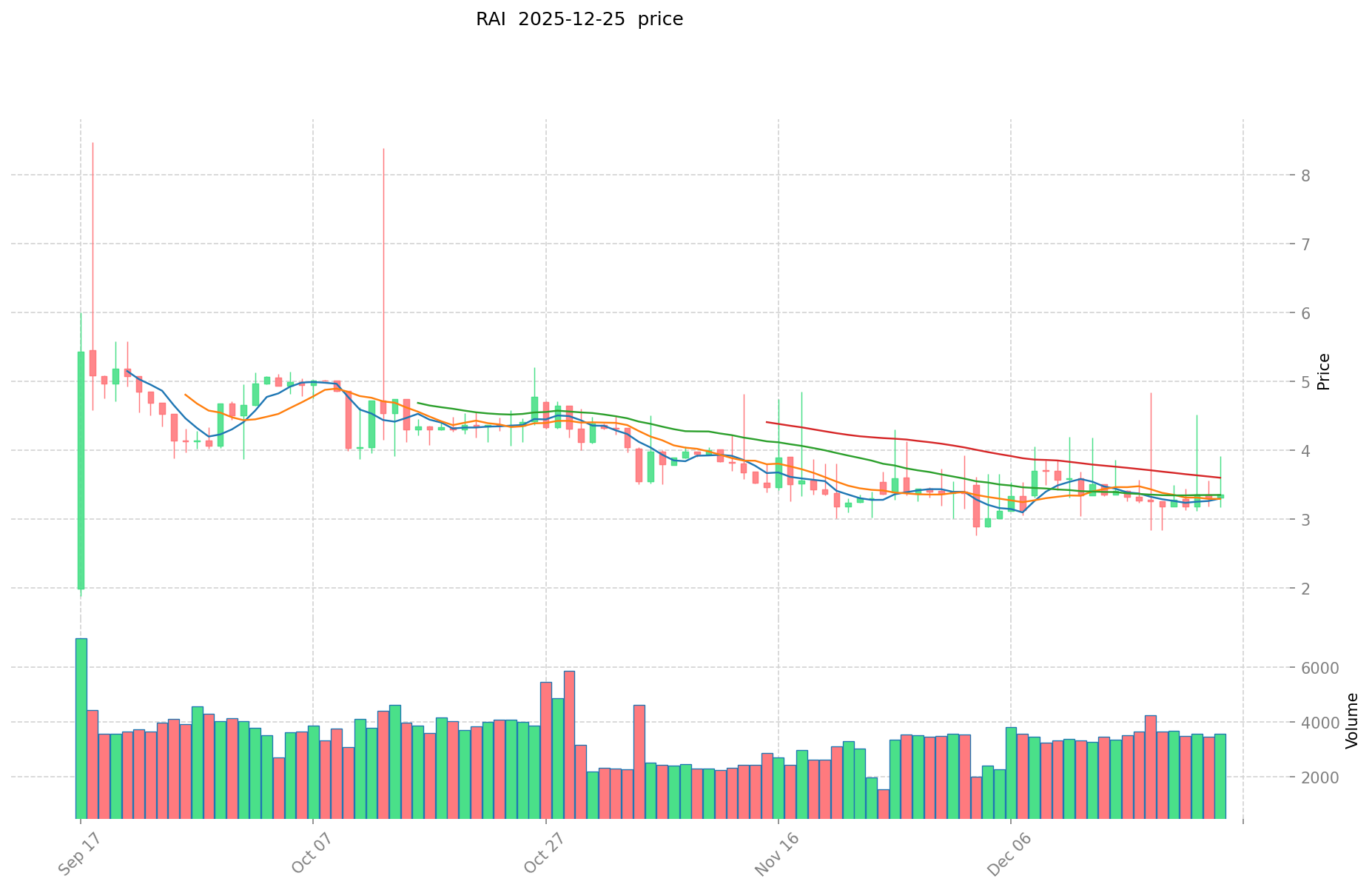
As of December 25, 2025, RAI is trading at $3.358, positioning it at a market capitalization of approximately $1.90 million with a circulating supply of 565,061.21 tokens. The token currently ranks 2,164 in market capitalization across all digital assets.
Recent price performance shows mixed momentum:
- 1-hour change: -0.21%, indicating slight downward pressure in the immediate short term
- 24-hour change: +1.51%, demonstrating recovery within the daily timeframe
- 7-day change: +2.25%, reflecting modest positive momentum over the week
- 30-day change: -4.87%, showing weakness over the monthly period
The 24-hour trading volume stands at $11,614.31, with the token fluctuating between a daily low of $3.239 and a daily high of $3.912. Current market sentiment registers at an "Extreme Fear" level (VIX: 23), suggesting heightened market anxiety conditions.
Click to view current RAI market price
RAI Market Sentiment Indicator
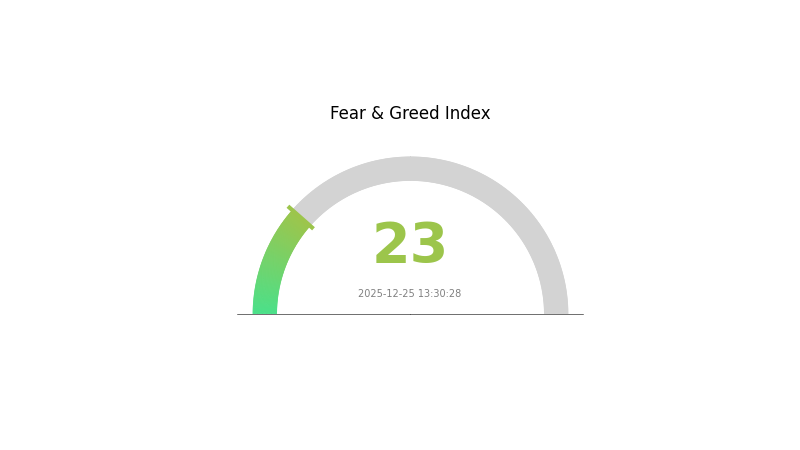
2025-12-25 Fear and Greed Index: 23(Extreme Fear)
Click to view current Fear & Greed Index
The cryptocurrency market is currently experiencing extreme fear, with the Fear and Greed Index at 23. This exceptionally low reading indicates severe market pessimism and heightened investor anxiety. Such extreme fear conditions often present contrarian opportunities for long-term investors, as assets may be oversold. However, volatility remains elevated, and traders should exercise caution with position sizing. Monitor key support levels closely and consider the broader macroeconomic context before making investment decisions on Gate.com.
RAI Holdings Distribution
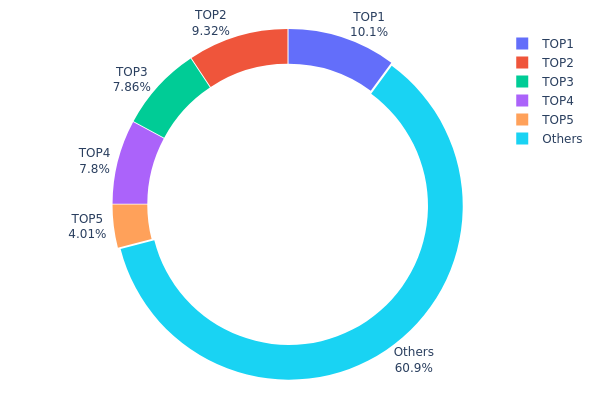
The address holdings distribution represents the concentration of RAI tokens across blockchain addresses, offering critical insights into ownership structure and market decentralization. By analyzing the top token holders and their respective percentages, we can assess the degree of wealth concentration and evaluate potential risks associated with token accumulation.
The current distribution of RAI demonstrates moderate concentration characteristics. The top four addresses collectively control approximately 35.02% of the token supply, with the largest holder commanding 10.07% and the second-largest holding 9.31%. While these figures indicate some level of concentration among principal holders, the distribution does not suggest extreme centralization. The fifth-largest address holds 4.00%, representing a significant drop-off point that suggests a more distributed structure beyond the top tier. Notably, the "Others" category encompasses 60.98% of total holdings, indicating that nearly two-thirds of RAI tokens remain distributed across the broader holder base.
This distribution pattern reflects a relatively healthy decentralization profile for RAI. The presence of a substantial "Others" segment suggests that token ownership is not dominated by a small cartel, reducing the likelihood of coordinated market manipulation through concentrated holdings. However, the combined influence of the top four addresses at approximately one-third of supply warrants monitoring, as these holders retain meaningful capacity to influence market sentiment and liquidity conditions. The gradual decline in holdings from top to secondary addresses indicates an organic distribution pattern rather than extreme concentration, positioning RAI within an acceptable range for market stability and suggesting a reasonably distributed chain-on structure.
Click to view current RAI holdings distribution
| Top |
Address |
Holding Qty |
Holding (%) |
| 1 |
0xa9d1...1d3e43 |
56.91K |
10.07% |
| 2 |
0xc9bc...2a46af |
52.65K |
9.31% |
| 3 |
0x8ae7...48a3b1 |
44.39K |
7.85% |
| 4 |
0x535d...115270 |
44.06K |
7.79% |
| 5 |
0x3a3e...061b6d |
22.65K |
4.00% |
| - |
Others |
344.40K |
60.98% |
II. Core Factors Influencing RAI's Future Price
Supply Mechanism
-
PID Control-Based Supply Adjustment: RAI employs a Proportional-Integral-Derivative (PID) controller mechanism, widely used in industrial feedback control systems, to dynamically adjust supply and stabilize the redemption price. This innovative approach allows RAI to anchor to market demand rather than to fiat currencies or physical assets.
-
Historical Performance: Since launching on February 2021 at a redemption price of $3.14, RAI has maintained exceptional price stability. Despite ETH experiencing severe volatility (ranging from $1,750 to $4,800) and RAI circulation fluctuating dramatically (from 650 million to 50 million units), the redemption price remained within a narrow band of $3.01–$3.04 until May 2022. Over its two-year operational history, RAI's price has predominantly oscillated between $2.75 and $3.05, with no liquidation events or safety incidents reported.
-
Current Impact: The proven stability of RAI's PID control mechanism demonstrates its ability to maintain price equilibrium even under extreme market conditions. As ETH volatility persists in the crypto markets, RAI's supply mechanism provides a reliable tool for maintaining relatively stable value for users seeking low-volatility assets backed solely by ETH collateral.
Macro-Economic Environment
-
Monetary Policy Independence: RAI addresses a critical limitation in the crypto ecosystem by achieving independent monetary policy. Unlike stablecoins pegged to the U.S. dollar (such as USDC), RAI avoids becoming a "puppet" of the Federal Reserve. This independence is crucial because if the Fed engages in unlimited monetary expansion, RAI holders remain protected from inflationary pressures transmitted through dollar-linked stablecoins.
-
Inflation Hedge Properties: RAI's non-fiat-anchored design provides intrinsic protection against inflation stemming from traditional monetary policy. While most cryptocurrencies depend on dollar-based stablecoins as their foundation, creating a systemic vulnerability to U.S. monetary decisions, RAI's ETH-collateralized structure offers genuine monetary sovereignty and resistance to external inflation pressures.
Governance and Protocol Development
-
Minimalist Governance Roadmap: Reflexer protocol has established a detailed minimalist governance pathway aimed at achieving full automation and governance-free operation within the coming years. The ultimate vision is for RAI's governance layer to control or upgrade none of the core contracts, maximizing decentralization and reducing human intervention risks.
-
System Stability Mechanisms: RAI incorporates surplus and debt auctions similar to MakerDAO. When the system experiences losses, FLX tokens are automatically minted and auctioned to maintain RAI holder interests. Conversely, system surpluses trigger discounted FLX auctions, with consumed FLX being permanently destroyed. To date, 25,057 FLX tokens have been burned, reinforcing deflationary pressure on the governance token.
-
Collateralization Efficiency: RAI maintains super-collateralization rates typically ranging between 300% and 400%, substantially higher than competing protocols like Liquity (200-260%) but lower than the broader DeFi average. This elevated collateral requirement reflects RAI's commitment to extreme decentralization and resilience, sacrificing capital efficiency for robustness and censorship resistance.
Technological Innovation
-
Pure Ideal Type of Collateralized Stablecoins: Ethereum founder Vitalik Buterin has explicitly endorsed RAI as the "pure 'ideal type' of a collateralized automated stablecoin, backed by ETH only." This validation from a founding figure underscores RAI's philosophical alignment with crypto's original anti-inflation and trustless principles.
-
Non-Pegged Design Philosophy: Unlike traditional stablecoins that anchor to fiat or real assets, RAI achieves price stability through indirect anchoring to market demand for the token itself. This revolutionary approach allows RAI to maintain the trilemma balance by prioritizing independent monetary policy and capital freedom over fixed exchange rates, enabling genuine monetary autonomy within the Ethereum ecosystem.
III. RAI Price Forecast for 2025-2030
2025 Outlook
- Conservative Forecast: $2.18-$3.36
- Neutral Forecast: $3.36
- Bullish Forecast: $3.90 (contingent on broader market recovery and increased stablecoin adoption)
2026-2028 Medium-term Outlook
- Market Stage Expectation: Consolidation phase with gradual recovery, transitioning into expansion cycle as institutional adoption accelerates
- Price Range Forecast:
- 2026: $3.48-$4.61
- 2027: $2.35-$5.93
- 2028: $2.66-$5.88
- Key Catalysts: Enhanced protocol functionality, integration with major trading platforms like Gate.com, growth in decentralized finance ecosystem, and strengthened partnerships within the crypto infrastructure sector
2029-2030 Long-term Outlook
- Base Case Scenario: $4.85-$5.71 (assumes steady adoption of RAI stablecoin in DeFi protocols and stable macroeconomic conditions)
- Bullish Case Scenario: $5.44-$6.81 (predicated on significant breakthrough in cross-chain interoperability and mainstream financial integration)
- Transformative Case Scenario: $6.81+ (extreme favorable conditions including regulatory clarity globally and RAI becoming primary reserve stablecoin across multiple blockchain networks)
- 2030-12-25: RAI approaches $6.81 (demonstrates sustained growth trajectory with 66% cumulative appreciation from 2025 baseline)
| 年份 |
预测最高价 |
预测平均价格 |
预测最低价 |
涨跌幅 |
| 2025 |
3.89528 |
3.358 |
2.1827 |
0 |
| 2026 |
4.60583 |
3.62664 |
3.48157 |
8 |
| 2027 |
5.92738 |
4.11624 |
2.34625 |
22 |
| 2028 |
5.87552 |
5.02181 |
2.66156 |
49 |
| 2029 |
5.7211 |
5.44866 |
4.84931 |
62 |
| 2030 |
6.81355 |
5.58488 |
4.63545 |
66 |
RAI (Rai Reflex Index) Professional Investment Strategy and Risk Management Report
IV. RAI Professional Investment Strategy and Risk Management
RAI Investment Methodology
(1) Long-term Holding Strategy
-
Target Investor Profile: Conservative investors seeking stable asset exposure with interest income potential; DeFi protocol participants looking for ETH-collateralized alternatives to traditional stablecoins.
-
Operational Recommendations:
- Dollar-cost averaging (DCA): Accumulate RAI systematically over time to reduce entry price volatility, particularly given RAI's historical price range of $2.44 to $5.80.
- Stake RAI in approved protocols: Explore yield-generating opportunities within the Reflexer ecosystem to capture interest income benefits.
- Hold through market cycles: RAI demonstrated a 31.11% one-year gain, suggesting long-term appreciation potential despite short-term volatility.
-
Storage Solution:
- Utilize Gate Web3 Wallet for secure custody of RAI tokens on the Ethereum network, enabling direct access to DeFi protocols and earning mechanisms.
(2) Active Trading Strategy
RAI Risk Management Framework
(1) Asset Allocation Principles
- Conservative Investors: 2-5% of portfolio allocation to RAI, focusing on stable asset diversification without excessive DeFi exposure.
- Active Investors: 5-10% of portfolio allocation, combining core holdings with tactical trading positions.
- Institutional Investors: 3-8% of portfolio allocation, with structured hedging strategies and multi-tranche deployment approaches.
(2) Risk Hedging Solutions
- Collateral Risk Mitigation: Maintain diversified collateral positions beyond ETH to reduce single-asset concentration risk, as RAI's stability is directly dependent on its ETH backing.
- Liquidity Risk Management: Establish stop-loss orders at 10-15% below entry prices to protect against sudden market downturns, given the asset's $1.9M market capitalization and limited trading volume.
(3) Secure Storage Solution
- Self-Custody Approach: Gate Web3 Wallet provides institutional-grade security for RAI holdings on Ethereum, with full control over private keys and direct smart contract interaction capabilities.
- Security Precautions: Enable multi-signature approval workflows when applicable, maintain offline backup records of wallet recovery phrases, and conduct regular security audits of connected protocols.
V. RAI Potential Risks and Challenges
RAI Market Risks
- Liquidity Risk: With 3,694 token holders and $11,614.31 daily volume, RAI faces significant liquidity constraints that could result in substantial slippage during large position exits or entries.
- Market Volatility: Historical price fluctuations from $2.44 to $5.80 represent 137.7% volatility range, creating elevated risk for leveraged positions or short-term traders.
- Adoption Risk: At market rank #2,164 and 0.000059% market dominance, RAI remains a niche asset with limited ecosystem integration compared to major stablecoins.
RAI Regulatory Risks
- Stablecoin Regulatory Uncertainty: Evolving global regulatory frameworks targeting stablecoin issuers could impact RAI's operational status and protocol governance.
- DeFi Protocol Compliance: Regulatory changes affecting collateralized lending protocols and Ethereum-based DeFi systems could create operational constraints for Reflexer platform.
RAI Technical Risks
- Smart Contract Vulnerability: RAI's dependency on Reflexer protocol's smart contracts creates exposure to potential security exploits or operational failures affecting collateral management systems.
- ETH Network Risk: As an Ethereum-based token, RAI inherits network congestion, transaction fee volatility, and potential blockchain-level disruptions affecting settlement times and transaction costs.
VI. Conclusion and Action Recommendations
RAI Investment Value Assessment
RAI represents a differentiated approach to non-pegged stablecoin mechanics, offering ETH-collateralized stability with embedded yield characteristics. The 31.11% one-year performance demonstrates appreciation potential beyond typical stablecoin parameters. However, limited liquidity ($11,614 daily volume), small holder base (3,694 addresses), and niche market positioning (#2,164 ranking) present material constraints for institutional adoption. RAI's value proposition appeals to DeFi-native investors comfortable with protocol risks, but broader market penetration remains uncertain given competition from established stablecoins.
RAI Investment Recommendations
✅ Beginners: Start with 1-2% portfolio allocation through Gate.com's RAI trading pairs; use DCA strategy to reduce timing risk and familiarize yourself with Reflexer protocol mechanics before advancing to yield-generating strategies.
✅ Experienced Investors: Implement 5-10% strategic allocation combining long-term holds with active range trading; explore Reflexer ecosystem participation for yield enhancement while maintaining disciplined stop-loss protocols at -15% levels.
✅ Institutional Investors: Structure 3-8% portfolio exposure through multi-tranche deployment; utilize Gate.com institutional services for settlement efficiency and execute comprehensive hedge strategies to counterbalance ETH collateral concentration risk.
RAI Trading Participation Methods
- Spot Trading on Gate.com: Execute RAI/USDT and RAI/ETH trading pairs directly through Gate.com's centralized platform with real-time liquidity and institutional settlement capabilities.
- DeFi Protocol Interaction: Engage with Reflexer platform for RAI issuance using ETH collateral, enabling direct participation in the non-pegged stablecoin mechanism.
- Yield Generation: Deposit RAI in compatible lending protocols within the DeFi ecosystem to capture interest income while maintaining exposure to potential price appreciation.
Cryptocurrency investment carries extreme risk and this report does not constitute investment advice. Investors must carefully evaluate their risk tolerance and financial situation before making decisions. It is strongly recommended to consult with qualified financial advisors. Never invest more capital than you can afford to lose entirely.
FAQ
What is RAI token and how does it work?
RAI token is the native currency of AgroFi, connecting blockchain participation with real agricultural activities. It facilitates transactions, wallet utility, and governance within the AgroFi ecosystem, enabling users to engage with agricultural activities on-chain.
What is the current price of RAI and where can I buy it?
The current price of RAI is $0.0917 USD. You can purchase RAI on Pinksale, a decentralized platform for token sales and launches. Check the live price charts for real-time market data and trading volume information.
Will RAI price increase in 2024-2025?
Based on market analysis, RAI price is projected to reach around $5.05 in 2025, indicating a positive upward trend during the 2024-2025 period. This reflects growing market confidence and adoption momentum.
What are the risks and benefits of investing in RAI?
RAI offers stability through algorithmic stablecoin mechanics and decentralized governance benefits. Risks include smart contract vulnerabilities, market volatility, and regulatory uncertainty. Potential upside comes from DeFi adoption and collateral appreciation.
How does RAI compare to other stablecoins and AI tokens?
RAI distinguishes itself as a decentralized stablecoin with unique collateralization mechanisms, offering greater censorship resistance than traditional stablecoins. Unlike AI tokens, RAI prioritizes stability over speculative growth, making it ideal for risk-averse users seeking reliable value storage and smart contract interactions.
* The information is not intended to be and does not constitute financial advice or any other recommendation of any sort offered or endorsed by Gate.