Explore a detailed comparison of BAS (BNB Attestation Service) and AVAX (Avalanche), focusing on investment value, market positioning, technical ecosystems, and risks. This article addresses the strategic decision between investing in emerging identity verification technology on BAS or a mature Layer 1 blockchain platform with AVAX's enterprise partnerships. Designed for investors seeking diversification, it outlines historical price trends, offers short and long-term insights, and provides guidance on portfolio allocation. Key topics include price dynamics, ecosystem advantages, market maturity, volatility, and regulatory impacts, with insights tailored for both conservative and aggressive investors.
Introduction: BAS vs AVAX Investment Comparison
In the cryptocurrency market, the comparison between BAS and AVAX has always been a topic investors cannot ignore. The two not only show significant differences in market capitalization ranking, application scenarios, and price performance, but also represent different positioning of crypto assets.
BAS (BAS): As the native verification and reputation layer on BNB Chain, it enables composable on-chain KYC, identity, and asset verification for RWA, DeFi, AI agents, and more by aggregating KYC data, asset proofs, on-chain behavior, social activity, and community contributions.
AVAX (AVAX): Since its launch in 2020, it has been recognized as an open-source platform for launching decentralized applications, financial primitives, and interoperable blockchains, utilizing a revolutionary consensus protocol that enables smart contracts with 1-second transaction finality and Ethereum toolkit compatibility.
This article will comprehensively analyze the investment value comparison between BAS and AVAX from the perspectives of historical price trends, supply mechanisms, market position, technical ecosystem, and future outlook, while attempting to answer the question investors care most about:
"Which is the better investment choice right now?"
Comparative Analysis: BNB Attestation Service (BAS) vs. Avalanche (AVAX)
I. Price History Comparison and Market Status
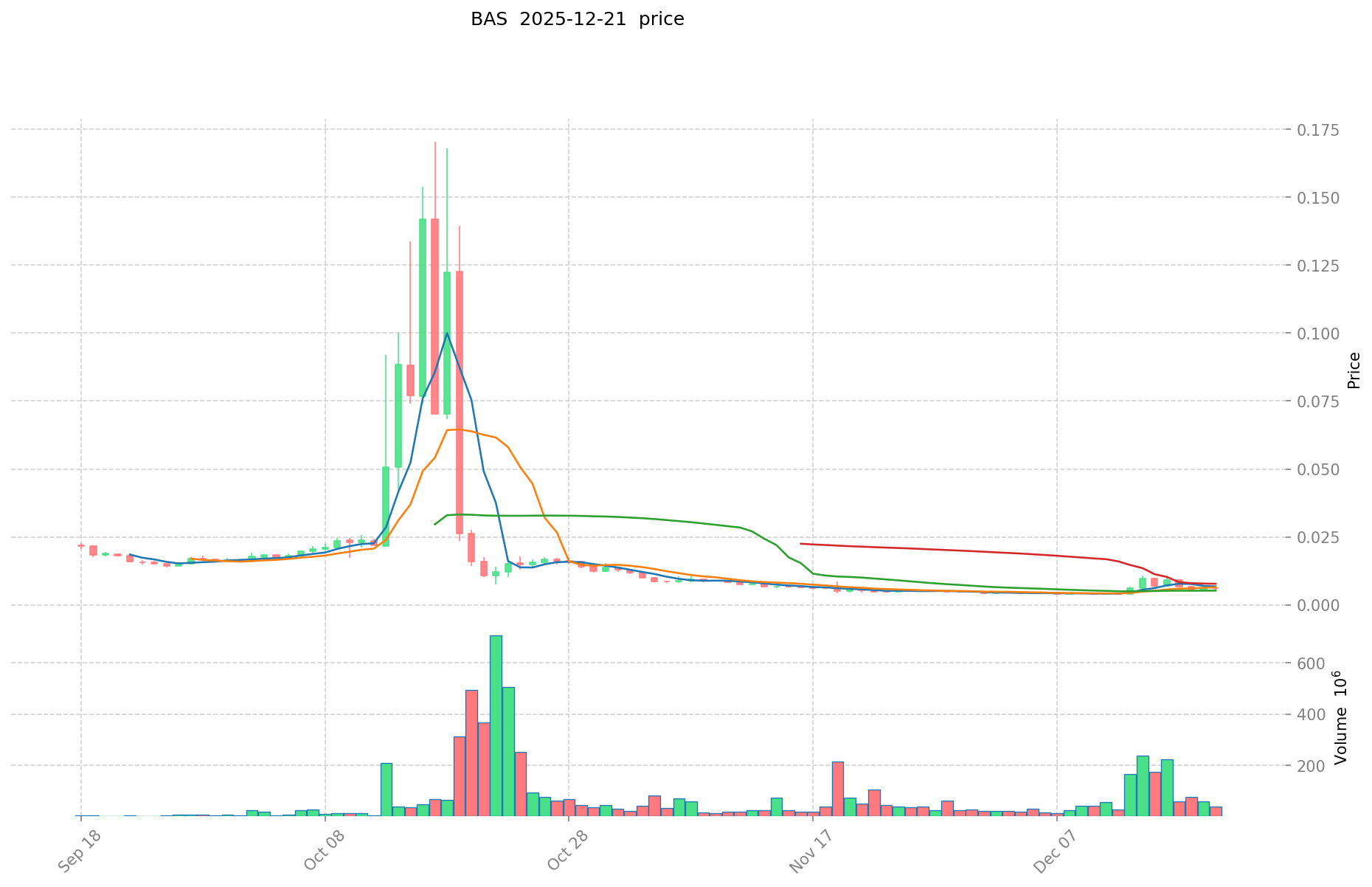
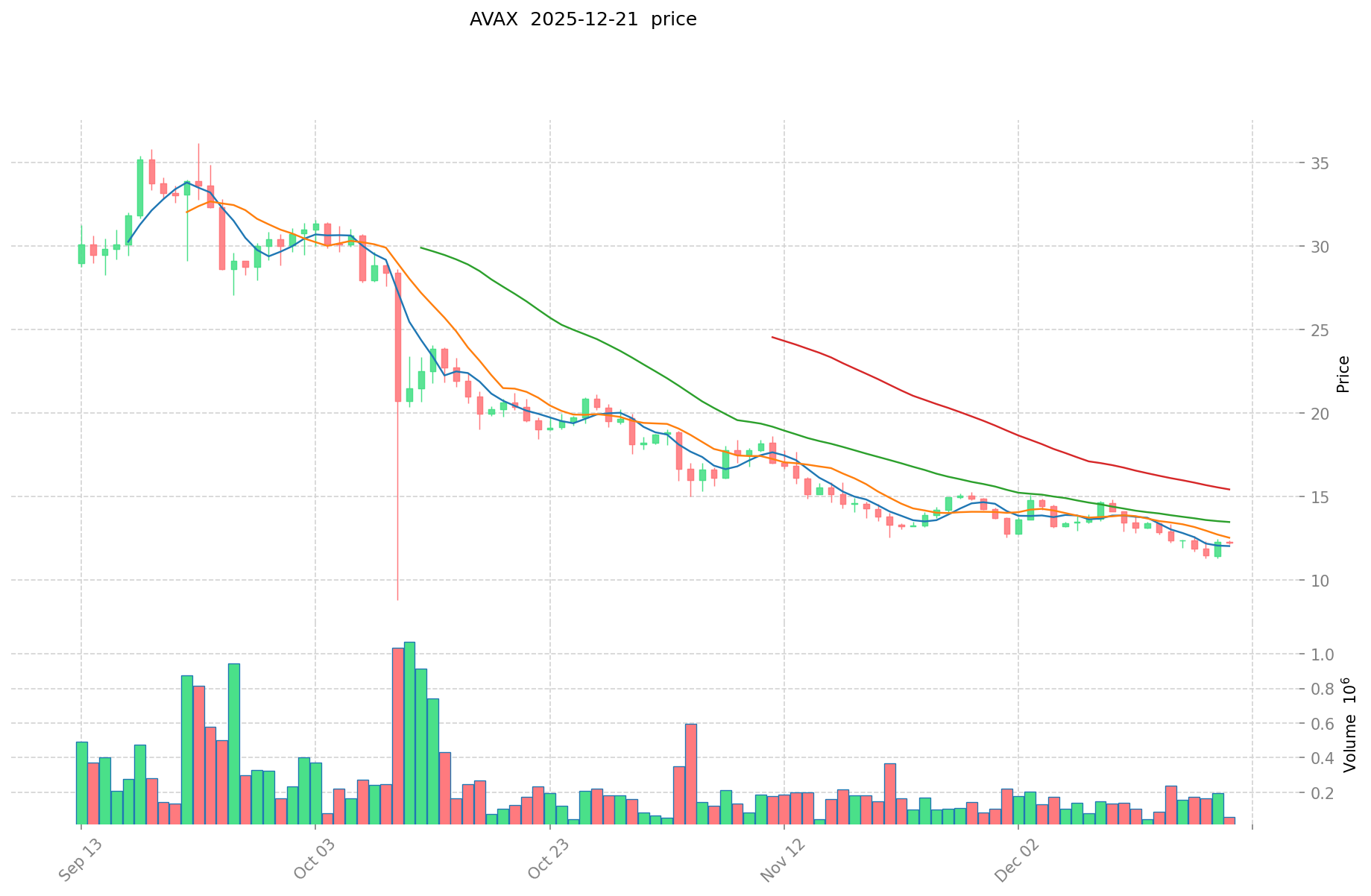
Historical Price Trends of BAS and AVAX
BAS (BNB Attestation Service):
- All-time high: $0.17051 (October 17, 2025)
- All-time low: $0.00385 (December 11, 2025)
- Price range span: Approximately 4,330% from low to high
AVAX (Avalanche):
- All-time high: $144.96 (November 21, 2021)
- All-time low: $2.80 (December 31, 2020)
- Price range span: Approximately 5,084% from low to high
- One-year price performance: -69.43%
Current Market Status (December 21, 2025)
Price Data:
- BAS current price: $0.005807
- AVAX current price: $12.16
24-Hour Trading Activity:
- BAS 24-hour volume: $199,642.16
- AVAX 24-hour volume: $716,256.60
Market Metrics:
- BAS market cap: $14,517,500
- AVAX market cap: $5,223,005,195
- BAS market dominance: 0.0018%
- AVAX market dominance: 0.17%
Market Sentiment Index:
Crypto Fear & Greed Index: 20 (Extreme Fear)
Access real-time prices:
II. Price Movement Analysis
Short-Term Price Dynamics
BAS Performance:
- 1-hour change: -1.55%
- 24-hour change: -0.61%
- 7-day change: -6.58%
- 30-day change: -8.51%
- 1-year change: +38.17%
AVAX Performance:
- 1-hour change: -0.65%
- 24-hour change: -0.4%
- 7-day change: -8.70%
- 30-day change: -12.77%
- 1-year change: -69.43%
Key Observations
Both assets exhibit downward pressure in medium-term timeframes (7-30 days). However, BAS demonstrates year-to-date gains of 38.17%, while AVAX has experienced severe long-term depreciation, declining 69.43% over the past year. The divergence reflects differing market cycles and investor sentiment trajectories for these two assets.
III. Project Overview
BAS (BNB Attestation Service)
Core Function:
BAS is the native verification and reputation layer on BNB Chain. It enables composable on-chain KYC (Know Your Customer), identity, and asset verification across multiple use cases including real-world assets (RWA), decentralized finance (DeFi), and AI agents.
Key Features:
- Aggregates KYC data, asset proofs, on-chain behavior, social activity, and community contributions
- Builds verifiable Human Reputation Profiles
- Operates on BNB Smart Chain (BSC) via BEP-20 standard
- Contract address: 0x0f0df6cb17ee5e883eddfef9153fc6036bdb4e37
Token Economics:
- Circulating supply: 2,500,000,000 BAS (25% of total supply)
- Total supply: 10,000,000,000 BAS
- Max supply: 10,000,000,000 BAS
- Token holders: 198,860
AVAX (Avalanche)
Core Function:
Avalanche is an open-source platform for launching decentralized applications, financial primitives, and interoperable blockchains. It utilizes a revolutionary consensus protocol enabling smart contracts with near-instant transaction finality (1 second) and Ethereum toolkit compatibility.
Key Features:
- Three-chain architecture enabling high-throughput transaction processing
- Modular scaling through subnets allowing applications to operate independent "lanes"
- Partnerships with major enterprises including Mastercard and Deloitte
- Founded by Emin Gün Sirer, Kevin Sekniqi, and Ted Yin
- Proof of Stake consensus mechanism
Token Economics:
- Circulating supply: 429,523,453.54 AVAX (59.66% of total supply)
- Total supply: 461,192,507.32 AVAX
- Max supply: 720,000,000 AVAX
- Token holders: 118,649
IV. Market Positioning and Liquidity
Exchange Presence:
- BAS: Listed on 11 exchanges
- AVAX: Listed on 67 exchanges
Market Capitalization Context:
- BAS ranks 992nd by market cap
- AVAX ranks 29th by market cap
- AVAX market cap exceeds BAS by approximately 360x
Valuation Metrics:
- BAS fully diluted valuation (FDV): $58,070,000
- AVAX fully diluted valuation (FDV): $5,608,100,888
- BAS FDV/market cap ratio: 25%
- AVAX FDV/market cap ratio: 59.66%
V. Risk and Volatility Assessment
Historical Volatility Ranges
BAS:
- 24-hour trading range: $0.005365 - $0.006367
- Recent extreme range (October-December 2025): $0.00385 - $0.17051
- Volatility characterization: Highly volatile given recent market entry
AVAX:
- 24-hour trading range: $12.13 - $12.38
- Historical range: $2.80 - $144.96
- Volatility characterization: Moderate current volatility with significant historical drawdown
Market Sentiment Context
The Crypto Fear & Greed Index reading of 20 (Extreme Fear) indicates pervasive market pessimism, which may constrain upside movements for both assets in the near term while potentially creating accumulation opportunities for longer-term investors.
VI. Conclusions
BAS represents an emerging infrastructure project focused on identity and reputation verification within the BNB Chain ecosystem, currently in early market discovery phase. AVAX is an established Layer 1 blockchain platform with demonstrated technical capabilities and enterprise partnerships, currently experiencing market-wide headwinds reflected in its significant year-to-date decline.
The substantial difference in market capitalization, exchange listings, and historical price stability suggests AVAX operates within a more mature, liquid market structure despite recent underperformance. BAS, with limited exchange availability and recent market introduction, exhibits characteristics typical of emerging tokens with higher volatility and price discovery dynamics.
Data as of: 21 December 2025
Information sources: Gate.com market data, on-chain metrics, and historical price databases
Avalanche (AVAX) Investment Value Analysis Report
I. Executive Summary
Avalanche (AVAX) is a significant digital asset in the cryptocurrency sector that has demonstrated substantial development since its mainnet launch in September 2020. As of 2025, the platform has achieved a market capitalization of $9.6 billion with approximately 426.3 million AVAX tokens in circulation at a price of around $22.52. The asset has attracted increasing investor attention due to its decentralized applications, financial primitives, and blockchain interoperability capabilities.
II. Core Factors Influencing AVAX Investment Value
Supply Mechanism and Scarcity
Token Supply Structure:
- Maximum supply cap: 720 million AVAX tokens
- Circulating supply: 429.45 million AVAX (59.65% of maximum supply)
- Total supply: 461.12 million AVAX
The token release model employs a novel emission function similar to Bitcoin's early-stage emission curve, balancing reasonable circulation with new token entry into the market. The genesis block generated 360 million AVAX tokens, with the remaining 360 million tokens following a controlled minting formula. The parameters γ and λ governing the release function are adjustable, providing protocol flexibility.
Scarcity Impact:
The limited supply of 72 million tokens serves as a fundamental factor supporting AVAX's long-term value proposition, similar to asset scarcity dynamics in traditional markets.
Institutional Adoption and Market Application
Market Position:
As of October 2025, AVAX demonstrates growing institutional interest, functioning as a "digital payment and computing platform." The asset has positioned itself as an alternative to Ethereum with improved infrastructure design for developers and users.
Ecosystem Development:
- DeFi and Web3 innovation driving long-term growth potential
- Thriving ecosystem with diverse applications across decentralized finance and digital services
- Lower transaction fees compared to competing platforms
- EVM compatibility facilitating developer adoption
Regulatory Environment:
Market trends and the regulatory environment significantly impact AVAX's value trajectory, though specific national regulatory positions toward AVAX were not detailed in available sources.
Technological Development and Ecosystem Construction
Core Technology Infrastructure:
- X-Chain: Serves as an instance of the Avalanche Virtual Machine (AVM), enabling asset creation and trading
- Subnet technology: Represents a key technical advancement for ecosystem expansion
- Avalanche-Ethereum Bridge: Facilitates cross-chain interoperability
Consensus Mechanism:
The AVAX consensus protocol delivers ideal system dynamic characteristics suitable for large-scale application deployment, balancing simplicity with robust security properties.
Ecosystem Advantages:
- Compatibility with Ethereum infrastructure attracting EVM-based developers
- Low transaction fees enhancing user adoption
- Strong development velocity relative to competing platforms
- Transparent code and community governance structures
Macroeconomic Environment and Market Cycles
Short-term Price Outlook (2025):
- Base scenario: $28.64 - $39.19 (assuming continued growth and mainstream adoption)
- Optimistic scenario: $39.19 - $42.88 (assuming large-scale applications and favorable market conditions)
Market Performance Context:
Market adjustments have been observed in recent periods, though price predictions for 2025 maintain optimistic positioning. The current price of approximately $16.98 to $22.52 reflects Avalanche ecosystem developments during the 2025 period.
III. Key Value Investment Factors
Development Capability
AVAX demonstrates superior public chain technology development capabilities comparable to major platforms. The infrastructure design is particularly conducive to both developer and user adoption, with the development team's strong academic background and transparent code disclosure reducing policy intervention sensitivity.
Current Valuation Position
The platform's core network value derives from the entire system's ecosystem innovation capability, reflecting in key data metrics. The blockchain network functions analogously to cities or nations, with value concentrated in systemic innovation capacity.
Benefits of AVAX Investment
- Low transaction fees
- Ethereum compatibility
- Developed ecosystem
- Growth potential
- Superior technical architecture compared to ETH 2.0 implementations
IV. Investment Risk Considerations
Primary Risk Factors
- High market volatility affecting price stability
- Price manipulation potential in less regulated markets
- Regulatory uncertainty in various jurisdictions
- Technical risks including network security considerations
Risk Management Recommendations
For new investors, cautious market entry is advised, potentially utilizing dollar-cost averaging with small positions while ensuring secure token storage. Comprehensive understanding of cryptocurrency market dynamics and AVAX technical fundamentals is essential before investment commitment.
V. Conclusion
Avalanche (AVAX) presents a blockchain platform with meaningful technological advantages, expanding ecosystem development, and positioned growth potential. The combination of limited token supply, strong institutional interest trajectory, technological innovation, and ecosystem maturation creates a multifaceted investment proposition. However, investors should maintain awareness of inherent cryptocurrency market volatility and regulatory uncertainties while conducting thorough due diligence aligned with individual risk tolerance parameters.
III. 2025-2030 Price Prediction: BAS vs AVAX
Short-term Prediction (2025)
- BAS: Conservative $0.00455-$0.005765 | Optimistic $0.005765-$0.00835925
- AVAX: Conservative $7.0528-$12.16 | Optimistic $12.16-$18.1184
Mid-term Prediction (2027-2028)
- BAS may enter consolidation phase with moderate volatility, estimated price range $0.00385-$0.00921
- AVAX may experience accelerated growth momentum, estimated price range $11.40-$27.04
- Key drivers: Institutional capital inflows, ETF adoption, ecosystem development
Long-term Prediction (2029-2030)
- BAS: Base case $0.00732-$0.01222 | Optimistic scenario $0.01222-$0.01354
- AVAX: Base case $13.85-$32.33 | Optimistic scenario $32.33-$35.96
View detailed price predictions for BAS and AVAX
Disclaimer
The predictions presented herein are derived from historical data analysis and market modeling. Cryptocurrency markets are highly volatile and subject to rapid fluctuations influenced by regulatory changes, macroeconomic conditions, and technological developments. These forecasts should not be construed as financial advice or investment recommendations. Past performance does not guarantee future results. Investors should conduct independent research and consult with qualified financial professionals before making investment decisions. The authors assume no liability for investment outcomes based on these projections.
BAS:
| 年份 |
预测最高价 |
预测平均价格 |
预测最低价 |
涨跌幅 |
| 2025 |
0.00835925 |
0.005765 |
0.00455435 |
0 |
| 2026 |
0.0080508225 |
0.007062125 |
0.0046610025 |
21 |
| 2027 |
0.0084632506 |
0.00755647375 |
0.0038538016125 |
30 |
| 2028 |
0.00921134150125 |
0.008009862175 |
0.0056069035225 |
37 |
| 2029 |
0.012227054610137 |
0.008610601838125 |
0.007319011562406 |
48 |
| 2030 |
0.01354447669137 |
0.010418828224131 |
0.005938732087754 |
79 |
AVAX:
| 年份 |
预测最高价 |
预测平均价格 |
预测最低价 |
涨跌幅 |
| 2025 |
18.1184 |
12.16 |
7.0528 |
0 |
| 2026 |
21.649056 |
15.1392 |
11.808576 |
24 |
| 2027 |
27.03936816 |
18.394128 |
11.40435936 |
51 |
| 2028 |
25.8970928112 |
22.71674808 |
13.630048848 |
86 |
| 2029 |
32.328204192648 |
24.3069204456 |
13.854944653992 |
99 |
| 2030 |
35.96330414528748 |
28.317562319124 |
15.5746592755182 |
132 |
Comparative Investment Analysis: BAS vs AVAX
I. Investment Strategy Comparison: BAS vs AVAX
Long-term vs Short-term Investment Strategy
BAS (BNB Attestation Service):
- Suitable for investors seeking exposure to emerging identity and reputation verification infrastructure within the BNB Chain ecosystem
- Short-term: High volatility presents tactical trading opportunities; 2025 predictions range $0.00455-$0.00836
- Long-term: Position as foundational verification layer may benefit from mainstream DeFi and RWA adoption; 2030 base case projects $0.00732-$0.01222
AVAX (Avalanche):
- Suitable for investors prioritizing established Layer 1 platforms with proven technical architecture and enterprise partnerships
- Short-term: Conservative positioning appropriate given -69.43% one-year decline; 2025 predictions range $7.05-$18.12
- Long-term: Ecosystem maturation and institutional adoption trajectory; 2030 base case projects $13.85-$35.96
Risk Management and Asset Allocation
Conservative Investors:
- BAS: 5-10% portfolio allocation (early-stage exposure with limited downside capital)
- AVAX: 85-90% portfolio allocation (established platform with greater market maturity)
- Hedge tools: Stablecoin reserves (20-30% of total crypto allocation), position diversification across Layer 1 alternatives
Aggressive Investors:
- BAS: 30-40% portfolio allocation (higher conviction in identity verification thesis, tolerance for volatility)
- AVAX: 50-60% portfolio allocation (core Layer 1 holding with growth potential)
- Hedging instruments: Cross-exchange arbitrage opportunities, options strategies for volatility capture, multi-chain diversification
II. Technical Ecosystem Comparison
BAS Ecosystem Structure
Verification Architecture:
- KYC data aggregation
- Asset proof compilation
- On-chain behavior tracking
- Social activity integration
- Community contribution assessment
Integration Scope:
- Real-world assets (RWA) verification
- DeFi protocol compliance
- AI agent credential validation
- BNB Smart Chain (BSC) native implementation via BEP-20 standard
AVAX Ecosystem Structure
Three-Chain Architecture:
- X-Chain: Asset creation and trading instance
- P-Chain: Validator coordination and subnet management
- C-Chain: Smart contract execution with EVM compatibility
Technical Capabilities:
- 1-second transaction finality
- Subnet-based modular scaling
- Cross-chain interoperability via Avalanche-Ethereum Bridge
- EVM compatibility reducing developer adoption barriers
III. Potential Risk Comparison
Market Risks
BAS:
- Extreme price volatility driven by recent market entry (October 2025); all-time range spans 4,330% from low to high
- Minimal trading liquidity ($199,642 24-hour volume) increasing slippage risk and price manipulation potential
- Limited exchange availability (11 exchanges) compared to established competitors restricts market efficiency
- Speculative price discovery phase characteristic of emerging infrastructure tokens
AVAX:
- Significant long-term depreciation (-69.43% year-to-date) indicates sustained market headwinds despite technical capabilities
- Broader cryptocurrency market sentiment (Crypto Fear & Greed Index: 20) constraining near-term appreciation potential
- Moderate current volatility ($12.13-$12.38 trading range) masking historical extreme ranges ($2.80-$144.96)
- Competitive pressure from alternative Layer 1 platforms with established market positions
Technical Risks
BAS:
- Early-stage protocol maturity; limited operational track record for identity verification infrastructure
- Dependency on BNB Chain ecosystem health and regulatory acceptance of on-chain KYC mechanisms
- Concentration risk within single blockchain network without cross-chain redundancy
AVAX:
- Consensus protocol complexity increases attack surface potential despite academic validation
- Subnet architecture requires continuous security auditing across dynamically deployed independent chains
- Validator concentration dynamics affecting network decentralization properties
Regulatory Risks
- Identity verification focus (BAS): Enhanced scrutiny from financial regulators regarding on-chain KYC data handling, cross-border compliance, and privacy framework alignment
- General blockchain platforms (AVAX): Exposure to evolving regulatory classifications of smart contract platforms; jurisdiction-specific restrictions on token trading and DeFi application deployment
- Jurisdictional variation: Regulatory treatment differs significantly across major markets (US, EU, Asia-Pacific), creating uneven compliance costs and market access constraints for both assets
IV. Conclusion: Which Is the Better Buy?
📌 Investment Value Summary
BAS Advantages:
- First-mover positioning in identity and reputation verification layer for BNB Chain ecosystem
- 38.17% one-year price appreciation demonstrating investor adoption momentum
- Lower circulating supply concentration (25% of total) suggesting upside potential during accumulation phases
- Mid-term (2027-2028) price predictions suggest consolidation phase with moderate upside
AVAX Advantages:
- Established Layer 1 platform with 5-year operational history and demonstrated technical capabilities
- Superior market liquidity and exchange availability (67 exchanges) enabling efficient position entry/exit
- 360x larger market capitalization ($5.2 billion) providing institutional-grade stability
- Long-term price predictions (2030) suggest potential 132% appreciation from current levels under optimistic scenarios
- EVM compatibility and enterprise partnerships (Mastercard, Deloitte) validating commercial viability
✅ Investment Recommendations
New Investors:
- Initiate AVAX exposure through dollar-cost averaging over 3-6 month period with conservative position sizing (5-10% of crypto allocation)
- Monitor BAS developments as emerging ecosystem token; defer allocation until clearer market adoption signals and institutional participation emerge
- Maintain 60-70% stablecoin reserve for volatility capture opportunities in both assets
Experienced Investors:
- Construct dual-position strategy allocating 60-70% to AVAX for core Layer 1 exposure and 20-30% to BAS for early-stage infrastructure upside
- Implement technical analysis entry signals around BAS resistance levels ($0.0084-$0.0104) and AVAX support levels ($10-12 range)
- Consider sector rotation strategies favoring BAS during identity/compliance focus periods and AVAX during DeFi ecosystem expansion cycles
Institutional Investors:
- Prioritize AVAX for core Layer 1 platform exposure with established market liquidity supporting large position deployment
- Conduct exploratory BAS analysis pending ecosystem maturation and clear institutional adoption pathways
- Implement portfolio-level cryptocurrency allocation within 2-5% of total assets, maintaining AVAX/BAS ratio of 8:1 based on market maturity differential
⚠️ Risk Disclosure: Cryptocurrency markets exhibit extreme volatility; historical price analysis cannot predict future performance. This report provides descriptive market analysis only and does not constitute investment advice, financial recommendations, or solicitation to purchase either asset. All price predictions carry substantial uncertainty reflecting model limitations and unforeseen market developments. Investors must conduct independent research, assess individual risk tolerance, and consult qualified financial professionals before committing capital. Past performance does not guarantee future results.
Data Current as of: December 21, 2025
Report Generated: December 21, 2025
None
FAQ: BAS vs AVAX Investment Comparison
I. What are the core differences between BAS and AVAX in terms of functionality?
Answer: BAS (BNB Attestation Service) is a verification and reputation layer designed specifically for identity verification, KYC aggregation, and asset proof compilation on the BNB Chain ecosystem. It serves use cases in RWA, DeFi, and AI agents. AVAX (Avalanche), by contrast, is a Layer 1 blockchain platform designed for deploying decentralized applications and financial primitives with its own three-chain architecture (X-Chain, P-Chain, C-Chain), offering 1-second transaction finality and EVM compatibility.
II. Which asset demonstrates better market maturity and stability?
Answer: AVAX demonstrates superior market maturity despite recent underperformance. It operates on 67 exchanges with a market capitalization of $5.2 billion and 360x larger market presence than BAS. AVAX has a 5-year operational history with established enterprise partnerships (Mastercard, Deloitte) and institutional adoption pathways. BAS, launched in October 2025, is listed on only 11 exchanges with $14.5 million market cap, characteristic of early-stage price discovery dynamics. Current Crypto Fear & Greed Index of 20 (Extreme Fear) constrains near-term upside for both assets.
III. What are the primary risk factors differentiating these two investments?
Answer: BAS faces extreme volatility (4,330% range from all-time low to high), minimal trading liquidity ($199,642 daily volume), limited exchange availability, and early-stage protocol maturity with unproven operational track record. AVAX exhibits moderate current volatility but has experienced significant long-term depreciation (-69.43% year-to-date) and faces competitive pressure from alternative Layer 1 platforms. Additionally, BAS carries enhanced regulatory scrutiny due to its identity verification focus and on-chain KYC data handling, while AVAX faces broader blockchain platform regulatory uncertainties across jurisdictions.
IV. Which asset offers superior long-term price appreciation potential based on 2030 projections?
Answer: AVAX projects 132% appreciation potential by 2030 under optimistic scenarios (base case $13.85-$32.33; optimistic $32.33-$35.96 from December 2025 baseline of $12.16). BAS projects 79% appreciation under comparable timeframes (base case $0.00732-$0.01222; optimistic $0.01222-$0.01354 from $0.005807 baseline). However, AVAX's higher absolute projections reflect its established market position, while BAS's percentage upside reflects early-stage discovery dynamics. Predictions carry substantial uncertainty dependent on institutional adoption, regulatory developments, and macroeconomic conditions.
V. How should conservative investors allocate between BAS and AVAX?
Answer: Conservative investors should allocate 85-90% to AVAX through dollar-cost averaging over 3-6 months with 5-10% of total crypto portfolio allocation, combined with 20-30% stablecoin reserves for volatility capture. Limit BAS exposure to 5-10% maximum as exploratory allocation pending ecosystem maturation and clearer institutional participation signals. This allocation strategy prioritizes established platform stability while maintaining disciplined exposure to emerging infrastructure opportunities. Comprehensive understanding of cryptocurrency market dynamics and each project's technical fundamentals is essential before commitment.
VI. What specific catalysts could drive significant price movements for each asset in 2025-2026?
Answer: For BAS: mainstream DeFi protocol adoption of its verification layer, institutional participation expansion, cross-chain interoperability developments, and clear regulatory frameworks for on-chain KYC mechanisms. For AVAX: large-scale enterprise application deployments, subnet ecosystem scaling acceleration, potential ETF approvals, sustained DeFi volume growth, and positive regulatory developments regarding smart contract platforms. BAS is more vulnerable to regulatory clarification regarding identity verification, while AVAX benefits from broader cryptocurrency market sentiment improvement and institutional capital rotation toward established platforms.
VII. How do token supply mechanics impact long-term value for each asset?
Answer: BAS has 10 billion maximum supply with only 2.5 billion circulating (25% of total), providing substantial upside potential during accumulation phases but significant dilution risk if all tokens enter circulation. AVAX has 720 million maximum supply with 429.5 million circulating (59.65%), approaching full circulation with reduced future dilution pressure. AVAX's emission function employs Bitcoin-style controlled minting with adjustable parameters, offering protocol flexibility. The stark difference in supply distribution suggests BAS carries higher volatility risk from future inflation, while AVAX's supply dynamics provide greater scarcity protection and price support, contributing to its institutional-grade appeal.
VIII. What portfolio construction strategy suits different investor profiles for this comparison?
Answer: Aggressive investors should allocate 30-40% to BAS with 50-60% AVAX positioning, employing cross-exchange arbitrage and options strategies for volatility capture. Experienced investors should construct 60-70% AVAX core holdings with 20-30% BAS allocation, implementing technical analysis entry signals (BAS resistance $0.0084-$0.0104; AVAX support $10-12) and sector rotation strategies. Institutional investors should prioritize 8:1 AVAX-to-BAS ratio within 2-5% total portfolio cryptocurrency allocation, maintaining emphasis on AVAX's institutional liquidity while conducting exploratory BAS analysis pending ecosystem maturation. All strategies require comprehensive risk assessment, independent research, consultation with qualified financial professionals, and alignment with individual risk tolerance parameters.
Disclaimer: These responses provide descriptive market analysis only and do not constitute investment advice, financial recommendations, or solicitation to purchase either asset. Cryptocurrency markets exhibit extreme volatility; historical analysis cannot predict future performance. All projections carry substantial uncertainty. Past performance does not guarantee future results. Investors must conduct independent research and consult qualified financial advisors before committing capital.
* The information is not intended to be and does not constitute financial advice or any other recommendation of any sort offered or endorsed by Gate.