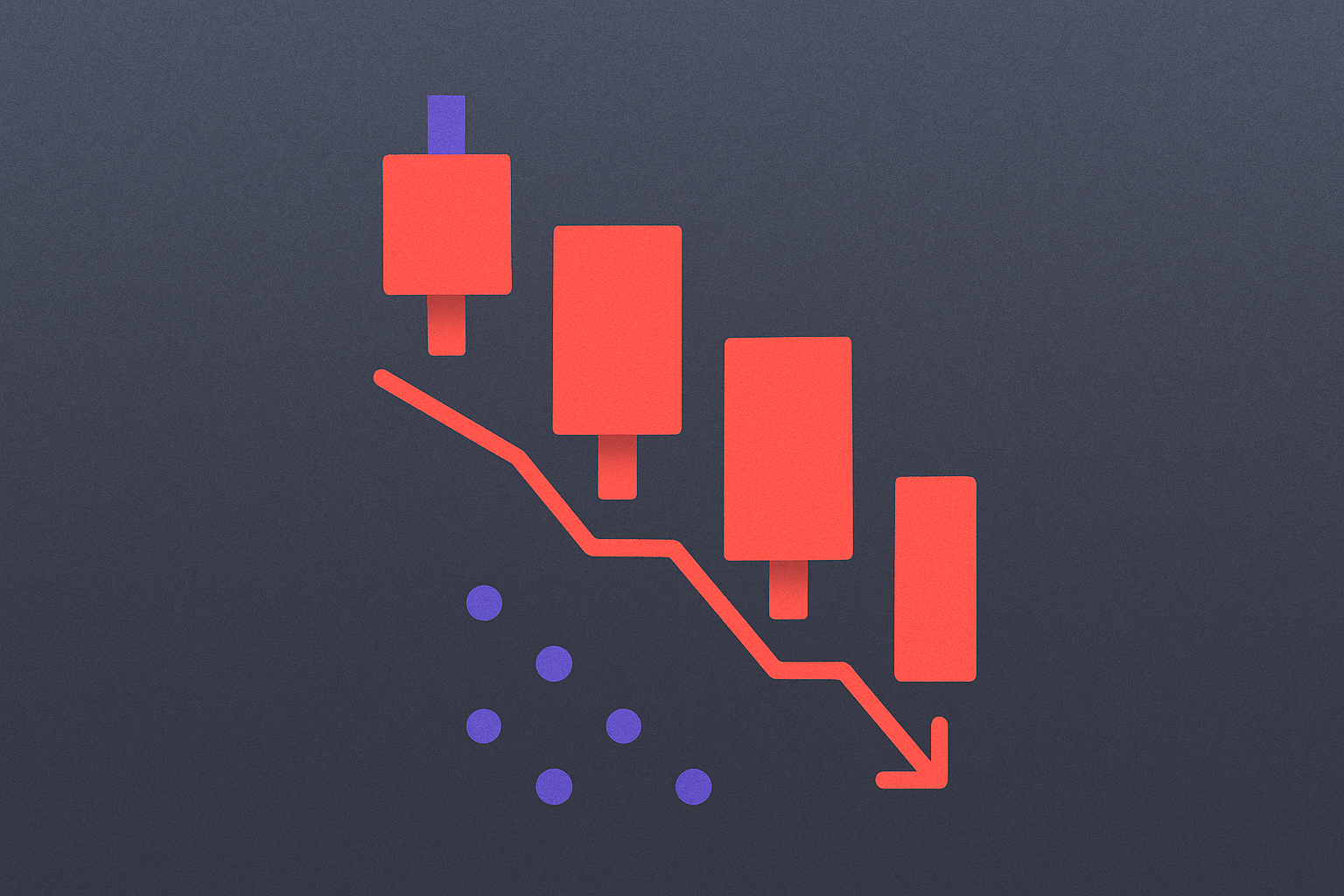
Bearish candlestick patterns

2026-01-06 13:36:37
Crypto Trading
Crypto Tutorial
Investing In Crypto
K-line
Trading Bots
Article Rating : 4
83 ratings
Discover how to spot bearish candlestick patterns in the crypto market. Explore pattern types such as the Shooting Star, Evening Star, and Three Black Crows, along with trading strategies and risk management techniques. This comprehensive guide is designed for traders and analysts on Gate.
Bearish candlestick patterns

Introduction to Bearish Candlestick Patterns

Bearish candlestick patterns are the inverse of bullish patterns and typically emerge after an uptrend. These patterns are essential in technical analysis for financial markets, helping traders and investors pinpoint potential price reversal points. When bearish candlestick patterns appear, they may indicate a shift from an upward to a downward trend, signaling a possible change in market sentiment.

Traders should evaluate bearish candlestick patterns alongside market context, trading volume, and other technical indicators. Note that on both cryptocurrency and traditional candlestick charts, green generally represents a price increase (bullish candles), while red indicates a price decrease (bearish candles).

Main Types of Bearish Candlestick Patterns

Common bearish candlestick patterns include:

  1. Hanging Man Pattern
  2. Shooting Star Pattern
  3. Bearish Engulfing Pattern
  4. Evening Star Pattern
  5. Three Black Crows Pattern

Each pattern has unique characteristics and varying levels of reliability as a trend reversal indicator.

Hanging Man Pattern

The Hanging Man is one of the most recognizable bearish candlestick patterns. It forms when, after a price rally, a candle appears at the top with a long lower shadow and a small body. This candle may be either bearish or bullish, but its structure defines the pattern.

The Hanging Man serves as a strong bearish reversal signal. The candle following the Hanging Man is typically bearish—the longer this bearish candle, the higher the probability of a downtrend starting. Traders often use this pattern to signal entry into short positions.

Shooting Star Pattern

The Shooting Star pattern usually emerges at the peak of an uptrend and is a clear indicator of a possible reversal. It’s characterized by a short body and a much longer upper shadow. This candle can be a small bullish or bearish candle.

The Shooting Star shows that buyers attempted to drive the price higher, but sellers forced it back to or below the opening price. This price action often precedes a reversal from an uptrend to a downtrend.

Bearish Engulfing Pattern

The Bearish Engulfing pattern typically appears at the end of an uptrend and consists of two candles. The first is a small bullish candle, followed by a large bearish candle that completely engulfs the smaller one. This is known as an engulfing pattern and is a strong signal that the trend may reverse.

A Bearish Engulfing pattern suggests heightened price volatility and a shift in the balance between buyers and sellers. The market is likely to turn bearish. The larger the body of the second bearish candle, the stronger and more reliable the potential downtrend signal.

Evening Star Pattern

The Evening Star pattern forms during an uptrend and reliably signals that the market may have reached a top. This three-candle formation is considered one of the most trustworthy reversal indicators.

The Evening Star consists of three candles and is the opposite of the Morning Star pattern. The first candle is bullish, the second can be bearish, bullish, or a doji (a candle where the opening and closing prices are nearly equal). The third candle is bearish, and its low falls below the low of the first candle, confirming the trend reversal.

Three Black Crows Pattern

The Three Black Crows pattern features three consecutive bearish candles with little or no shadows. Each session opens near the previous session’s close, and as selling pressure intensifies, the closing price falls further each day.

This pattern typically signals the start of a downtrend and consistent selling pressure. It shows steady price weakening and is often accompanied by rising trading volume, confirming the strength of the bearish trend.

FAQ

What are bearish candlestick patterns? What are the most common types of bearish candlestick chart patterns?

Bearish candlestick patterns are chart formations that develop during downtrends. The most common types are the bearish flag, descending triangle, head and shoulders (top), and double top. These patterns point to a continuation or strengthening of the price decline.

How do you identify and trade bearish candlestick patterns (such as Shooting Star, Cloud Cover, Engulfing)?

To identify bearish patterns: The Shooting Star forms after a rally and has a long lower wick; Cloud Cover is made up of two red candles; Engulfing occurs when a small green candle is engulfed by a large red one. Trade the downward reversal in combination with support and resistance levels. These signals work best in downtrends.

When using bearish candlestick patterns in trading, how should you manage risk and set stop-loss orders?

Set your stop-loss above the upper boundary of the pattern to manage risk effectively. The size of your stop-loss should reflect your risk tolerance. Trade only during strong downtrends to maximize the probability of success.

How accurate are bearish candlestick patterns? Can you rely on them alone for trading decisions?

Bearish candlestick patterns have an average accuracy of about 60–70%. They are most effective when combined with other technical indicators and volume analysis. You should not rely solely on these patterns for trading decisions.

How do you use bearish candlestick patterns with other technical analysis tools (such as support and resistance levels, moving averages)?

Combine bearish patterns with support and resistance levels to identify sell points. Moving average crossovers reinforce these signals. Oscillators used alongside these tools improve trend prediction accuracy and increase signal reliability.

What are the differences between bearish candlestick patterns across different timeframes (daily, weekly, monthly)?

Bearish patterns on different timeframes reflect different levels of analysis: daily patterns show short-term moves and more detail, weekly patterns reveal medium-term trends, and monthly patterns indicate long-term direction. The same pattern can mean different things depending on the timeframe. Monthly patterns are generally more reliable as signals.

* The information is not intended to be and does not constitute financial advice or any other recommendation of any sort offered or endorsed by Gate.
Related Articles
How to Interpret MACD, RSI, and KDJ Indicators for Crypto Technical Analysis?

How to Interpret MACD, RSI, and KDJ Indicators for Crypto Technical Analysis?

This article explores the interpretation of MACD, RSI, and KDJ indicators in crypto technical analysis, providing essential insights for traders on Gate. It addresses challenges of volatile market conditions and offers a combined approach with price and volume analysis for greater accuracy in predicting market trends. Key problems solved include detecting trend strength, identifying overbought/oversold conditions, and signaling potential reversals. The structure focuses on understanding these indicators, moving average crossovers, and volume-price divergence, enhancing readability for quick scanning and efficient decision-making.

2025-11-19 09:42:23
How to Interpret Crypto Technical Indicators: Mastering MACD, RSI, and Volume Analysis

How to Interpret Crypto Technical Indicators: Mastering MACD, RSI, and Volume Analysis

This article explores how traders can leverage technical indicators like MACD, RSI, and KDJ for crypto trading signals, emphasizing their application in volatile markets such as Chainlink (LINK). It addresses the need for reliable analytical tools to identify market trends and reversals, benefiting both short-term and swing traders. The structured analysis covers interpreting moving average crossovers and analyzing volume-price divergences, offering practical insights for enhanced decision-making. Key topics include the synergy of indicator use, timeframe selection, and volume confirmation, making it essential for readers aiming to refine their trading strategies and risk management approaches.
2025-11-24 08:54:55
How to Interpret MACD, RSI, and Moving Averages for Crypto Trading Success?

How to Interpret MACD, RSI, and Moving Averages for Crypto Trading Success?

The article explores technical indicator analysis for crypto trading, focusing on MACD, RSI, and KDJ, providing traders with tools to identify market trends and entry/exit points. It addresses the need for reliable market analysis among crypto investors seeking consistent returns. The structure covers the function and application of each indicator, moving average crossovers, and volume-price divergences. Keywords include crypto trading, MACD, RSI, moving averages, and volume divergences, enhancing readability and searchability for quick understanding. The insights offered are invaluable for traders aiming to refine their strategy using comprehensive technical analysis.
2025-11-27 11:33:22
An Introduction to Candlestick Charts for Beginners

An Introduction to Candlestick Charts for Beginners

Discover how to read and interpret candlestick charts with our complete guide for beginners. Gain mastery over candlestick patterns, analyze cryptocurrency trends on Gate, and confidently make informed investment decisions.
2025-12-26 20:33:50
Demo Trading

Demo Trading

This article delves into cryptocurrency demo trading, showcasing its rise as an essential tool for risk-free practice. It covers what demo trading is, comparing top platforms like TradeSim Pro, CryptoLab, BlockchainX, FuturesTech, and Gate for their features and educational resources. The piece provides strategies on effectively using demo platforms, emphasizing skill development and disciplined practices. Lastly, it guides the transition from simulation to real trading, underscoring emotional preparedness and smart capital allocation. Designed for beginners and experienced traders alike, the content aids readers in navigating crypto markets with confidence.
2025-07-25 05:30:03
Trading Simulator: The Complete Guide to Paper, Backtests, and Live Drills

Trading Simulator: The Complete Guide to Paper, Backtests, and Live Drills

Before risking real funds, smart traders pressure-test their edge in a simulator. Here’s how to choose one, set it up properly, and use it to turn ideas into a repeatable, data-driven playbook.
2025-08-28 04:52:30
Recommended for You
Derivatives Surge: A New Chapter in Crypto Volatility

Derivatives Surge: A New Chapter in Crypto Volatility

This article analyzes the crypto derivatives market dynamics in late 2025, focusing on surging futures volume and options market shifts. It examines Bitcoin futures reaching $48.4 billion in daily volume and the pronounced put-heavy skew in options, indicating traders are positioning for heightened volatility. The guide decodes what these signals mean: market participants are either hedging downside risks or preparing for sharp momentum moves. It explores institutional positioning strategies, explains the decline in call-writing activity, and outlines practical risk management approaches for traders. The article covers potential market scenarios—upward momentum, downside acceleration, or range-bound volatility—and provides actionable hedging strategies using options and position sizing on platforms like Gate. Designed for both institutional and retail traders seeking to navigate volatile derivatives markets strategically.

2026-01-08 17:09:46
Top TRON Memecoins to Watch After SunPump Launch

Top TRON Memecoins to Watch After SunPump Launch

A comprehensive guide to investing in leading TRON memecoins for 2024. Explore high-potential tokens like Sundog, Tron Bull, and Dragon Sun. Find out how to purchase via SunPump, master secure trading strategies, and understand key risks. This resource is ideal for both novice and seasoned investors within the TRON ecosystem.
2026-01-08 17:05:45
BONK's 1 Trillion Token Burn: A Game-Changer for the Solana Meme Coin Ecosystem

BONK's 1 Trillion Token Burn: A Game-Changer for the Solana Meme Coin Ecosystem

This comprehensive guide explores BONK's deflationary token burn strategy and its role in the Solana ecosystem. BONK has evolved from a simple meme coin to a utility-driven asset with real-world applications through strategic partnerships and ecosystem integrations on Gate and other platforms. The article examines the planned 1 trillion token burn initiative, community-driven engagement strategies, and deflationary mechanics designed to create long-term value and scarcity. It analyzes BONK's unique positioning within Solana's high-performance blockchain infrastructure, institutional interest including Grayscale recognition, and key platforms like LetsBonk.fun capturing majority market share. The guide addresses market volatility, sustainability challenges, and crucial milestones for future growth, providing investors with actionable insights into how token burn strategies and ecosystem development drive meme coin success in competitive cryptocurrency markets.

2026-01-08 16:57:36
What Country Is Bibox Based In?

What Country Is Bibox Based In?

Explore Bibox, a cutting-edge cryptocurrency trading platform offering advanced technology, exceptional security, and comprehensive global services for investors. See how Bibox stacks up against Gate and find out how to utilize this trusted exchange.
2026-01-08 16:55:01
Samoyedcoin (SAMO): The Meme Coin Revolutionizing Solana's DeFi Ecosystem

Samoyedcoin (SAMO): The Meme Coin Revolutionizing Solana's DeFi Ecosystem

This comprehensive analysis compares Samoyedcoin (SAMO) and Vine Coin within the competitive meme coin landscape, revealing SAMO's established dominance in Solana's DeFi ecosystem. SAMO distinguishes itself through utility-driven features including Samo Tips, SamoDEX, and deep integration with Solana platforms like Orca and Raydium, enabling active yield farming and liquidity provision. Built on Solana's high-performance blockchain, SAMO offers exceptional transaction speeds (0.8 seconds) and energy efficiency compared to Ethereum-based alternatives. The token's robust tokenomics feature aggressive burning (66.1% supply reduction) and community-focused distribution (14.4% airdrops). With 49,000+ holders and $1.6B trading volume, SAMO demonstrates proven adoption backed by strong community engagement and strategic partnerships with GenesysGo. For investors seeking established utility and DeFi functionality, SAMO represents a compelling meme coin evolution beyond speculation.
2026-01-08 16:50:11
World App Virtual Bank Accounts Drive Crypto Adoption with Zero-Fee Access

World App Virtual Bank Accounts Drive Crypto Adoption with Zero-Fee Access

World App revolutionizes cryptocurrency adoption through a fee-free virtual banking gateway that eliminates traditional barriers to crypto access. The platform enables users to receive direct deposits and automatically convert them to USDC stablecoins without gas fees, operating through partnerships with regulated banking institutions while maintaining FDIC protections. With 33 million global users and 15 million biometrically verified through iris scanning technology, World App combines security with accessibility. The platform integrates 150+ mini-programs including DeFi protocols and marketplaces, transforming it into a comprehensive financial super-app. While evolving regulations like the Genius Act boost institutional adoption, World App navigates complex privacy frameworks across jurisdictions. This solution addresses critical pain points in crypto onboarding by merging traditional finance infrastructure with decentralized capabilities, making blockchain-based transactions accessible to mainstream users
2026-01-08 16:47:39