Beginner’s Guide to Candlestick Charts

2026-01-01 10:48:58
Crypto Trading
Crypto Tutorial
K-line
Spot Trading
Trading Bots
Article Rating : 4
52 ratings
Master reading candlestick charts for cryptocurrencies as a beginner. Uncover how to interpret candlestick patterns, apply technical analysis using candlesticks, and develop trading strategies on Gate. This is your complete guide for traders.
Beginner’s Guide to Candlestick Charts

Introduction

For newcomers to trading or investing, chart reading can seem daunting. Many rely on hunches and make investment decisions based on intuition. However, trading and investing are fundamentally about probability and risk management. That's why understanding how to read candlestick charts is essential for nearly any investment approach, no matter your experience level.

What Is a Candlestick Chart?

A candlestick chart is a financial chart that visually displays an asset’s price movement over a defined time interval. Each chart consists of candles, with each candle representing the same duration. Candles can depict any timeframe—ranging from seconds to years—making them versatile tools for different analytical strategies.

Candlestick charts trace back to the 17th century. They are widely credited to a Japanese rice trader named Homma, who used them to analyze rice prices. His concepts likely formed the foundation for today’s modern candlestick charts, which are now a cornerstone of technical analysis.

How Do Candlestick Charts Work?

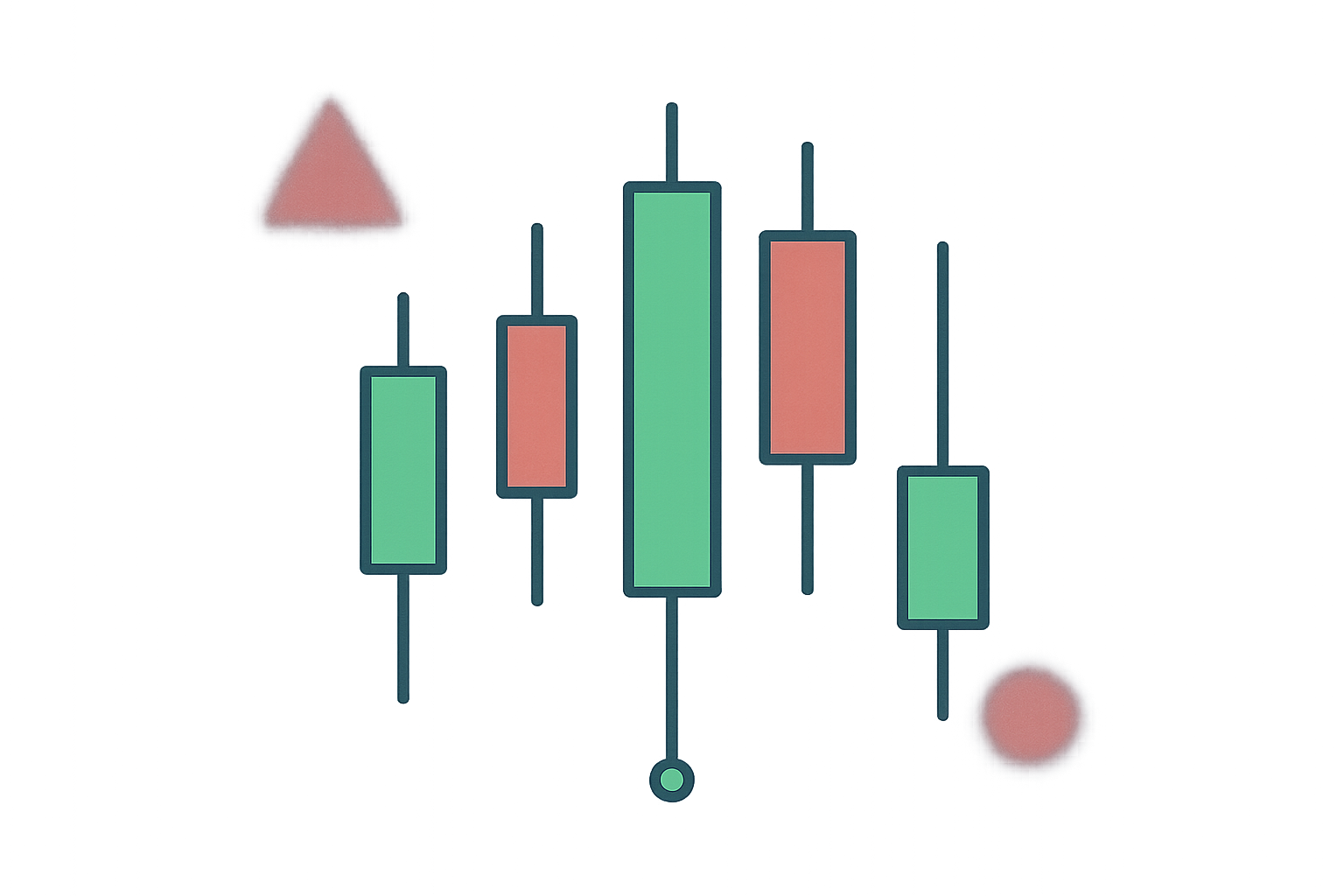
Candlestick charts display four key price points within a specific timeframe. Each candle is constructed using these data points:

  1. Open — The initial trading price of the asset in the timeframe.
  2. High — The highest trading price of the asset recorded in the timeframe.
  3. Low — The lowest trading price of the asset recorded in the timeframe.
  4. Close — The final trading price of the asset in the timeframe.

The distance between the open and close forms the “body,” while the space between these points and the high or low is known as the wick or shadow. This structure enables traders to quickly assess price direction and volatility for the analyzed period.

How to Read Candlestick Charts

Most traders find candlestick charts easier to interpret than traditional bar or line charts. Each candle reflects the struggle between buyers (bulls) and sellers (bears) within a specific period. A longer body signals stronger buying or selling momentum during that timeframe.

The color of the candle is crucial for reading market direction. A green body means the asset closed higher than it opened, indicating upward (bullish) pressure. Conversely, a red body shows the price fell during the period, with the close below the open, signaling downward (bearish) pressure. Wicks also offer insights into price rejection or reversal attempts.

What Candlestick Charts Don’t Reveal

While candlesticks give a useful overview of price action, they don’t offer every detail for thorough analysis. They only show the open and close distance, not the full price action between those points. This means significant price swings within the period may go unrepresented by the candle’s appearance.

Candlestick charts can also introduce substantial market noise, especially on shorter timeframes. This noise can trigger false signals that mislead less experienced traders. As a result, many analysts combine candlestick charts with other technical indicators and analysis tools for a more comprehensive market perspective.

Heikin-Ashi Candles

Heikin-Ashi, which translates to “average bar” in Japanese, refers to a modified candlestick chart that calculates candles using average price data. This approach distinguishes Heikin-Ashi from traditional Japanese candlesticks. Its main purpose is to smooth price movements and filter out market noise, giving a clearer view of underlying trends.

Traders frequently use Heikin-Ashi candles alongside standard candlesticks to avoid false signals and improve market trend detection. Green Heikin-Ashi candles without lower wicks generally signal a strong uptrend, while red candles without upper wicks can indicate a strong downtrend. This combination helps analysts pinpoint trend reversals with greater accuracy.

Conclusion

Candlestick charts are foundational tools for traders and investors aiming to understand market dynamics. They not only provide a clear visual record of an asset’s price action, but also allow flexible analysis across multiple timeframes, supporting a range of trading strategies.

Systematic study of candlestick charts and patterns, paired with analytical thinking and hands-on practice, can give traders a decisive edge. Mastering this core skill is a key step toward building a robust and profitable investment strategy.

FAQ

What is a candlestick chart and how does it work?

A candlestick chart visualizes price quotes using geometric shapes. The body shows the gap between open and close (green for rises, red for declines). Wicks mark the period’s highest and lowest prices, helping you analyze market moves.

What are the main components of a candlestick (open, close, high, low)?

Each candlestick consists of four key elements: open (starting price), close (ending price), high (maximum price), and low (minimum price) within a given period. These elements create the candle’s body and wicks.

What’s the difference between a bullish (green) and a bearish (red) candle?

A bullish (green) candle means the price closed above the open, indicating buyer strength. A bearish (red) candle means the price closed below the open, showing seller control.

A hammer pattern signals a bullish reversal after a drop; an inverted hammer points to a bearish reversal; a doji indicates market indecision when open and close are nearly equal. Always use these in conjunction with other analytical tools.

Which timeframes should beginners use to read candlestick charts?

As a beginner, start with 5- to 15-minute timeframes. These intervals highlight clear trends without overloading your analysis. Once comfortable, progressively move to longer timeframes like hourly or daily charts.

What are the most basic buy and sell signals in candlestick charts?

Basic buy signals include hammers at support levels, while shooting stars at resistance suggest sells. Also, look for small bodies with long wicks and shifts in trading volume to confirm trend changes.

* The information is not intended to be and does not constitute financial advice or any other recommendation of any sort offered or endorsed by Gate.
Related Articles
What is a red hammer Candlestick and how to use it

What is a red hammer Candlestick and how to use it

Understanding how the red hammer Candlestick pattern serves as a powerful bullish reversal signal is crucial for cryptocurrency traders operating in volatile markets. This article helps identify genuine red hammer patterns, emphasizing their formation after downtrends and at key support levels, and validating them with higher trading volume. Learn strategic trading implementation, utilizing technical indicators and risk management to enhance profitability. Gate's advanced tools assist in pattern recognition and real-time alerts. Optimize your trading approach through red hammer analysis to enhance your cryptocurrency investment strategy.
2025-11-03 03:11:16
Decoding the KDJ Indicator: A Comprehensive Guide

Decoding the KDJ Indicator: A Comprehensive Guide

"Decoding the KDJ Indicator" is a comprehensive guide for traders and analysts, focusing on the KDJ as a short-term analysis tool in financial markets. It explains the indicator's components: K-line, D-line, and J-line, and their roles in identifying overbought and oversold conditions. The article highlights key usage rules and signals like Golden and Death Crosses, and divergence detection. It also discusses the practical application of KDJ in day trading and crypto markets, guiding readers on decision-making with it and addressing FAQs for deeper understanding. Suitable for traders seeking clearer insights into price movements and market sentiment.
2025-11-26 09:10:48
How to Use the MACD Indicator for Crypto Trading Success

How to Use the MACD Indicator for Crypto Trading Success

The article delves into using the MACD indicator for successful crypto trading by breaking down its components: DIF, DEA, and histogram. It explains how these elements work together to identify market momentum and potential trading opportunities. Key insights include recognizing "golden cross" buy signals, leveraging MACD for analyzing market trends, and generating trading signals for optimal entry and exit points. The content is tailored for traders seeking actionable insights to enhance their trading strategies. This comprehensive guide emphasizes clear, structured analysis to facilitate informed trading decisions.
2025-12-02 09:23:50
Mastering the Exponential Moving Average (EMA): A Comprehensive Trading Strategy Guide

Mastering the Exponential Moving Average (EMA): A Comprehensive Trading Strategy Guide

This article serves as a comprehensive guide to mastering the Exponential Moving Average (EMA) as a trading strategy, highlighting its enhanced responsiveness to recent market changes. It addresses how EMA aids in trend identification, crossover strategies, and trading in volatile markets like cryptocurrency. The content is structured to first clarify what EMA is, followed by a step-by-step calculation guide, and practical examples in cryptocurrency trading. Ideal for traders seeking to refine their technical analysis skills, it also discusses combining EMA with other indicators for optimal trading decisions. Enhanced keyword density ensures clarity and readability for quick scanning.
2025-12-23 22:37:39
What Is a Breakout in the Cryptocurrency Sector?

What Is a Breakout in the Cryptocurrency Sector?

Explore the concept of breakouts in cryptocurrency markets and learn how to spot them to refine your trading strategies on Gate. Gain insights into the significance of trading volume, key pattern types, and practical methods to apply technical theory to your trades. Identify buy and sell signals and develop tactics to avoid false breakouts. Empower your trading decisions with this indispensable guide.
2025-12-23 11:31:09
Ultimate Guide to Understanding Popular Candlestick Patterns

Ultimate Guide to Understanding Popular Candlestick Patterns

# Ultimate Guide to Understanding Popular Candlestick Patterns Master candlestick analysis to elevate your trading on Gate. This comprehensive guide decodes essential candlestick patterns—from bullish hammers and three white soldiers to bearish shooting stars and dark cloud covers—enabling traders to identify trend reversals and continuations. Learn how to read candlestick charts, recognize bullish and bearish signals, and combine multiple patterns with technical indicators like RSI and MACD for stronger trade confirmation. Discover proven strategies for multi-timeframe analysis, risk management, and pattern implementation that work for both beginners and experienced traders seeking reliable technical analysis tools on Gate.


2025-12-26 18:36:34
Recommended for You
Pi Network Aligns with MiCA and Targets Listing on European Regulated Platforms

Pi Network Aligns with MiCA and Targets Listing on European Regulated Platforms

This article provides a comprehensive overview of Pi Network's compliance achievement with the Markets in Crypto-Assets (MiCA) regulatory framework and its implications for European market adoption. It highlights Pi Network's successful alignment with EU regulations, positioning the project for potential listings on Gate regulated trading platforms by late 2025. The content covers critical developments including whitepaper updates reflecting structural improvements, the deployment of ISO-compliant smart contracts on the DEX platform, and current market performance showing consolidation around the $0.20 price level. Technical analysis reveals a double bottom pattern suggesting potential bullish momentum upon breakout. The article addresses key concerns through FAQ sections, explaining MiCA's significance for regulatory credibility, security enhancements, and Pi Network's competitive advantages in the European market. Ideal for investors and community members seeking clarity on regulatory compliance, technical
2026-01-10 15:03:50
Chris Larsen de Ripple entra en la lista de los 200 más ricos del mundo con 15.3 mil millones de dólares

Chris Larsen de Ripple entra en la lista de los 200 más ricos del mundo con 15.3 mil millones de dólares

Ripple co-founder Chris Larsen achieves a remarkable $15.3 billion net worth, officially entering the world's top 200 wealthiest individuals as of November 2025. His wealth primarily derives from an 18% equity stake in Ripple Labs and approximately 2.7 billion XRP tokens valued at $6.3 billion, demonstrating strategic diversification within the blockchain ecosystem. The SEC's favorable August 2024 ruling and Ripple's October $500 million funding round—valuing the company at $40 billion—catalyzed substantial wealth appreciation. Larsen's ascent underscores cryptocurrency industry maturation and the legitimacy of digital asset markets as wealth-creation sectors. With regulatory clarity established and institutional adoption accelerating, Ripple's cross-border payment solutions position Larsen's holdings for continued value growth within the multi-trillion dollar financial services market.
2026-01-10 15:02:34
Bitcoin vs. Tokenized Gold: The Battle for Digital Gold Status

Bitcoin vs. Tokenized Gold: The Battle for Digital Gold Status

What Is the True Meaning of “Digital Gold”? An In-Depth Comparison of Bitcoin and Tokenized Gold. Examining decentralization, scarcity, asset-backed collateral, and stability. This comprehensive guide is essential reading for Web3 investors. It also details trading procedures on leading exchanges like Gate. Discover the best strategies for inflation protection and safeguarding your assets.

2026-01-10 15:01:10
Jim Cramer Predicts Potential Market Rally

Jim Cramer Predicts Potential Market Rally

This article presents Jim Cramer's optimistic market outlook and the key factors driving his prediction of a significant market rally. The analysis examines the convergence of favorable economic indicators, strong corporate earnings performance, and supportive policy developments that create a bullish foundation for investors. The piece explores how current market volatility presents both challenges and opportunities, while investor sentiment appears poised to shift toward greater optimism. Key sectors including precious metals, passive components, and power transmission equipment demonstrate the strongest growth potential. The article provides practical guidance for investors seeking to align their portfolio strategies with Cramer's market assessment and capitalize on anticipated gains through Gate trading platform exposure. Understanding these dynamics helps investors navigate uncertain market conditions with greater confidence and strategic clarity.
2026-01-10 14:59:21
Bitcoin Market Enters Distribution Phase as CVD Data Indicates Emerging Signals

Bitcoin Market Enters Distribution Phase as CVD Data Indicates Emerging Signals

See how analyzing crypto market sentiment with the CVD indicator uncovers Bitcoin’s shift from accumulation to distribution. Master real-time sentiment-driven trading strategies on Gate.
2026-01-10 14:57:41
Arthur Britto, Ripple Co-founder, Breaks 14-Year Silence on X

Arthur Britto, Ripple Co-founder, Breaks 14-Year Silence on X

This article unveils Arthur Britto's historic return to social media after 14 years of silence, marking a rare moment for one of blockchain's most enigmatic figures. Britto, co-founder of Ripple and the XRP Ledger, broke his privacy streak with a public post verified by CTO David Schwartz, immediately sparking significant market response with XRP surging 7.6% within 24 hours. The piece explores Britto's deliberate low-profile approach, his substantial influence on investor sentiment, and the implications for Ripple's ecosystem. Additionally, it addresses the connection to Ripple's landmark SEC lawsuit resolution and examines how Britto's cryptic emergence reflects broader trends among blockchain pioneers who prioritize innovation and privacy over public engagement in the cryptocurrency space.
2026-01-10 14:56:03