# Bitcoin's November Dip: A Catalyst for 2026 Price Recovery?
Bitcoin's recent 18% correction below $91,000 presents a critical market consolidation phase that merits investor attention. This article examines technical support levels ($93,400-$102,400), institutional market evolution through spot Bitcoin ETFs, and seasonal volatility patterns to assess long-term recovery potential. Designed for traders and strategic investors on Gate, this guide decodes whether November's downturn signals opportunity or caution for 2026 positioning. Discover how market cleansing, institutional flows, and technical rebounds could reshape Bitcoin's trajectory while managing volatility risks across multiple market cycles.
In recent market developments, Bitcoin experienced a significant decline, dropping approximately 18% during a notable correction period. The cryptocurrency traded below $91,000 as the market entered a potential consolidation phase. Market analysts suggest that this decline serves an important function in the ecosystem by cleansing overleveraged positions and filtering out weaker projects, potentially creating favorable conditions for long-term buyers to accumulate assets at more reasonable valuations.
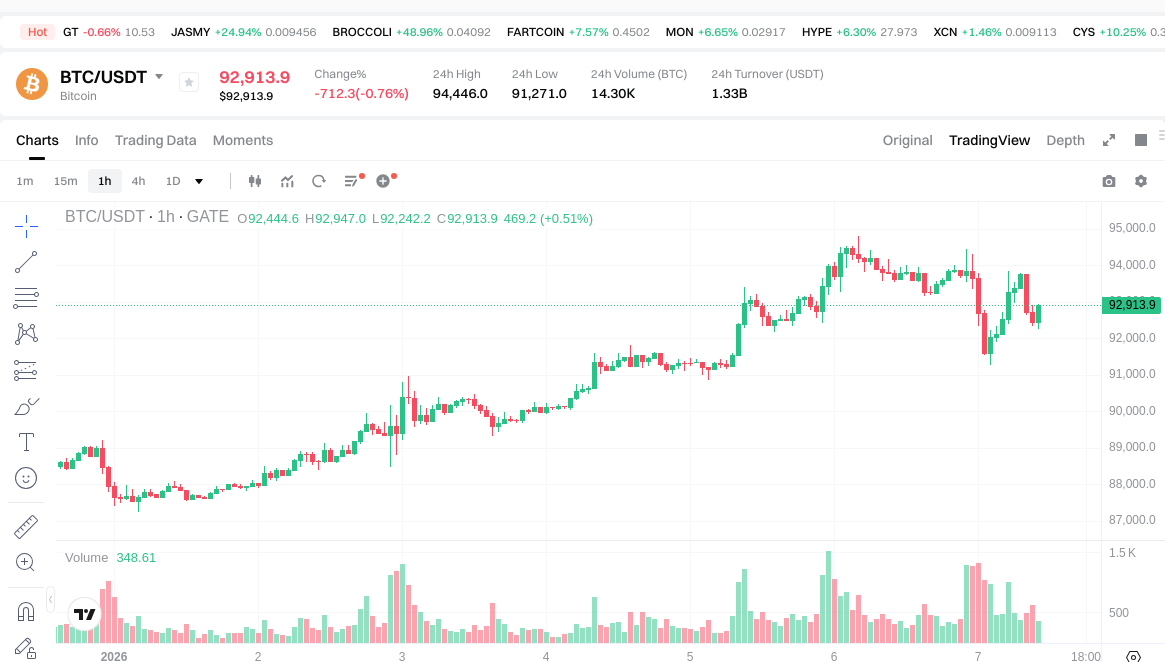
From a technical perspective, key price levels are drawing considerable attention from traders and investors. Support and resistance levels at $93,400 and $102,400 are being closely monitored as potential turning points. A successful close above the $93,400 level is generally perceived as a modest positive signal, suggesting that buying pressure may be building. These technical levels provide important reference points for understanding potential market direction and investor sentiment.
Market Dynamics and Institutional Influence
The cryptocurrency market landscape has undergone substantial transformation in recent years. The introduction of spot Bitcoin ETFs has significantly altered market dynamics by bringing institutional capital into the ecosystem. These institutional flows have created new patterns of demand and supply that differ from previous market cycles.
Institutional participation has fundamentally changed how Bitcoin behaves during market cycles. The presence of large institutional investors has added stability to certain price ranges while also creating new trading patterns. This shift represents a maturation of the Bitcoin market, where professional investors now play a more prominent role alongside retail participants.
Future Outlook and Market Positioning
The market currently finds itself in a consolidation phase, with Bitcoin hovering within a range bounded by lower and upper technical levels. This sideways movement pattern is characteristic of markets gathering strength for potential directional moves. Historically, such consolidation periods have often set important precedents for subsequent market behavior and seasonal patterns.
Investors and analysts are awaiting clearer signals from the market to determine the next significant move. The interplay between institutional flows, technical levels, and broader market sentiment will likely prove crucial in determining whether Bitcoin can establish a stronger uptrend. Many market participants view the current environment as a potential setup for renewed strength, particularly as new market cycles develop and investor appetite for risk assets evolves.
FAQ
Why did Bitcoin experience a decline in November? What are the main reasons?
Bitcoin's November decline was primarily driven by panic selling and liquidation of leveraged long positions. Macro-economic factors triggered widespread market fear, causing investors to exit positions rapidly, leading to significant price corrections across the cryptocurrency market.
Does Bitcoin historically experience declines in November? Is this a seasonal phenomenon?
Yes, Bitcoin shows a notable seasonal pattern in November, with historical data indicating approximately 91-92% correlation in price movements during this month. Declines are particularly pronounced around November 8th, suggesting this is indeed a recognizable seasonal phenomenon in Bitcoin's trading patterns.
Can Bitcoin's November decline predict its trajectory in 2026?
November's decline alone cannot accurately predict 2026 Bitcoin trends. Bitcoin prices are influenced by multiple factors including market sentiment, technological developments, and macroeconomic conditions. Historical short-term movements do not determine long-term trajectories.
What impact does this decline have on Bitcoin's long-term value?
Short-term volatility doesn't undermine Bitcoin's fundamental value proposition. Historical downturns have consistently preceded major rallies. Bitcoin's scarcity and adoption trajectory remain intact, positioning it favorably for 2026 and beyond.
How should investors view Bitcoin's short-term volatility and long-term potential?
Investors should recognize short-term fluctuations as normal market dynamics while maintaining confidence in Bitcoin's long-term trajectory. Historical data demonstrates Bitcoin's superior long-term performance compared to traditional indices, positioning it as a strategic asset for patient investors seeking substantial growth potential.
What are the main market risks or opportunities Bitcoin may face before 2026?
Bitcoin faces regulatory clarity opportunities, institutional adoption acceleration, and potential halving cycle effects. Key risks include macroeconomic shifts, geopolitical tensions, and market volatility. Technical advancement and mainstream integration present significant growth catalysts.
Compared with the bear markets of 2018 and 2022, what is different about the current downturn cycle?
The current downturn is longer and broader in scope than previous bear markets. While 2018 and 2022 primarily affected digital assets, today's correction extends to traditional financial markets, creating a more interconnected and complex market environment with wider asset class involvement.
* The information is not intended to be and does not constitute financial advice or any other recommendation of any sort offered or endorsed by Gate.