The article "CHESS vs STX: A Comprehensive Comparison of Two Leading Blockchain Protocols" provides an in-depth analysis of Tranchess (CHESS) and Stacks (STX) across dimensions like price history, market status, technical systems, and ecosystem development. It addresses the investment question of "Which is the better buy?" while examining market sentiment, risk factors, and investment strategies for various profiles. Ideal for investors navigating the cryptocurrency landscape, it offers insights on the buy recommendations for CHESS and STX through data-driven comparisons and predictive analysis. Keywords: CHESS, STX, blockchain, investment, cryptocurrency.
Introduction: CHESS vs STX Investment Comparison
In the cryptocurrency market, the comparison between CHESS and STX has always been a topic investors cannot avoid. The two not only show significant differences in market cap rankings, application scenarios, and price performance, but also represent different positioning of crypto assets.
Tranchess (CHESS): Since its launch in 2021, it has gained market recognition by providing a tokenized asset management and derivatives trading protocol inspired by tiered funds that cater to investors with different risk preferences.
Stacks (STX): Since its inception in 2019, it has been positioned as a new internet layer for decentralized applications, equipped with a complete set of open-source development tools to build and guide a decentralized application and protocol ecosystem, featuring a hybrid consensus mechanism known as Proof of Transfer (PoX).
This article will comprehensively analyze the investment value comparison between CHESS and STX from multiple dimensions including historical price trends, supply mechanisms, market positioning, and technical ecosystem, while attempting to answer the question investors care most about:
"Which is the better buy right now?"
Comparative Analysis Report: Tranchess (CHESS) vs Stacks (STX)
I. Price History Comparison and Current Market Status
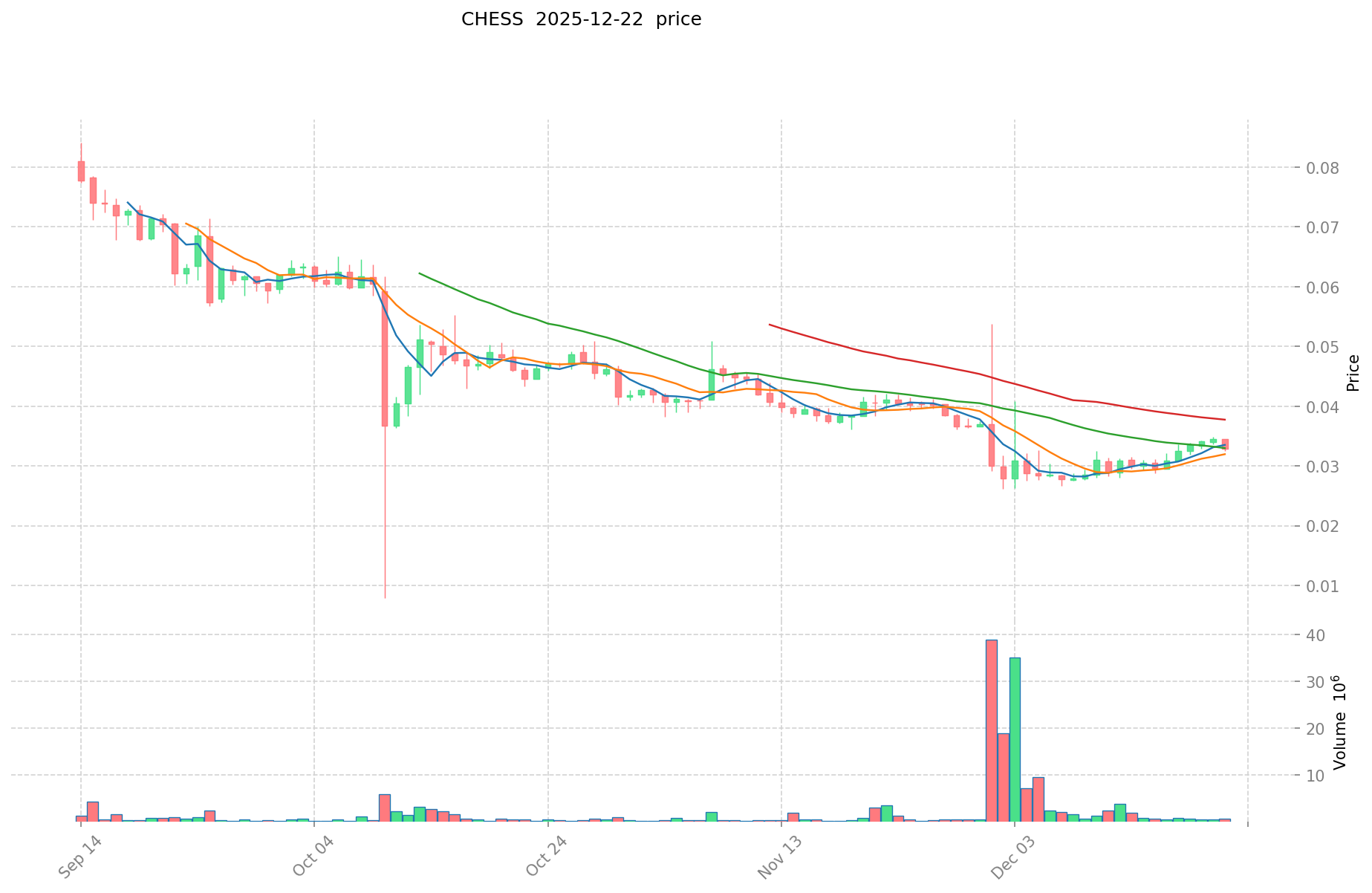
Historical Price Trajectories of CHESS and STX
Tranchess (CHESS):
- All-time high: $7.91 (October 22, 2021)
- All-time low: $0.0170983 (October 11, 2025)
- Year-over-year performance: -83.01% decline
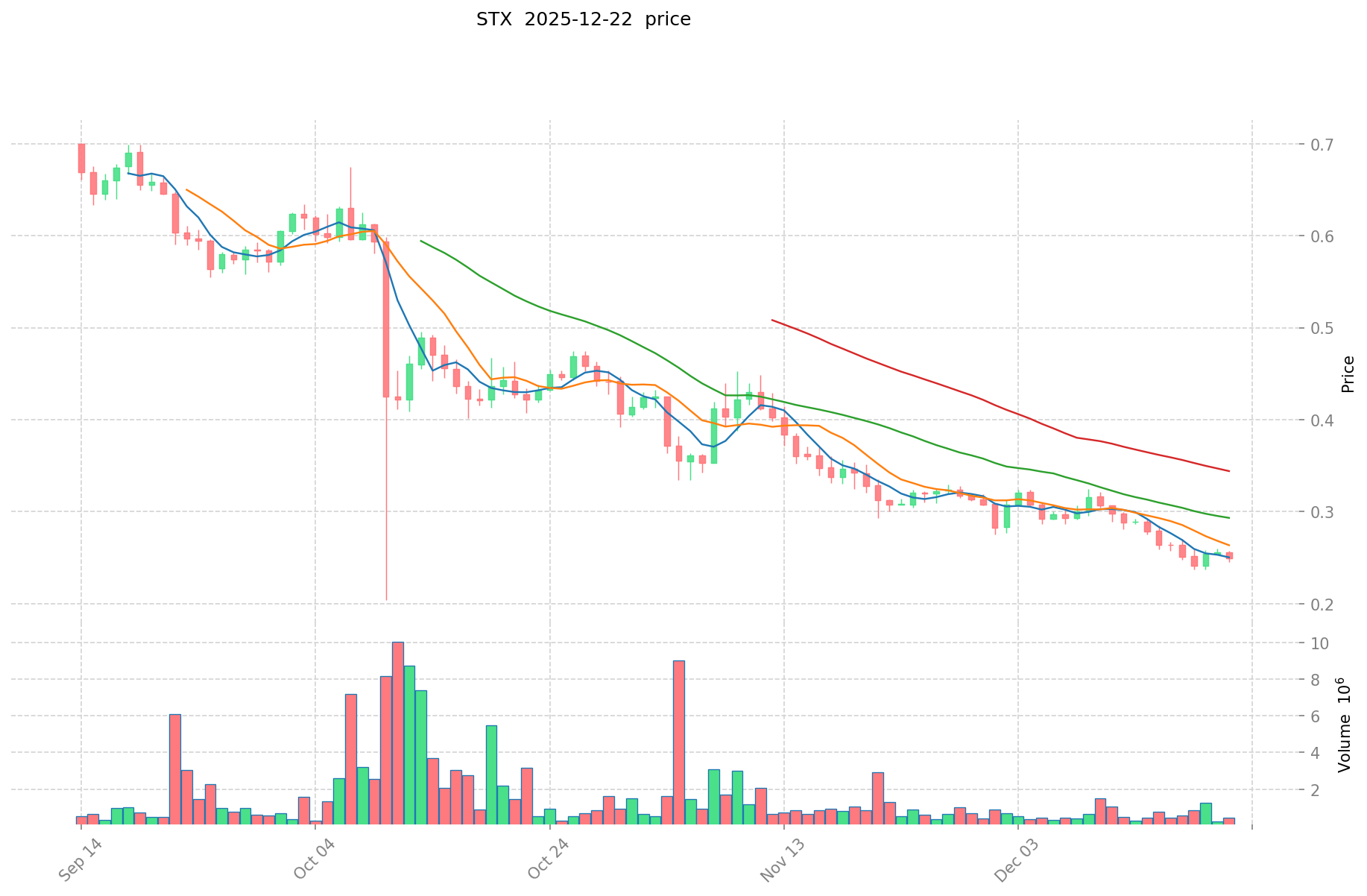
Stacks (STX):
- All-time high: $3.86 (April 1, 2024)
- All-time low: $0.04559639 (March 13, 2020)
- Year-over-year performance: -85.01% decline
Comparative Analysis: Both tokens have experienced substantial depreciation over the past year. CHESS has declined from higher valuations established in 2021, while STX, despite reaching its peak more recently in 2024, has also faced significant downward pressure. The broader cryptocurrency market downturn appears to have affected both protocols, though STX maintains a more substantial market capitalization position.
Current Market Status (December 23, 2025)
CHESS Current Metrics:
- Current price: $0.03259
- 24-hour change: -0.66%
- 24-hour trading volume: $15,945.42
- Circulating supply: 205,965,896 CHESS
- Market capitalization: $6,712,428.55
- Market ranking: #1,367
STX Current Metrics:
- Current price: $0.2473
- 24-hour change: -0.88%
- 24-hour trading volume: $131,921.03
- Circulating supply: 1,818,480,718.75 STX
- Market capitalization: $449,710,281.75
- Market ranking: #131
Market Emotion Index: 25 (Extreme Fear)
Current price data:
II. Technical Protocol Overview
CHESS: Tokenized Asset Management Framework
Tranchess operates as a tokenized asset management and derivatives trading protocol. The mechanism allows BTC holders to create QUEEN tokens using BTCB collateral and stake them within the protocol to generate additional CHESS token rewards. The protocol also facilitates token acquisition through Tranchess Swap using USDC.
Key Characteristics:
- Inspiration: Tranched fund structures catering to varying risk profiles
- Primary mechanism: BTC collateralization for token generation
- Token utility: Protocol participation and reward accumulation
Blockchain deployment: BSC (Binance Smart Chain)
Stacks is a Layer-2 blockchain enabling decentralized applications, smart contracts, and DeFi functionality on top of Bitcoin. The protocol operates through a hybrid consensus mechanism termed Proof of Transfer (PoX), which directly connects to Bitcoin's blockchain without modifying the base layer.
Core Features:
- Smart contract language: Clarity
- Consensus mechanism: Proof of Transfer (PoX)
- Architecture: Three-layer structure (blockchain foundation—peer-to-peer network—data layer)
- Data sovereignty: Built-in privacy with default encryption for user data
- Asset creation: Support for tokens, NFTs, and digital collectibles
Development tools: Open-source development kit for building decentralized applications and protocol ecosystems
Price Volatility Analysis
CHESS Performance Trajectory:
- 1-hour change: -0.12%
- 7-day change: +11.88%
- 30-day change: -19.29%
- 52-week change: -83.01%
STX Performance Trajectory:
- 1-hour change: -1.00%
- 7-day change: -6.30%
- 30-day change: -19.28%
- 52-week change: -85.01%
Analysis: Both tokens exhibit downward pressure across extended timeframes. STX demonstrates greater near-term volatility (1-hour: -1.00% vs CHESS: -0.12%), while CHESS shows stronger short-term recovery potential (7-day: +11.88% vs STX: -6.30%). The similar 30-day decline rates (-19.29% for CHESS vs -19.28% for STX) suggest both protocols face comparable market headwinds.
Market Capitalization and Dominance
- CHESS: $6.71 million market cap with 0.0003% market dominance
- STX: $449.71 million market cap with 0.014% market dominance
STX maintains approximately 67 times greater market capitalization than CHESS, reflecting deeper market integration and broader adoption.
Liquidity Metrics
- CHESS 24-hour volume: $15,945.42
- STX 24-hour volume: $131,921.03
STX demonstrates significantly superior trading volume, with approximately 8.3 times higher 24-hour transaction activity, indicating greater market liquidity and trading accessibility.
IV. Ecosystem Development and Use Cases
CHESS Ecosystem Focus
The Tranchess protocol emphasizes structured financial instruments through tokenization, enabling:
- Risk stratification for diverse investor profiles
- Bitcoin-backed token generation mechanisms
- staking incentive structures
STX Ecosystem Development
Stacks facilitates broader blockchain functionality through:
- Decentralized application development on Bitcoin
- Smart contract execution via Clarity programming language
- DeFi protocol creation and NFT infrastructure
- Creator economy and value distribution mechanisms
- Bitcoin-native DeFi functionality
V. Network Adoption and User Base
- CHESS token holders: 17,401 addresses
- STX token holders: Data not specified in source materials
STX's market position and trading volume suggest broader network adoption, though specific holder count data remains unavailable for direct comparison.
VI. Market Sentiment and Risk Assessment
Current market conditions reflect extreme fear (Fear & Greed Index: 25), indicating elevated volatility and risk aversion across cryptocurrency markets. Both tokens face identical sentiment pressures, though STX's superior market positioning and trading infrastructure may provide relative resilience during bearish cycles.
Disclaimer: This report presents factual market data and protocol information based on available sources as of December 23, 2025. Past performance does not indicate future results. Cryptocurrency markets remain highly volatile and unpredictable. This analysis is for informational purposes only and should not be construed as investment advice or recommendation.
Stacks (STX) Investment Value Analysis Report
I. Executive Summary
This report analyzes the core investment factors for Stacks (STX) based on available market data as of December 23, 2025. The analysis focuses on valuation metrics, market dynamics, and macroeconomic influences on the asset's investment potential.
Key Data Point:
- STX Market Capitalization: USD 3.658 billion (as of February 24, 2024)
- Primary Focus: Bitcoin Layer 2 interoperability and blockchain scalability
II. Core Investment Value Factors for Stacks (STX)
Market Valuation and Positioning
- Current Valuation Context: STX maintains a market capitalization of USD 3.658 billion, positioning it within the mid-tier cryptocurrency projects. Market participants evaluate STX valuation relative to Ethereum Layer 2 solutions for comparative analysis.
- Investor Capital Requirements: For institutional investors, the core concern centers on achieving stable returns within a secure framework, rather than speculative gains alone.
Technological Innovation and Scalability
- Blockchain Focus: Stacks operates as a Bitcoin Layer 2 solution emphasizing interoperability, security improvements, and transaction scalability.
- Potential Value Drivers: Technological enhancements in blockchain infrastructure directly correlate with ecosystem adoption and long-term asset appreciation prospects.
Market Sentiment and Price-Value Dynamics
- Sentiment-Value Gap: Market pricing fluctuates independent of underlying value changes. Price volatility does not necessarily reflect fundamental value deterioration or improvement.
- Investor Control: Market participants maintain discretionary authority over trading decisions regardless of short-term price movements.
III. Macroeconomic and Policy Environment Impact
Monetary Policy Influence
- Interest Rate Adjustments: Central bank monetary policy and interest rate changes significantly influence market attractiveness for digital assets. Rate environments directly affect capital allocation toward cryptocurrency investments.
- Inflation Context: Inflationary environments strengthen the "digital asset" positioning of cryptocurrencies, as investors seek alternative value stores and hedge mechanisms against currency debasement.
Geopolitical Considerations
- Cross-Border Transaction Demand: Geopolitical uncertainty and international instability potentially stimulate investment demand growth for blockchain-based solutions like STX, particularly those facilitating cross-border transactions and financial sovereignty.
- Capital Flight Dynamics: Political instability may redirect capital toward decentralized blockchain solutions, increasing STX investment appeal.
Regulatory Environment
- Policy Uncertainty: The evolving regulatory landscape remains a critical variable affecting institutional adoption and mainstream acceptance of cryptocurrency assets.
- Compliance Framework Development: Regulatory clarity and institutional-grade compliance mechanisms support long-term sustainable growth.
IV. Risk and Limitation Considerations
The reference materials contain limited specific data regarding CHESS cryptocurrency, preventing comprehensive comparative analysis between CHESS and STX as originally requested.
Data Constraints
- Reference materials primarily address STX valuation metrics and general cryptocurrency investment principles rather than detailed CHESS project specifications.
- Comparative analysis between the two assets cannot be executed without sufficient primary source material on CHESS fundamentals, technology, and market positioning.
Market Dynamics
- Investor sentiment volatility remains a persistent factor affecting short-term price performance independent of technological or fundamental developments.
- Capital flows responding to macroeconomic shifts create additional unpredictability beyond project-specific metrics.
V. Conclusion
Stacks (STX) investment value assessment depends primarily on: market trends reflecting monetary policy adjustments, technological innovation capacity within the Bitcoin Layer 2 ecosystem, and macroeconomic conditions affecting digital asset capital allocation. Institutional interest centers on risk-adjusted returns within secure infrastructure frameworks rather than speculative appreciation alone. Geopolitical uncertainty and inflationary environments may support incremental demand growth, though regulatory developments remain a significant uncertainty variable requiring ongoing monitoring.
III. 2025-2030 Year Price Prediction: CHESS vs STX
Short-term Prediction (2025)
- CHESS: Conservative $0.0182504 - $0.03259 | Optimistic $0.03259 - $0.0410634
- STX: Conservative $0.193518 - $0.2481 | Optimistic $0.2481 - $0.354783
Medium-term Prediction (2027-2028)
- CHESS may enter growth consolidation phase, projected price range $0.0322760983344 - $0.0798408748272
- STX may enter expansion phase, projected price range $0.292803995259 - $0.404661701313
- Key drivers: institutional capital inflows, ETF adoption, ecosystem development
Long-term Prediction (2030)
- CHESS: Base case $0.061682455153734 - $0.077103068942168 | Optimistic case $0.077103068942168 - $0.107173265829613
- STX: Base case $0.407728740915024 - $0.453031934350027 | Optimistic case $0.453031934350027 - $0.50286544712853
View detailed price predictions for CHESS and STX
Disclaimer: This analysis is based on historical data and predictive models. Cryptocurrency markets are highly volatile and subject to regulatory, technological, and macroeconomic uncertainties. These forecasts should not be considered investment advice. Past performance does not guarantee future results. Investors should conduct their own due diligence and consult financial advisors before making investment decisions.
CHESS:
| 年份 |
预测最高价 |
预测平均价格 |
预测最低价 |
涨跌幅 |
| 2025 |
0.0410634 |
0.03259 |
0.0182504 |
0 |
| 2026 |
0.054503516 |
0.0368267 |
0.034248831 |
13 |
| 2027 |
0.06758435984 |
0.045665108 |
0.04292520152 |
40 |
| 2028 |
0.0798408748272 |
0.05662473392 |
0.0322760983344 |
73 |
| 2029 |
0.085973333510736 |
0.0682328043736 |
0.048445291105256 |
109 |
| 2030 |
0.107173265829613 |
0.077103068942168 |
0.061682455153734 |
136 |
STX:
| 年份 |
预测最高价 |
预测平均价格 |
预测最低价 |
涨跌幅 |
| 2025 |
0.354783 |
0.2481 |
0.193518 |
0 |
| 2026 |
0.31349916 |
0.3014415 |
0.28335501 |
21 |
| 2027 |
0.3505161762 |
0.30747033 |
0.2306027475 |
24 |
| 2028 |
0.404661701313 |
0.3289932531 |
0.292803995259 |
33 |
| 2029 |
0.539236391493555 |
0.3668274772065 |
0.267784058360745 |
48 |
| 2030 |
0.50286544712853 |
0.453031934350027 |
0.407728740915024 |
83 |
Comparative Investment Analysis: Tranchess (CHESS) vs Stacks (STX)
IV. Investment Strategy Comparison: CHESS vs STX
Long-term vs Short-term Investment Strategy
CHESS: Better suited for investors focused on structured financial instruments and Bitcoin-backed tokenization mechanisms. The protocol's recovery trajectory (7-day performance: +11.88%) suggests potential medium-term consolidation, appealing to those comfortable with niche derivatives trading platforms.
STX: Better suited for investors pursuing broader blockchain infrastructure exposure and Layer 2 Bitcoin scalability solutions. Superior market capitalization ($449.71M vs $6.71M) and trading volume provide institutional-grade accessibility, attracting investors seeking exposure to Bitcoin's decentralized application ecosystem.
Risk Management and Asset Allocation
Conservative Investor Profile:
- CHESS: 15% allocation | STX: 85% allocation
- Rationale: STX's superior liquidity (8.3x higher trading volume), larger market capitalization (67x larger), and established Layer 2 positioning reduce concentration risk compared to CHESS's smaller, less liquid market.
Aggressive Investor Profile:
- CHESS: 35% allocation | STX: 65% allocation
- Rationale: Higher CHESS weighting captures potential upside from emerging protocol recovery; STX maintains dominant position due to superior infrastructure maturity and institutional adoption.
Hedging Instruments: Stablecoin positioning (40-50% portfolio allocation) recommended given current extreme fear sentiment (Fear & Greed Index: 25). Cross-asset diversification through Bitcoin and Ethereum correlation analysis provides additional downside protection.
V. Comparative Risk Analysis
Market Risk
CHESS: Extreme liquidity risk evidenced by minimal 24-hour trading volume ($15,945.42), creating potential slippage during substantial position accumulation or liquidation. Market capitalization of $6.71M renders the asset susceptible to whale manipulation and sudden price volatility. Year-over-year decline of -83.01% indicates sustained market rejection.
STX: Moderate liquidity constraints despite superior positioning relative to CHESS. Trading volume of $131,921.03 remains modest within cryptocurrency markets. Year-over-year decline of -85.01% reflects broader market pressures, though market cap stability suggests institutional support mechanisms.
Technology Risk
CHESS: Centralized protocol dependency on Binance Smart Chain creates single-chain exposure. Limited ecosystem development reduces diversification of use cases and revenue streams. Smart contract auditing and security framework specificity not addressed in available documentation.
STX: Architectural dependency on Bitcoin Layer 2 positioning creates inherent constraint—Bitcoin mainchain throughput limitations may restrict STX scalability potential. Proof of Transfer consensus mechanism, while innovative, lacks extensive real-world validation compared to established consensus models. Clarity smart contract language represents emerging technology with limited developer ecosystem maturity.
Regulatory Risk
Global Impact on Both Assets: Cryptocurrency regulatory frameworks remain in formative stages across major jurisdictions. Both CHESS and STX face similar policy uncertainty regarding token classification (security vs utility), taxation treatment, and exchange listing requirements.
Jurisdictional Variations: STX's Bitcoin Layer 2 positioning may benefit from regulatory clarity surrounding Bitcoin infrastructure development. CHESS's derivatives trading function could trigger stricter compliance requirements in jurisdictions implementing derivative trading restrictions.
VI. Conclusion: Which Is the Better Buy?
📌 Investment Value Summary
CHESS Advantages:
- Specialized protocol addressing structured financial instrument demand
- Bitcoin collateralization mechanism provides intrinsic backing
- Emerging recovery trajectory (7-day: +11.88%) offers potential mean-reversion opportunity
- Lower absolute price ($0.03259) reduces capital requirements for position accumulation
STX Advantages:
- Superior market positioning with 67x larger market capitalization
- Institutional-grade liquidity (8.3x higher trading volume) enabling efficient execution
- Established Layer 2 Bitcoin ecosystem with broader decentralized application support
- Technical infrastructure maturity backed by development tools and creator economy mechanisms
- Diversified use cases (smart contracts, NFTs, DeFi) reduce single-point-of-failure risk
✅ Investment Recommendations
Beginner Investors:
Prioritize STX allocation (80-85% of cryptocurrency holdings) given superior market liquidity, established infrastructure, and reduced concentration risk. CHESS exposure should remain limited (15-20%) due to extreme liquidity constraints and technical complexity. Emphasize stablecoin positions (40-50% portfolio) during current extreme fear sentiment.
Experienced Investors:
Consider tactical CHESS accumulation during extreme depression phases to capture potential protocol recovery premium, while maintaining STX as core holdings (60-70%) for portfolio stability. Implement dollar-cost averaging across both assets, spacing purchases across multiple market cycles. Deploy hedging strategies through options contracts on STX given superior derivatives market liquidity.
Institutional Investors:
Maintain primary allocation to STX (70-75%) reflecting institutional custody availability, regulatory compliance frameworks, and established trading infrastructure. Evaluate CHESS exclusively through specialized fund structures or direct protocol participation given illiquidity constraints. Emphasize due diligence on Proof of Transfer mechanism validation and Layer 2 Bitcoin regulatory treatment within target jurisdictions.
⚠️ Risk Disclaimer: Cryptocurrency markets exhibit extreme volatility and remain subject to regulatory uncertainty, technological vulnerabilities, and macroeconomic disruption. Both CHESS and STX declined -83% to -85% year-over-year despite divergent technical positioning, indicating market sentiment dominates fundamental factors during extended bearish cycles. This analysis presents factual market data and does not constitute investment advice. All cryptocurrency investments carry substantial capital loss risk. Consult qualified financial advisors and conduct independent due diligence before executing investment decisions. Past performance does not guarantee future results.
None
CHESS vs STX: Frequently Asked Questions
FAQ
Q1: What are the main technical differences between CHESS and STX?
Answer: Tranchess (CHESS) operates as a tokenized asset management and derivatives trading protocol on Binance Smart Chain, primarily focused on Bitcoin-backed token generation and structured financial instruments. Stacks (STX) functions as a Bitcoin Layer 2 smart contract platform using Proof of Transfer consensus mechanism and Clarity programming language, enabling decentralized applications, DeFi protocols, and NFT infrastructure directly on Bitcoin. STX offers broader ecosystem functionality, while CHESS specializes in tranched fund structures for risk stratification.
Q2: Which token has better liquidity and trading accessibility as of December 23, 2025?
Answer: STX demonstrates significantly superior liquidity with USD 131,921.03 in 24-hour trading volume compared to CHESS's USD 15,945.42—approximately 8.3 times higher. STX's market capitalization of USD 449.71 million dwarfs CHESS's USD 6.71 million by 67 times. STX ranks #131 on cryptocurrency exchanges with institutional-grade accessibility, while CHESS ranks #1,367 with extreme liquidity constraints that create slippage risks during substantial position trades.
Q3: How have CHESS and STX performed over the past year?
Answer: Both tokens experienced severe depreciation over the previous 12 months. CHESS declined -83.01% from higher 2021 valuations (all-time high USD 7.91 in October 2021), while STX declined -85.01% despite achieving its all-time high more recently in April 2024 (USD 3.86). Both tokens face identical downward market pressure, though STX maintains greater market positioning and trading infrastructure resilience during bearish cycles.
Q4: What market conditions currently impact both CHESS and STX?
Answer: Both tokens operate within extreme fear market sentiment (Fear & Greed Index: 25 as of December 23, 2025), indicating elevated volatility and risk aversion across cryptocurrency markets. Current macroeconomic factors include monetary policy uncertainty, inflationary pressures affecting digital asset valuations, and evolving regulatory frameworks. The extreme fear environment suggests both assets face similar headwinds regardless of technical differentiation, making sentiment-driven price movements more influential than fundamental developments.
Q5: Which token offers better investment value for different investor profiles?
Answer: Conservative investors should prioritize STX allocation (80-85%) due to superior liquidity, institutional custody availability, and market stability, with minimal CHESS exposure (15-20%). Experienced investors may tactically accumulate CHESS during extreme depression phases while maintaining STX core holdings (60-70%) for portfolio stability. Institutional investors should focus on STX (70-75%) given regulatory compliance frameworks and established trading infrastructure, approaching CHESS exclusively through specialized fund structures given illiquidity constraints.
Q6: What are the primary risk factors differentiating CHESS and STX?
Answer: CHESS faces extreme liquidity risk with minimal 24-hour trading volume (USD 15,945.42), creating susceptibility to whale manipulation and sudden price volatility. It also depends entirely on Binance Smart Chain infrastructure with limited ecosystem diversification. STX carries Bitcoin Layer 2 architectural constraints—Bitcoin mainchain throughput limitations may restrict scalability—and Proof of Transfer consensus represents emerging technology lacking extensive validation. Both tokens face identical regulatory uncertainty regarding token classification and taxation treatment across jurisdictions.
Q7: What price predictions exist for CHESS and STX through 2030?
Answer: CHESS conservative 2030 projection ranges USD 0.061682 to USD 0.077103 (base case), with optimistic scenarios reaching USD 0.077103 to USD 0.107173, representing 136% potential appreciation from current USD 0.03259. STX conservative 2030 projection ranges USD 0.407729 to USD 0.453032 (base case), with optimistic scenarios reaching USD 0.453032 to USD 0.502865, representing 83% potential appreciation from current USD 0.2473. Medium-term 2027-2028 projections suggest CHESS consolidation phase (USD 0.032276 to USD 0.079841) while STX enters expansion phase (USD 0.292804 to USD 0.404662).
Q8: Should I invest in CHESS, STX, or both, given current market conditions?
Answer: This analysis provides factual market data and comparative metrics only and does not constitute investment advice or recommendations. The decision depends on individual risk tolerance, investment timeline, capital availability, and portfolio diversification objectives. Current extreme fear sentiment (Index: 25) indicates elevated volatility requiring substantial downside risk tolerance. Emphasize stablecoin positioning (40-50% portfolio allocation) during current conditions. Consult qualified financial advisors and conduct independent due diligence before executing investment decisions. Cryptocurrency investments carry substantial capital loss risk—past performance does not guarantee future results.
* The information is not intended to be and does not constitute financial advice or any other recommendation of any sort offered or endorsed by Gate.