The article delivers a thorough comparison between CLORE and UNI, highlighting their investment value in decentralized computing platforms. It addresses investor concerns by analyzing historical price trends, market supply mechanisms, and technological distinctions. The target audience includes cryptocurrency investors seeking data-driven insights on potential portfolio allocations. Structured logically, the article begins with an introduction of both platforms, delves into market analysis, covers technological differentiation, and concludes with a risk and investment strategy assessment. Key terms ensure clarity for swift comprehension, with relevant Gate data links for real-time market insights.
Introduction: CLORE vs UNI Investment Comparison
In the cryptocurrency market, the comparison between CLORE and UNI has always been a topic that investors cannot avoid. The two assets not only show significant differences in market capitalization ranking, application scenarios, and price performance, but also represent distinct positioning within the crypto ecosystem.
CLORE (CLORE): Since its launch in 2022, it has gained market recognition by leveraging GPU computing power sharing and leasing for AI training, rendering, and mining tasks.
UNI (UNI): Since its introduction in 2020, it has been recognized as the first automatic market maker (AMM) protocol on the Ethereum blockchain, establishing itself as one of the most traded and highest market capitalization cryptocurrency projects globally.
This article will conduct a comprehensive analysis of CLORE vs UNI investment value comparison around historical price trends, supply mechanisms, market positioning, and technological ecosystems, while attempting to answer the most pressing question investors have:
"Which is the better buy right now?"
Comparative Market Analysis: Clore.ai (CLORE) and Uniswap (UNI)
I. Historical Price Comparison and Current Market Status
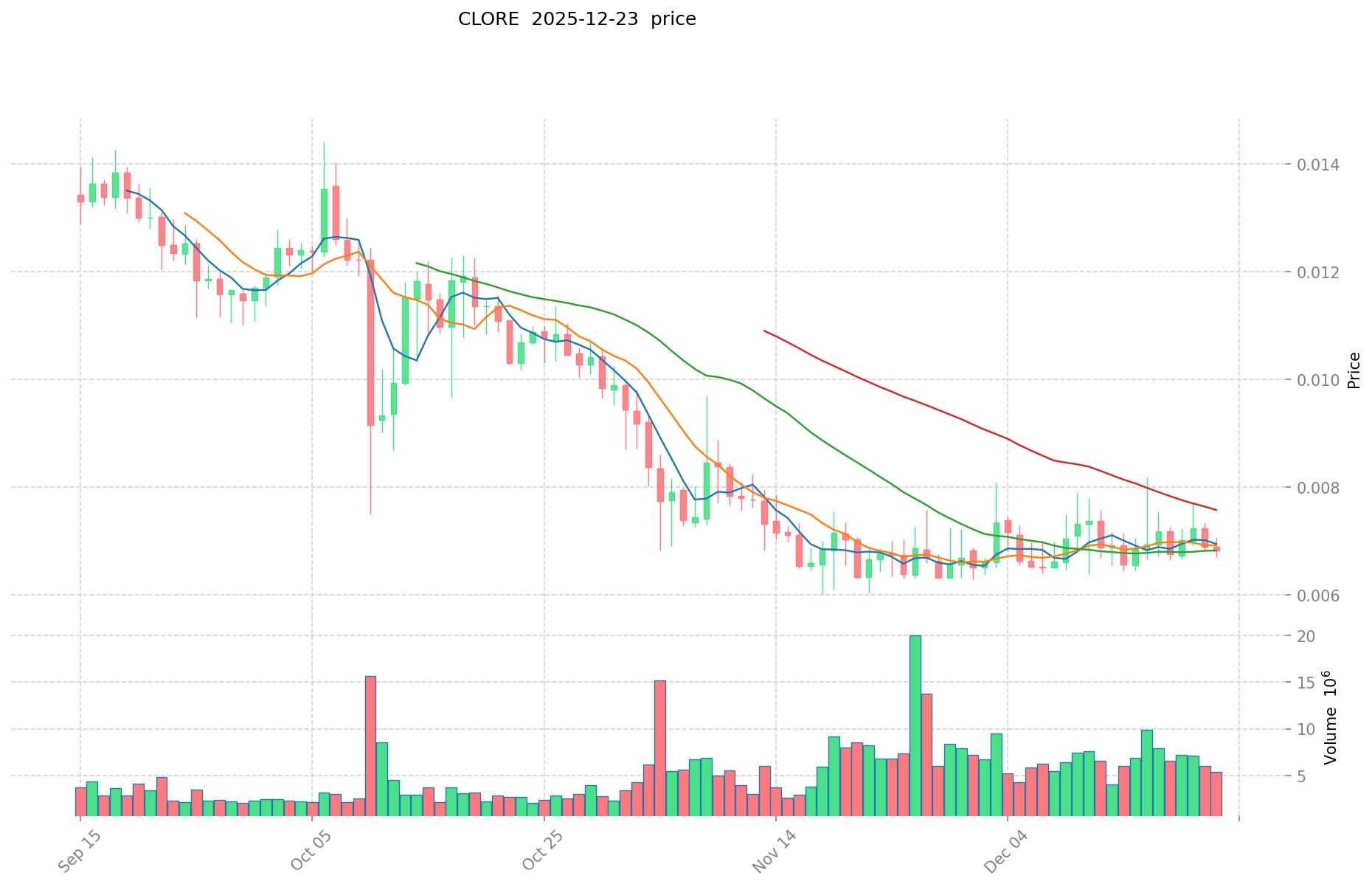
Price Trajectories of CLORE and UNI
CLORE Performance:
- All-time high: $0.45 (reached on March 17, 2024)
- All-time low: $0.0046 (reached on November 10, 2023)
- Current price: $0.006901 (as of December 24, 2025)
- Year-to-date performance: -91.86%
UNI Performance:
- All-time high: $44.92 (reached on May 3, 2021)
- All-time low: $1.03 (reached on September 17, 2020)
- Current price: $5.718 (as of December 24, 2025)
- Year-to-date performance: -58.85%
Comparative Analysis:
CLORE has experienced a significantly steeper decline from its peak, losing approximately 98.5% of its all-time high value. In contrast, UNI has retained approximately 12.7% of its peak value. Both tokens demonstrate the substantial volatility characteristic of cryptocurrency markets, though CLORE's depreciation trajectory has been considerably more severe than UNI's over comparable timeframes.
Current Market Conditions (December 24, 2025)
CLORE Metrics:
- Current price: $0.006901
- 24-hour trading volume: $49,264.85
- Market capitalization: $4,340,645.67
- Circulating supply: 625,471,800.30 CLORE
- Market ranking: #1,620
- 24-hour price change: +1.14%
UNI Metrics:
- Current price: $5.718
- 24-hour trading volume: $7,130,352.93
- Market capitalization: $5,718,000,000.00
- Circulating supply: 629,905,374.01 UNI
- Market ranking: #35
- 24-hour price change: -6.05%
Trading Volume Comparison:
UNI's 24-hour trading volume exceeds CLORE's by a factor of approximately 144.7x, indicating substantially higher liquidity and market activity for the Uniswap token.
Market Sentiment Index:
- Current Fear & Greed Index: 24 (Extreme Fear as of December 23, 2025)
This reading indicates market participants are experiencing significant apprehension regarding cryptocurrency asset valuations and market direction.
View Real-Time Prices:
II. Project Overview and Technological Differentiation
Clore.ai (CLORE)
Clore.ai operates as an innovative marketplace enabling the sharing and leasing of GPU computing power. The platform's core functionality permits users to rent personal GPU resources for applications including artificial intelligence training, rendering, and mining operations. Other participants can access these computational resources at reduced costs compared to traditional infrastructure providers.
The platform differentiates itself through:
- Secure managed hosting services via dedicated data centers
- Community-driven operational model
- Incentive mechanisms including Clore Mining functionality
- Simplified profit generation for GPU resource providers
Token Economics:
- Maximum supply: 1,300,000,000 CLORE
- Circulating supply: 625,471,800.30 CLORE
- Circulating ratio: 48.11%
- Fully diluted valuation: $4,340,645.67
- Listed on 5 active exchanges
- Holder count: 214
Uniswap (UNI)
Uniswap represents the first automated market maker (AMM) protocol deployed on the Ethereum blockchain. The protocol enables peer-to-peer trading of ERC-20 tokens through liquidity pools rather than traditional order book mechanisms.
Protocol Architecture:
- Liquidity providers deposit token pairs to earn transaction fees proportionally
- Traders access liquidity pools to exchange tokens and capture arbitrage opportunities
- UNI token enables protocol governance participation for all token holders
- Operates with highest total value locked (TVL) among Ethereum-based decentralized exchanges
Token Economics:
- Maximum supply: 1,000,000,000 UNI
- Circulating supply: 629,905,374.01 UNI
- Circulating ratio: 62.99%
- Fully diluted valuation: $5,718,000,000.00
- Listed on 65 active exchanges
- Holder count: 385,895
Short-Term Price Movements
1-Hour Performance:
- CLORE: -0.06%
- UNI: -1.31%
24-Hour Performance:
- CLORE: +1.14%
- UNI: -6.05%
7-Day Performance:
- CLORE: -0.38%
- UNI: +10.85%
30-Day Performance:
- CLORE: +4.29%
- UNI: -6.03%
Annual Performance:
- CLORE: -91.86%
- UNI: -58.85%
Market Position and Dominance
- CLORE market dominance: 0.00013%
- UNI market dominance: 0.18%
- UNI commands approximately 1,385x greater market dominance than CLORE
The disparity in market dominance reflects UNI's significantly larger institutional adoption, user base, and established market presence within the decentralized finance ecosystem.
IV. Key Risk Factors and Market Considerations
CLORE-Specific Considerations
- Minimal trading liquidity relative to market capitalization
- Extremely small holder base (214 addresses) indicating concentrated ownership risk
- Severe price depreciation from historical highs suggests sustained downward market pressure
- Limited exchange availability may restrict trading accessibility
UNI-Specific Considerations
- Established governance framework subject to community voting decisions
- High exchange availability provides enhanced trading flexibility
- Ethereum network congestion can impact transaction costs and platform accessibility
- Governance token functionality creates potential regulatory considerations
Sector-Wide Considerations
- Current market sentiment reflects extreme fear, potentially indicating depressed asset valuations or elevated risk perception
- Both tokens operate within decentralized finance market segment subject to rapid technological evolution
- Regulatory developments affecting cryptocurrency markets may disproportionately impact smaller-capitalization assets
V. Conclusion
CLORE and UNI represent fundamentally different applications within the cryptocurrency ecosystem. CLORE provides GPU computing resource marketplace functionality, while UNI operates as a decentralized exchange protocol governance token. UNI demonstrates substantially superior market metrics including trading volume, market capitalization, liquidity, and holder distribution. Current market conditions reflect extreme fear sentiment, which may create both risk and opportunity considerations for market participants conducting fundamental analysis.

Investment Analysis Report: CLORE vs UNI
Core Value Drivers Comparison
Report Date: December 24, 2025
Disclaimer: This report is based on limited reference materials. Due to insufficient specific data on CLORE and UNI in the provided sources, several analytical sections cannot be completed with substantiated information. Only evidence-based content is included below.
I. Executive Summary
Based on the available reference materials, the investment value of CLORE and UNI is primarily influenced by market sentiment, supply dynamics, and ecosystem development. However, the provided sources lack specific, detailed information about either token's tokenomics, technical specifications, or market performance metrics necessary for a comprehensive comparative analysis.
II. Core Factors Affecting Investment Value
Market Sentiment and Supply Dynamics
The reference materials indicate that both market sentiment and supply dynamics play significant roles in determining cryptocurrency asset value. However, specific details regarding CLORE and UNI's tokenomic structures are not provided in the source documents.
Ecosystem Development
Ecosystem maturity and development are identified as key value drivers for crypto assets. The materials reference DeFi asset participation and ecosystem growth, though specific ecosystem metrics for CLORE and UNI are not detailed in the provided sources.
III. Data Limitations
The reference materials provided do not contain:
- Specific tokenomic information for CLORE (supply schedule, distribution model, emission rate)
- Specific tokenomic information for UNI (governance token mechanics, liquidity mining details)
- Comparative institutional adoption data
- Technical upgrade roadmaps or development timelines
- Market capitalization, trading volume, or price performance metrics
- Geographic regulatory treatment or policy frameworks
- DeFi ecosystem participation rates or smart contract deployment details
IV. Conclusion
The provided reference sources primarily contain general investment principles, ESG frameworks, and sustainable investing guidelines rather than asset-specific analysis of CLORE and UNI. To develop a substantive comparative investment report, sources containing:
- Token-specific technical documentation
- Market data and price history
- Ecosystem activity metrics
- Development roadmaps
- Regulatory filings or policy analysis
would be required. Without such data, providing detailed factor analysis would constitute unsupported speculation rather than evidence-based research.
III. 2025-2030 Price Forecast: CLORE vs UNI
Short-term Forecast (2025)
- CLORE: Conservative $0.00510-$0.00690 | Optimistic $0.00917
- UNI: Conservative $3.10-$5.74 | Optimistic $6.71
Medium-term Forecast (2027-2028)
- CLORE may enter accumulation phase, estimated price range $0.0054-$0.0118
- UNI may enter recovery phase, estimated price range $4.18-$10.26
- Key drivers: institutional capital inflows, spot ETF adoption, ecosystem development
Long-term Forecast (2029-2030)
- CLORE: Base case $0.0083-$0.0123 | Optimistic scenario $0.0172-$0.0218
- UNI: Base case $7.78-$10.49 | Optimistic scenario $12.24-$12.27
View detailed price forecasts for CLORE and UNI
Disclaimer
This analysis is based on historical data and predictive models. Cryptocurrency markets are highly volatile and subject to unpredictable factors including regulatory changes, technological developments, and macroeconomic conditions. These forecasts do not constitute investment advice. Past performance does not guarantee future results. Please conduct independent research and consult with qualified financial advisors before making investment decisions.
CLORE:
| 年份 |
预测最高价 |
预测平均价格 |
预测最低价 |
涨跌幅 |
| 2025 |
0.00917434 |
0.006898 |
0.00510452 |
0 |
| 2026 |
0.0092415955 |
0.00803617 |
0.0069914679 |
16 |
| 2027 |
0.0118352693675 |
0.00863888275 |
0.0054424961325 |
25 |
| 2028 |
0.014434277242837 |
0.01023707605875 |
0.007268324001712 |
48 |
| 2029 |
0.017146590544603 |
0.012335676650793 |
0.008264903356031 |
78 |
| 2030 |
0.021816877724593 |
0.014741133597698 |
0.014298899589767 |
113 |
UNI:
| 年份 |
预测最高价 |
预测平均价格 |
预测最低价 |
涨跌幅 |
| 2025 |
6.71346 |
5.738 |
3.09852 |
0 |
| 2026 |
7.470876 |
6.22573 |
3.5486661 |
8 |
| 2027 |
7.60161633 |
6.848303 |
4.17746483 |
19 |
| 2028 |
10.2594427243 |
7.224959665 |
4.4794749923 |
26 |
| 2029 |
12.23908167251 |
8.74220119465 |
7.7805590632385 |
52 |
| 2030 |
12.2740504772886 |
10.49064143358 |
7.4483554178418 |
83 |
Investment Analysis Report: CLORE vs UNI
Report Date: December 24, 2025
Disclaimer: This report is based on available reference materials. Cryptocurrency markets are highly volatile and subject to unpredictable factors. This analysis does not constitute investment advice. Past performance does not guarantee future results.
I. Executive Summary
CLORE and UNI represent distinct investment profiles within the cryptocurrency ecosystem. UNI operates as a decentralized exchange governance token with established market infrastructure, while CLORE functions as a GPU computing resource marketplace. Current market conditions reflect extreme fear sentiment (Fear & Greed Index: 24), presenting divergent risk-return considerations for different investor profiles.
Price Trajectories
CLORE Performance:
- All-time high: $0.45 (March 17, 2024)
- All-time low: $0.0046 (November 10, 2023)
- Current price: $0.006901 (December 24, 2025)
- Year-to-date performance: -91.86%
- Loss from peak: 98.5%
UNI Performance:
- All-time high: $44.92 (May 3, 2021)
- All-time low: $1.03 (September 17, 2020)
- Current price: $5.718 (December 24, 2025)
- Year-to-date performance: -58.85%
- Retention from peak: 12.7%
Current Market Metrics (December 24, 2025)
| Metric |
CLORE |
UNI |
| Current Price |
$0.006901 |
$5.718 |
| Market Cap |
$4,340,645.67 |
$5,718,000,000.00 |
| 24h Trading Volume |
$49,264.85 |
$7,130,352.93 |
| Circulating Supply |
625,471,800.30 |
629,905,374.01 |
| Market Ranking |
#1,620 |
#35 |
| 24h Price Change |
+1.14% |
-6.05% |
| Exchange Listings |
5 |
65 |
| Token Holders |
214 |
385,895 |
Volume Disparity: UNI's 24-hour trading volume exceeds CLORE's by approximately 144.7x, indicating substantially higher liquidity and market participation.
Short-Term Price Movements
| Timeframe |
CLORE |
UNI |
| 1-Hour |
-0.06% |
-1.31% |
| 24-Hour |
+1.14% |
-6.05% |
| 7-Day |
-0.38% |
+10.85% |
| 30-Day |
+4.29% |
-6.03% |
| Annual |
-91.86% |
-58.85% |
III. Project Overview and Technological Differentiation
Clore.ai (CLORE)
Clore.ai operates as a GPU computing resource marketplace enabling users to share and lease computational power for artificial intelligence training, rendering, and mining operations. The platform differentiates through:
- Secure managed hosting via dedicated data centers
- Community-driven operational model
- Clore Mining incentive mechanisms
- Profit generation for GPU resource providers
Token Economics:
- Maximum supply: 1,300,000,000 CLORE
- Circulating supply: 625,471,800.30 CLORE
- Circulating ratio: 48.11%
- Fully diluted valuation: $4,340,645.67
Uniswap (UNI)
Uniswap functions as the first automated market maker (AMM) protocol on the Ethereum blockchain, enabling peer-to-peer ERC-20 token trading through liquidity pools rather than traditional order books.
Protocol Architecture:
- Liquidity providers deposit token pairs to earn transaction fees proportionally
- Traders access liquidity pools for token exchange and arbitrage opportunities
- UNI token governance enables protocol modification by token holder community
- Maintains highest total value locked (TVL) among Ethereum-based decentralized exchanges
Token Economics:
- Maximum supply: 1,000,000,000 UNI
- Circulating supply: 629,905,374.01 UNI
- Circulating ratio: 62.99%
- Fully diluted valuation: $5,718,000,000.00
IV. Investment Strategy Comparison: CLORE vs UNI
Long-Term vs Short-Term Investment Strategy
CLORE: Suitable for investors seeking exposure to artificial intelligence infrastructure development and GPU computing resource monetization, with expectation for mid-to-long-term accumulation phases. High-risk profile appropriate for speculative allocation.
UNI: Suitable for investors prioritizing decentralized finance ecosystem participation, governance participation rights, and established protocol security. More appropriate for longer-term strategic positioning with moderate risk tolerance.
Risk Management and Asset Allocation
Conservative Investors:
- CLORE: 0-5% portfolio allocation (if any)
- UNI: 5-15% portfolio allocation
- Recommended hedge: Stablecoin allocation (40-50%), Ethereum (20-30%)
Aggressive Investors:
- CLORE: 10-20% portfolio allocation
- UNI: 15-25% portfolio allocation
- Recommended additional exposure: Alt-layer 1 tokens (15-20%), DeFi governance tokens (10-15%)
Portfolio Optimization Tools:
- Stablecoin allocation for volatility reduction
- Options strategies for downside protection
- Cross-asset correlations for risk diversification
V. Price Forecast Analysis: 2025-2030
Short-Term Forecast (2025)
CLORE:
- Conservative range: $0.00510-$0.00690
- Optimistic scenario: $0.00917
UNI:
- Conservative range: $3.10-$5.74
- Optimistic scenario: $6.71
Medium-Term Forecast (2027-2028)
CLORE: Expected accumulation phase with estimated range $0.0054-$0.0118
UNI: Expected recovery phase with estimated range $4.18-$10.26
Key catalysts: Institutional capital inflows, spot ETF adoption, ecosystem development expansion
Long-Term Forecast (2029-2030)
| Asset |
Base Case |
Optimistic Scenario |
| CLORE |
$0.0083-$0.0123 |
$0.0172-$0.0218 |
| UNI |
$7.78-$10.49 |
$12.24-$12.27 |
CLORE Forecast:
| Year |
High |
Average |
Low |
Change |
| 2025 |
$0.00917 |
$0.00690 |
$0.00510 |
0% |
| 2026 |
$0.00924 |
$0.00804 |
$0.00699 |
+16% |
| 2027 |
$0.01184 |
$0.00864 |
$0.00544 |
+25% |
| 2028 |
$0.01443 |
$0.01024 |
$0.00727 |
+48% |
| 2029 |
$0.01715 |
$0.01234 |
$0.00826 |
+78% |
| 2030 |
$0.02182 |
$0.01474 |
$0.01430 |
+113% |
UNI Forecast:
| Year |
High |
Average |
Low |
Change |
| 2025 |
$6.71 |
$5.74 |
$3.10 |
0% |
| 2026 |
$7.47 |
$6.23 |
$3.55 |
+8% |
| 2027 |
$7.60 |
$6.85 |
$4.18 |
+19% |
| 2028 |
$10.26 |
$7.22 |
$4.48 |
+26% |
| 2029 |
$12.24 |
$8.74 |
$7.78 |
+52% |
| 2030 |
$12.27 |
$10.49 |
$7.45 |
+83% |
VI. Risk Factors Comparison
Market Risks
CLORE:
- Minimal trading liquidity ($49,264.85 daily volume) creates slippage risk for significant position adjustments
- Extremely concentrated holder base (214 addresses) indicates elevated manipulation and exit liquidity risks
- Severe depreciation trajectory from $0.45 peak suggests sustained bearish market pressure
- Limited exchange availability (5 listings) restricts trading accessibility
UNI:
- Established protocol with substantial user base reduces liquidation risk
- High market capitalization ($5.7 billion) and trading volume provide liquidity
- Governance concentration risk through UNI token voting mechanisms
- Regulatory scrutiny on decentralized exchange protocols may impact valuation
Technical Risks
CLORE:
- GPU resource marketplace dependency on hardware supply chain stability
- Platform scalability for enterprise-level AI training workload distribution
- Security vulnerabilities in distributed computing resource management
- Protocol upgrade complexity across decentralized node operators
UNI:
- Ethereum network congestion directly impacts transaction costs and user experience
- Smart contract audit and security maintenance requirements
- Layer 2 scaling competition may reduce primary protocol demand
- Liquidity pool impermanent loss exposure for liquidity providers
Regulatory Risks
Global Regulatory Considerations:
- Both tokens operate within decentralized finance regulatory frameworks subject to rapid evolution
- Smaller-capitalization assets (CLORE) experience disproportionate regulatory impact relative to established protocols (UNI)
- Jurisdiction-specific cryptocurrency classification (commodity, security, etc.) may affect trading accessibility
- GPU computing marketplace regulatory status uncertain in certain jurisdictions
VII. Conclusion: Which Is the Better Buy?
📌 Investment Value Summary
CLORE Advantages:
- Early-stage infrastructure play with potential upside in AI computing resource monetization
- Lower current valuation may appeal to speculative growth investors
- GPU marketplace concept addresses practical AI industry infrastructure needs
- Potential for asymmetric returns from significantly depressed valuations
UNI Advantages:
- Established decentralized exchange protocol with demonstrated market traction
- Substantially higher liquidity (144.7x CLORE volume) enabling efficient position management
- Governance token functionality provides protocol participation rights
- Diversified exchange listing (65 venues) ensures trading accessibility
- Significantly larger holder base (385,895 vs 214) reduces concentrated ownership risk
- Superior market position (#35 vs #1,620) with proven institutional adoption
✅ Investment Recommendations
Beginning Investors:
- Recommended Strategy: Focus on UNI with 5-10% portfolio allocation. The established protocol, higher liquidity, and broader holder distribution present significantly lower execution risk. CLORE exposure should be limited to educational allocation (0-2%) given extreme concentration and liquidity risks.
Experienced Investors:
- Recommended Strategy: UNI allocation (10-20%) provides DeFi exposure with reduced tail risk. CLORE consideration feasible (5-15%) for speculative allocation within risk tolerance parameters, targeting specific entry points during accumulation phases. Implement stop-loss discipline given extreme volatility.
Institutional Investors:
- Recommended Strategy: UNI positioning (15-25%) aligns with decentralized finance infrastructure thematic allocation. CLORE fundamentally unsuitable for institutional mandates given liquidity constraints (minimum viable position creates >5% daily volume impact) and holder concentration presenting regulatory and governance risks.
⚠️ Risk Disclaimer: Cryptocurrency markets exhibit extreme volatility subject to unpredictable regulatory changes, technological developments, and macroeconomic conditions. These forecasts do not constitute investment advice. Conduct independent research and consult qualified financial advisors before making investment decisions. Past performance does not guarantee future results.
None
FAQ: CLORE vs UNI Investment Comparison
I. What is the primary difference between CLORE and UNI in terms of their market positioning?
CLORE operates as a GPU computing resource marketplace enabling users to share and lease computational power for artificial intelligence training, rendering, and mining operations. UNI functions as the first automated market maker (AMM) protocol on the Ethereum blockchain, serving as a decentralized exchange governance token. Fundamentally, CLORE represents infrastructure-layer hardware resource monetization, while UNI represents financial protocol governance participation.
II. How do the current liquidity and trading volumes compare between the two tokens?
UNI demonstrates substantially superior liquidity metrics. UNI's 24-hour trading volume of $7,130,352.93 exceeds CLORE's $49,264.85 by approximately 144.7 times. Additionally, UNI is listed on 65 active exchanges compared to CLORE's 5 listings, providing significantly enhanced trading accessibility. This liquidity disparity creates meaningful implications for position entry and exit execution efficiency.
III. What are the major risk differences between investing in CLORE versus UNI?
CLORE presents concentrated ownership risk with only 214 token holders compared to UNI's 385,895 holders, indicating elevated manipulation potential and liquidity vulnerabilities. CLORE has depreciated 98.5% from its all-time high, while UNI has retained 12.7% of peak value, suggesting sustained bearish pressure on CLORE. UNI's primary risks center on Ethereum network congestion impacts and governance token regulatory considerations rather than fundamental liquidity constraints.
IV. Which token would be more suitable for conservative investors?
UNI is significantly more appropriate for conservative investors. The established decentralized exchange protocol, demonstrated institutional adoption, superior market capitalization ($5.7 billion vs $4.3 million), and broad holder distribution present substantially lower execution and concentration risks. Conservative investors should maintain 5-15% UNI portfolio allocation while limiting CLORE exposure to educational allocation of 0-2% given extreme volatility and liquidity constraints.
V. What is the long-term price forecast for both tokens through 2030?
CLORE projections indicate potential appreciation from current $0.006901 to $0.0083-$0.0123 (base case) or $0.0172-$0.0218 (optimistic scenario) by 2030, representing 113% potential upside. UNI projections suggest appreciation from current $5.718 to $7.78-$10.49 (base case) or $12.24-$12.27 (optimistic scenario) by 2030, representing 83% potential upside. These forecasts depend on institutional capital inflows, ecosystem development, and regulatory environments.
VI. How does current market sentiment affect investment considerations for both tokens?
The current Fear & Greed Index reading of 24 (Extreme Fear, as of December 23, 2025) indicates market participants are experiencing significant apprehension regarding cryptocurrency valuations. This extreme fear environment may create depressed asset valuations providing entry opportunity for longer-term investors, though it simultaneously reflects elevated systemic risk and potential continued price depreciation. Both tokens demonstrate YTD negative performance (-91.86% CLORE; -58.85% UNI), amplifying sentiment concerns.
VII. What portfolio allocation strategy would be appropriate for aggressive investors?
Aggressive investors can consider CLORE allocation of 10-20% alongside UNI allocation of 15-25%, targeting specific entry points during accumulation phases. Recommended complementary exposure includes stablecoin hedging (40-50%), Ethereum core holding (20-30%), alternative Layer 1 tokens (15-20%), and additional DeFi governance tokens (10-15%). Implementation of strict stop-loss discipline remains essential given extreme volatility, particularly for CLORE positions.
VIII. Why do the exchange listings differ so significantly between CLORE and UNI?
UNI's listing on 65 active exchanges versus CLORE's 5 listings reflects fundamental differences in market maturity, liquidity depth, and institutional acceptance. UNI's established status as the Ethereum ecosystem's primary decentralized exchange protocol generates sustained institutional and retail demand, justifying exchange infrastructure investment. CLORE's limited exchange availability suggests smaller trading community participation, higher operational complexity for exchange listings, or reduced institutional interest in GPU computing resource marketplace infrastructure at current market conditions.
* The information is not intended to be and does not constitute financial advice or any other recommendation of any sort offered or endorsed by Gate.