This article offers an in-depth comparative analysis of yield farming opportunities between Curve (CRV) and Ethereum (ETH) in the DeFi sphere. It examines the historical price trends, supply mechanisms, institutional adoption, technical developments, and macroeconomic factors affecting both assets. Addressing investors' key questions, "Which is the better buy?" the article serves prospective and experienced crypto investors seeking to understand the investment potential of CRV versus ETH. It outlines price predictions up to 2030, investment strategies, risk management tips, and regulatory considerations, providing a comprehensive roadmap for asset allocation and decision-making. For real-time pricing, readers are directed to Gate, enhancing engagement and utility.
Introduction: CRV vs ETH Investment Comparison
In the cryptocurrency market, Curve (CRV) vs Ethereum (ETH) comparison has always been a topic that investors can't avoid. The two not only have significant differences in market cap ranking, application scenarios, and price performance, but also represent different positions in crypto assets.
Curve (CRV): Since its launch in January 2020, it has gained market recognition for its highly efficient stable coin trading in decentralized finance (DeFi).
Ethereum (ETH): Since its inception in 2015, it has been hailed as the foundation for decentralized applications and smart contracts, and is one of the cryptocurrencies with the highest global trading volume and market capitalization.
This article will provide a comprehensive analysis of the investment value comparison between CRV and ETH, focusing on historical price trends, supply mechanisms, institutional adoption, technological ecosystems, and future predictions, attempting to answer the question investors care about most:
"Which is the better buy right now?"
I. Price History Comparison and Current Market Status
CRV and ETH Historical Price Trends
- 2020: CRV launched in January, experiencing price volatility as a new DeFi token.
- 2022: ETH completed The Merge, transitioning to Proof of Stake, impacting its price.
- Comparative analysis: In the recent market cycle, CRV dropped from its all-time high of $15.37 to a low of $0.180354, while ETH showed more stability, falling from $4,946.05 to its current price.
Current Market Situation (2025-10-16)
- CRV current price: $0.551
- ETH current price: $3981.2
- 24-hour trading volume: CRV $6,075,394.99 vs ETH $1,426,280,738.19
- Market Sentiment Index (Fear & Greed Index): 28 (Fear)
Click to view real-time prices:
- View CRV current price Market Price
- View ETH current price Market Price
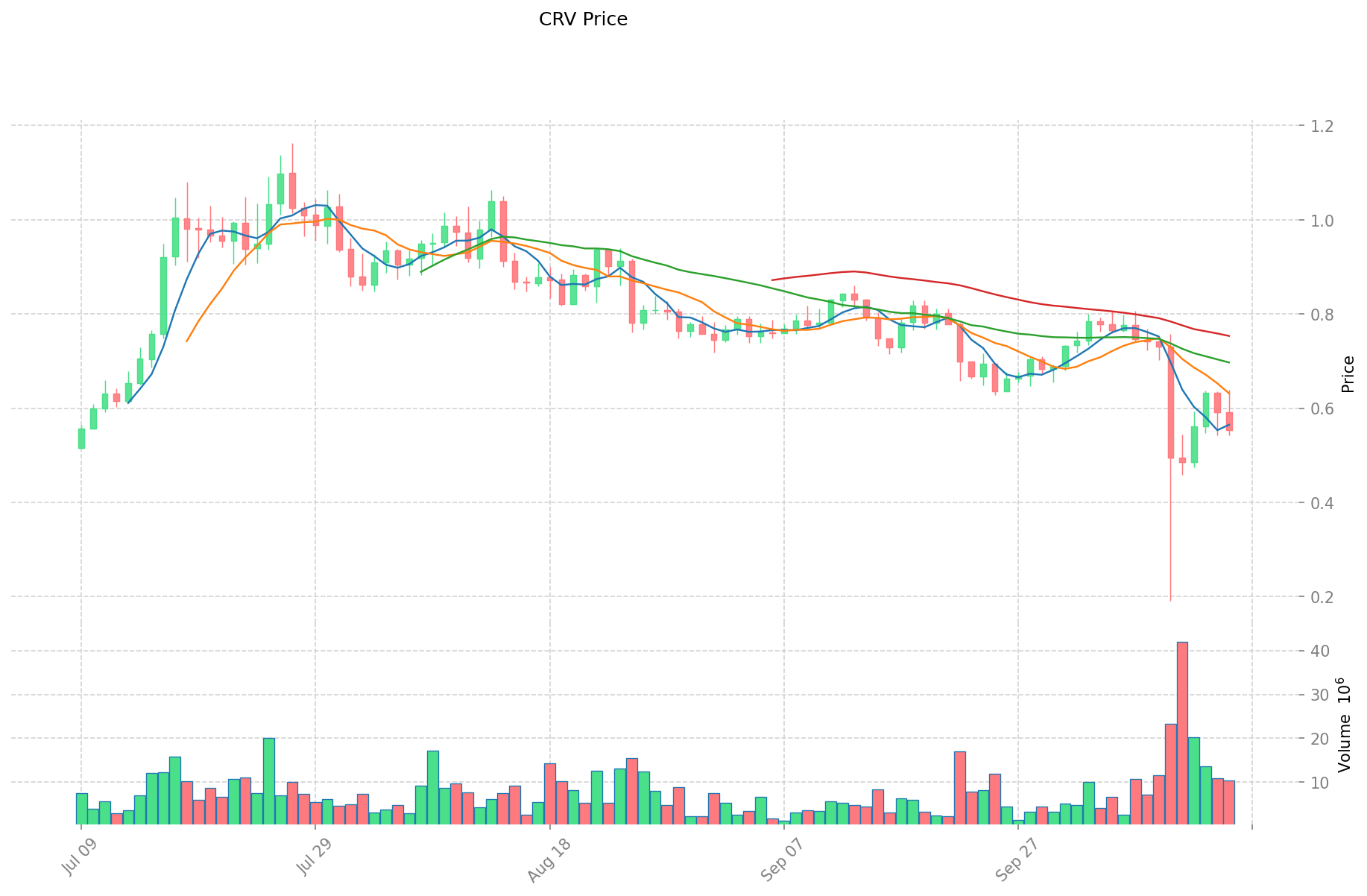
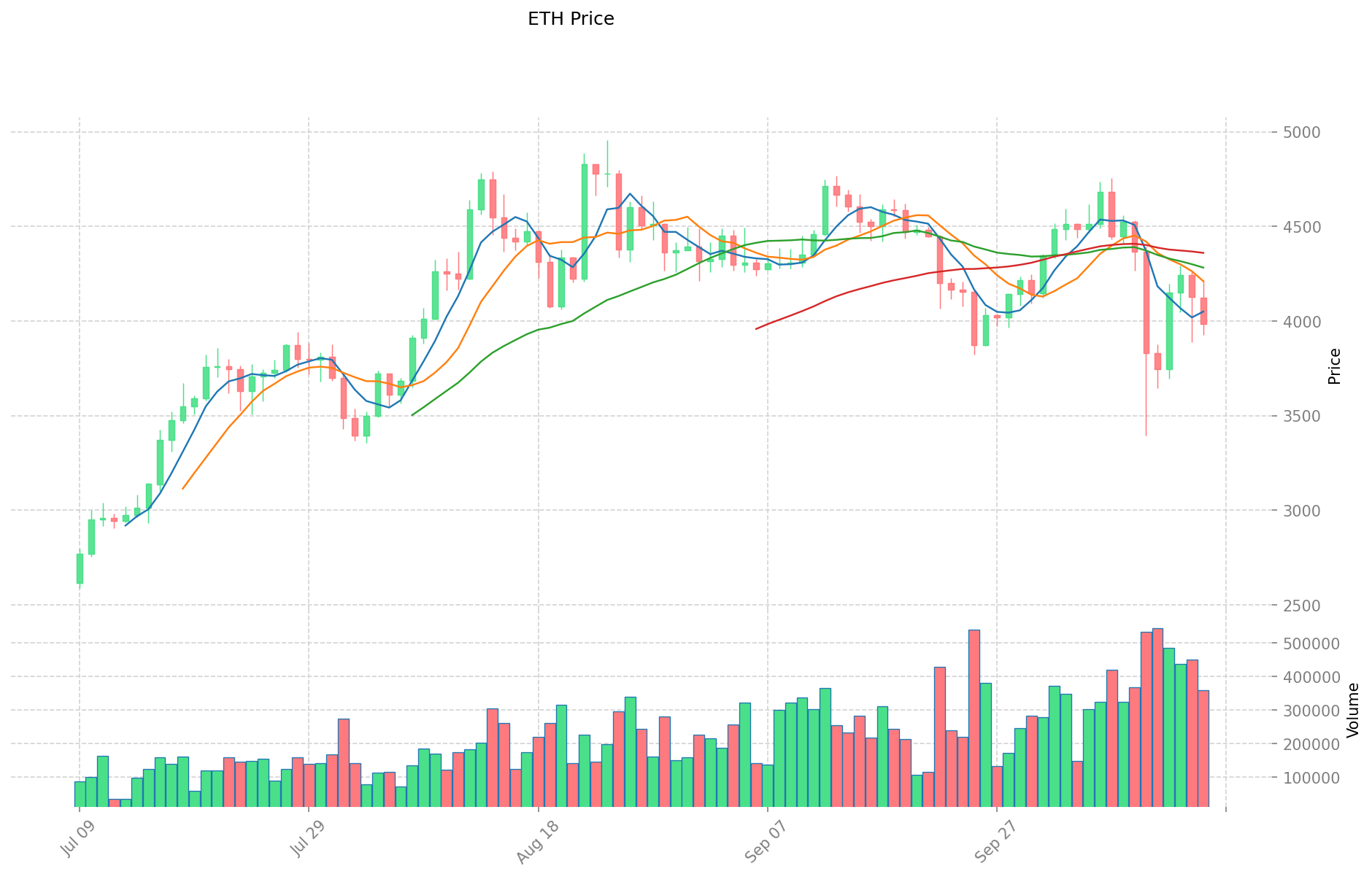
Investment Value Drivers: CRV vs ETH
Supply Mechanisms (Tokenomics)
- CRV: Governance and incentive token with value capture through veCRV locking model, fee distribution mechanism (priced in crvUSD), and maintaining stablecoin exchange liquidity
- ETH: Deflationary mechanism through gas fee burning, with staking rewards providing 3-4% annual yields
- 📌 Historical pattern: CRV's value relies on its monopolistic position in stablecoin markets, while ETH's deflationary properties strengthen with increased ecosystem activity
Institutional Adoption & Market Applications
- Institutional holdings: ETH has gained significant institutional interest through ETF products, while CRV remains primarily utilized within DeFi
- Enterprise applications: ETH serves as core infrastructure for blockchain applications, while CRV focuses on stablecoin exchange and "DeFi receipts" market
- Regulatory environment: ETH ETFs have received regulatory approval, signaling broader acceptance compared to more specialized DeFi tokens like CRV
Technical Development & Ecosystem
- CRV technical advances: Curve V2 introduced dynamic pegging for non-stable assets with internal EMA oracle system providing 5-10x greater liquidity efficiency than constant product formulas
- ETH technical roadmap: Planned RISC-V architecture implementation (2025-2030) targeting 3-5x execution speed improvements and 50%+ gas fee reduction; ZK-proofs optimization targeting 10-second block verification
- Ecosystem comparison: ETH powers the entire DeFi ecosystem including Curve itself, while CRV specializes in stablecoin markets and has expanded into foreign exchange trading
Macroeconomic Factors & Market Cycles
- Inflation performance: ETH demonstrates stronger store of value characteristics with institutional backing and ETF adoption
- Monetary policy impact: ETH market closely follows traditional financial market sentiment and interest rate environments
- Cross-border dynamics: ETH serves as global settlement layer with institutional strategic positioning, while CRV remains specialized within the DeFi ecosystem
III. 2025-2030 Price Prediction: CRV vs ETH
Short-term Prediction (2025)
- CRV: Conservative $0.41-$0.55 | Optimistic $0.55-$0.60
- ETH: Conservative $2,667-$3,981 | Optimistic $3,981-$4,140
Mid-term Prediction (2027)
- CRV may enter a growth phase, with estimated prices of $0.54-$0.79
- ETH may enter a consolidation phase, with estimated prices of $4,288-$4,913
- Key drivers: Institutional inflows, ETFs, ecosystem development
Long-term Prediction (2030)
- CRV: Base scenario $0.93-$1.06 | Optimistic scenario $1.06-$1.46
- ETH: Base scenario $3,608-$6,221 | Optimistic scenario $6,221-$9,269
View detailed price predictions for CRV and ETH
Disclaimer
CRV:
| 年份 |
预测最高价 |
预测平均价格 |
预测最低价 |
涨跌幅 |
| 2025 |
0.598752 |
0.5544 |
0.410256 |
0 |
| 2026 |
0.85333248 |
0.576576 |
0.4612608 |
4 |
| 2027 |
0.7935992064 |
0.71495424 |
0.5433652224 |
29 |
| 2028 |
1.123872317568 |
0.7542767232 |
0.41485219776 |
36 |
| 2029 |
1.17384315048 |
0.939074520384 |
0.59161694784192 |
70 |
| 2030 |
1.45791319289616 |
1.056458835432 |
0.92968377518016 |
91 |
ETH:
| 年份 |
预测最高价 |
预测平均价格 |
预测最低价 |
涨跌幅 |
| 2025 |
4140.032 |
3980.8 |
2667.136 |
0 |
| 2026 |
4872.4992 |
4060.416 |
2801.68704 |
1 |
| 2027 |
4913.10336 |
4466.4576 |
4287.799296 |
12 |
| 2028 |
5721.5321856 |
4689.78048 |
2673.1748736 |
17 |
| 2029 |
7235.862302592 |
5205.6563328 |
2654.884729728 |
30 |
| 2030 |
9268.93138336704 |
6220.759317696 |
3608.04040426368 |
56 |
IV. Investment Strategy Comparison: CRV vs ETH
Long-term vs Short-term Investment Strategies
- CRV: Suitable for investors focused on DeFi yield opportunities and stablecoin market growth
- ETH: Suitable for investors seeking a more established ecosystem with institutional adoption and potential for long-term value appreciation
Risk Management and Asset Allocation
- Conservative investors: CRV: 10% vs ETH: 90%
- Aggressive investors: CRV: 30% vs ETH: 70%
- Hedging tools: Stablecoin allocation, options, cross-currency portfolios
V. Potential Risk Comparison
Market Risk
- CRV: Higher volatility due to smaller market cap and DeFi-specific factors
- ETH: Susceptible to broader crypto market trends and macroeconomic factors
Technical Risk
- CRV: Scalability, network stability, smart contract vulnerabilities
- ETH: Execution client centralization, potential security vulnerabilities in Layer 2 solutions
Regulatory Risk
- Global regulatory policies may have a more significant impact on ETH due to its larger market presence, while CRV may face scrutiny within DeFi-specific regulations
VI. Conclusion: Which Is the Better Buy?
📌 Investment Value Summary:
- CRV advantages: Specialized in stablecoin markets, higher potential returns in DeFi ecosystem, innovative tokenomics with veCRV model
- ETH advantages: Established ecosystem, institutional adoption, deflationary mechanism, broader use cases beyond DeFi
✅ Investment Advice:
- New investors: Consider a higher allocation to ETH for its established market position and lower volatility
- Experienced investors: Balanced portfolio with both ETH and CRV, adjusting based on risk tolerance and DeFi market outlook
- Institutional investors: Focus on ETH for regulatory clarity and established market infrastructure, with potential small allocation to CRV for DeFi exposure
⚠️ Risk Warning: The cryptocurrency market is highly volatile, and this article does not constitute investment advice.
None
VII. FAQ
Q1: What are the key differences between CRV and ETH in terms of investment potential?
A: CRV specializes in stablecoin markets and DeFi yield opportunities, offering potentially higher returns but with increased volatility. ETH has a more established ecosystem, broader institutional adoption, and serves as the foundation for many blockchain applications, providing more stability and long-term growth potential.
Q2: How do the supply mechanisms of CRV and ETH compare?
A: CRV utilizes a governance and incentive token model with value capture through veCRV locking and fee distribution. ETH has a deflationary mechanism through gas fee burning and offers staking rewards of 3-4% annually.
Q3: Which asset is more suitable for institutional investors?
A: ETH is generally more suitable for institutional investors due to its regulatory clarity, established market infrastructure, and the availability of ETF products. CRV may be considered for smaller allocations to gain DeFi exposure.
Q4: What are the projected price ranges for CRV and ETH by 2030?
A: Based on the provided predictions, CRV's price range for 2030 is estimated at $0.93-$1.46, while ETH's range is projected to be $3,608-$9,269.
Q5: How should investors approach risk management when investing in CRV and ETH?
A: For risk management, conservative investors might consider allocating 10% to CRV and 90% to ETH, while more aggressive investors could opt for a 30% CRV to 70% ETH split. Utilizing stablecoins, options, and cross-currency portfolios can help hedge risks.
Q6: What are the main technical risks associated with CRV and ETH?
A: CRV faces risks related to scalability, network stability, and smart contract vulnerabilities. ETH's main technical risks include execution client centralization and potential security issues in Layer 2 solutions.
Q7: How do macroeconomic factors affect CRV and ETH differently?
A: ETH tends to be more closely aligned with traditional financial market sentiment and interest rate environments, serving as a global settlement layer. CRV is more specialized within the DeFi ecosystem and may be less directly impacted by broader macroeconomic trends.
* The information is not intended to be and does not constitute financial advice or any other recommendation of any sort offered or endorsed by Gate.












