This comprehensive analysis compares DEGEN and QNT as cryptocurrency investment options in 2024. DEGEN, launched in 2024 as an unofficial Farcaster token, represents early-stage social network opportunities with higher volatility. QNT, established since 2018, focuses on enterprise blockchain interoperability through Overledger technology. The article examines historical price trends, current market status (DEGEN $0.0011814 vs QNT $85.4), tokenomics, institutional adoption, and long-term forecasts through 2031. DEGEN offers aggressive growth potential but carries elevated risk, while QNT provides stability through enterprise adoption. Investment strategies vary by risk tolerance: conservative investors should favor QNT (80%), while aggressive investors might allocate 45% to DEGEN. Check real-time prices on Gate for both cryptocurrencies to inform your investment decision.
Introduction: Investment Comparison Between DEGEN and QNT
In the cryptocurrency market, the comparison between DEGEN vs QNT has been a topic that investors cannot avoid. The two not only show significant differences in market cap ranking, application scenarios, and price performance, but also represent different positioning in crypto assets.
DEGEN (DEGEN): Launched in 2024, it has gained market recognition as an unofficial token distributed on the decentralized social network Farcaster.
QNT (QNT): Since its launch in 2018, it has been positioned as a technology provider enabling trusted digital interactions through the global blockchain operating system Overledger, and is one of the cryptocurrencies focused on enterprise blockchain adoption and interoperability solutions.
This article will comprehensively analyze the investment value comparison between DEGEN vs QNT around historical price trends, supply mechanisms, institutional adoption, technical ecosystem, and future predictions, attempting to answer the question that investors care about most:
"Which is the better buy right now?"
I. Historical Price Comparison and Current Market Status
DEGEN and QNT Historical Price Trends
- 2024: DEGEN reached a peak price of $0.06999 in April 2024, representing a significant milestone for the token distributed on the Farcaster decentralized social network.
- 2021: QNT experienced substantial growth, reaching its all-time high of $427.42 in September 2021, driven by recognition of its blockchain interoperability solutions.
- Comparative Analysis: During recent market cycles, DEGEN declined from its high of $0.06999 to a low of $0.000984 in October 2025, while QNT decreased from its peak of $427.42 to a low of $0.215773 in August 2018, showing different volatility patterns across their respective trading histories.
Current Market Status (2026-01-20)
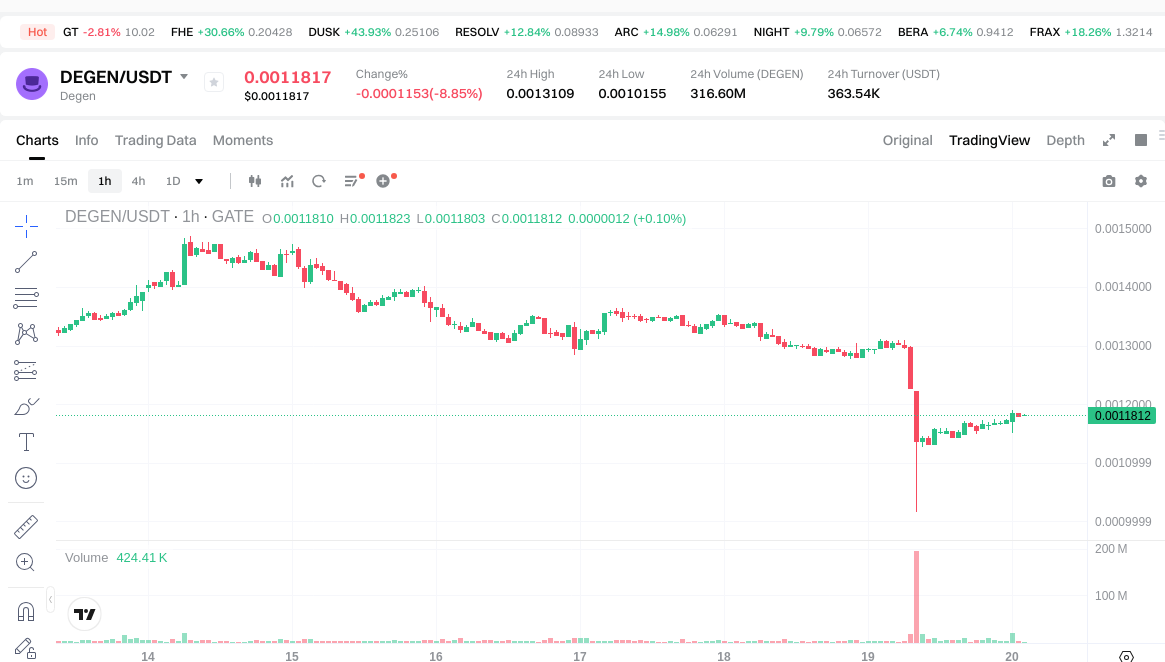
- DEGEN Current Price: $0.0011814
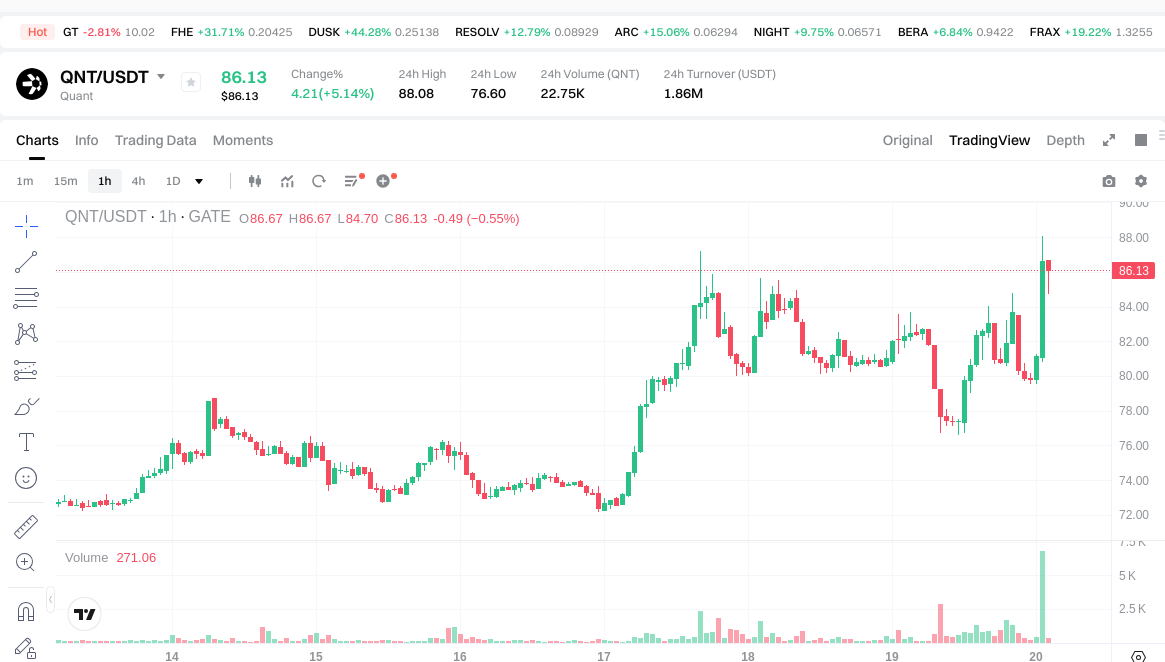
- QNT Current Price: $85.4
- 24-Hour Trading Volume: DEGEN $364,290.72 vs QNT $1,850,320.65
- Market Sentiment Index (Fear & Greed Index): 44 (Fear)
View real-time prices:
II. Core Factors Influencing DEGEN vs QNT Investment Value
Supply Mechanism Comparison (Tokenomics)
- DEGEN: The available materials do not provide specific information about DEGEN's supply mechanism or tokenomics structure.
- QNT: The reference materials do not contain details regarding QNT's supply model, circulation dynamics, or token distribution mechanisms.
- 📌 Historical Pattern: Investment analysis suggests that probability-based evaluation and market positioning tend to influence price cycles more significantly than purely technical supply factors. Market sentiment and capital flow patterns have historically shown correlation with asset performance cycles.
Institutional Adoption and Market Application
- Institutional Holdings: The provided materials do not contain comparative data on institutional preference between DEGEN and QNT.
- Enterprise Adoption: Specific applications in cross-border payments, settlement systems, or investment portfolios for either asset are not documented in the reference materials.
- National Policies: Regulatory attitudes toward these specific assets across different jurisdictions are not covered in the available information.
Technology Development and Ecosystem Construction
- DEGEN Technology: Technical upgrade information and developmental roadmap details are not available in the reference materials.
- QNT Technology: Specific technological advancements or protocol improvements are not documented in the provided sources.
- Ecosystem Comparison: The materials do not contain comparative analysis of DeFi integration, NFT functionality, payment applications, or smart contract implementation for either project.
Macroeconomic Environment and Market Cycles
- Inflation Environment Performance: While the materials discuss general principles of inflation hedge assets (such as gold and silver dynamics), specific comparative performance data for DEGEN and QNT under inflationary conditions is not provided.
- Macroeconomic Monetary Policy: The reference materials emphasize that investment decisions should be based on calculated probabilities and market conditions rather than external triggers. Market dynamics are influenced by capital flows and psychological expectations, though specific impacts of interest rates or dollar index movements on these two assets are not documented.
- Geopolitical Factors: General investment philosophy suggests that global economic order fluctuations affect asset positioning, though specific cross-border transaction demand or international situation impacts on DEGEN and QNT are not detailed in the materials.
III. 2026-2031 Price Forecast: DEGEN vs QNT
Short-term Forecast (2026)
- DEGEN: Conservative $0.000756 - $0.001182 | Optimistic $0.001182 - $0.001725
- QNT: Conservative $68.24 - $85.30 | Optimistic $85.30 - $90.42
Medium-term Forecast (2028-2029)
- DEGEN may enter a gradual accumulation phase, with estimated price range of $0.001530 - $0.002110
- QNT may enter a moderate growth phase, with estimated price range of $93.69 - $136.62
- Key drivers: institutional capital inflows, ETF developments, ecosystem expansion
Long-term Forecast (2030-2031)
- DEGEN: Baseline scenario $0.001011 - $0.002241 | Optimistic scenario $0.001689 - $0.003104
- QNT: Baseline scenario $88.48 - $150.03 | Optimistic scenario $109.91 - $155.82
View detailed price predictions for DEGEN and QNT
Disclaimer
Price predictions are based on historical data analysis and market trend modeling. Cryptocurrency markets involve uncertainty and risk. This content does not constitute investment advice. Users should conduct independent research and assess their risk tolerance before making any decisions.
DEGEN:
| Year |
Predicted High Price |
Predicted Average Price |
Predicted Low Price |
Price Change |
| 2026 |
0.001725282 |
0.0011817 |
0.000756288 |
0 |
| 2027 |
0.00206395722 |
0.001453491 |
0.00075581532 |
23 |
| 2028 |
0.002110468932 |
0.00175872411 |
0.0015300899757 |
48 |
| 2029 |
0.00203132634705 |
0.001934596521 |
0.00185721266016 |
63 |
| 2030 |
0.002240746420448 |
0.001982961434025 |
0.001011310331352 |
67 |
| 2031 |
0.003104425273037 |
0.002111853927236 |
0.001689483141789 |
78 |
QNT:
| Year |
Predicted High Price |
Predicted Average Price |
Predicted Low Price |
Price Change |
| 2026 |
90.418 |
85.3 |
68.24 |
0 |
| 2027 |
130.03132 |
87.859 |
61.5013 |
2 |
| 2028 |
130.734192 |
108.94516 |
93.6928376 |
27 |
| 2029 |
136.61723064 |
119.839676 |
68.30861532 |
40 |
| 2030 |
150.0272903844 |
128.22845332 |
88.4776327908 |
50 |
| 2031 |
155.823216474464 |
139.1278718522 |
109.911018763238 |
62 |
IV. Investment Strategy Comparison: DEGEN vs QNT
Long-term vs Short-term Investment Strategies
- DEGEN: May be suitable for investors focused on emerging social network ecosystems and early-stage token opportunities, with a higher risk tolerance for volatility
- QNT: May be suitable for investors interested in enterprise blockchain solutions and interoperability infrastructure, seeking exposure to institutional adoption trends
Risk Management and Asset Allocation
- Conservative Investors: DEGEN 20% vs QNT 80%
- Aggressive Investors: DEGEN 45% vs QNT 55%
- Hedging Tools: Stablecoin allocation, options strategies, cross-asset portfolio diversification
V. Potential Risk Comparison
Market Risk
- DEGEN: Price volatility reflects early-stage market dynamics, with historical price range showing significant fluctuation between $0.06999 and $0.000984, indicating sensitivity to market sentiment shifts
- QNT: Price movements have demonstrated substantial range variation from $427.42 to lower levels, reflecting exposure to broader market cycles and enterprise blockchain adoption pace
Technical Risk
- DEGEN: Scalability considerations and network stability factors associated with decentralized social network infrastructure
- QNT: Network architecture considerations and potential security considerations inherent in blockchain interoperability solutions
Regulatory Risk
- Global regulatory frameworks continue to evolve, potentially affecting both social network tokens and enterprise blockchain solutions differently across jurisdictions
VI. Conclusion: Which Is the Better Buy?
📌 Investment Value Summary:
- DEGEN Advantages: Positioning in the decentralized social network space, early-stage market entry point with potential for ecosystem expansion
- QNT Advantages: Established presence since 2018, focus on enterprise blockchain interoperability, institutional-oriented positioning in blockchain infrastructure
✅ Investment Recommendations:
- Novice Investors: Consider starting with smaller allocations to understand market dynamics, prioritize risk assessment and position sizing appropriate to individual circumstances
- Experienced Investors: Evaluate portfolio balance between emerging ecosystem tokens and established infrastructure projects, considering correlation with broader market cycles
- Institutional Investors: Assess alignment with strategic objectives regarding social network ecosystems versus enterprise blockchain infrastructure, considering liquidity profiles and market depth
⚠️ Risk Disclaimer: The cryptocurrency market exhibits significant volatility. This content does not constitute investment advice. Users should conduct independent research and assess their risk tolerance before making any investment decisions.
VII. FAQ
Q1: What is the main difference between DEGEN and QNT in terms of use cases?
DEGEN serves as an unofficial token distributed on the Farcaster decentralized social network ecosystem, while QNT functions as a technology provider enabling trusted digital interactions through the global blockchain operating system Overledger. DEGEN launched in 2024 and focuses on social network applications, representing an early-stage positioning in the emerging decentralized social space. QNT, operational since 2018, targets enterprise blockchain adoption and interoperability solutions, providing infrastructure for cross-chain communication and institutional-grade blockchain integration.
Q2: Which asset has shown greater historical price volatility?
DEGEN has demonstrated significantly higher volatility relative to its price range. DEGEN experienced a decline from its April 2024 peak of $0.06999 to a low of $0.000984 in October 2025, representing approximately a 98.6% drawdown. QNT decreased from its September 2021 all-time high of $427.42 to a low of $0.215773 in August 2018, though this comparison spans different market cycle periods. The percentage volatility of DEGEN over its shorter trading history indicates higher risk-reward dynamics compared to QNT's more established market presence.
Q3: What are the projected price ranges for DEGEN and QNT by 2030?
For 2030, DEGEN's baseline scenario projects a price range of $0.001011 to $0.002241, with an optimistic scenario ranging from $0.001689 to $0.003104. QNT's baseline scenario for 2030 estimates a range of $88.48 to $150.03, with an optimistic scenario between $109.91 and $155.82. These projections suggest DEGEN may experience a 67% increase from current levels under baseline assumptions, while QNT could see approximately 50% growth. However, these forecasts are based on historical data modeling and do not account for unforeseen market disruptions or regulatory changes.
Q4: How should conservative versus aggressive investors allocate between DEGEN and QNT?
Conservative investors may consider a 20% DEGEN and 80% QNT allocation strategy, prioritizing the more established infrastructure project with lower volatility exposure. Aggressive investors might adopt a 45% DEGEN and 55% QNT allocation, accepting higher risk in exchange for potential upside from DEGEN's early-stage positioning. These allocation recommendations reflect risk tolerance differences, with QNT representing a relatively more stable enterprise blockchain investment, while DEGEN offers higher-risk exposure to emerging social network ecosystems. Both strategies should incorporate hedging tools such as stablecoin reserves, options strategies, and cross-asset diversification.
Q5: What are the primary risks associated with investing in DEGEN versus QNT?
DEGEN's primary risks include extreme price volatility evidenced by its historical drawdown, scalability challenges inherent in decentralized social network infrastructure, and uncertainty surrounding ecosystem adoption rates. QNT's risks involve dependency on enterprise blockchain adoption pace, potential security considerations in interoperability solutions, and exposure to broader market cycle fluctuations. Both assets face evolving regulatory frameworks that may affect social network tokens and enterprise blockchain solutions differently across jurisdictions. Market risk remains significant for both, with current market sentiment at 44 (Fear) indicating cautious investor positioning.
Q6: What market conditions favor DEGEN over QNT investment, and vice versa?
DEGEN may outperform during periods of strong retail investor sentiment, expansion in decentralized social network adoption, and bull market phases favoring early-stage tokens with high beta characteristics. QNT may demonstrate relative strength during market consolidation phases, periods of increased institutional blockchain adoption, regulatory clarity favorable to enterprise solutions, and flight-to-quality scenarios where investors prioritize established projects. The current 24-hour trading volume differential ($364,290.72 for DEGEN versus $1,850,320.65 for QNT) suggests QNT maintains significantly higher liquidity, which may be advantageous during volatile market conditions.
Q7: Are there specific ecosystem developments that could significantly impact either asset's valuation?
For DEGEN, significant valuation catalysts could include expanded integration with Farcaster network growth metrics, partnerships with major social media platforms, and successful implementation of token utility within decentralized social applications. For QNT, key drivers may include enterprise client announcements, successful deployment of Overledger technology across multiple blockchain networks, institutional adoption milestones, and potential ETF developments related to blockchain infrastructure assets. Both projects' valuations remain sensitive to broader cryptocurrency market cycles, technological breakthroughs in their respective sectors, and macroeconomic factors influencing risk appetite across digital assets.
Q8: How does current market liquidity compare between DEGEN and QNT?
QNT demonstrates substantially higher market liquidity with 24-hour trading volume of $1,850,320.65 compared to DEGEN's $364,290.72, representing approximately a 5x differential. This liquidity advantage provides QNT investors with better price execution capabilities, reduced slippage on larger position sizes, and greater ease of entry and exit. DEGEN's lower trading volume reflects its earlier market stage and smaller holder base, potentially resulting in higher spreads and increased difficulty executing larger trades without impacting market price. For institutional investors or those managing significant position sizes, QNT's superior liquidity profile represents a meaningful advantage in portfolio management and risk mitigation.
* The information is not intended to be and does not constitute financial advice or any other recommendation of any sort offered or endorsed by Gate.