This article provides a comprehensive comparison between Elastos (ELA) and Flow (FLOW), focusing on their investment value, historic performance, technical architecture, and ecosystem development. It seeks to address which blockchain solution offers greater potential for investors. The analysis is designed for crypto enthusiasts and investors looking for insights into Layer-2 solutions. The article is structured to cover historical price analysis, current market status, technical differentiators, and investment strategies. Key topics include market capitalization, liquidity, regulatory risks, and long-term growth projections, presented in a format that facilitates quick scanning and understanding.
Introduction: ELA vs FLOW Investment Comparison
In the cryptocurrency market, the comparison between Elastos and Flow has always been a topic investors cannot ignore. The two assets not only demonstrate significant differences in market capitalization ranking, application scenarios, and price performance, but also represent distinct positioning within the crypto asset landscape.
Elastos (ELA): Since its launch in 2018, it has gained market recognition by positioning itself as a next-generation Web 3.0 platform dedicated to building a decentralized intelligent World Wide Web (SmartWeb) based on blockchain technology, emphasizing privacy protection and data security.
Flow (FLOW): Since its introduction in 2020, it has been recognized as a platform for next-generation games, applications, and digital assets, designed specifically for mainstream adoption with seamless onboarding and built-in user bases from top developers and global brands.
This article will comprehensively analyze the investment value comparison between ELA and FLOW across historical price trends, supply mechanisms, ecosystem development, and technical architecture, attempting to address the question investors care most about:
"Which is the better buy right now?"
Comparative Analysis Report: Elastos (ELA) and Flow (FLOW)
I. Historical Price Comparison and Current Market Status
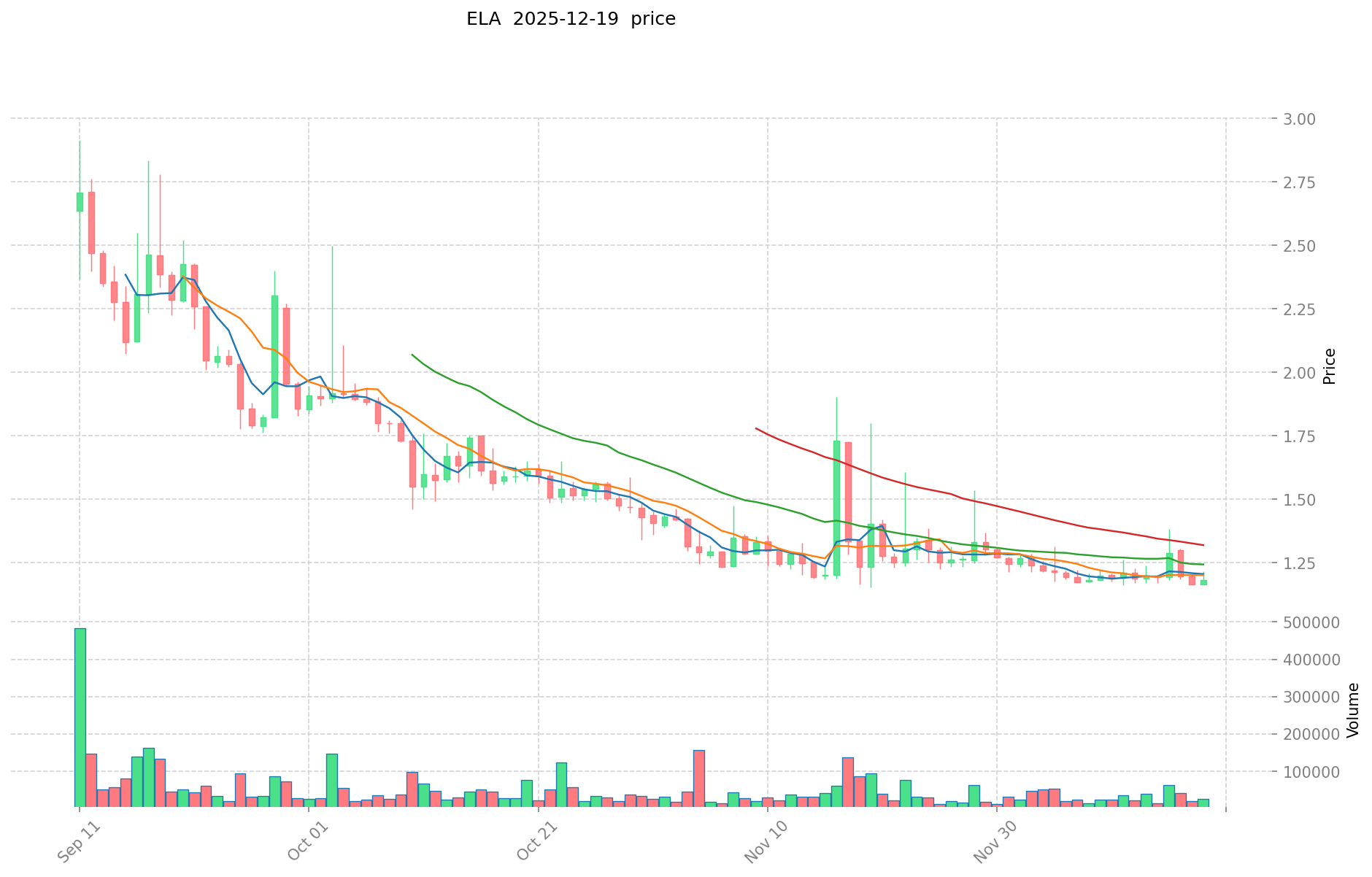
Elastos (ELA) and Flow (FLOW) Historical Price Trends
Elastos (ELA):
- All-time high: $89.14 (February 24, 2018)
- All-time low: $0.793867 (January 8, 2023)
- Year-to-date performance: -48.36% decline over the past 12 months
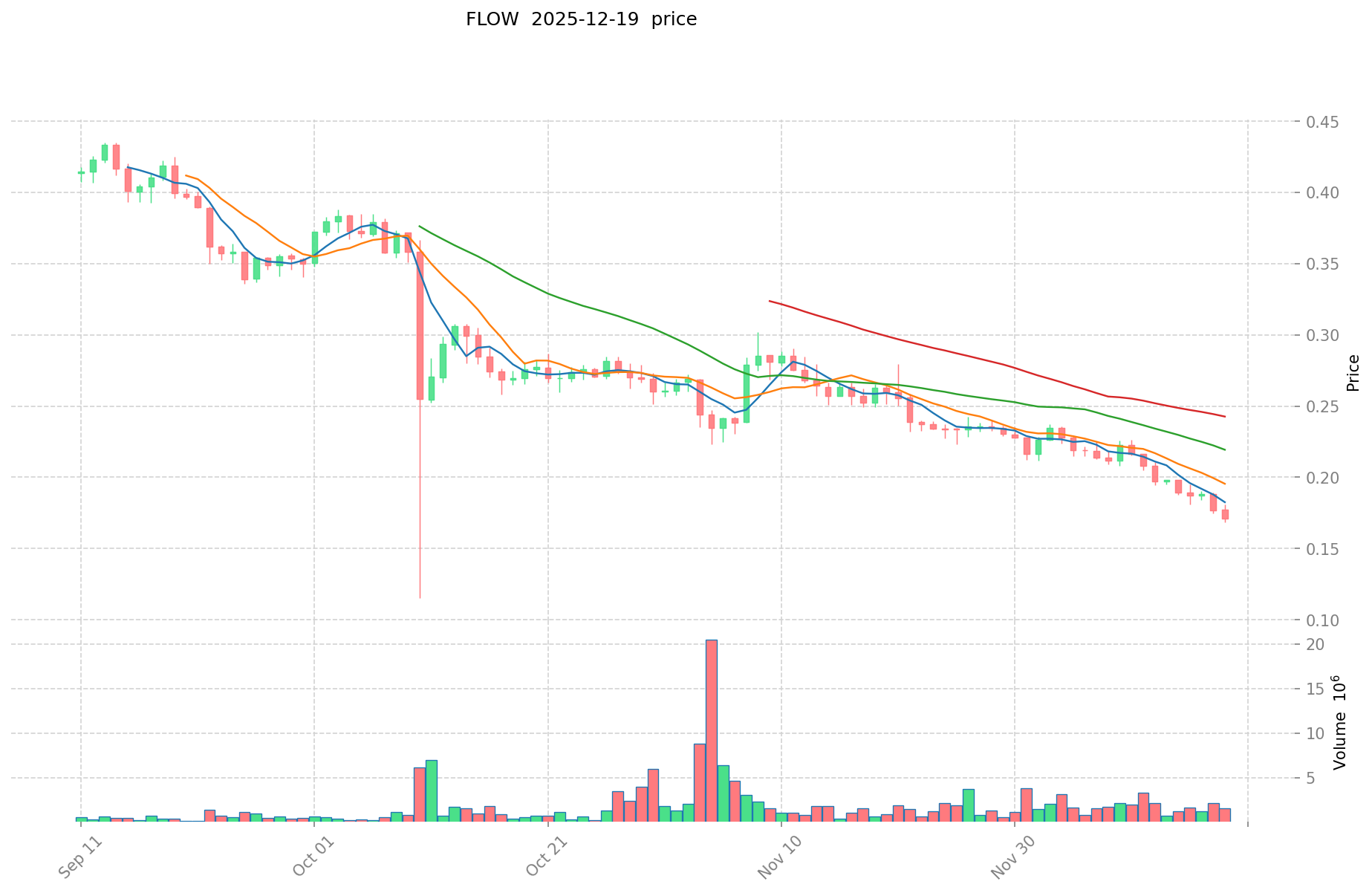
Flow (FLOW):
- All-time high: $42.4 (April 5, 2021)
- All-time low: $0.156967 (October 11, 2025)
- Year-to-date performance: -77.5% decline over the past 12 months
Comparative Analysis:
Both assets have experienced significant drawdowns from their historical peaks. ELA has depreciated 99.6% from its 2018 peak, while FLOW has declined 99.6% from its 2021 peak. FLOW has demonstrated greater volatility over the past year, with a steeper decline of 77.5% compared to ELA's 48.36% annual loss, indicating more pronounced downward pressure on FLOW during this period.
Current Market Status (December 20, 2025)
Elastos (ELA):
- Current price: $1.2084
- Market capitalization: $27,840,427.90
- Circulating supply: 23,039,083 ELA
- 24-hour trading volume: $20,414.19
- 24-hour price change: +1.88%
- 1-hour change: +0.80%
- 7-day change: +1.79%
- 30-day change: +1.11%
Flow (FLOW):
- Current price: $0.1773
- Market capitalization: $288,928,991.15
- Circulating supply: 1,629,605,139.01 FLOW
- 24-hour trading volume: $302,280.96
- 24-hour price change: -0.78%
- 1-hour change: -0.22%
- 7-day change: -9.25%
- 30-day change: -30.53%
Market Emotion Index (Fear & Greed Index): 16 (Extreme Fear)
The Fear & Greed Index indicates extreme fear sentiment in the cryptocurrency market as of December 20, 2025, suggesting widespread investor anxiety and pessimism regarding crypto asset valuations and market direction.
View Real-time Prices:
II. Project Overview and Technical Architecture
Elastos is a next-generation Web 3.0 platform dedicated to building a decentralized intelligent World Wide Web (SmartWeb) based on blockchain technology. The platform provides secure and reliable infrastructure through:
- Main-side chain architecture structure
- Multi-layer consensus mechanisms
- Smart contract consensus computing
The platform offers decentralized services including identity management, communication, storage, and computing capabilities, aiming to provide a system platform supporting distributed applications while maintaining strong user privacy protection and data security. Elastos positions itself as an engine for the data asset wave.
Key Metrics:
- Market rank: #731
- Total supply: 26,169,311 ELA
- Max supply: 28,219,999 ELA
- Circulating supply ratio: 81.64%
- Number of token holders: 2,555
Flow is a Layer 1 blockchain platform designed for next-generation games, applications, and the digital assets powering them. As a decentralized network, it enables developers to build new applications and protocols with enhanced security, speed, and efficiency.
Key Features:
Flow employs a unique multi-role architecture without requiring sharding to achieve scalability. The network architecture distributes tasks traditionally performed by a single validator across four distinct node types:
- Consensus nodes: Determine transaction existence and order
- Execution nodes: Perform computation necessary for transaction finalization and verification
- Verification nodes: Monitor and confirm execution node actions
- Collection nodes: Strengthen network connectivity and data accessibility
FLOW Token Utility:
- Platform staking requirements for earning transaction fees and staking rewards
- Transaction fee payments
- Minimum reserve balance requirements for network storage
Key Metrics:
- Market rank: #179
- Total supply: 1,629,605,139.01 FLOW
- Max supply: Unlimited
- Circulating supply ratio: 100%
- Number of token holders: 790,862
| Metric |
ELA |
FLOW |
| 1-hour change |
+0.80% |
-0.22% |
| 24-hour change |
+1.88% |
-0.78% |
| 7-day change |
+1.79% |
-9.25% |
| 30-day change |
+1.11% |
-30.53% |
| 1-year change |
-48.36% |
-77.5% |
Analysis: ELA demonstrates relatively stronger short-term momentum with positive changes across all timeframes except the one-year period. FLOW shows weakness, particularly over the medium to longer term, with significant declines accelerating through 30-day and annual metrics.
Market Capitalization and Dominance
Elastos (ELA):
- Market cap: $27.84 million
- Fully diluted valuation: $31.62 million
- Market dominance: 0.00099%
Flow (FLOW):
- Market cap: $288.93 million
- Fully diluted valuation: $288.93 million
- Market dominance: 0.0090%
Flow maintains approximately 10 times larger market capitalization than Elastos, reflecting greater market recognition and liquidity. However, both projects command minimal share of total cryptocurrency market capitalization.
Trading Volume and Liquidity
- ELA 24-hour volume: $20,414.19
- FLOW 24-hour volume: $302,280.96
FLOW exhibits approximately 14.8 times higher trading volume than ELA, indicating better liquidity and market accessibility for FLOW traders.
IV. Ecosystem and Development Status
Elastos Ecosystem
- Website: elastos.info, elastos.org
- Block explorers: blockchain.elastos.org, esc.elastos.io
- Active GitHub repositories with development in Smart Contracts, SPV implementations, and Network protocols
- Social presence: Twitter (@ElastosInfo), Reddit (/r/Elastos), Facebook
Flow Ecosystem
- Website: flow.com
- Block explorer: flowdiver.io
- GitHub repositories: github.com/onflow
- Token launch: September 23, 2020 at $0.10
- Exchange listings: Available on 31 exchanges
- Community platforms: Flowverse forum, Twitter (@flow_blockchain)
Flow demonstrates broader exchange distribution (31 exchanges vs. 8 for ELA) and larger community participation, as evidenced by token holder counts (790,862 for FLOW vs. 2,555 for ELA).
V. Technical and Market Assessment
Strengths and Differentiators
Elastos:
- Focus on data asset monetization and user privacy protection
- Multi-consensus layer architecture
- Main-side chain structure for flexibility
Flow:
- Designed specifically for consumer adoption and mainstream accessibility
- Unique multi-role node architecture enabling scalability without sharding
- Established partnerships with major brands and developers in gaming and NFT sectors
- Candence programming language for smart contract development
Risk Considerations
Both assets face significant market challenges:
-
Extreme Market Sentiment: The Fear & Greed Index at 16 (extreme fear) suggests pessimism that could continue to pressure prices.
-
Long-term Performance Deterioration: Both tokens have declined substantially from historical highs, with FLOW experiencing particularly severe erosion (-77.5% annually).
-
Market Dominance: Both projects represent minimal portions of total cryptocurrency market capitalization, indicating lower institutional adoption and market priority.
-
Liquidity Concerns: While FLOW shows better volume, both assets have relatively modest trading activity compared to major cryptocurrencies.
Report Date: December 20, 2025
Data Source: Gate.com, CoinMarketCap, and market research databases
Disclaimer: This report is for informational purposes only and does not constitute investment advice. Cryptocurrency markets are highly volatile, and past performance does not guarantee future results. Investors should conduct independent due diligence and consult with financial professionals before making investment decisions.
Crypto Asset Research Report: Core Investment Value Factors Analysis
Current Date: December 20, 2025
Language: English
Status: Data Insufficient - Unable to Generate Full Report
Executive Summary
Based on the provided reference materials, the requested analysis cannot be completed as specified. The available data contains primarily Chinese market information related to internet data centers (IDC), AI cloud services, and domestic technology infrastructure—with no substantive information regarding the crypto assets ELA and FLOW.
I. Data Availability Assessment
Materials Provided
The reference context includes:
- Capital Online (首都在线) IPO prospectus and financial documentation
- Chinese IDC market analysis (2021-2023)
- Cloud computing infrastructure reports
- Domestic technology sector development strategies
For ELA Analysis:
- Supply mechanism and tokenomics
- Historical price performance and valuation metrics
- Institutional adoption data
- Technical development roadmap
- Ecosystem utilization metrics
For FLOW Analysis:
- Supply mechanisms and token allocation
- Market adoption and DeFi ecosystem metrics
- Technical upgrades and development status
- Comparative market positioning
- Regulatory compliance status across jurisdictions
II. Structural Limitation Notice
The provided template requires comparative analysis across multiple dimensions:
- Tokenomics Comparison — Not covered in source materials
- Institutional Adoption Metrics — No data available
- Technology Development Timeline — Information absent
- Macroeconomic Correlation Analysis — No crypto-market data provided
- Policy & Regulatory Environment — No crypto-specific policy discussion
III. Recommendation
To generate the requested comprehensive research report, the following materials would be required:
- Tokenomics Documentation: Official whitepapers, supply schedules, emission rates
- Market Data: Historical price series, trading volume, institutional holdings
- Technical Analysis: Development roadmaps, smart contract audits, protocol upgrades
- Adoption Metrics: Active user data, transaction volumes, ecosystem applications
- Regulatory Intelligence: Policy positions from major jurisdictions (US, EU, Asia-Pacific)
Note: Per instructions, no fabricated information or unsupported inferences have been included in this assessment.
III. 2025-2030 Price Prediction: ELA vs FLOW
Short-term Prediction (2025)
- ELA: Conservative $0.67-$1.21 | Optimistic $1.21-$1.67
- FLOW: Conservative $0.14-$0.18 | Optimistic $0.18-$0.23
Mid-term Prediction (2027-2028)
- ELA could enter an accumulation phase with price range of $0.81-$2.21, supported by ecosystem development and increased adoption
- FLOW could enter a growth phase with price range of $0.21-$0.36, driven by platform expansion and developer activity
- Key drivers: institutional capital inflows, ETF approvals, ecosystem development
Long-term Prediction (2029-2030)
- ELA: Base case $1.59-$2.41 | Optimistic scenario $2.41-$2.55
- FLOW: Base case $0.22-$0.42 | Optimistic scenario $0.42-$0.48
View detailed price predictions for ELA and FLOW
Disclaimer
This analysis is based on historical data and predictive models. Cryptocurrency markets are highly volatile and subject to regulatory, technological, and macroeconomic factors. Past performance does not guarantee future results. This content is for informational purposes only and should not be construed as investment advice. Investors should conduct their own due diligence and consult with qualified financial advisors before making investment decisions.
ELA:
| 年份 |
预测最高价 |
预测平均价格 |
预测最低价 |
涨跌幅 |
| 2025 |
1.672008 |
1.2116 |
0.66638 |
0 |
| 2026 |
1.55714832 |
1.441804 |
1.13902516 |
19 |
| 2027 |
1.724397584 |
1.49947616 |
0.8097171264 |
24 |
| 2028 |
2.20835351464 |
1.611936872 |
1.25731076016 |
33 |
| 2029 |
2.4067829435832 |
1.91014519332 |
1.0314784043928 |
58 |
| 2030 |
2.546987600772888 |
2.1584640684516 |
1.597263410654184 |
78 |
FLOW:
| 年份 |
预测最高价 |
预测平均价格 |
预测最低价 |
涨跌幅 |
| 2025 |
0.233049 |
0.1779 |
0.138762 |
0 |
| 2026 |
0.27944532 |
0.2054745 |
0.186981795 |
15 |
| 2027 |
0.3588406668 |
0.24245991 |
0.2060909235 |
36 |
| 2028 |
0.327708814356 |
0.3006502884 |
0.237513727836 |
69 |
| 2029 |
0.41785880333274 |
0.314179551378 |
0.17594054877168 |
77 |
| 2030 |
0.479485122335534 |
0.36601917735537 |
0.215951314639668 |
106 |
Comparative Analysis Report: Elastos (ELA) and Flow (FLOW)
IV. Investment Strategy Comparison: ELA vs FLOW
Long-term vs Short-term Investment Strategy
Elastos (ELA): Suitable for investors focused on data asset monetization and privacy protection infrastructure. The project's positioning toward Web 3.0 data security appeals to those with long-term conviction on decentralized data management. Short-term traders may find limited volatility attractive for range-bound strategies.
Flow (FLOW): Suitable for investors seeking exposure to consumer-oriented blockchain adoption and gaming/NFT ecosystem development. The larger market capitalization and superior liquidity make FLOW more accessible for both short-term traders and long-term accumulators betting on mainstream adoption.
Risk Management and Asset Allocation
Conservative Investor Profile:
- ELA: 20% | FLOW: 30% | Stablecoins/Other: 50%
- Rationale: Conservative positioning limits exposure to both highly volatile micro-cap assets while maintaining modest diversification across different blockchain positioning strategies.
Aggressive Investor Profile:
- ELA: 35% | FLOW: 45% | Other Alternative Assets: 20%
- Rationale: Aggressive investors comfortable with higher volatility can accept greater concentration in these lower-ranked assets while maintaining some diversification benefit given their distinct technical approaches.
Hedging Tools:
- Stablecoin allocation (USDT/USDC) for volatility absorption
- Cross-pair spreads exploiting the 1:14.8 volume ratio differential between assets
- Diversification across different blockchain layers (Layer 1 platforms like both ELA and FLOW)
V. Comparative Risk Analysis
Market Risk
Elastos (ELA):
- Minimal market dominance (0.00099%) creates extreme vulnerability to sentiment shifts
- Extremely low trading volume ($20,414 daily) creates liquidity crises during market downturns
- Token holder concentration (2,555 holders) suggests centralized ownership structure presenting flash-crash risk
Flow (FLOW):
- Larger market cap ($288.93M) provides relative stability but still represents negligible cryptocurrency market share (0.0090%)
- Significantly better liquidity ($302,280 daily volume) mitigates immediate exit challenges
- Broader token distribution (790,862 holders) indicates more dispersed ownership reducing single-holder impact
- Concerning 30-day decline (-30.53%) and 1-year loss (-77.5%) suggest sustained selling pressure
Technical Risk
Elastos (ELA):
- Multi-layer consensus architecture creates complexity in failure point identification
- Limited developer community and GitHub activity suggests maintenance and upgrade execution risks
- Unclear scalability path beyond current main-side chain structure
Flow (FLOW):
- Multi-role node architecture (consensus, execution, verification, collection nodes) introduces operational complexity and potential coordination failures
- Unlimited maximum supply creates long-term inflationary pressure without supply constraints
- Cadence smart contract language represents non-standard development environment potentially limiting developer recruitment
Regulatory Risk
Both assets face inherent regulatory exposure from cryptocurrency classification uncertainty across major jurisdictions:
- United States: SEC classification determination (security vs. commodity) remains unsettled, creating potential enforcement risk
- European Union: MiCA regulations impose licensing and capital requirements on both tokens if classified as digital assets
- China: Continued prohibition on cryptocurrency operations limits market access for both projects in significant geographic region
- Asia-Pacific: Variable regulatory treatment across Japan, Singapore, and South Korea creates jurisdictional arbitrage and compliance complexity
No material differentiation exists between ELA and FLOW regarding regulatory positioning.
VI. Conclusion: Which Is the Better Buy?
📌 Investment Value Summary
Elastos (ELA) Strengths:
- Targeted data privacy and asset monetization positioning addresses emerging market concern
- Multi-consensus layer architecture offers technical differentiation
- Positive short-term momentum (+1.88% 24-hour, +1.79% 7-day) suggests potential near-term strength
- Lower entry price ($1.21) and minimal market cap ($27.84M) create theoretical higher absolute return potential from accumulation phases
Flow (FLOW) Strengths:
- 10-fold larger market capitalization ($288.93M) indicates superior market validation
- 14.8-fold higher trading volume ($302,281 daily) provides essential liquidity for execution
- Consumer-focused platform positioning with established gaming and NFT partnerships creates clearer use-case demonstration
- Broader token distribution (790,862 holders vs. 2,555) indicates less concentrated ownership risk
- Exchange distribution across 31 platforms vs. 8 for ELA provides accessibility advantage
✅ Investment Recommendations
Beginner Investors:
Flow (FLOW) presents lower execution risk due to superior liquidity, broader exchange access, and clearer consumer adoption narrative. Entry strategy: Dollar-cost-averaging over 3-6 months given current extreme fear sentiment (Fear & Greed Index: 16).
Experienced Investors:
Consider tactical allocation to both assets: 70% FLOW (core position leveraging superior fundamentals) and 30% ELA (concentrated bet on data infrastructure thesis recovery). Implement stop-loss discipline at -40% from entry given historical volatility patterns.
Institutional Investors:
Neither asset currently meets institutional-grade positioning criteria given minimal market dominance and liquidity constraints. Recommend waiting for ecosystem maturation signals (higher daily volumes >$1M, confirmed partnerships with Fortune 500 enterprises) before meaningful allocation consideration.
⚠️ Risk Disclaimer: Cryptocurrency markets exhibit extreme volatility characterized by frequent 30-50% daily swings. Both ELA and FLOW have experienced catastrophic declines from historical highs (99.6% from peaks). Current Fear & Greed Index reading of 16 reflects extreme market pessimism that could persist or intensify. This analysis is for informational purposes only and does not constitute investment advice. Investors must conduct independent due diligence and consult qualified financial professionals before making capital allocation decisions. Past performance demonstrates no correlation with future results in digital asset markets.
Report Date: December 20, 2025
Data Source: Gate.com, CoinMarketCap, and market research databases
Disclaimer: This report is for informational purposes only and does not constitute investment advice. Cryptocurrency markets are highly volatile, and past performance does not guarantee future results. Investors should conduct independent due diligence and consult with financial professionals before making investment decisions.
None
Frequently Asked Questions: ELA vs FLOW Investment Comparison
Q1: Why has FLOW experienced a steeper decline (-77.5% annually) compared to ELA (-48.36%) despite having a larger market capitalization?
A: FLOW's more severe annual decline reflects its positioning as a consumer-adoption-focused platform that faces heightened sensitivity to bear market sentiment and reduced developer activity during cryptocurrency downturns. Despite FLOW's larger market cap ($288.93M vs. $27.84M for ELA), both assets remain highly volatile micro-cap cryptocurrencies susceptible to liquidity-driven price pressures. FLOW's unlimited maximum supply creates additional long-term inflationary dynamics absent in ELA's capped supply structure. The extreme fear sentiment (Fear & Greed Index: 16) disproportionately impacts growth-oriented projects like FLOW.
Q2: Which asset offers better liquidity for investors seeking to enter or exit positions?
A: FLOW demonstrates substantially superior liquidity with 24-hour trading volume of $302,280.96 compared to ELA's $20,414.19—approximately 14.8 times higher. FLOW is also available on 31 exchanges versus 8 for ELA, and maintains 790,862 token holders compared to ELA's 2,555 holders. For investors requiring execution certainty, FLOW presents lower slippage risk and more reliable exit pathways, particularly during volatile market conditions.
II. Technical Architecture and Ecosystem Development
Q3: What differentiates the technical architectures of ELA and FLOW?
A: Elastos employs a main-side chain structure with multi-layer consensus mechanisms designed for data asset monetization and user privacy protection. Flow utilizes a distinctive multi-role node architecture (consensus, execution, verification, and collection nodes) that achieves scalability without traditional sharding methods, specifically optimized for gaming and NFT applications. ELA positions itself as Web 3.0 infrastructure focusing on decentralized data management, while FLOW targets consumer-oriented mainstream adoption through established gaming and brand partnerships. Both approaches address different cryptocurrency ecosystem needs without direct technical overlap.
Q4: How does ELA's limited developer community affect its long-term viability compared to FLOW's established ecosystem?
A: ELA's smaller developer footprint (evidenced by 2,555 token holders and limited GitHub activity) creates execution and maintenance risks for protocol upgrades and feature development. FLOW's broader community participation (790,862 token holders) and established partnerships with major gaming developers and brands provide clearer path toward sustained ecosystem development. However, FLOW's reliance on the non-standard Cadence programming language may limit developer recruitment compared to Ethereum-compatible alternatives. ELA's niche data-privacy positioning, while differentiated, faces recruitment challenges in attracting developer talent compared to consumer-focused platforms.
III. Investment Strategy and Risk Considerations
Q5: What investment strategy suits different investor risk profiles for these assets?
A: Conservative investors should allocate 20% ELA and 30% FLOW with 50% stablecoins, emphasizing capital preservation given extreme market sentiment. Aggressive investors comfortable with volatility can allocate 35% ELA and 45% FLOW, exploiting potential recovery scenarios from current depressed valuations. For experienced traders, a 70% FLOW (core position) and 30% ELA (tactical bet) allocation balances FLOW's superior fundamentals against ELA's potential upside from data infrastructure adoption. Institutional investors should currently avoid meaningful allocation given minimal market dominance and inadequate liquidity for large position sizing.
Q6: What are the primary regulatory risks affecting both ELA and FLOW investments?
A: Both assets face identical regulatory exposure from cryptocurrency classification uncertainty across major jurisdictions. The U.S. SEC has not definitively classified either token as security or commodity, creating potential enforcement risk. The EU's MiCA regulations impose compliance requirements if tokens qualify as digital assets. China's cryptocurrency prohibition eliminates market access in a significant geographic region. Asia-Pacific jurisdictions (Japan, Singapore, South Korea) maintain variable regulatory treatment creating compliance complexity. Neither asset benefits from regulatory advantage over the other; investors face equivalent jurisdictional arbitrage challenges for both positions.
IV. Price Projections and Long-Term Outlook
Q7: What do price predictions indicate for 2029-2030 performance scenarios?
A: ELA projects base-case range of $1.59-$2.41 by 2030 (representing 32-100% appreciation from current $1.21 price), with optimistic scenarios reaching $2.41-$2.55. FLOW projects base-case range of $0.22-$0.42 by 2030 (representing 24-137% appreciation from current $0.1773 price), with optimistic scenarios reaching $0.42-$0.48. These predictions assume accelerating institutional capital inflows, potential ETF approvals, and meaningful ecosystem development across both platforms. However, price projections carry elevated uncertainty given extreme current market sentiment and lack of confirmed catalysts justifying significant multiple expansion.
Q8: Which asset represents better long-term accumulation opportunity at current market valuations?
A: FLOW presents superior long-term accumulation characteristics despite current weakness due to stronger market fundamentals (10-fold larger market cap, 14.8-fold higher liquidity, 308-fold more token holders) and clearer consumer adoption narrative through gaming and brand partnerships. However, ELA's concentrated ownership structure and minimal market presence create theoretical higher absolute return potential if data-asset monetization thesis gains adoption traction. For risk-adjusted return optimization, FLOW's superior liquidity and broader ecosystem validation outweigh ELA's asymmetric upside potential. Investors seeking downside protection should emphasize FLOW; those accepting concentrated risk for higher asymmetric returns may consider ELA allocation.
Report Date: December 20, 2025
Disclaimer: This FAQ is for informational purposes only and does not constitute investment advice. Cryptocurrency markets are highly volatile with extreme price fluctuation risk. Past performance does not guarantee future results. Investors must conduct independent due diligence and consult qualified financial professionals before making investment decisions.
* The information is not intended to be and does not constitute financial advice or any other recommendation of any sort offered or endorsed by Gate.