This comprehensive analysis compares GALA and RUNE, two prominent blockchain tokens with distinct market positioning. GALA operates within the blockchain gaming ecosystem since 2020, enabling NFT integration and player rewards through the Gala Games platform. RUNE functions as THORChain's cross-chain liquidity protocol since 2019, facilitating decentralized finance infrastructure and interoperability solutions. Current market data shows GALA at $0.007194 versus RUNE at $0.6626, with divergent price performance patterns reflecting their different use cases. The article examines historical price trends, supply mechanisms, institutional adoption levels, and technological ecosystems to evaluate investment value. Key forecast scenarios through 2031 suggest distinct growth trajectories based on gaming sector adoption versus DeFi infrastructure expansion. Investment suitability varies by risk profile, with RUNE appealing to conservative investors seeking DeFi exposure and GALA attracting aggressive investors targeti
Introduction: Investment Comparison Between GALA and RUNE
In the cryptocurrency market, the comparison between GALA vs RUNE has been a topic that investors cannot bypass. The two not only have significant differences in market cap ranking, application scenarios, and price performance, but also represent different crypto asset positioning.
GALA (GALA): Since its launch in 2020, it has gained market recognition by redefining the gaming world through blockchain technology. Gala Games was founded by industry leaders in gaming and blockchain, establishing a user-supported network ecosystem where participants can earn rewards including GALA tokens, limited edition NFTs, and opportunities to contribute to the Gala gaming ecosystem.
RUNE (RUNE): Since its emergence in 2019, it has been recognized as a multi-chain liquidity protocol, operating as one of the notable projects in the decentralized finance space. THORChain utilizes pBFT consensus to achieve sub-second block finality and supports protocol-level cross-chain transactions and order matching.
This article will comprehensively analyze the investment value comparison of GALA vs RUNE around historical price trends, supply mechanisms, institutional adoption, technological ecosystems, and future predictions, attempting to answer the question that investors care about most:
"Which is the better buy right now?"
I. Historical Price Comparison and Current Market Status
GALA (Coin A) and RUNE (Coin B) Historical Price Trends
- 2021: GALA reached a notable price level during the blockchain gaming expansion period, with price movements influenced by the growth of the Gala Games ecosystem.
- 2021: RUNE experienced price fluctuations related to the development of the THORChain protocol and its decentralized liquidity solutions.
- Comparative Analysis: During market cycles, GALA has demonstrated volatility between different price levels, while RUNE has shown its own distinct price behavior patterns influenced by protocol developments.
Current Market Status (2026-01-15)
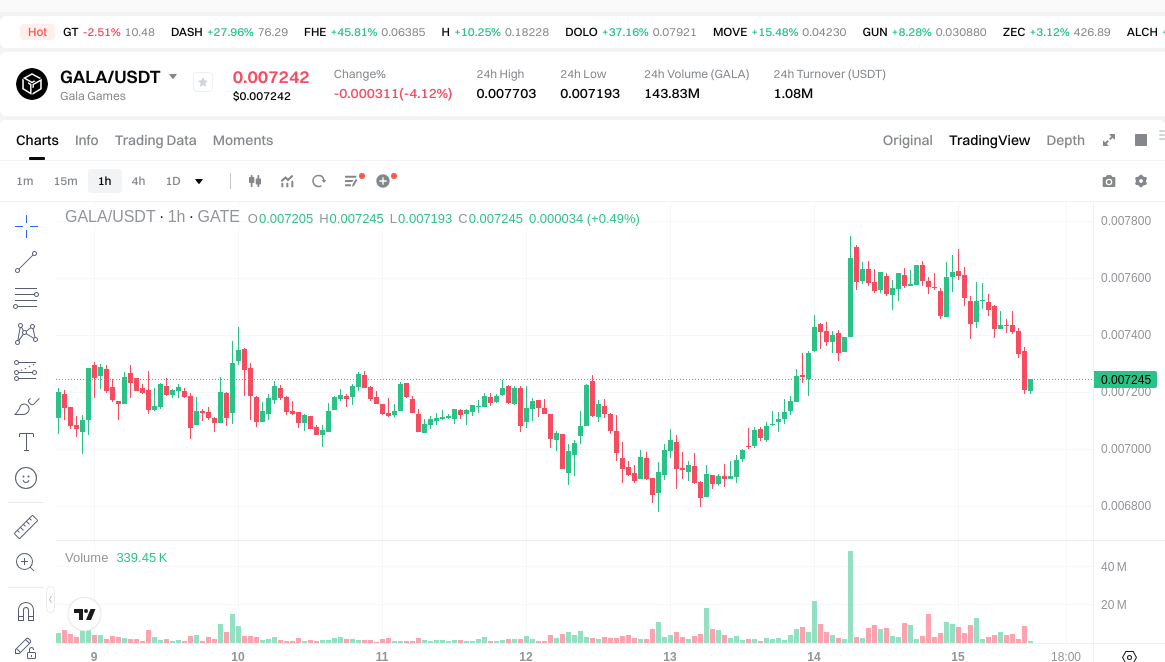
- GALA Current Price: $0.007194
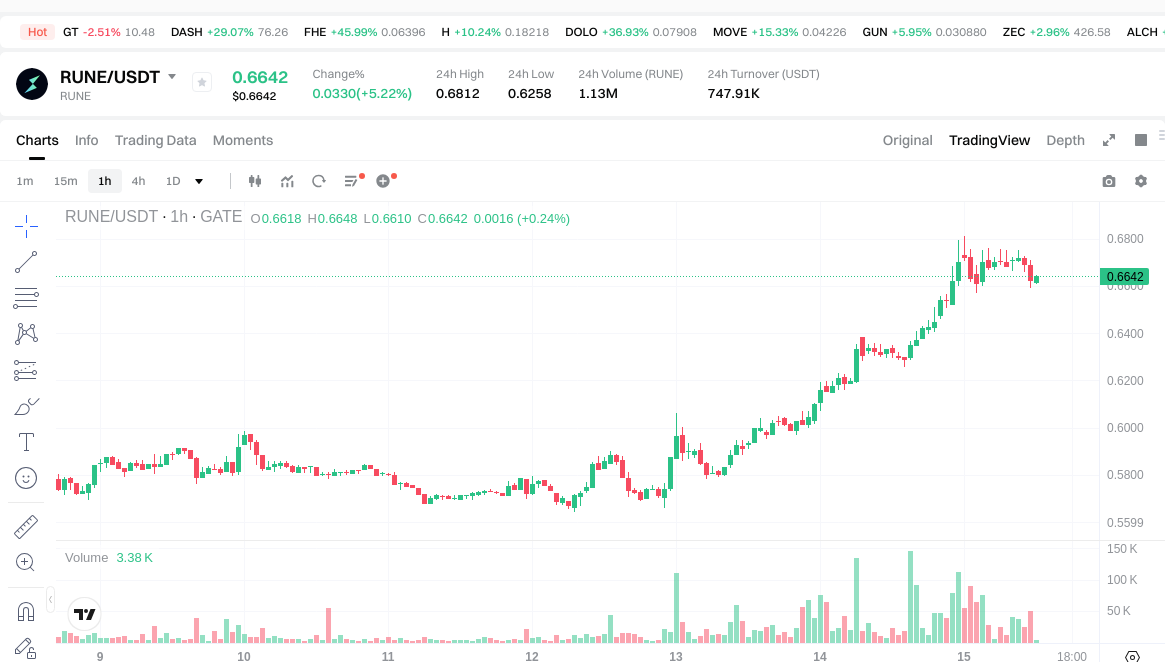
- RUNE Current Price: $0.6626
- 24-Hour Trading Volume: GALA $1,088,797.98 vs RUNE $750,481.91
- Market Sentiment Index (Fear & Greed Index): 61 (Greed)
View real-time prices:
II. Core Factors Influencing GALA vs RUNE Investment Value
Supply Mechanism Comparison (Tokenomics)
- GALA: The token operates within a blockchain gaming platform ecosystem, with supply dynamics tied to platform growth and gaming application adoption. The tokenomics structure is designed to support game developers and player engagement through incentive mechanisms.
- RUNE: Functions as a cross-chain bridge protocol token, with supply mechanisms aligned with liquidity provision and cross-chain transaction facilitation. The token economics are structured to incentivize network participation and liquidity depth.
- 📌 Historical Pattern: Supply mechanisms influence price cycles through demand fluctuations driven by ecosystem expansion, platform adoption rates, and network utility requirements.
Institutional Adoption and Market Application
- Institutional Holdings: Market materials suggest RUNE has gained attention within cross-chain infrastructure discussions, particularly among participants focused on interoperability solutions. GALA's institutional profile remains primarily tied to blockchain gaming sector interest.
- Enterprise Adoption: RUNE's application centers on cross-chain liquidity and decentralized exchange infrastructure, while GALA's use cases concentrate on gaming platform integration and in-game asset economies.
- Policy Environment: Regulatory perspectives vary by jurisdiction, with gaming tokens and DeFi protocols facing different compliance frameworks across regions.
Technology Development and Ecosystem Construction
- GALA Technology Evolution: Development focuses on expanding blockchain gaming platform capabilities, enhancing game developer tools, and improving player experience through technological refinements.
- RUNE Technology Progress: Technical advancement emphasizes cross-chain bridge efficiency, transaction speed optimization, and gas fee reduction potential, particularly in relation to infrastructure upgrades.
- Ecosystem Comparison: GALA's ecosystem centers on gaming applications and NFT integration within entertainment contexts, while RUNE's ecosystem revolves around DeFi protocols, liquidity pools, and cross-chain asset transfer mechanisms.
Macroeconomic Environment and Market Cycles
- Inflation Context Performance: Neither token demonstrates clear inflation-hedging characteristics comparable to traditional store-of-value assets. Performance is more closely tied to sector-specific demand and crypto market sentiment.
- Macro Monetary Policy: Interest rate movements and dollar strength influence risk appetite for both tokens, with effects manifesting through broader crypto market correlations rather than asset-specific hedging properties.
- Geopolitical Factors: Cross-border transaction demand may influence RUNE through increased interoperability requirements, while GALA remains more sensitive to digital entertainment sector trends and gaming industry developments.
III. 2026-2031 Price Forecast: GALA vs RUNE
Short-term Forecast (2026)
- GALA: Conservative $0.0042-$0.0072 | Optimistic $0.0072-$0.0075
- RUNE: Conservative $0.54-$0.66 | Optimistic $0.66-$0.88
Mid-term Forecast (2028-2029)
- GALA may enter a consolidation phase with estimated price range of $0.0047-$0.0094
- RUNE may enter a growth phase with estimated price range of $0.62-$1.02
- Key drivers: institutional capital inflows, ETF developments, ecosystem expansion
Long-term Forecast (2030-2031)
- GALA: Baseline scenario $0.0048-$0.0091 | Optimistic scenario $0.0091-$0.013
- RUNE: Baseline scenario $0.57-$0.98 | Optimistic scenario $0.98-$1.55
View detailed price predictions for GALA and RUNE
Disclaimer
GALA:
| Year |
Predicted High Price |
Predicted Average Price |
Predicted Low Price |
Price Change |
| 2026 |
0.00752544 |
0.007236 |
0.00419688 |
0 |
| 2027 |
0.0096687432 |
0.00738072 |
0.0037641672 |
2 |
| 2028 |
0.00937720476 |
0.0085247316 |
0.00468860238 |
18 |
| 2029 |
0.0092194972254 |
0.00895096818 |
0.0048335228172 |
24 |
| 2030 |
0.012810178110807 |
0.0090852327027 |
0.004815173332431 |
26 |
| 2031 |
0.011604567731158 |
0.010947705406753 |
0.007772870838794 |
52 |
RUNE:
| Year |
Predicted High Price |
Predicted Average Price |
Predicted Low Price |
Price Change |
| 2026 |
0.87714 |
0.6645 |
0.54489 |
0 |
| 2027 |
1.0483152 |
0.77082 |
0.693738 |
16 |
| 2028 |
0.991428684 |
0.9095676 |
0.618505968 |
37 |
| 2029 |
1.01703301194 |
0.950498142 |
0.6653486994 |
43 |
| 2030 |
1.2198693154428 |
0.98376557697 |
0.7181488711881 |
48 |
| 2031 |
1.553562599151024 |
1.1018174462064 |
0.572945072027328 |
66 |
IV. Investment Strategy Comparison: GALA vs RUNE
Long-term vs Short-term Investment Strategies
- GALA: Suitable for investors focused on blockchain gaming sector exposure and entertainment-oriented crypto applications, with consideration for ecosystem expansion potential tied to gaming platform adoption rates.
- RUNE: Suitable for investors seeking exposure to cross-chain infrastructure development and DeFi protocol growth, with focus on interoperability solutions and liquidity provision mechanisms.
Risk Management and Asset Allocation
- Conservative Investors: GALA 20-30% vs RUNE 70-80%
- Aggressive Investors: GALA 40-50% vs RUNE 50-60%
- Hedging Tools: Stablecoin allocation, derivatives instruments, cross-asset portfolio diversification
V. Potential Risk Comparison
Market Risk
- GALA: Price volatility influenced by gaming sector adoption trends, NFT market sentiment fluctuations, and entertainment industry developments. Trading volume concentration may impact liquidity during market stress periods.
- RUNE: Price movements affected by cross-chain transaction demand variations, DeFi sector performance cycles, and competing protocol developments. Market cap positioning creates exposure to broader crypto market correlation risks.
Technical Risk
- GALA: Scalability considerations related to gaming platform capacity, network stability requirements for user experience maintenance, and integration dependencies with gaming developer adoption rates.
- RUNE: Cross-chain bridge security considerations, transaction processing efficiency requirements, and protocol upgrade implementation risks affecting network stability.
Regulatory Risk
- Global regulatory frameworks show divergent approaches toward gaming tokens versus DeFi protocols. Gaming-oriented tokens face content regulation considerations in certain jurisdictions, while cross-chain liquidity protocols encounter varying compliance requirements related to financial service classifications across different regions.
VI. Conclusion: Which Is the Better Buy?
📌 Investment Value Summary:
- GALA Characteristics: Positioned within blockchain gaming sector with ecosystem tied to entertainment industry adoption, NFT integration capabilities, and gaming platform expansion potential. Price performance correlates with gaming sector developments and player engagement metrics.
- RUNE Characteristics: Functions as cross-chain infrastructure component with utility in DeFi ecosystem connectivity, liquidity provision mechanisms, and interoperability solutions. Value proposition linked to cross-chain transaction demand and protocol development progress.
✅ Investment Considerations:
- Beginning Investors: Consider portfolio diversification across multiple asset classes, emphasis on risk management through position sizing, and educational focus on understanding gaming versus DeFi sector dynamics before allocation decisions.
- Experienced Investors: Evaluation may incorporate sector rotation strategies between gaming and DeFi exposure, technical analysis of ecosystem development metrics, and correlation assessment with broader crypto market cycles.
- Institutional Participants: Due diligence may encompass regulatory compliance frameworks across jurisdictions, liquidity depth analysis for position management, and infrastructure integration considerations for portfolio construction.
⚠️ Risk Disclosure: Cryptocurrency markets demonstrate high volatility characteristics. This content does not constitute investment advice.
VII. FAQ
Q1: What are the main differences between GALA and RUNE in terms of use cases?
GALA focuses on blockchain gaming and entertainment applications, while RUNE serves as cross-chain DeFi infrastructure. GALA operates within the Gala Games ecosystem, enabling in-game asset economies, NFT integration, and player reward mechanisms. Its value proposition centers on gaming platform adoption and entertainment sector growth. RUNE, conversely, functions as the native token of THORChain, facilitating cross-chain liquidity provision, decentralized asset swaps, and interoperability between different blockchain networks. Its utility derives from DeFi protocol usage and cross-chain transaction demand.
Q2: Which token shows higher price volatility based on historical data?
GALA typically demonstrates higher relative volatility compared to RUNE. The gaming token's price movements are more sensitive to NFT market sentiment fluctuations, entertainment industry trends, and gaming adoption cycles. RUNE's price behavior, while still volatile, tends to correlate more closely with broader DeFi sector performance and cross-chain infrastructure development milestones. Current 24-hour trading volume data shows GALA at $1,088,797.98 versus RUNE at $750,481.91, suggesting GALA maintains higher trading activity levels that can contribute to increased price swings.
Q3: How do supply mechanisms differ between GALA and RUNE?
The two tokens employ fundamentally different tokenomics structures aligned with their respective ecosystems. GALA's supply mechanism is designed to incentivize gaming platform participation, reward game developers, and encourage player engagement through ecosystem growth-based distribution. RUNE's supply dynamics are structured around liquidity provision incentives, cross-chain transaction facilitation, and network security through staking mechanisms. These distinct approaches mean GALA's token value correlates with gaming adoption metrics, while RUNE's value ties to liquidity depth and cross-chain transaction volumes.
Q4: What are the key risk factors investors should consider for each token?
For GALA, primary risks include gaming sector adoption uncertainty, NFT market sentiment volatility, competition from alternative gaming platforms, and regulatory considerations specific to gaming tokens in certain jurisdictions. Network scalability and gaming developer adoption rates also represent critical risk variables. For RUNE, key concerns involve cross-chain bridge security vulnerabilities, DeFi sector competition, regulatory frameworks affecting decentralized liquidity protocols, and technical risks associated with protocol upgrades. Both tokens face exposure to broader cryptocurrency market correlation risks and macroeconomic conditions affecting risk asset appetite.
Q5: Which token is more suitable for conservative versus aggressive investors?
Conservative investors may find RUNE more appropriate due to its established cross-chain infrastructure positioning, correlation with DeFi sector fundamentals, and utility tied to ongoing blockchain interoperability demand. Risk-averse portfolios might allocate 70-80% toward RUNE exposure. Aggressive investors seeking higher potential volatility and entertainment sector exposure may favor increased GALA allocation (40-50%), accepting greater risk in exchange for gaming adoption upside. However, both tokens remain high-risk assets requiring comprehensive due diligence and appropriate position sizing within diversified portfolios.
Q6: How do institutional adoption levels compare between GALA and RUNE?
RUNE has demonstrated relatively stronger institutional interest within cross-chain infrastructure and DeFi protocol discussions, particularly among participants focused on blockchain interoperability solutions. The token's utility in facilitating decentralized liquidity provision attracts institutional attention seeking DeFi exposure. GALA's institutional profile remains primarily concentrated within blockchain gaming sector participants and entertainment-focused crypto investment strategies. The divergent institutional adoption patterns reflect the different maturity levels and investment thesis characteristics of gaming tokens versus DeFi infrastructure components.
Q7: What timeline should investors consider when evaluating GALA versus RUNE?
Investment timeline considerations depend significantly on risk tolerance and sector outlook. Short-term traders (2026) may find opportunities in both tokens' volatility patterns, with GALA projected between $0.0042-$0.0075 and RUNE between $0.54-$0.88. Mid-term investors (2028-2029) should evaluate gaming sector adoption trajectories versus DeFi infrastructure expansion, with forecasts suggesting GALA consolidation ($0.0047-$0.0094) and RUNE growth potential ($0.62-$1.02). Long-term holders (2030-2031) must assess fundamental ecosystem development prospects, with baseline scenarios indicating GALA at $0.0048-$0.0091 and RUNE at $0.57-$0.98.
Q8: How do regulatory environments affect GALA and RUNE differently?
Regulatory frameworks impact the two tokens through distinct pathways reflecting their different use cases. GALA faces gaming-specific regulations that vary by jurisdiction, including content restrictions, age verification requirements, and entertainment industry compliance standards. Some regions classify gaming tokens under stricter oversight frameworks affecting platform operations. RUNE encounters regulatory considerations related to DeFi protocols, cross-chain financial services, and decentralized exchange classifications. Jurisdictional differences in treating liquidity protocols create varying compliance requirements. Both tokens remain subject to evolving cryptocurrency regulations, but the specific regulatory pressures differ according to their gaming versus DeFi positioning.
* The information is not intended to be and does not constitute financial advice or any other recommendation of any sort offered or endorsed by Gate.