This comprehensive comparison analyzes HEI versus QNT, two leading blockchain infrastructure projects with distinct market positioning. HEI, a Layer 1 blockchain launched in 2025, focuses on multi-chain interoperability, while QNT, established since 2018, serves as a trusted digital interaction provider with significant enterprise adoption. The analysis covers historical price trends, current market status, tokenomics, institutional adoption, technology ecosystems, and 2026-2031 price forecasts. For investment strategy, conservative investors might allocate 20-30% HEI and 70-80% QNT, while aggressive investors could consider a 40-50% and 50-60% split. Both assets carry market, technical, and regulatory risks, with HEI showing higher volatility and limited liquidity. The article provides detailed guidance for beginner, experienced, and institutional investors making blockchain infrastructure investment decisions.
Introduction: Investment Comparison Between HEI and QNT
In the cryptocurrency market, the comparison between HEI vs QNT remains a topic investors cannot overlook. The two assets demonstrate notable differences in market cap ranking, application scenarios, and price performance, representing distinct positioning within the crypto asset landscape.
HEI (Heima): Launched in 2025, it has gained market recognition through its positioning as a Layer 1 blockchain designed for seamless multi-chain and cross-chain interoperability.
QNT (Quant): Since its inception in 2018, it has been recognized as a technology provider enabling trusted digital interaction, standing as one of the prominent projects in blockchain interoperability with significant enterprise adoption.
This article will comprehensively analyze the investment value comparison between HEI vs QNT, covering historical price trends, supply mechanisms, institutional adoption, technical ecosystems, and future projections, attempting to address the question investors care about most:
"Which is the better buy right now?"
I. Historical Price Comparison and Current Market Status
HEI (Heima) and QNT (Quant) Historical Price Trends
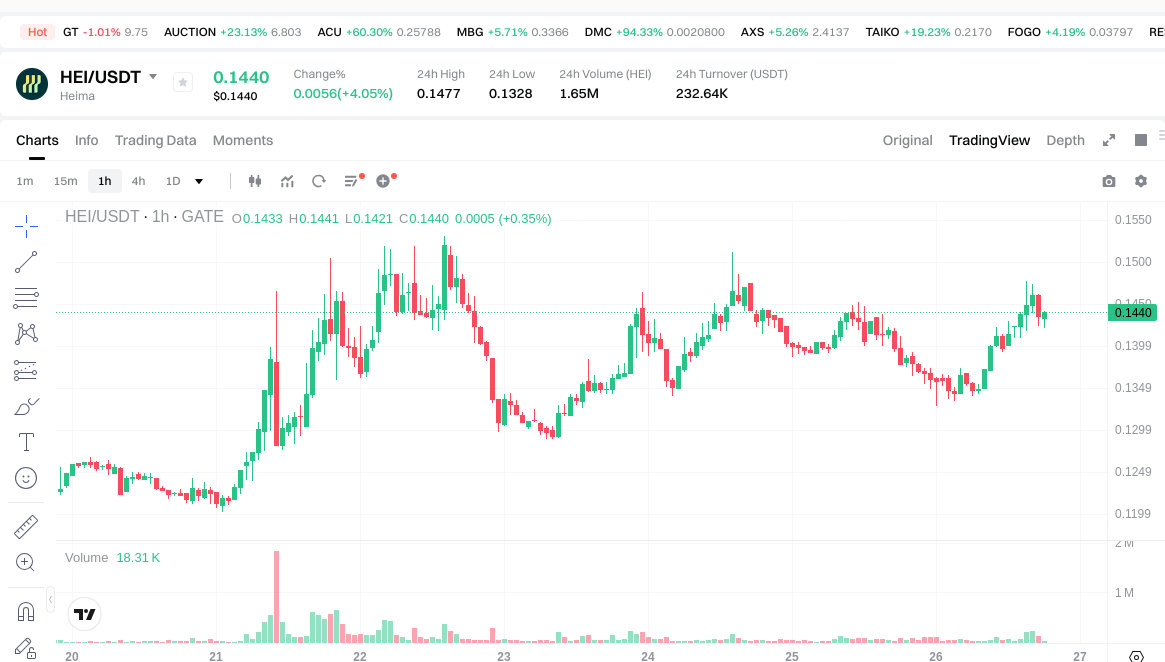
- 2025: HEI reached a notable price point of $1.25 on February 13, 2025, representing a significant milestone in its early trading history.
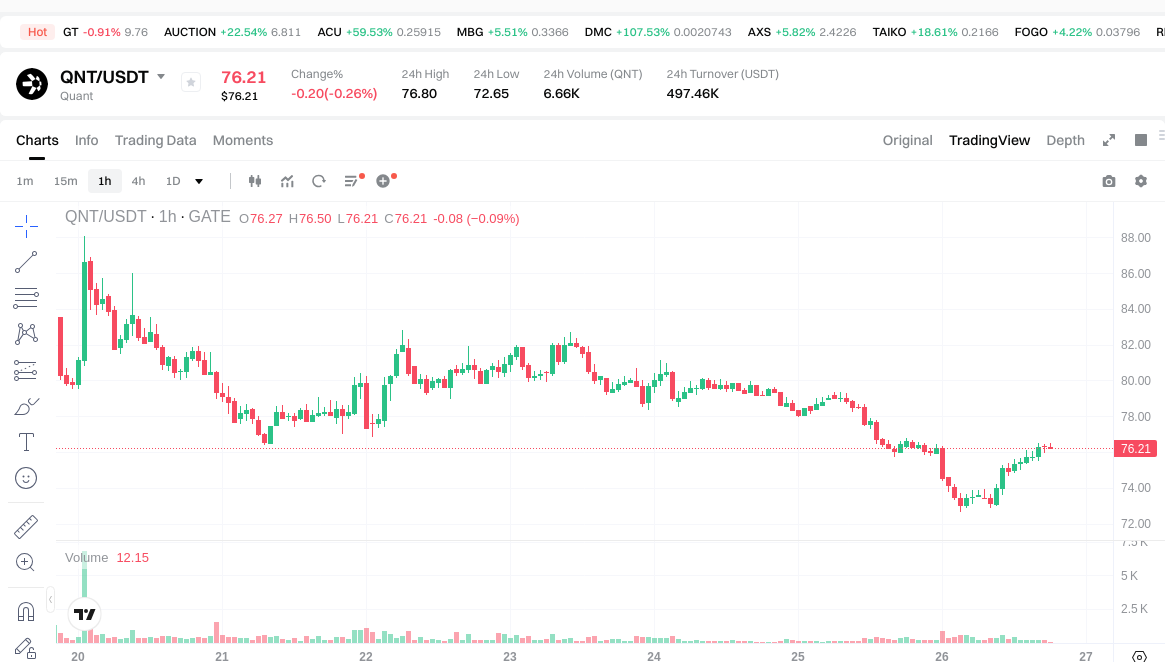
- 2021: QNT experienced substantial growth, reaching $427.42 on September 11, 2021, during a period of heightened interest in blockchain interoperability solutions.
- Comparative Analysis: During market cycles, HEI has shown volatility with a decline from its peak of $1.25 to a low of $0.04755675 in October 2025, while QNT has experienced a more extended trading history with price movements from its all-time high of $427.42 to its current levels.
Current Market Status (2026-01-26)
- HEI Current Price: $0.143
- QNT Current Price: $76.28
- 24-Hour Trading Volume: HEI $231,929.44 vs QNT $498,416.42
- Market Sentiment Index (Fear & Greed Index): 20 (Extreme Fear)
View real-time prices:
- Check HEI Current Price Market Price
- Check QNT Current Price Market Price
II. Core Factors Influencing HEI vs QNT Investment Value
Supply Mechanism Comparison (Tokenomics)
Due to limited available data on the specific supply mechanisms of HEI and QNT, a detailed comparison cannot be provided at this time. Investors are advised to refer to official project documentation for accurate tokenomics information.
Institutional Adoption and Market Application
Institutional Holdings
Insufficient data is available to determine institutional preference between HEI and QNT.
Enterprise Adoption
Comprehensive information regarding the adoption of HEI and QNT in cross-border payments, settlements, and investment portfolios is not currently available.
National Policies
Specific regulatory attitudes from different countries toward HEI and QNT have not been documented in available sources.
Technology Development and Ecosystem Building
Detailed information about technology upgrades for both HEI and QNT, as well as their ecosystem development in DeFi, NFT, payments, and smart contract implementation, is not available in current materials.
Macroeconomic Factors and Market Cycles
Comparative analysis of anti-inflation properties between HEI and QNT cannot be conducted due to insufficient historical performance data.
Macroeconomic Monetary Policy
The specific impacts of interest rates and dollar index movements on HEI and QNT require further data collection and analysis.
Geopolitical Factors
The influence of cross-border transaction demand and international situations on both assets remains undocumented in available reference materials.
III. 2026-2031 Price Forecast: HEI vs QNT
Short-term Forecast (2026)
- HEI: Conservative $0.0935-$0.1439 | Optimistic $0.1439-$0.1669
- QNT: Conservative $45.74-$76.24 | Optimistic $76.24-$94.54
Medium-term Forecast (2028-2029)
- HEI may enter a consolidation phase with estimated price range of $0.1072-$0.2277 in 2028, potentially expanding to $0.1662-$0.2577 by 2029
- QNT may enter a growth phase with estimated price range of $76.90-$110.29 in 2028, potentially reaching $72.96-$136.40 by 2029
- Key drivers: institutional capital inflows, ETF developments, ecosystem expansion
Long-term Forecast (2030-2031)
- HEI: Base scenario $0.1583-$0.2327 (2030) | Optimistic scenario $0.2005-$0.3460 (2031)
- QNT: Base scenario $79.91-$121.07 (2030) | Optimistic scenario $83.90-$183.79 (2031)
View detailed price predictions for HEI and QNT
Disclaimer
HEI:
| Year |
Predicted High Price |
Predicted Average Price |
Predicted Low Price |
Price Change |
| 2026 |
0.166924 |
0.1439 |
0.093535 |
0 |
| 2027 |
0.22068504 |
0.155412 |
0.11189664 |
8 |
| 2028 |
0.2275387092 |
0.18804852 |
0.1071876564 |
31 |
| 2029 |
0.257664082104 |
0.2077936146 |
0.16623489168 |
45 |
| 2030 |
0.31651123375872 |
0.232728848352 |
0.15825561687936 |
62 |
| 2031 |
0.346021251729753 |
0.27462004105536 |
0.200472629970412 |
92 |
QNT:
| Year |
Predicted High Price |
Predicted Average Price |
Predicted Low Price |
Price Change |
| 2026 |
94.5376 |
76.24 |
45.744 |
0 |
| 2027 |
116.982656 |
85.3888 |
67.457152 |
11 |
| 2028 |
110.29244352 |
101.185728 |
76.90115328 |
32 |
| 2029 |
136.4034206304 |
105.73908576 |
72.9599691744 |
38 |
| 2030 |
145.28550383424 |
121.0712531952 |
79.907027108832 |
58 |
| 2031 |
183.7861623503136 |
133.17837851472 |
83.9023784642736 |
74 |
IV. Investment Strategy Comparison: HEI vs QNT
Long-term vs Short-term Investment Strategies
- HEI: May be suitable for investors interested in emerging Layer 1 blockchain projects with multi-chain interoperability focus, though its relatively short trading history since 2025 requires careful consideration of volatility patterns
- QNT: May appeal to investors seeking exposure to established blockchain interoperability solutions with a longer market track record dating back to 2018, particularly those focused on enterprise adoption scenarios
Risk Management and Asset Allocation
- Conservative Investors: A cautious approach might consider HEI 20-30% vs QNT 70-80%, given QNT's longer operational history
- Aggressive Investors: A more balanced allocation such as HEI 40-50% vs QNT 50-60% could be considered, accounting for HEI's potential growth trajectory alongside QNT's established market position
- Hedging Tools: Stablecoin allocation for liquidity management, derivatives for downside protection, cross-asset portfolio diversification
V. Potential Risk Comparison
Market Risks
- HEI: Price volatility evidenced by the decline from $1.25 in February 2025 to $0.04755675 in October 2025, limited trading volume of $231,929.44 may impact liquidity during market stress
- QNT: Historical price fluctuation from all-time high of $427.42 in September 2021 to current levels around $76.28, though with relatively higher trading volume of $498,416.42 compared to HEI
Technical Risks
- HEI: As a newer Layer 1 blockchain launched in 2025, scalability testing under network stress conditions, ecosystem maturity, and cross-chain implementation challenges require ongoing monitoring
- QNT: Network stability considerations, potential security vulnerabilities inherent in blockchain interoperability solutions, dependency on multiple blockchain network integrations
Regulatory Risks
- Both HEI and QNT operate within an evolving global regulatory landscape for blockchain interoperability and Layer 1 solutions. Regulatory developments in major jurisdictions could impact adoption trajectories, enterprise partnerships, and market accessibility differently depending on each project's specific compliance frameworks and geographic focus
VI. Conclusion: Which Is the Better Buy?
📌 Investment Value Summary:
- HEI Advantages: Positioning as a Layer 1 blockchain with multi-chain interoperability focus, launched in 2025 with potential for growth in emerging blockchain infrastructure sector, current price point of $0.143 may present entry opportunities relative to historical levels
- QNT Advantages: Established market presence since 2018 in blockchain interoperability technology, recognition for enabling trusted digital interactions with enterprise adoption focus, longer trading history providing more reference data for analysis
✅ Investment Recommendations:
- Beginner Investors: Consider starting with smaller allocations to understand market dynamics, prioritize learning about both projects' fundamentals, technological approaches, and market positioning before committing significant capital
- Experienced Investors: Evaluate portfolio diversification benefits by considering both assets' different market positions, analyze risk-adjusted return potential based on historical volatility patterns and forecast ranges, implement appropriate position sizing aligned with overall portfolio risk tolerance
- Institutional Investors: Conduct comprehensive due diligence on technological infrastructure, assess liquidity profiles for position building and management, evaluate regulatory compliance frameworks and potential enterprise adoption pathways for both projects
⚠️ Risk Disclosure: The cryptocurrency market exhibits high volatility and carries substantial risks. This analysis does not constitute investment advice. Investors should conduct independent research and consider their financial circumstances before making investment decisions.
VII. FAQ
Q1: What are the main differences between HEI and QNT in terms of project positioning?
HEI is a Layer 1 blockchain launched in 2025 focused on multi-chain and cross-chain interoperability, while QNT is an established interoperability technology provider since 2018 enabling trusted digital interactions with significant enterprise adoption. The key distinction lies in HEI's infrastructure-level approach as a blockchain platform versus QNT's role as a technology enabler connecting existing blockchains, with QNT having a seven-year operational track record compared to HEI's emerging market presence.
Q2: Which asset shows higher price volatility based on historical data?
HEI demonstrates significantly higher volatility with a decline from $1.25 in February 2025 to $0.04755675 in October 2025 (approximately 96% drawdown), whereas QNT experienced a decline from its all-time high of $427.42 in September 2021 to current levels around $76.28 (approximately 82% drawdown over a longer period). HEI's shorter trading history and lower 24-hour trading volume of $231,929.44 compared to QNT's $498,416.42 suggest potentially higher volatility and liquidity risks for HEI investors.
Q3: What is the price forecast outlook for HEI and QNT through 2031?
For 2026, HEI's conservative forecast ranges from $0.0935-$0.1439, while QNT's ranges from $45.74-$76.24. By 2031, HEI's optimistic scenario projects $0.2005-$0.3460, representing a potential 92% increase from 2026 levels, whereas QNT's optimistic scenario estimates $83.90-$183.79, indicating a potential 74% growth. However, these projections assume favorable market conditions and should be considered alongside inherent cryptocurrency market uncertainties and the projects' respective development trajectories.
Q4: How should investors approach portfolio allocation between HEI and QNT?
Conservative investors might consider a 20-30% HEI and 70-80% QNT allocation, prioritizing QNT's longer operational history and established market position, while aggressive investors could explore a more balanced 40-50% HEI and 50-60% QNT split to capture potential growth in emerging blockchain infrastructure alongside proven interoperability solutions. The allocation strategy should align with individual risk tolerance, investment timeframes, and overall portfolio diversification objectives, with consideration for implementing hedging tools such as stablecoin reserves and cross-asset diversification.
Q5: What are the primary risk factors investors should monitor for both assets?
Market risks include HEI's demonstrated high volatility and limited liquidity evidenced by lower trading volumes, alongside QNT's historical price fluctuations and market cycle sensitivity. Technical risks encompass HEI's relatively untested scalability as a newer Layer 1 blockchain and ecosystem maturity challenges, while QNT faces network stability considerations inherent in multi-blockchain integration dependencies. Regulatory risks affect both assets as they operate within an evolving global framework for blockchain interoperability, with potential impacts on enterprise adoption and market accessibility varying based on each project's compliance approach and geographic focus.
Q6: Which asset is more suitable for long-term versus short-term investment strategies?
QNT may be more appropriate for long-term investors seeking exposure to established blockchain interoperability solutions with a proven track record since 2018 and enterprise adoption focus, providing more historical data for fundamental analysis. HEI might appeal to investors with higher risk tolerance interested in short-to-medium term opportunities in emerging Layer 1 blockchain infrastructure, though its limited trading history since 2025 requires careful evaluation of volatility patterns and ecosystem development progress before committing to extended holding periods.
Q7: What information gaps exist in the current analysis of HEI versus QNT?
Significant data limitations include unavailable detailed tokenomics and supply mechanism information for both projects, insufficient documentation on institutional holdings and enterprise adoption metrics, lack of specific regulatory positions from major jurisdictions, and incomplete technical development roadmaps and ecosystem integration data. Investors should conduct additional independent research through official project documentation, on-chain analytics, and verified third-party sources to address these information gaps before making investment decisions, particularly regarding governance structures, token distribution, and partnership verification.
Q8: How does the current market sentiment affect the investment outlook for both assets?
With the Fear & Greed Index at 20 (Extreme Fear) as of January 26, 2026, market sentiment reflects significant risk aversion in the cryptocurrency sector, potentially creating entry opportunities for contrarian investors while presenting challenges for short-term price appreciation. This extreme fear environment may disproportionately impact HEI due to its lower liquidity and shorter market presence, while QNT's established position might provide relative stability. Investors should consider whether current market conditions align with their investment thesis, risk capacity, and ability to withstand potential continued downward pressure before accumulating positions in either asset.
* The information is not intended to be and does not constitute financial advice or any other recommendation of any sort offered or endorsed by Gate.