This comprehensive analysis compares HOT and LRC, two distinct blockchain tokens with different market positioning and investment characteristics. HOT, launched in 2018, operates as a distributed peer-to-peer hosting platform for Holochain applications, currently trading at $0.0005295 with a market cap of $94.05 million. LRC, introduced in 2017, functions as a Layer-2 scaling solution for Ethereum-based decentralized exchanges, priced at $0.05469 with a $68.14 million market cap. The article examines historical price trends, tokenomics mechanisms, trading volumes, and technical ecosystems to evaluate which asset offers superior investment value. Through structured analysis of market data, risk factors, and 2026-2031 price forecasts via Gate, the comparison provides actionable insights for conservative and aggressive investors seeking exposure to emerging blockchain infrastructure. Key recommendations differentiate investment strategies based on risk tolerance, liquidity preferences, and exposure to distribute
Introduction: Investment Comparison Between HOT and LRC
In the cryptocurrency market, the comparison between HOT vs LRC has consistently been a topic that investors cannot overlook. Both demonstrate notable differences in market cap ranking, application scenarios, and price performance, representing distinct positioning within the crypto asset landscape.
HOT (Holo): Launched in 2018, it has gained market recognition as a distributed peer-to-peer hosting platform for Holochain applications, positioning itself as a bridge to a new internet infrastructure.
LRC (Loopring): Introduced in 2017, it has established itself as an open, multilateral token trading protocol based on ERC20 and smart contracts, enabling decentralized exchange applications without asset custody requirements.
This article will comprehensively analyze the investment value comparison of HOT vs LRC through historical price trends, supply mechanisms, technical ecosystems, and future outlook, attempting to address investors' most pressing question:
"Which asset offers more compelling investment characteristics at the current market juncture?"
By examining market data as of January 17, 2026, where HOT trades at $0.0005295 with a market cap of approximately $94.05 million (ranking 369), and LRC trades at $0.05469 with a market cap of approximately $68.14 million (ranking 448), we will provide a structured framework for understanding their respective value propositions.
I. Historical Price Comparison and Current Market Conditions
Historical Price Trends of HOT (Coin A) and LRC (Coin B)
- 2021: HOT reached its all-time high of $0.03126682 on April 6, 2021, during a period of heightened interest in decentralized applications and peer-to-peer hosting platforms.
- 2021: LRC achieved its all-time high of $3.75 on November 10, 2021, driven by increased adoption of Layer 2 scaling solutions and partnerships with major platforms.
- Comparative Analysis: During the 2021-2022 market cycle, HOT declined from its peak of $0.0313 to a low of $0.0002202 recorded on March 13, 2020, representing substantial volatility. In contrast, LRC experienced a similar downturn, falling from its high of $3.75 to a low of $0.01963893 on December 18, 2019, before recovering during the 2021 bull market.
Current Market Situation (2026-01-17)
- HOT Current Price: $0.0005295
- LRC Current Price: $0.05469
- 24-Hour Trading Volume: HOT recorded $13,656.67 compared to LRC's $71,705.97
- Market Sentiment Index (Fear & Greed Index): 50 (Neutral)
View real-time prices:
- Check HOT current price Market Price
- Check LRC current price Market Price
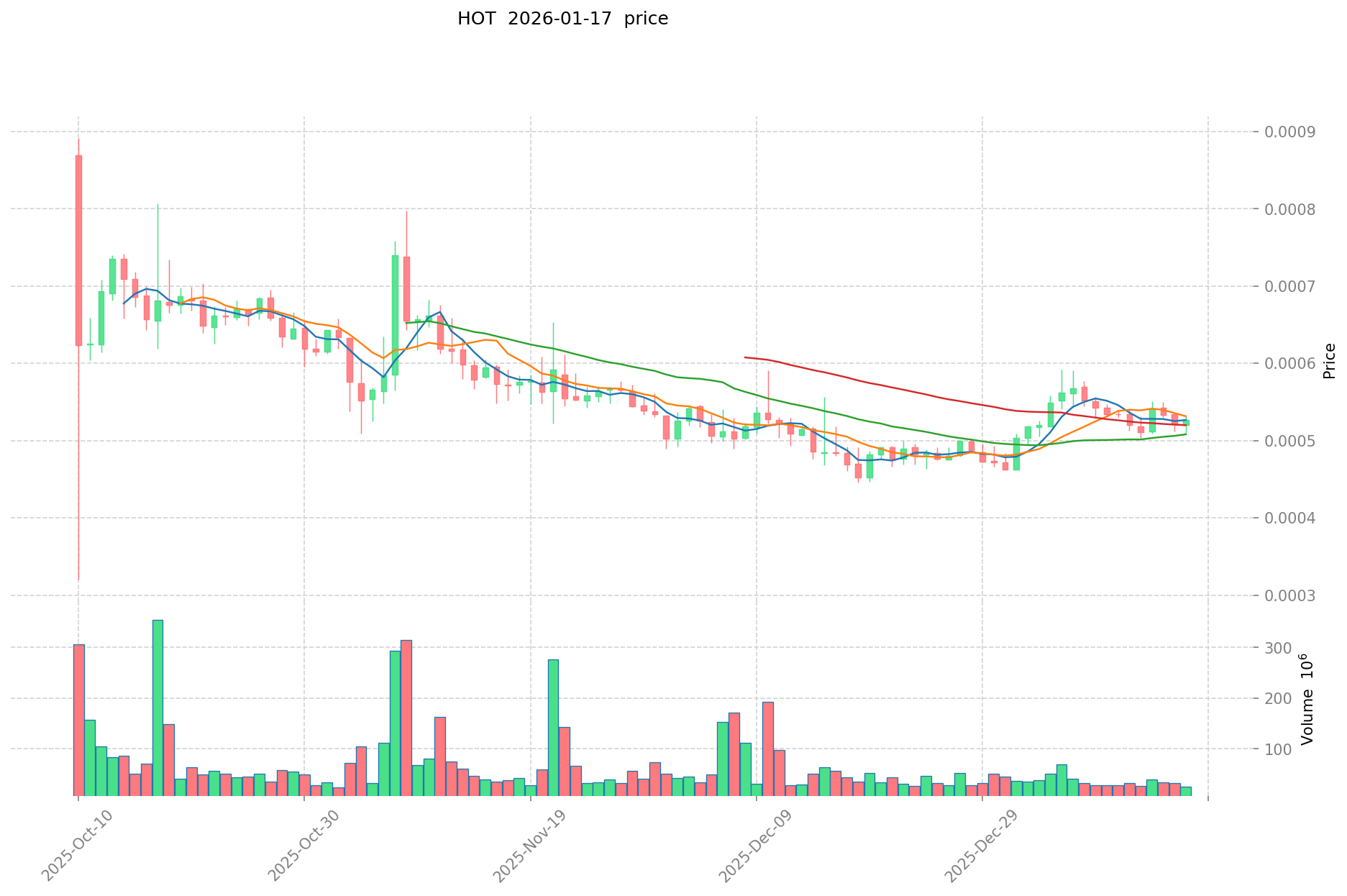
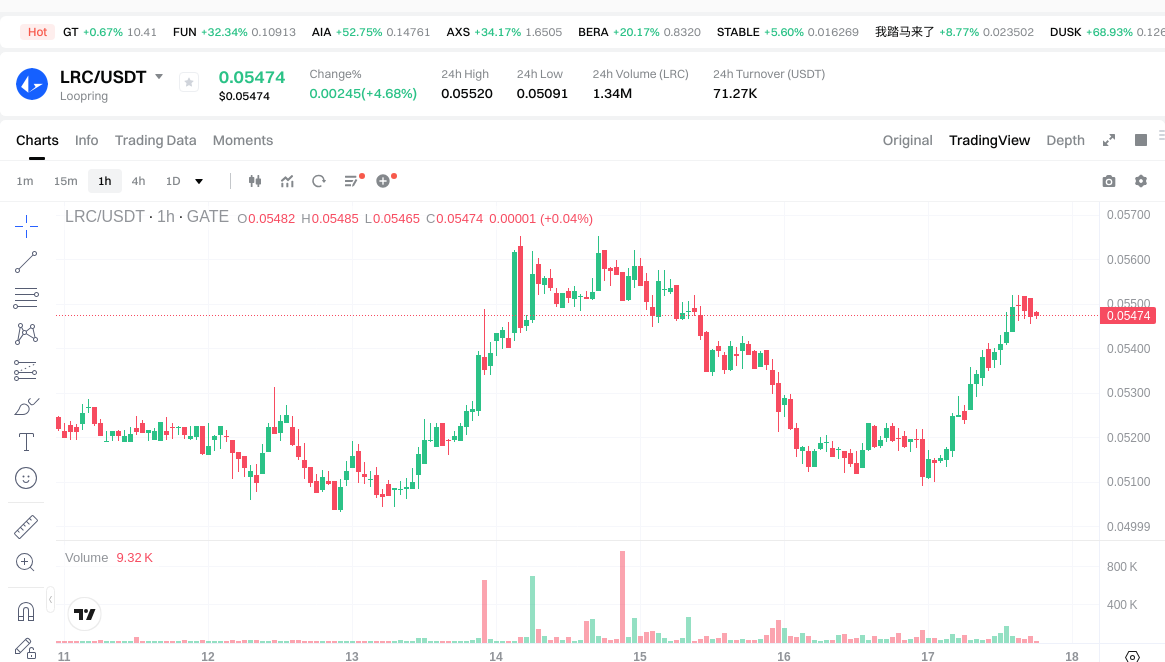
II. Core Factors Influencing HOT vs LRC Investment Value
Supply Mechanism Comparison (Tokenomics)
- LRC: Maximum supply of approximately 1.37 billion tokens, featuring a deflationary mechanism that adjusts token circulation based on network activity and protocol usage.
- HOT: Information regarding specific supply mechanism characteristics is not detailed in the available materials.
- 📌 Historical Pattern: Supply mechanisms with deflationary characteristics may enhance token value proposition by reducing circulating supply over time, potentially creating upward price pressure during periods of increased network utilization.
Institutional Adoption and Market Application
- Institutional Holdings: The materials do not provide specific comparative data on institutional preference between HOT and LRC.
- Enterprise Adoption: LRC's value proposition is primarily linked to network efficiency improvements and Layer-2 scaling solutions for Ethereum, though specific enterprise adoption metrics are not detailed in the reference materials.
- Regulatory Landscape: The materials do not contain information regarding differential regulatory treatment of these assets across jurisdictions.
Technology Development and Ecosystem Construction
- LRC Technology Development: As a Layer-2 scaling solution, LRC's market performance appears connected to technological innovation and application expansion within the Ethereum ecosystem, though specific upgrade details are not provided in the materials.
- HOT Technology Development: Technical development specifics are not covered in the available reference materials.
- Ecosystem Comparison: The materials indicate that LRC's value is influenced by network efficiency metrics, suggesting relevance to DeFi applications, though comprehensive ecosystem deployment data across DeFi, NFT, payment, and smart contract implementations is not available for comparison.
Macroeconomic Environment and Market Cycles
- Performance in Inflationary Environments: The reference materials do not contain comparative analysis of anti-inflation characteristics for either asset.
- Macroeconomic Monetary Policy: The materials do not discuss how interest rate fluctuations, US dollar index movements, or other macroeconomic factors differentially impact HOT versus LRC.
- Geopolitical Factors: Cross-border transaction demand and international situation impacts are not addressed in the available materials.
III. 2026-2031 Price Forecast: HOT vs LRC
Short-term Forecast (2026)
- HOT: Conservative $0.000492435 - $0.0005295 | Optimistic $0.0005295 - $0.000693645
- LRC: Conservative $0.038255 - $0.05465 | Optimistic $0.05465 - $0.073231
Medium-term Forecast (2028-2029)
- HOT may enter a consolidation phase, with projected price range of $0.0005595888375 - $0.000865497402 in 2028, and $0.00063658826154 - $0.00083804024304 in 2029
- LRC may enter a growth phase, with projected price range of $0.038968537725 - $0.0855779652 in 2028, and $0.043736452929 - $0.1190603440845 in 2029
- Key drivers: institutional capital inflows, ecosystem development, and market adoption
Long-term Forecast (2031)
- HOT: Baseline scenario $0.000717457533377 - $0.000834252945787 | Optimistic scenario $0.000834252945787 - $0.001076186300066
- LRC: Baseline scenario $0.089248990565716 - $0.107528904296043 | Optimistic scenario $0.107528904296043 - $0.115055927596766
View detailed price predictions for HOT and LRC
Disclaimer: Price predictions are based on historical data and market analysis models. Cryptocurrency markets are highly volatile and subject to numerous unpredictable factors. These forecasts should not be considered as investment advice. Users should conduct independent research and assess their risk tolerance before making any investment decisions.
HOT:
| Year |
Predicted High Price |
Predicted Average Price |
Predicted Low Price |
Price Change |
| 2026 |
0.000693645 |
0.0005295 |
0.000492435 |
0 |
| 2027 |
0.0008806644 |
0.0006115725 |
0.0005871096 |
15 |
| 2028 |
0.000865497402 |
0.00074611845 |
0.0005595888375 |
40 |
| 2029 |
0.00083804024304 |
0.000805807926 |
0.00063658826154 |
52 |
| 2030 |
0.000846581807055 |
0.00082192408452 |
0.000624662304235 |
55 |
| 2031 |
0.001076186300066 |
0.000834252945787 |
0.000717457533377 |
57 |
LRC:
| Year |
Predicted High Price |
Predicted Average Price |
Predicted Low Price |
Price Change |
| 2026 |
0.073231 |
0.05465 |
0.038255 |
0 |
| 2027 |
0.088877295 |
0.0639405 |
0.04603716 |
17 |
| 2028 |
0.0855779652 |
0.0764088975 |
0.038968537725 |
39 |
| 2029 |
0.1190603440845 |
0.08099343135 |
0.043736452929 |
48 |
| 2030 |
0.115030920874837 |
0.10002688771725 |
0.0800215101738 |
83 |
| 2031 |
0.115055927596766 |
0.107528904296043 |
0.089248990565716 |
96 |
IV. Investment Strategy Comparison: HOT vs LRC
Long-term vs Short-term Investment Strategies
- HOT: May appeal to investors focused on distributed application infrastructure and peer-to-peer hosting platforms, with a longer-term outlook aligned to emerging internet architecture adoption cycles.
- LRC: May suit investors interested in Layer-2 scaling solutions and decentralized exchange protocols, particularly those tracking Ethereum ecosystem development and DeFi infrastructure growth.
Risk Management and Asset Allocation
- Conservative Investors: HOT 30% vs LRC 70% - This allocation reflects LRC's relatively higher liquidity as indicated by 24-hour trading volume ($71,705.97 compared to HOT's $13,656.67) and established position within the Ethereum scaling narrative.
- Aggressive Investors: HOT 50% vs LRC 50% - Balanced exposure captures both the speculative potential of emerging distributed hosting infrastructure (HOT) and the growth trajectory of Layer-2 solutions (LRC).
- Hedging Tools: Stablecoin allocation for portfolio stabilization, options strategies for downside protection, and cross-asset diversification to mitigate concentration risk.
V. Potential Risk Comparison
Market Risk
- HOT: Trading at $0.0005295 with market cap ranking of 369, the asset exhibits lower liquidity compared to higher-ranked cryptocurrencies, potentially leading to increased price volatility during market stress periods. The 24-hour trading volume of $13,656.67 suggests limited market depth.
- LRC: Currently priced at $0.05469 with market cap ranking of 448, despite lower ranking than HOT, it demonstrates relatively higher trading activity with $71,705.97 in 24-hour volume. However, both assets operate in segments outside the top-tier market cap rankings, exposing holders to heightened volatility risks.
Technical Risk
- HOT: As a distributed peer-to-peer hosting platform for Holochain applications, potential technical challenges may include network scalability as adoption increases, reliability of distributed hosting infrastructure, and the complexity of transitioning traditional applications to the Holochain framework.
- LRC: Operating as a Layer-2 scaling solution, technical considerations include dependency on Ethereum mainnet security, potential smart contract vulnerabilities inherent in decentralized exchange protocols, and the competitive landscape of emerging Layer-2 technologies that may impact market positioning.
Regulatory Risk
- The evolving global regulatory landscape for cryptocurrency assets presents differential impacts based on asset classification and functionality. Decentralized exchange protocols and Layer-2 solutions may face scrutiny regarding securities law compliance, while distributed hosting platforms may encounter regulations related to data sovereignty and content hosting responsibilities. Investors should monitor jurisdiction-specific regulatory developments that may affect token utility, exchange listings, and cross-border transferability.
VI. Conclusion: Which Is the Better Buy?
📌 Investment Value Summary:
- HOT Strengths: Positioned within the distributed application infrastructure narrative with potential alignment to peer-to-peer internet evolution, offering exposure to an alternative internet architecture paradigm at a lower price point ($0.0005295).
- LRC Strengths: Established presence within the Ethereum Layer-2 ecosystem with deflationary tokenomics features, demonstrating higher trading liquidity and connection to the expanding DeFi sector, with price forecasts suggesting potential growth trajectory through 2031.
✅ Investment Recommendations:
- Novice Investors: Consider starting with smaller position sizes in LRC given its relatively higher liquidity metrics and clearer connection to established blockchain scaling narratives. Prioritize understanding the fundamental technology and market dynamics before committing significant capital to either asset.
- Experienced Investors: A diversified approach allocating to both assets may capture distinct value propositions - HOT for emerging distributed hosting infrastructure exposure, and LRC for Layer-2 scaling solution participation. Regular portfolio rebalancing based on evolving market conditions and technological developments is advisable.
- Institutional Investors: Conduct comprehensive due diligence on regulatory compliance, custody solutions, and liquidity requirements. Consider LRC for its connection to established DeFi infrastructure, while evaluating HOT's long-term infrastructure narrative within broader portfolio diversification strategies. Risk management frameworks should account for the nascent nature of both market segments.
⚠️ Risk Disclaimer: The cryptocurrency market exhibits extreme volatility. This analysis does not constitute investment advice. Investors should conduct independent research, assess their risk tolerance, and consult with qualified financial advisors before making investment decisions.
VII. FAQ
Q1: What is the primary difference between HOT and LRC in terms of blockchain functionality?
HOT serves as a distributed peer-to-peer hosting platform for Holochain applications, while LRC operates as a Layer-2 scaling solution for Ethereum-based decentralized exchanges. HOT focuses on creating alternative internet infrastructure through distributed hosting, positioning itself as a bridge to new web architecture. In contrast, LRC provides an open, multilateral token trading protocol based on ERC20 and smart contracts, enabling decentralized exchange applications without requiring asset custody. This fundamental distinction means HOT targets the distributed application hosting market, whereas LRC addresses blockchain scalability and DeFi trading efficiency.
Q2: Which asset demonstrates better liquidity characteristics as of January 2026?
LRC exhibits superior liquidity metrics compared to HOT. As of January 17, 2026, LRC recorded a 24-hour trading volume of $71,705.97, significantly exceeding HOT's $13,656.67. This approximately 5x higher trading volume suggests LRC maintains deeper market depth and potentially lower slippage during transactions. Despite LRC's lower market cap ranking (448 versus HOT's 369), the higher trading activity indicates more robust market participation and liquidity, which is particularly relevant for investors concerned about position entry and exit efficiency.
Q3: How do the tokenomics differ between HOT and LRC?
LRC features a maximum supply of approximately 1.37 billion tokens with a deflationary mechanism that adjusts token circulation based on network activity and protocol usage. This deflationary characteristic potentially creates upward price pressure during periods of increased network utilization by reducing circulating supply over time. However, specific supply mechanism details for HOT are not available in current market documentation. The deflationary aspect of LRC's tokenomics may appeal to investors seeking assets with built-in scarcity mechanisms, though the absence of detailed HOT supply information limits comprehensive tokenomics comparison.
Q4: What are the projected price trajectories for HOT and LRC through 2031?
Based on historical data and market analysis models, HOT's conservative forecast ranges from $0.000492435 in 2026 to $0.000717457533377 by 2031, with an optimistic scenario reaching $0.001076186300066. LRC demonstrates potentially stronger growth projections, with conservative estimates ranging from $0.038255 in 2026 to $0.089248990565716 by 2031, and optimistic scenarios reaching $0.115055927596766. These forecasts suggest LRC may offer higher absolute price appreciation potential, though cryptocurrency markets remain highly volatile and subject to numerous unpredictable factors. Investors should note these projections are analytical models, not guarantees of future performance.
Q5: What risk factors differentiate HOT and LRC investments?
HOT's primary risks stem from its lower liquidity ($13,656.67 daily volume) and dependence on distributed hosting infrastructure adoption, including network scalability challenges and application migration complexity. LRC faces technical risks related to Ethereum mainnet dependency, potential smart contract vulnerabilities in decentralized exchange protocols, and competition from emerging Layer-2 technologies. Market risk analysis shows HOT trades at $0.0005295 with ranking 369, while LRC trades at $0.05469 with ranking 448, both operating outside top-tier market cap positions and therefore exhibiting heightened volatility exposure. Regulatory risk varies based on asset classification—LRC may face securities law scrutiny as a DeFi protocol, while HOT confronts data sovereignty regulations as a hosting platform.
Q6: Which asset is more suitable for conservative versus aggressive investors?
Conservative investors may favor a 30% HOT / 70% LRC allocation, reflecting LRC's higher liquidity metrics and established position within the Ethereum scaling narrative. This allocation prioritizes the relatively more liquid asset with clearer connection to established blockchain infrastructure. Aggressive investors might consider a balanced 50% HOT / 50% LRC approach to capture both the speculative potential of emerging distributed hosting infrastructure and the growth trajectory of Layer-2 solutions. The conservative strategy emphasizes risk mitigation through liquidity preference, while the aggressive approach seeks diversified exposure to distinct technological narratives within the cryptocurrency ecosystem.
Q7: How do institutional adoption patterns differ between HOT and LRC?
Current market documentation does not provide specific comparative data on institutional holdings or enterprise adoption preferences between HOT and LRC. However, LRC's value proposition is primarily linked to network efficiency improvements and Layer-2 scaling solutions for Ethereum, suggesting potential alignment with institutional interest in DeFi infrastructure. HOT's positioning as distributed hosting infrastructure for Holochain applications represents a more nascent market segment. Institutional investors should conduct independent due diligence on regulatory compliance, custody solutions, and liquidity requirements when evaluating either asset, recognizing that both operate in emerging rather than fully matured institutional adoption phases.
Q8: What macroeconomic factors should investors monitor when holding HOT or LRC?
Cryptocurrency assets including HOT and LRC are influenced by broader macroeconomic conditions such as interest rate policies, US dollar index movements, and inflation trends, though specific comparative analysis is not available in current documentation. The Fear & Greed Index currently stands at 50 (Neutral) as of January 17, 2026, indicating balanced market sentiment. Investors should monitor regulatory developments across jurisdictions, as decentralized exchange protocols (LRC) and distributed hosting platforms (HOT) face different compliance landscapes. Additionally, tracking Ethereum ecosystem developments is particularly relevant for LRC given its Layer-2 dependency, while HOT investors should follow distributed application adoption trends and Holochain network growth metrics.
* The information is not intended to be and does not constitute financial advice or any other recommendation of any sort offered or endorsed by Gate.