This comprehensive guide evaluates whether Bancor (BNT), a pioneering decentralized liquidity protocol, represents a viable investment opportunity. BNT currently trades at $0.4204 with a market capitalization of $46.10 million, having declined 96% from its 2018 peak of $10.72. The article examines BNT's price history, institutional adoption, and technical innovations including Carbon DeFi protocol and impermanent loss protection mechanisms. Price forecasts suggest gradual appreciation through 2031, with optimistic scenarios reaching $1.10. Key investment factors include near-complete token circulation (99.21%), competitive DeFi landscape, and Ethereum network dependencies. Investment strategies span long-term holding for conservative investors to active trading for experienced traders, with recommended portfolio allocations of 1-15% based on risk tolerance. Critical risks include extreme volatility, regulatory uncertainty, and smart contract vulnerabilities. The analysis emphasizes secure storage via hardware
Introduction: Bancor (BNT)'s Investment Position and Market Prospects
BNT is a significant asset in the cryptocurrency field. Since its launch in 2017, it has achieved notable developments in decentralized liquidity solutions. As of January 2026, Bancor holds a market capitalization of approximately $46.10 million, with a circulating supply of about 109.67 million tokens, and the current price maintains around $0.4204. With its positioning as a liquidity protocol, BNT has gradually become a focal point for investors discussing "Is Bancor (BNT) a good investment?" This article will comprehensively analyze BNT's investment value, historical trends, future price predictions, and investment risks to provide reference for investors.
I. Bancor (BNT) Price History Review and Current Investment Value
BNT Historical Price Trends and Investment Returns
- 2017: Initial Coin Offering (ICO) price at $3.92 → Early investors experienced notable returns during the initial period
- 2018: Token reached a significant peak at $10.72 → Price experienced substantial volatility during the crypto market cycle
- 2017-2024: ICO raised approximately $150 million (390,000 ETH) → Current BNT market capitalization has declined to around $70 million, while the original ETH holdings would now be valued at approximately $1.1 billion
- 2020-2021: DeFi sector expansion → Bancor completed frontend upgrades and introduced liquidity mining programs, though failed to maintain early momentum
Current BNT Investment Market Status (January 2026)
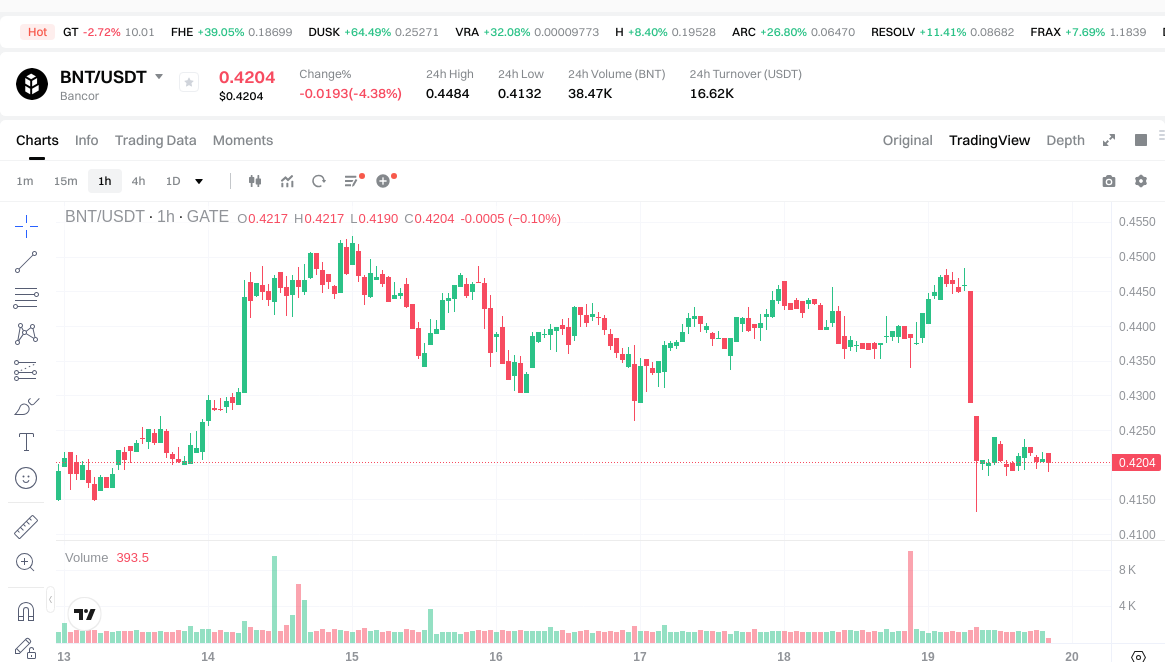
- Current BNT price: $0.4204
- Market sentiment: General indicators suggest neutral to bearish positioning
- 24-hour trading volume: $16,591.60
- Circulating supply: 109.67 million BNT (99.21% of maximum supply)
- Market capitalization: $46.10 million
- Total holders: 38,514 addresses
View real-time BNT market price
Note: Historical data indicates that BNT token performance has significantly underperformed compared to holding the original ETH raised during the ICO. The token's market value represents a considerable decline from its 2017-2018 levels, reflecting challenges in maintaining competitive positioning within the evolving DeFi landscape.
II. Core Factors Affecting Whether BNT Is a Good Investment
Supply Mechanism and Scarcity (BNT Investment Scarcity)
- Fixed supply mechanism: BNT has a maximum supply of approximately 110.54 million tokens, with a circulating supply of around 109.67 million tokens, representing a circulation ratio of 99.21%.
- Supply dynamics and investment implications: The token supply is nearly fully circulated, limiting further dilution risks. As liquidity is added to Bancor pools, demand for BNT may grow since every pool on Bancor must hold BNT tokens.
- Historical context: BNT previously traded at higher price levels, though current market conditions show a substantial decline from historical ranges.
- Investment significance: The near-complete token circulation and integral role in pool mechanics may support long-term value retention as network activity expands.
Institutional Investment and Mainstream Adoption (Institutional Investment in BNT)
- Current holder base: BNT has approximately 38,514 token holders as of January 2026, indicating a moderate level of decentralized ownership.
- Ecosystem integration: Bancor operates within the decentralized finance (DeFi) space, with BNT serving as the intermediary asset in liquidity pools and supporting governance through BancorDAO.
- Market positioning: BNT is listed on 29 exchanges, providing accessibility for both retail and institutional participants.
- Investment implications: The token's utility in facilitating cross-pool trades and governance participation may influence its adoption trajectory among DeFi participants.
Macroeconomic Environment's Impact on BNT Investment
- DeFi market conditions: The broader decentralized finance sector influences liquidity provision activity and demand for automated market maker (AMM) protocols like Bancor.
- Competitive landscape: Bancor competes with other AMM protocols in the DeFi space, where macroeconomic factors affecting risk appetite may impact liquidity provider participation.
- Market sentiment: BNT's market capitalization stands at approximately $46.10 million, representing 0.0013% market dominance, suggesting sensitivity to broader crypto market trends.
Technology and Ecosystem Development (Technology & Ecosystem for BNT Investment)
- Carbon DeFi protocol: Bancor's flagship product upgrade enables programmable, automated order strategies combining features of centralized exchanges with DeFi flexibility, introduced in 2022-2023.
- Impermanent loss protection: Bancor introduced mechanisms to compensate liquidity providers for losses over time, addressing a significant concern in DeFi participation.
- Single-sided liquidity provision: Unlike many AMMs requiring token pairs, Bancor allows users to stake single tokens alongside BNT, potentially lowering barriers to participation.
- Arb Fast Lane: Facilitates arbitrage opportunities between Bancor protocols and other on-chain exchanges, creating additional utility for ecosystem participants.
- Governance framework: BNT holders participate in protocol governance through BancorDAO, influencing protocol development direction.
- Smart contract infrastructure: Deployed on Ethereum (contract address: 0x1F573D6Fb3F13d689FF844B4cE37794d79a7FF1C), leveraging established blockchain security and interoperability.
III. BNT Future Investment Forecast and Price Outlook (Is Bancor(BNT) worth investing in 2026-2030)
Short-term Investment Forecast (2026, short-term BNT investment outlook)
- Conservative forecast: $0.23 - $0.42
- Neutral forecast: $0.42 - $0.50
- Optimistic forecast: $0.50 - $0.58
Mid-term Investment Outlook (2027-2028, mid-term Bancor(BNT) investment forecast)
- Market stage expectations: Based on available data, BNT may experience gradual price appreciation during the mid-term period, influenced by broader DeFi sector developments and protocol adoption trends.
- Investment return forecast:
- 2027: $0.37 - $0.67
- 2028: $0.45 - $0.87
- Key catalysts: Protocol enhancements, liquidity provision mechanisms, and overall decentralized finance ecosystem growth may serve as potential drivers.
Long-term Investment Outlook (Is BNT a good long-term investment?)
- Baseline scenario: $0.39 - $0.84 (assuming moderate protocol development and steady DeFi sector growth)
- Optimistic scenario: $0.60 - $1.10 (assuming enhanced adoption, technological improvements, and favorable market conditions)
- Risk scenario: Below $0.23 (considering potential market downturns or reduced protocol utility)
View BNT long-term investment and price forecast: Price Prediction
2026-01-19 - 2031 Long-term Outlook
- Baseline scenario: $0.39 - $0.84 (corresponding to steady progress and gradual mainstream application enhancement)
- Optimistic scenario: $0.60 - $1.10 (corresponding to large-scale adoption and favorable market environment)
- Transformative scenario: Above $1.10 (if ecosystem achieves breakthrough progress and mainstream adoption)
- 2031-12-31 forecast high: $1.10 (based on optimistic development assumptions)
Disclaimer: Price forecasts are subject to market volatility and multiple external factors. Historical performance does not guarantee future results. The information provided is for reference purposes only and should not be considered as investment advice.
| Year |
Predicted High Price |
Predicted Average Price |
Predicted Low Price |
Price Change |
| 2026 |
0.584356 |
0.4204 |
0.227016 |
0 |
| 2027 |
0.67318652 |
0.502378 |
0.37175972 |
19 |
| 2028 |
0.8699177448 |
0.58778226 |
0.4467145176 |
40 |
| 2029 |
0.83817750276 |
0.7288500024 |
0.393579001296 |
73 |
| 2030 |
0.9480516406218 |
0.78351375258 |
0.6816569647446 |
86 |
| 2031 |
1.099544024683143 |
0.8657826966009 |
0.597390060654621 |
106 |
IV. Bancor Investment Strategy and Risk Management (How to invest in decentralized liquidity protocols)
Investment Methodology (Bancor investment strategy)
Long-term Holding (HODL BNT): Suitable for Conservative Investors
For investors seeking exposure to decentralized finance (DeFi) liquidity infrastructure, a long-term holding strategy may align with BNT's protocol-level value proposition. The Bancor protocol's automated market maker (AMM) mechanism creates intrinsic utility for BNT tokens within its ecosystem, as they serve as reserve assets for liquidity pools.
Investors considering this approach should evaluate:
- Protocol adoption metrics and total value locked (TVL) trends
- Development activity and protocol upgrades
- Competitive positioning against alternative AMM solutions
- Token utility within the Bancor ecosystem
Active Trading: Technical Analysis and Swing Operations
BNT has demonstrated significant price volatility, with 24-hour fluctuations of -4.27% and broader movements showing -39.23% over the past year. This volatility profile may present opportunities for traders employing technical analysis:
- Support and Resistance Levels: Recent 24-hour range between $0.4132 (low) and $0.4484 (high)
- Volume Analysis: 24-hour trading volume of $16,591.60 suggests moderate liquidity for position entry/exit
- Trend Identification: 7-day performance of +1.13% and 30-day performance of +2.74% indicate short-term stabilization after the significant annual decline
Risk Management (Risk management for Bancor investment)
Asset Allocation Ratios: Conservative / Aggressive / Professional Investors
- Conservative Investors (1-3% portfolio allocation): Minimal exposure to DeFi protocols with focus on capital preservation
- Moderate Investors (3-7% portfolio allocation): Balanced approach with diversified DeFi exposure including liquidity protocols
- Aggressive Investors (7-15% portfolio allocation): Higher risk tolerance with concentrated positions in specialized DeFi infrastructure
Risk Hedging Solutions: Multi-Asset Portfolio + Hedging Instruments
Given BNT's correlation with broader crypto market movements and Ethereum ecosystem performance:
Secure Storage: Hot/Cold Wallets + Hardware Wallet Recommendations
Bancor (BNT) is an ERC-20 token on the Ethereum blockchain (contract address: 0x1F573D6Fb3F13d689FF844B4cE37794d79a7FF1C), requiring appropriate Ethereum-compatible storage:
-
Cold Storage Solutions:
- Hardware wallets (Ledger, Trezor) for long-term holdings
- Air-gapped systems for institutional-grade security
- Multi-signature wallets for enhanced protection
-
Hot Wallet Management:
- MetaMask or similar browser wallets for active trading
- Mobile wallets for moderate amounts and regular transactions
- Exchange wallets only for active trading positions (not recommended for storage)
-
Security Best Practices:
- Regular verification of contract addresses before transactions
- Enable two-factor authentication on all exchange accounts
- Maintain secure backup of seed phrases in multiple physical locations
- Regular security audits of wallet configurations
V. Bancor Investment Risks and Challenges (Risks of investing in decentralized liquidity protocols)
Market Risks: High Volatility and Price Manipulation
Bancor exhibits substantial price volatility characteristics:
- Historical Volatility: BNT has experienced significant price swings, with an all-time high of $10.72 (January 2018) and all-time low of $0.120935 (March 2020), representing a 98.87% decline from peak levels
- Current Price Position: Trading at $0.4204, BNT remains approximately 96.08% below its historical peak
- 24-hour Volatility: Recent price fluctuation of -4.27% demonstrates continued volatility in shorter timeframes
- Liquidity Considerations: With a market capitalization of approximately $46.10 million and ranking #551, BNT represents a mid-to-lower cap asset with potential liquidity constraints during stress periods
- Market Depth: 24-hour trading volume of $16,591.60 suggests limited market depth, which may amplify price movements and slippage for larger orders
Regulatory Risks: Policy Uncertainty Across Jurisdictions
As a decentralized finance protocol, Bancor faces evolving regulatory landscapes:
- DeFi Regulatory Framework: Increasing scrutiny of automated market makers and liquidity protocols by financial regulators globally
- Token Classification Uncertainty: Ongoing debates regarding whether protocol tokens constitute securities, utilities, or other asset classes
- Compliance Requirements: Potential implementation of Know Your Customer (KYC) and Anti-Money Laundering (AML) requirements that could impact protocol accessibility
- Cross-border Regulatory Divergence: Varying approaches to DeFi regulation across jurisdictions may fragment user bases and liquidity
- Smart Contract Regulation: Emerging frameworks for governing autonomous smart contract systems and their legal implications
Technical Risks: Network Security Vulnerabilities and Upgrade Failures
-
Smart Contract Risks: As an Ethereum-based protocol utilizing complex smart contracts for automated market making, Bancor inherits inherent smart contract vulnerabilities including:
- Coding errors or logical flaws
- Reentrancy attacks
- Oracle manipulation risks
- Composability risks from interactions with other protocols
-
Protocol Upgrade Challenges: Evolution of the Bancor protocol through various versions carries implementation risks, including:
- Migration complications during protocol upgrades
- Backward compatibility issues
- Governance decision risks
- Community consensus challenges
-
Ethereum Network Dependencies: BNT's functionality depends on Ethereum network performance:
- Network congestion affecting transaction speeds
- Gas fee volatility impacting user economics
- Ethereum network upgrade risks
- Competition from alternative Layer 1 blockchains
-
Competitive Technical Risks: Rapid innovation in DeFi AMM designs may render Bancor's approach less competitive:
- Emergence of capital-efficient alternatives
- Concentrated liquidity models (Uniswap V3)
- Cross-chain liquidity solutions
- Aggregator platforms optimizing routing
VI. Conclusion: Is Decentralized Liquidity Protocol Investment a Good Opportunity?
Investment Value Summary
Bancor (BNT) represents a pioneering approach to decentralized liquidity provision through its automated market maker protocol. The token has demonstrated resilience since its 2017 launch, maintaining operational continuity despite significant market volatility. However, the substantial decline from historical peaks (-96.08% from all-time high) and modest market capitalization ($46.10 million) reflect the challenges faced by early DeFi protocols in an increasingly competitive landscape.
The protocol's fundamental innovation—asynchronous price discovery through constant reserve ratios—offers theoretical advantages over traditional order book models. However, investors should weigh this technological differentiation against evolving AMM designs and the project's current market position (ranking #551).
Investor Recommendations
✅ Beginners:
- Strategy: Dollar-cost averaging (DCA) approach to build positions gradually
- Storage: Prioritize hardware wallet storage for security (Ledger/Trezor supporting ERC-20 tokens)
- Allocation: Limit exposure to 1-2% of overall portfolio
- Education: Understand DeFi mechanics and Bancor protocol functionality before investing
- Verification: Always confirm contract address (0x1F573D6Fb3F13d689FF844B4cE37794d79a7FF1C) before transactions
✅ Experienced Investors:
- Strategy: Swing trading opportunities leveraging technical analysis and volatility patterns
- Portfolio Construction: Include BNT as part of diversified DeFi exposure (5-10% DeFi allocation)
- Risk Management: Implement stop-loss mechanisms and rebalancing protocols
- Market Timing: Monitor 24-hour price ranges and volume patterns for entry/exit optimization
- Competitive Analysis: Track developments in competing AMM protocols
✅ Institutional Investors:
- Strategy: Strategic long-term allocation within DeFi infrastructure thesis
- Due Diligence: Comprehensive smart contract audits and protocol security assessments
- Custody Solutions: Enterprise-grade multi-signature wallets and institutional custody services
- Compliance Framework: Establish regulatory compliance protocols for DeFi token holdings
- Liquidity Planning: Account for limited market depth when sizing positions
⚠️ Disclaimer: Cryptocurrency investments carry substantial risks including complete capital loss. This analysis provides informational content only and does not constitute financial advice, investment recommendations, or solicitation to buy or sell securities. Investors should conduct independent research, consult qualified financial advisors, and consider their risk tolerance and financial circumstances before making investment decisions. Past performance does not indicate future results.
VII. FAQ
Q1: What is Bancor (BNT) and how does it differ from other decentralized exchanges?
Bancor (BNT) is an automated market maker (AMM) protocol that enables decentralized liquidity provision through its unique token-based model. Unlike traditional exchanges requiring matched buy-sell orders, Bancor utilizes BNT as an intermediary reserve asset in all liquidity pools, facilitating cross-pool trades through constant reserve ratios. The protocol distinguishes itself through single-sided liquidity provision (users can stake individual tokens alongside BNT rather than requiring token pairs) and impermanent loss protection mechanisms that compensate liquidity providers over time—features not commonly found in competing AMM protocols like Uniswap or SushiSwap.
Q2: Is Bancor (BNT) a good investment for beginners in 2026?
For beginners, BNT represents a higher-risk investment requiring careful consideration. The token has declined approximately 96% from its all-time high of $10.72, currently trading around $0.42 with a modest market capitalization of $46 million. Beginners should limit exposure to 1-2% of overall portfolio, utilize dollar-cost averaging to build positions gradually, and prioritize secure storage through hardware wallets supporting ERC-20 tokens. Understanding DeFi mechanics and Bancor's protocol functionality is essential before investing. The token's volatility (-39.23% annual performance) and competitive DeFi landscape create both opportunities and risks that beginners must carefully evaluate.
Q3: What are the main risks associated with investing in Bancor (BNT)?
Bancor investment carries three primary risk categories: (1) Market risks including extreme volatility (98.87% peak-to-trough decline), limited liquidity with $16,591 daily trading volume, and potential price manipulation due to modest market depth; (2) Regulatory risks from evolving DeFi frameworks, uncertain token classification, and potential KYC/AML requirements that could impact protocol accessibility; (3) Technical risks involving smart contract vulnerabilities, Ethereum network dependencies (congestion and gas fees), protocol upgrade complications, and competitive pressures from capital-efficient alternatives like concentrated liquidity models. Investors should implement robust risk management including diversification, position sizing, and secure storage practices.
Q4: What is the price forecast for Bancor (BNT) from 2026 to 2030?
Price forecasts suggest gradual appreciation scenarios: 2026 conservative range $0.23-$0.42, neutral $0.42-$0.50, optimistic $0.50-$0.58; 2027 projected $0.37-$0.67 (19% average increase); 2028 forecasted $0.45-$0.87 (40% average growth); 2029 estimated $0.39-$0.84 (73% average rise); 2030 predicted $0.68-$0.95 (86% average increase). The optimistic long-term scenario suggests potential reaching $1.10 by 2031, assuming enhanced adoption, technological improvements, and favorable market conditions. However, these projections carry significant uncertainty due to market volatility, competitive dynamics, and regulatory developments. Historical performance shows substantial underperformance (ICO raised $150M in ETH now worth $1.1B, while BNT market cap declined to $70M), indicating forecasts should be viewed cautiously.
Q5: How should investors store Bancor (BNT) tokens securely?
Bancor (BNT) is an ERC-20 token requiring Ethereum-compatible storage solutions. For long-term holdings: hardware wallets (Ledger, Trezor) provide optimal security through cold storage, supplemented by multi-signature configurations for institutional amounts. For active trading: browser wallets like MetaMask or mobile wallets offer convenience for moderate amounts and regular transactions. Critical security practices include verifying the correct contract address (0x1F573D6Fb3F13d689FF844B4cE37794d79a7FF1C) before transactions, enabling two-factor authentication on exchange accounts, maintaining secure physical backups of seed phrases in multiple locations, and avoiding prolonged storage on exchange wallets. Air-gapped systems provide institutional-grade security for substantial holdings.
Q6: What role does BNT play in the Bancor ecosystem and why is it necessary?
BNT serves three critical functions within the Bancor protocol ecosystem: (1) Reserve Asset: Every liquidity pool on Bancor must hold BNT tokens, making it the intermediary asset for all cross-pool trades and establishing inherent demand correlation with protocol usage; (2) Governance Token: BNT holders participate in BancorDAO governance, influencing protocol development direction, parameter adjustments, and strategic decisions; (3) Network Liquidity: The token facilitates automated market-making through constant reserve ratios, enabling asynchronous price discovery without traditional order books. With 99.21% of maximum supply already circulating (109.67M of 110.54M tokens), the near-complete distribution limits further dilution risks while creating scarcity dynamics as network activity expands.
Q7: How does Bancor's Carbon DeFi protocol enhance investment value?
Carbon DeFi represents Bancor's flagship protocol upgrade combining centralized exchange features with DeFi flexibility through programmable, automated order strategies. The system enables liquidity providers to set custom price ranges and automated rebalancing parameters, addressing capital efficiency concerns that plague traditional constant-product AMMs. Key features include the Arb Fast Lane facilitating arbitrage opportunities between Bancor and other on-chain exchanges, creating additional revenue streams for ecosystem participants. However, despite these technological innovations, market reception has been moderate—reflected in BNT's current market position (#551 ranking) and price performance. Investors should evaluate whether protocol enhancements can translate into increased adoption and token value appreciation against competing solutions offering similar capital efficiency improvements.
Q8: What investment allocation is appropriate for Bancor (BNT) in different investor profiles?
Portfolio allocation should align with risk tolerance and investment objectives: Conservative investors (1-3% allocation) seeking minimal DeFi exposure with capital preservation focus; Moderate investors (3-7% allocation) pursuing balanced approach with diversified DeFi holdings including liquidity protocols; Aggressive investors (7-15% allocation) accepting higher risk for concentrated positions in specialized DeFi infrastructure. Given BNT's volatility characteristics (-39.23% annual performance), modest market capitalization ($46M), and competitive pressures, even aggressive allocations should remain within broader cryptocurrency portfolio risk parameters. Institutional investors require comprehensive due diligence including smart contract audits, regulatory compliance frameworks, and liquidity planning accounting for limited market depth before establishing strategic positions.
* The information is not intended to be and does not constitute financial advice or any other recommendation of any sort offered or endorsed by Gate.