# Is Brokoli (BRKL) a Good Investment? - Article Overview
**Comprehensive Investment Analysis of BRKL Token**
This article evaluates whether Brokoli (BRKL) represents a viable investment opportunity by examining its market fundamentals, price performance, and risk factors. As of January 2026, BRKL trades at $0.002744 with a market cap of $146,728.87, having declined 99.85% from its 2021 all-time high. The analysis addresses key investor concerns: identifying BRKL's green DeFi positioning and Impact-to-Earn mechanism, evaluating price volatility and liquidity constraints, assessing governance structure and ecosystem potential, and determining appropriate portfolio allocation strategies. The article provides segmented guidance for beginner, experienced, and institutional investors while presenting price forecasts through 2031 and comprehensive risk assessments. Ideal for cryptocurrency investors seeking detailed BRKL fundamentals, risk evaluation, and market positioning analysis on Gate.
Introduction: Brokoli (BRKL) Investment Position and Market Prospects
Brokoli is an emerging asset in the cryptocurrency sector, launched in October 2021. Since its inception, it has positioned itself as a pioneering platform within the environmental impact and green DeFi space. As of January 2026, BRKL maintains a market capitalization of approximately $343,000 with a circulating supply of around 53.47 million tokens. The current price stands at $0.002744, reflecting significant market volatility from its all-time high of $1.83 in December 2021.
As a green DeFi protocol governed by a decentralized autonomous organization (DAO) model, Brokoli distinguishes itself through its "Impact-to-Earn" mechanism, which integrates environmental sustainability with decentralized finance. The platform enables users to conduct transactions—including token exchange, lending, and liquidity mining—while generating positive environmental impact at no additional cost. Through its NFT Digital Forest feature and API integration capabilities, Brokoli offers a decentralized alternative to traditional carbon offset mechanisms, allowing token holders complete governance authority over climate impact fund allocation.
With 627 active holders and deployment across multiple blockchain networks including Ethereum and Binance Smart Chain, BRKL has attracted attention as investors increasingly explore "Is Brokoli (BRKL) a good investment?" This comprehensive analysis examines BRKL's investment fundamentals, historical performance trajectories, prospective price dynamics, and associated investment risks to provide stakeholders with informed perspectives on this environmental-focused digital asset.
Brokoli (BRKL) Cryptocurrency Research Report
I. Price History Review and Current Investment Status
- 2021: Environmental blockchain theme boom → BRKL reached all-time high of $1.83
- 2025: Market consolidation period → Price declined significantly from peak levels
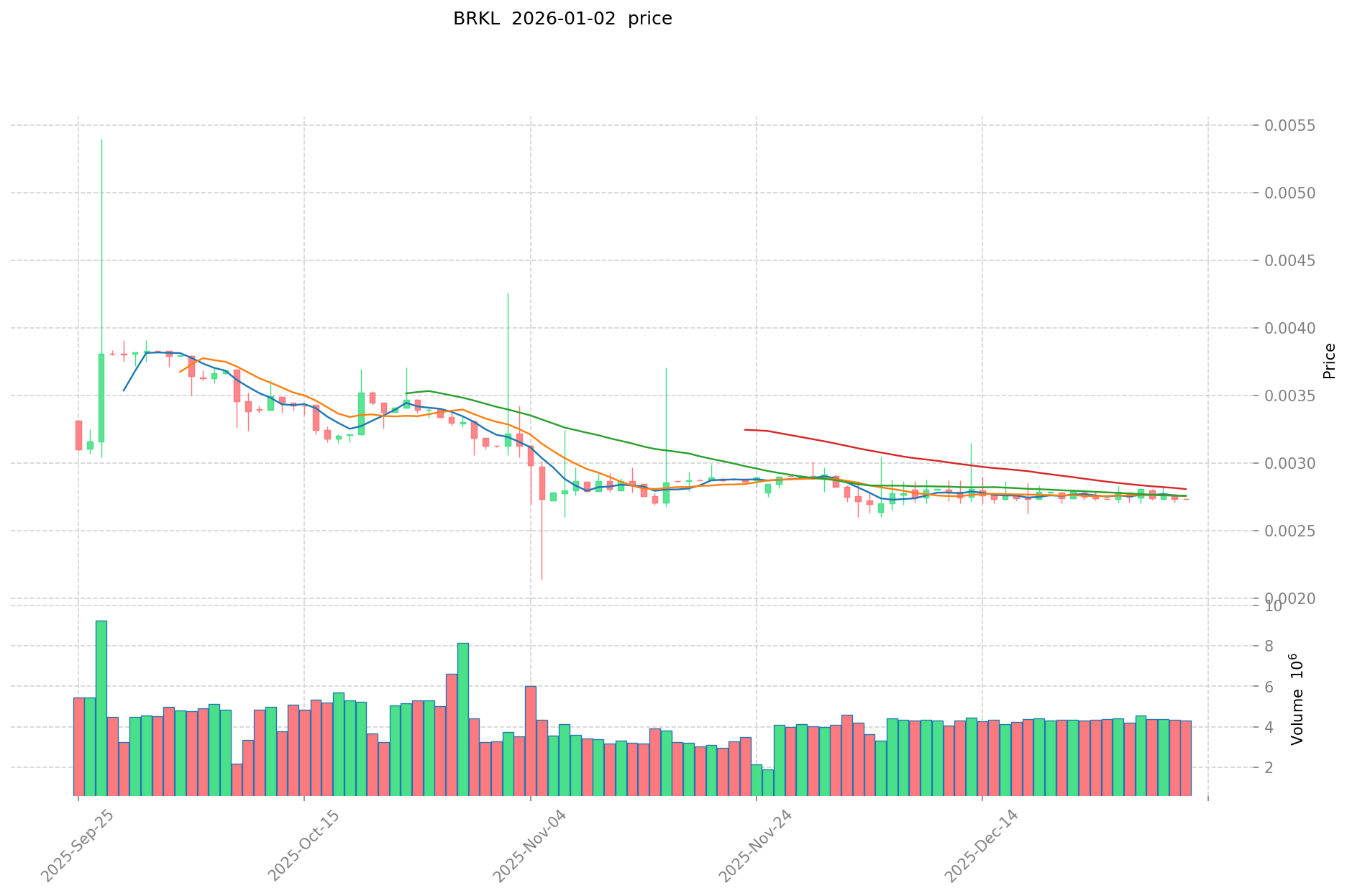
- Current period (as of January 2, 2026): Extended downtrend from 2021 peak to current levels
Current BRKL Market Status (January 2026)
- Current Price: $0.002744 USD
- Market Sentiment: Neutral (Market emotion score: 1)
- 24-Hour Trading Volume: $12,216.44
- Market Capitalization: $146,728.87
- Fully Diluted Valuation: $343,000.00
- Price Movement (Last 24 Hours): +0.03%
- Price Movement (1 Year): -38.56%
For real-time BRKL market prices, visit: https://www.gate.com/price/brokoli-brkl
Key Price Metrics
| Metric |
Value |
| All-Time High |
$1.83 (December 1, 2021) |
| All-Time Low |
$0.00261979 (December 3, 2025) |
| 24H High |
$0.002872 |
| 24H Low |
$0.002699 |
| Market Dominance |
0.000010% |
| Circulating Supply |
53,472,622 BRKL |
| Total Supply |
125,000,000 BRKL |
| Circulation Ratio |
42.78% |
II. Project Overview and Core Functionality
Project Introduction
Brokoli is a decentralized platform designed to enable users to focus on climate action and environmental impact through blockchain technology. The platform operates on an Impact-to-Earn model, where each DeFi functionality is engineered to generate positive environmental impact without imposing additional costs on users.
I. Green DeFi Aggregator
- Token exchange functionality
- Lending services
- Liquidity mining operations
- All transactions designed to have positive environmental impact at no additional user cost
II. API Integration Layer
- Allows any GameFi and DeFi platforms to integrate Brokoli's API
- Enables users to offset carbon footprints of their transactions through voluntary fee contributions
- Provides interoperability across multiple blockchain ecosystems
III. NFT Digital Forest Ecosystem
- Users accumulate seeds through Brokoli green product usage or task completion
- Seeds can be transformed into NFT trees following DAO governance voting
- Digital NFT forest functions as impact points (Brokoli's influence scoring system)
- Impact points are tradeable between users seeking to accumulate environmental credits
- Enterprise customers can acquire impact points for corporate social responsibility goals
- Functions as a decentralized alternative to traditional carbon credit systems
Governance Structure
Brokoli protocol operates under a Decentralized Autonomous Organization (DAO) model governed by BRKL token holders, with the following characteristics:
- Core Token: BRKL token serves as the governance mechanism
- Fund Control: 100% control over climate impact offset fund allocation by token holders
- Project Selection: DAO mechanism selects globally-distributed projects in three categories:
- Tree planting initiatives
- Renewable energy projects
- Electronic waste management programs
- Fund Distribution: Selected projects receive funding based on DAO voting outcomes
III. Blockchain Network Presence
Brokoli token operates across multiple blockchain networks:
| Network |
Contract Address |
Explorer |
| Ethereum (ETH) |
0x4674a4F24C5f63D53F22490Fb3A08eAAAD739ff8 |
Etherscan |
| Binance Smart Chain (BSC) |
0x66cafcf6c32315623c7ffd3f2ff690aa36ebed38 |
BSCscan |
IV. Community and Resources
V. Market Analysis Summary
Concentration and Liquidity Profile
With only 627 token holders and a 24-hour trading volume of approximately $12,216, BRKL exhibits characteristics of a low-liquidity asset with concentrated ownership. The token's market capitalization of $146,728.87 and fully diluted valuation of $343,000 indicate a relatively small market presence within the broader cryptocurrency ecosystem.
Performance Context
The -38.56% return over the past year, combined with the significant decline from the 2021 all-time high of $1.83 to the current price of $0.002744, reflects the broader market pressures facing environmental and sustainability-focused blockchain projects. The token's recent all-time low of $0.00261979 (December 3, 2025) suggests ongoing market challenges.
Report generated: January 2, 2026
Brokoli (BRKL) Cryptocurrency Research Report
Report Date: January 2, 2026
I. Executive Summary
Brokoli (BRKL) is an environmental-focused decentralized platform that enables users to contribute to climate action through green DeFi products. As of January 2, 2026, BRKL is trading at $0.002744 USD with a market capitalization of $146,728.87 USD, ranking #4474 among cryptocurrencies. The token demonstrates significant volatility and has experienced substantial price decline over the past year.
II. Core Factors Influencing BRKL Investment Considerations
Token Supply Mechanism and Scarcity
Supply Structure:
- Total Supply: 125,000,000 BRKL
- Circulating Supply: 53,472,622 BRKL (42.78% of total supply)
- Fully Diluted Valuation: $343,000 USD
The token maintains a substantial portion of total supply in circulation. With approximately 57% of tokens not yet in circulation, future supply increases could influence price dynamics. The token holder base comprises 627 addresses, indicating concentrated ownership patterns typical of early-stage projects.
Recent Price Trends:
- 1-Hour Change: -0.23%
- 24-Hour Change: +0.03%
- 7-Day Change: -1.93%
- 30-Day Change: +2.27%
- 1-Year Change: -38.56%
Historical Price Range:
- All-Time High: $1.83 USD (December 1, 2021)
- All-Time Low: $0.00261979 USD (December 3, 2025)
- Current Price Decline from ATH: 99.85%
The asset exhibits substantial volatility with a 24-hour trading volume of $12,216.44 USD against a market cap of $146,728.87 USD, resulting in a volume-to-market-cap ratio indicating limited liquidity depth.
Core Platform Components:
-
Green DeFi Aggregator
- Token exchange functionality
- Lending services
- Liquidity mining operations
- Environmental impact measurement integrated into all transactions
-
API Integration Layer
- GameFi and DeFi platform integration capability
- Carbon offset contribution mechanisms
- Cross-platform environmental impact tracking
-
NFT Digital Forest System
- Seed acquisition through green product usage or task completion
- DAO voting mechanism for seed-to-NFT conversion
- Digital forest tradeable as impact credits
- Decentralized carbon credit alternative mechanism
Governance and Tokenomics
Governance Model:
- Decentralized Autonomous Organization (DAO) structure
- BRKL token holders exercise 100% control over climate impact offset fund allocation
- Global project selection spanning reforestation, renewable energy, and e-waste initiatives
Token Distribution and Mechanics:
- Tokens acquire and trade positive environmental impact from green DeFi product usage
- No additional user fees applied for environmental impact generation
- Impact points tradeable between users or with corporate social responsibility-focused enterprises
Market Position and Adoption Metrics
Exchange Presence:
- Available on multiple blockchain networks:
- Ethereum (ETH): Contract address 0x4674a4F24C5f63D53F22490Fb3A08eAAAD739ff8
- Binance Smart Chain (BSC): Contract address 0x66cafcf6c32315623c7ffd3f2ff690aa36ebed38
Market Metrics:
- Market Dominance: 0.000010%
- Circulating-to-Fully Diluted Valuation Ratio: 42.78%
- Market Cap: $146,728.87 USD
- Initial Publication Price: $0.19 USD (September 2021)
III. Risk Assessment
Liquidity Considerations:
The relatively low 24-hour trading volume ($12,216.44 USD) against total market capitalization indicates potential liquidity constraints for larger position entries or exits.
Historical Performance:
The 38.56% year-over-year price decline and 99.85% decline from all-time high reflect substantial investor losses during the token's operational history.
Market Capitalization:
At $146,728.87 USD, BRKL maintains an extremely small market capitalization within the cryptocurrency ecosystem, suggesting early-stage or niche market positioning with corresponding volatility characteristics.
IV. Project Resources
Official Channels:
Disclaimer: This report presents factual data and project information derived from available sources. Analysis does not constitute investment advice. Cryptocurrency investments carry substantial risk, and past performance does not indicate future results.
III. BRKL Future Investment Predictions and Price Outlook (Is Brokoli(BRKL) worth investing in 2026-2031)
Short-term Investment Prediction (2026, short-term BRKL investment outlook)
- Conservative forecast: $0.00230 - $0.00275
- Neutral forecast: $0.00275 - $0.00379
- Optimistic forecast: $0.00379 - $0.00420
Mid-term Investment Outlook (2027-2029, mid-term Brokoli(BRKL) investment forecast)
-
Market phase expectation: Brokoli is establishing itself as a climate-focused decentralized finance platform with growing ecosystem adoption and DAO governance maturation, positioning itself within the emerging ESG-conscious blockchain sector.
-
Investment return projections:
- 2027: $0.00300 - $0.00402 (19% potential appreciation)
- 2028: $0.00251 - $0.00484 (32% potential appreciation)
- 2029: $0.00331 - $0.00619 (54% potential appreciation)
-
Key catalysts: Expansion of API integrations across GameFi and DeFi platforms; scaling of the NFT Digital Forest mechanism; increased enterprise adoption of carbon offset solutions; DAO governance participation growth; strategic partnerships within the ESG ecosystem.
Long-term Investment Outlook (Is Brokoli a good long-term investment?)
-
Base case scenario: $0.00397 - $0.00520 (2030 projection, assuming steady ecosystem growth and moderate market adoption)
-
Optimistic scenario: $0.00521 - $0.00720 (2030-2031 projection, assuming significant mainstream adoption of green DeFi products, expanded API ecosystem integration, and increased institutional interest in climate-focused digital assets)
-
Risk scenario: $0.00230 - $0.00350 (2030 projection, reflecting potential challenges in market adoption, regulatory headwinds for environmental impact claims, or competitive pressures from established ESG platforms)
For BRKL long-term investment and price forecasts, visit: Price Prediction
2026-01-02 to 2031 Long-term Outlook
-
Base case: $0.00350 - $0.00625 USD (corresponding to steady ecosystem development and gradual mainstream adoption of climate-focused DeFi solutions)
-
Optimistic case: $0.00625 - $0.00857 USD (corresponding to large-scale adoption and favorable market conditions for ESG-integrated blockchain platforms)
-
Transformative case: $0.00857 USD and above (contingent on breakthrough ecosystem developments and mainstream integration of climate-positive financial mechanisms)
-
2031-12-31 forecast high: $0.00857 USD (based on optimistic development assumptions)
Disclaimer: This analysis is based on historical data and market trends. It does not constitute investment advice. Cryptocurrency markets are highly volatile and subject to regulatory changes, technological developments, and macroeconomic factors. Investors should conduct their own due diligence and consult with financial advisors before making investment decisions. Past performance does not guarantee future results.
| 年份 |
预测最高价 |
预测平均价格 |
预测最低价 |
涨跌幅 |
| 2026 |
0.00378672 |
0.002744 |
0.00230496 |
0 |
| 2027 |
0.0040163928 |
0.00326536 |
0.0030041312 |
19 |
| 2028 |
0.004842365612 |
0.0036408764 |
0.002512204716 |
32 |
| 2029 |
0.00619276666876 |
0.004241621006 |
0.00330846438468 |
54 |
| 2030 |
0.007199727495584 |
0.00521719383738 |
0.003965067316408 |
90 |
| 2031 |
0.008567675719745 |
0.006208460666482 |
0.00347673797323 |
126 |
Brokoli (BRKL) Research Report
I. Project Overview
Project Name: Brokoli
Token Symbol: BRKL
Blockchain Networks: Ethereum (ETH), Binance Smart Chain (BSC)
Current Price: $0.002744 (as of January 2, 2026)
Market Capitalization: $146,728.87
Fully Diluted Valuation: $343,000.00
Circulating Supply: 53,472,622 BRKL
Total Supply: 125,000,000 BRKL
Token Holders: 627
Market Ranking: 4,474
Project Description
Brokoli is an Impact-to-Earn platform designed to enable users to focus on climate action and environmental preservation. The protocol operates on the principle that every DeFi transaction can generate positive environmental impact without imposing additional costs on users.
The platform's core functions include:
- Green DeFi Aggregator: Provides token exchange, lending, and liquidity mining services with built-in environmental impact mechanisms.
- API Integration: GameFi and DeFi platforms can integrate Brokoli's API to allow users to offset the carbon footprint of their transactions.
- NFT Digital Forest: Users earn seeds through engagement with Brokoli's green products or task completion. These seeds can be voted by the DAO to grow into NFT trees, functioning as decentralized carbon credits and corporate social responsibility trading instruments.
- DAO Governance: The protocol is governed by a decentralized autonomous organization model, with BRKL token holders maintaining 100% control over climate impact offset fund allocation. The mechanism selects and funds global tree-planting, renewable energy, and e-waste projects.
Price Dynamics
| Time Period |
Change (%) |
Change (Amount) |
| 1 Hour |
-0.23% |
-$0.000006 |
| 24 Hours |
+0.03% |
+$0.000001 |
| 7 Days |
-1.93% |
-$0.000054 |
| 30 Days |
+2.27% |
+$0.000061 |
| 1 Year |
-38.56% |
-$0.001722 |
24-Hour High: $0.002872
24-Hour Low: $0.002699
All-Time High: $1.83 (December 1, 2021)
All-Time Low: $0.00261979 (December 3, 2025)
Trading Activity
- 24-Hour Trading Volume: $12,216.44
- Market Dominance: 0.000010%
- Market Cap to FDV Ratio: 42.78%
III. Key Observations
The token has experienced significant depreciation from its all-time high of $1.83, representing a 99.85% decline. Current price levels approach the all-time low, suggesting the asset is trading near historical bottom valuations.
With a market cap of only $146,728.87 and limited trading volume, BRKL demonstrates characteristics typical of micro-cap tokens with potentially low liquidity.
The project's focus on environmental impact and decentralized governance through DAO mechanisms aligns with broader sustainability trends in the cryptocurrency sector.
Token distribution shows relatively concentrated holder base with only 627 addresses, which may indicate moderate adoption or potential centralization risks.
IV. Investment Strategy and Risk Management
Investment Methodology
Long-Term Holding (HODL BRKL):
Suitable for investors aligned with the project's environmental impact mission and willing to tolerate extended recovery periods from current depressed valuation levels.
Active Trading:
Dependent on technical analysis and price recovery patterns; requires careful entry and exit timing given the micro-cap nature and limited trading volume.
Risk Management
Asset Allocation Proportions:
- Conservative Investors: Allocation should not exceed 0.1-0.5% of total portfolio due to extreme volatility and micro-cap status
- Aggressive Investors: May allocate 1-2% in speculative positioning
- Institutional Investors: Typically avoid micro-cap tokens with limited liquidity
Risk Hedging Solutions:
- Multi-asset diversification with established cryptocurrencies and traditional assets
- Position sizing to limit downside exposure
- Avoid concentrated positions given the token's illiquidity
Secure Storage:
- Hot wallets: Use for active trading on recognized exchanges only
- Cold Storage: Hardware wallets (Ledger, Trezor) recommended for medium to long-term holdings
- Multi-signature wallet solutions for institutional holdings
V. Investment Risks and Challenges
Market Risks
- Extreme Volatility: BRKL has experienced price swings exceeding 99%, creating significant liquidation risk for leveraged positions
- Micro-Cap Illiquidity: Low trading volume ($12,216 daily) may prevent efficient exit execution at desired price levels
- Price Discovery: Limited price history post-all-time high makes valuation assessment challenging
Regulatory Risks
- Uncertain Policy Environment: Changing global cryptocurrency regulations and carbon credit regulations may impact project viability
- Environmental Claims Verification: Regulatory bodies may impose stricter requirements for verifying environmental impact claims
- DAO Governance Scrutiny: Regulatory classification of DAO governance mechanisms remains evolving across jurisdictions
Technical Risks
- Smart Contract Security: Any vulnerabilities in the platform's DeFi protocols could result in fund loss
- Network Expansion: Integration with GameFi and DeFi platforms depends on adoption success and technical compatibility
- Cross-Chain Operations: Maintaining consistent functionality across Ethereum and BSC networks introduces operational complexity
VI. Conclusion: Is BRKL a Good Investment?
Investment Value Summary
Brokoli presents a unique proposition focused on environmental impact through decentralized mechanisms, operating at valuations significantly below historical highs. However, the project faces substantial challenges including micro-cap liquidity constraints, unproven market adoption, and extreme historical volatility.
The token's current price proximity to all-time lows may indicate either a recovery opportunity or validation of fundamental value concerns, requiring careful due diligence.
Investor Recommendations
✅ Beginners:
If pursuing this investment, implement dollar-cost averaging over extended periods with position sizes not exceeding 0.1% of portfolio. Utilize hardware wallet storage exclusively.
✅ Experienced Investors:
Technical analysis-based entry points near support levels with pre-defined exit strategies. Implement stop-loss orders at 15-20% below entry price given volatility. Combine with higher-conviction holdings.
✅ Institutional Investors:
Generally avoid due to liquidity constraints. If acquiring, implement over extended periods to minimize market impact and establish positions only after direct platform evaluation.
⚠️ Disclaimer: Cryptocurrency investments carry substantial risk, including potential total capital loss. This analysis is provided for informational purposes only and does not constitute investment advice, financial recommendation, or an offer to buy or sell securities. Conduct independent research and consult qualified financial advisors before making investment decisions. Past performance does not guarantee future results.
Brokoli (BRKL) Cryptocurrency Research Report - FAQ
I. FAQ
Q1: What is Brokoli (BRKL) and how does its Impact-to-Earn model work?
A: Brokoli is an environmental-focused decentralized platform launched in October 2021 that operates as a green DeFi protocol governed by a decentralized autonomous organization (DAO). Its Impact-to-Earn model enables users to participate in DeFi transactions—including token exchange, lending, and liquidity mining—while simultaneously generating positive environmental impact at no additional cost. The platform integrates environmental sustainability directly into blockchain transactions, distinguishing itself through mechanisms like its NFT Digital Forest ecosystem and API integration capabilities that allow other GameFi and DeFi platforms to enable carbon offset contributions from their users.
Q2: What are the current market metrics and price performance of BRKL as of January 2026?
A: As of January 2, 2026, BRKL is trading at $0.002744 USD with a market capitalization of $146,728.87 USD and a fully diluted valuation of $343,000. The token shows a circulating supply of 53,472,622 BRKL out of a total supply of 125,000,000 BRKL (42.78% circulation ratio). Price performance indicates a 24-hour change of +0.03%, a 1-year change of -38.56%, and a 99.85% decline from its all-time high of $1.83 (December 1, 2021). The 24-hour trading volume stands at $12,216.44, indicating limited liquidity. The token maintains only 627 active holders and ranks #4,474 in the cryptocurrency market.
Q3: What are the key risks associated with investing in BRKL?
A: BRKL presents several significant risks including extreme volatility (historical price swings exceeding 99%), severe illiquidity with only $12,216 daily trading volume against a $146,728 market cap, and micro-cap characteristics typical of early-stage projects. Additional risks encompass regulatory uncertainty regarding cryptocurrency and carbon credit frameworks, unproven market adoption of the Impact-to-Earn mechanism, potential smart contract vulnerabilities in DeFi protocols, technical challenges in cross-chain operations between Ethereum and Binance Smart Chain networks, and concentrated token holder base (627 addresses) suggesting centralization risks. The token's proximity to all-time lows raises questions about fundamental valuation sustainability.
Q4: What price predictions exist for BRKL through 2031?
A: Price forecasts vary by scenario through 2031. Short-term 2026 predictions range from $0.00230 (conservative) to $0.00420 (optimistic). Mid-term projections for 2027-2029 anticipate ranges of $0.00300-$0.00402, $0.00251-$0.00484, and $0.00331-$0.00619 respectively. Long-term outlooks to 2031 include base case scenarios of $0.00350-$0.00625, optimistic scenarios of $0.00625-$0.00857, and transformative scenarios exceeding $0.00857. These projections depend on factors including ecosystem adoption expansion, API integration growth across platforms, increased enterprise carbon offset adoption, DAO governance maturation, and broader market sentiment toward ESG-focused blockchain solutions.
Q5: How does BRKL governance and token allocation operate?
A: BRKL operates under a decentralized autonomous organization (DAO) governance model where token holders maintain 100% control over climate impact offset fund allocation. The DAO mechanism selects global environmental projects across three categories: tree-planting initiatives, renewable energy projects, and electronic waste management programs. Token holders vote on fund distribution to selected projects. Additionally, the platform's NFT Digital Forest ecosystem allows users to accumulate seeds through engagement with Brokoli green products or task completion, which can then be voted by the DAO to convert into NFT trees functioning as tradeable impact points. Enterprise customers and individuals seeking environmental credits can acquire these impact points, creating a decentralized alternative to traditional carbon credit systems.
Q6: On which blockchain networks is BRKL deployed and how can users access it?
A: BRKL token is deployed across two major blockchain networks: Ethereum (ETH) with contract address 0x4674a4F24C5f63D53F22490Fb3A08eAAAD739ff8, and Binance Smart Chain (BSC) with contract address 0x66cafcf6c32315623c7ffd3f2ff690aa36ebed38. Users can access and trade BRKL on cryptocurrency exchanges including Gate. The token can be verified on Etherscan for Ethereum transactions and BSCscan for Binance Smart Chain transactions. The multi-chain deployment enables interoperability across blockchain ecosystems and provides users with flexibility in transaction execution across different network environments.
Q7: What investment recommendations exist for different investor categories?
A: For beginners, BRKL presents extreme risk requiring position sizes not exceeding 0.1% of total portfolio, with emphasis on dollar-cost averaging over extended periods and mandatory hardware wallet storage. Experienced investors may employ technical analysis-based entry strategies near support levels with pre-defined exit plans and stop-loss orders set 15-20% below entry prices, combined with higher-conviction holdings to manage risk. Institutional investors generally should avoid BRKL due to severe liquidity constraints ($12,216 daily volume) preventing efficient large-position execution, though limited acquisition over extended periods following direct platform evaluation remains theoretically possible. Conservative investors overall should maintain allocation below 0.5% of portfolio; aggressive investors may allocate 1-2% in speculative positioning.
Q8: What ecosystem components and API capabilities does Brokoli offer to other platforms?
A: Brokoli provides three core ecosystem components accessible to external platforms. The Green DeFi Aggregator offers token exchange, lending services, and liquidity mining operations with integrated environmental impact mechanisms. The API Integration Layer enables any GameFi and DeFi platform to integrate Brokoli's infrastructure, allowing their users to offset transaction carbon footprints through voluntary fee contributions with decentralized impact tracking. The NFT Digital Forest ecosystem functions as a tradeable environmental credit system where accumulated impact points represent verified environmental contributions. These components collectively provide a decentralized alternative to traditional carbon offset mechanisms, enabling enterprises to achieve corporate social responsibility objectives while end-users maintain complete governance authority over climate impact fund allocation through DAO voting mechanisms.
Disclaimer: This analysis is provided for informational purposes only and does not constitute investment advice, financial recommendation, or an offer to buy or sell securities. Cryptocurrency investments carry substantial risk, including potential total capital loss. Conduct independent research and consult qualified financial advisors before making investment decisions. Past performance does not guarantee future results. Avoid subjective, politically-motivated, or speculative investment recommendations.
* The information is not intended to be and does not constitute financial advice or any other recommendation of any sort offered or endorsed by Gate.