This comprehensive analysis examines whether Civic (CVC) represents a viable investment opportunity in the decentralized identity verification sector. The article evaluates CVC's current market position with a $35.34 million market cap and $0.04407 price point as of January 2026, while reviewing its historical performance including a 70.47% year-over-year decline. Core investment factors include the token's supply mechanism, ecosystem development on Ethereum, institutional adoption across 61,653 holders, and listing on 30 exchanges including Gate. The analysis provides detailed price forecasts ranging from conservative to optimistic scenarios through 2031, with 2026 projections between $0.0405-$0.0502. Strategic recommendations address portfolio allocation methods, risk management approaches, and both long-term holding and active trading strategies suitable for varying investor profiles. Critical risk considerations encompass market volatility, evolving regulatory frameworks for digital identity, and technica
Introduction: Civic (CVC) Investment Position and Market Prospects
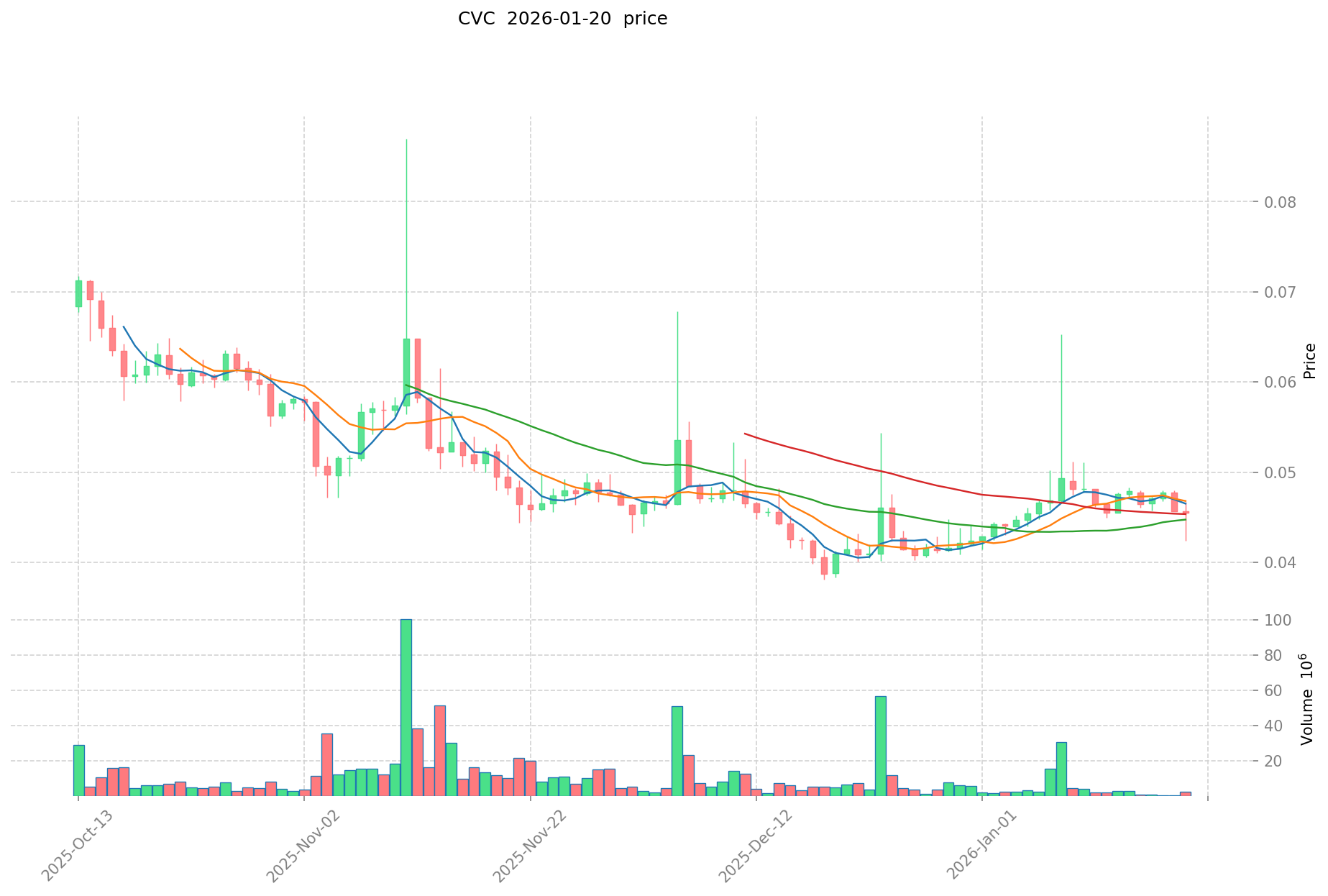
CVC is a notable asset in the cryptocurrency sector, having been launched in July 2017 and establishing itself within the decentralized identity verification space. As of January 2026, Civic maintains a market capitalization of approximately $35.34 million, with a circulating supply of around 802 million tokens, and a current price hovering near $0.04407. Positioned as a decentralized identity ecosystem, Civic has gradually become a focal point for investors considering "Is Civic (CVC) a good investment?" This article provides a comprehensive analysis of CVC's investment value, historical price movements, future price projections, and associated investment risks to offer reference for potential investors.
I. Civic (CVC) Price History Review and Current Investment Value Status
- 2018: CVC experienced significant volatility in its early trading period → Price declined from elevated levels recorded on January 3, 2018
- 2020: Market correction phase → CVC reached a lower price point on March 13, 2020
- 2021-2025: Multi-year market cycle → Price movement reflected broader cryptocurrency market trends with varying degrees of fluctuation
- Recent 12 months: Substantial price adjustment → CVC demonstrated a decline of approximately 70.47% year-over-year as of January 2026
Current CVC Investment Market Status (January 2026)
- CVC current price: $0.04407
- 24-hour trading volume: $71,117.26
- Market capitalization: $35,344,140.44
- Circulating supply: 802,000,010 CVC (80.2% of total supply)
- 24-hour price range: $0.04371 - $0.04671
- Number of token holders: 61,653
- Available on 30 exchanges
Click to view real-time CVC market price
II. Core Factors Affecting Whether CVC is a Good Investment (Is Civic(CVC) a Good Investment)
Supply Mechanism and Scarcity (CVC investment scarcity)
- Supply mechanism → Affects price and investment value
- Historical patterns: Supply changes have driven CVC price increases in the past
- Investment significance: Scarcity is key to supporting long-term investment
CVC has a total supply of 1,000,000,000 tokens with a circulating supply of 802,000,010 tokens, representing approximately 80.2% of the total supply. The circulating supply ratio indicates a relatively high level of token distribution in the market. The token's historical price volatility demonstrates the impact of supply dynamics, with CVC reaching a historical high of $1.35 in January 2018 and experiencing a low of $0.01102541 in March 2020.
Institutional Investment and Mainstream Adoption (Institutional investment in CVC)
- Institutional holding trends: Data indicates CVC has 61,653 holders
- Enterprise adoption → Enhances investment value
- Policy impact on CVC investment prospects
The number of token holders provides insight into the breadth of CVC adoption. With over 61,000 holders, the token demonstrates a distributed ownership structure. CVC is listed on 30 exchanges, which facilitates accessibility for both institutional and retail investors. The token's market capitalization stands at approximately $35.34 million, representing 0.0013% of the total cryptocurrency market.
Macroeconomic Environment's Impact on CVC Investment
- Monetary policy and interest rate changes → Alter investment attractiveness
- Hedging role in inflationary environments → Potential positioning considerations
- Geopolitical uncertainty → May influence CVC investment demand
CVC's price performance reflects broader market conditions and investor sentiment. The token has experienced a year-over-year decline of 70.47%, indicating significant price pressure during the period. Short-term performance shows a 30-day increase of 9.5%, while the 7-day trend shows a decline of 4.8%. These fluctuations may correlate with macroeconomic factors affecting risk appetite in digital asset markets.
Technology and Ecosystem Development (Technology & Ecosystem for CVC investment)
- Decentralized identity verification platform: Provides secure, low-cost access → Supports investment value proposition
- Ethereum-based infrastructure: Enables smart contract functionality → Facilitates ecosystem applications
- Digital identity applications drive investment value
Civic operates as a decentralized identity ecosystem built on the Ethereum blockchain, utilizing smart contracts for identity verification processes. The platform allows users to establish virtual identities with personal information stored on their devices, which can be verified and accessed by service providers with appropriate user permissions. CVC tokens serve as the payment mechanism within this ecosystem, enabling transactions between users, verifiers, and identity owners. The contract address 0x41e5560054824eA6B0732E656E3Ad64E20e94E45 on the Ethereum network facilitates these operations.
III. CVC Future Investment Forecast and Price Outlook (Is Civic(CVC) worth investing in 2026-2031)
Short-term Investment Forecast (2026, short-term CVC investment outlook)
- Conservative forecast: $0.0405352 - $0.04406
- Neutral forecast: $0.04406 - $0.0471442
- Optimistic forecast: $0.04406 - $0.0502284
Mid-term Investment Outlook (2027-2029, mid-term Civic(CVC) investment forecast)
-
Market stage expectation: Based on the provided data, CVC may enter a gradual recovery phase during the mid-term period, with potential price appreciation driven by market dynamics and ecosystem development.
-
Investment return forecast:
- 2027: $0.024986426 - $0.066473322
- 2028: $0.04885553446 - $0.08237270345
- 2029: $0.061239844358 - $0.091859766537
-
Key catalysts: Broader adoption of decentralized identity solutions, potential partnerships within the identity verification sector, and overall cryptocurrency market sentiment.
Long-term Investment Outlook (Is Civic a good long-term investment?)
- Base scenario: $0.07184547194909 - $0.10332831920768 (assuming steady development and moderate market conditions through 2030)
- Optimistic scenario: $0.09202678429434 - $0.096628123509057 (assuming enhanced adoption of identity verification technologies and favorable regulatory environment through 2031)
- Risk scenario: $0.052455267047773 - $0.07184547194909 (considering potential market volatility or slower-than-expected adoption rates)
Click to view CVC long-term investment and price forecast: Price Prediction
2026-01-20 - 2031 Long-term Outlook
- Base scenario: $0.0405352 - $0.10332831920768 (corresponding to steady progress and gradual mainstream application enhancement)
- Optimistic scenario: $0.066473322 - $0.096628123509057 (corresponding to large-scale adoption and favorable market environment)
- Transformative scenario: Above $0.10332831920768 (such as breakthrough progress in the ecosystem and mainstream popularization)
- 2031-12-31 forecast high: $0.096628123509057 (based on optimistic development assumptions)
Disclaimer: The above forecasts are based on historical data and market analysis models. Cryptocurrency markets are highly volatile and subject to numerous unpredictable factors. This information does not constitute investment advice, and investors should conduct independent research and risk assessment before making any investment decisions.
| Year |
Predicted High Price |
Predicted Average Price |
Predicted Low Price |
Price Change |
| 2026 |
0.0502284 |
0.04406 |
0.0405352 |
0 |
| 2027 |
0.066473322 |
0.0471442 |
0.024986426 |
6 |
| 2028 |
0.08237270345 |
0.056808761 |
0.04885553446 |
28 |
| 2029 |
0.091859766537 |
0.069590732225 |
0.061239844358 |
57 |
| 2030 |
0.10332831920768 |
0.080725249381 |
0.07184547194909 |
83 |
| 2031 |
0.096628123509057 |
0.09202678429434 |
0.052455267047773 |
108 |
IV. Civic Investment Strategy and Risk Management (How to invest in Civic)
Investment Methodology (Civic investment strategy)
Long-term Holding (HODL Civic)
For conservative investors seeking exposure to the decentralized identity sector, a long-term holding strategy may be appropriate. This approach involves purchasing CVC tokens and holding them through market cycles, with the expectation that the fundamental value proposition of blockchain-based identity verification will gain broader adoption over time. This strategy typically requires less active monitoring and may help reduce the impact of short-term price volatility.
Active Trading
Active traders may employ technical analysis and swing trading strategies to capitalize on CVC's price movements. Given the token's 24-hour price fluctuation of -1.43% and a 7-day change of -4.8%, traders should carefully monitor key support and resistance levels. The 24-hour trading range between $0.04371 and $0.04671 provides insight into intraday volatility patterns. Technical indicators such as moving averages, RSI, and volume analysis can inform entry and exit points.
Risk Management (Risk management for Civic investment)
Asset Allocation Ratios
- Conservative Investors: Consider allocating no more than 1-3% of total crypto portfolio to CVC, focusing on established cryptocurrencies for the majority of holdings
- Aggressive Investors: May allocate 5-10% to CVC as part of a diversified altcoin strategy, while maintaining exposure to larger-cap assets
- Professional Investors: Could implement dynamic allocation strategies based on market conditions, technical indicators, and sector rotation patterns within the identity and authentication space
Risk Hedging Solutions
Implementing a multi-asset portfolio approach can help mitigate concentration risk. Investors may consider pairing CVC holdings with:
- Established cryptocurrencies to provide portfolio stability
- Assets in complementary sectors to reduce correlation risk
- Stablecoins to maintain liquidity and provide downside protection during market volatility
Secure Storage
Cold and Hot Wallet Solutions:
- Hot Wallets: Suitable for tokens intended for active trading, providing convenient access through mobile or desktop applications that support ERC-20 tokens (CVC is deployed on Ethereum at contract address 0x41e5560054824eA6B0732E656E3Ad64E20e94E45)
- Cold Wallets: Recommended for long-term holdings to minimize exposure to online security threats
- Hardware Wallet Options: Leading hardware wallet providers offer support for Ethereum-based tokens, providing enhanced security through offline private key storage
V. Civic Investment Risks and Challenges (Risks of investing in Civic)
Market Risk
High Volatility: CVC has demonstrated considerable price volatility, with a 1-year performance showing -70.47% change. The token reached a historical high of $1.35 on January 3, 2018, while experiencing a low of $0.01102541 on March 13, 2020. Current price action shows the token trading at $0.04407, representing continued fluctuation from these historical levels. Investors should be prepared for significant price swings that characterize smaller-cap digital assets.
Trading Volume Considerations: With a 24-hour trading volume of $71,117.26 and listing on 30 exchanges, liquidity levels should be carefully evaluated, particularly for larger position sizes that may impact market depth.
Regulatory Risk
The decentralized identity sector faces evolving regulatory frameworks across different jurisdictions. Digital identity verification and data privacy regulations vary significantly by country, potentially affecting:
- Platform operational requirements and compliance costs
- Cross-border identity verification services
- Token classification and securities regulations
- Data protection and privacy law compliance
Investors should monitor regulatory developments in key markets that may impact adoption and utility of identity verification solutions.
Technical Risk
Network Security Considerations: As an Ethereum-based token, CVC inherits both the security properties and potential vulnerabilities of the Ethereum network. Investors should be aware of:
- Smart contract risks associated with the token contract
- Potential vulnerabilities in identity verification protocols
- Dependencies on Ethereum network performance and security
- Risks associated with platform upgrades or protocol changes
Platform Development Risk: The success of CVC as an investment depends on continued development and adoption of the Civic platform's identity verification services. Technical challenges in implementation or competition from alternative solutions may affect long-term value.
VI. Conclusion: Is Civic a Good Investment?
Investment Value Summary
Civic presents a value proposition centered on decentralized identity verification infrastructure. The token has a circulating supply of 802,000,010 CVC (80.2% of total supply) with a market capitalization of approximately $35.34 million and a market cap to fully diluted valuation ratio of 80.2%. While the project addresses a potentially significant use case in blockchain-based identity services, recent performance metrics show challenges, with the 1-year price change of -70.47% reflecting broader market conditions and sector-specific factors. The platform's focus on secure, low-cost identity authentication may offer potential in the longer term, though price volatility presents notable short-term considerations.
Investor Recommendations
✅ New Investors: Consider a dollar-cost averaging approach to build positions gradually, reducing the impact of entry timing. Prioritize secure storage solutions using reputable wallets that support ERC-20 tokens. Begin with modest allocations to understand market dynamics before increasing exposure.
✅ Experienced Investors: May implement swing trading strategies based on technical analysis, given the token's volatility patterns. Portfolio diversification across multiple sectors within the cryptocurrency space can help manage concentration risk. Monitor developments in the decentralized identity sector and competitive landscape.
✅ Institutional Investors: Could evaluate CVC as part of a thematic allocation to identity and authentication solutions within a broader digital asset strategy. Conduct thorough due diligence on platform adoption metrics, partnership developments, and regulatory compliance frameworks.
⚠️ Disclaimer: Cryptocurrency investments carry substantial risk, including the potential loss of principal. Market volatility, regulatory uncertainty, and technical challenges can significantly impact asset values. This analysis is provided for informational purposes only and does not constitute investment advice. Investors should conduct independent research and consider their risk tolerance, investment objectives, and financial situation before making investment decisions.
VII. FAQ
Q1: What is Civic (CVC) and what problem does it solve?
Civic (CVC) is a decentralized identity verification platform built on the Ethereum blockchain that provides secure, low-cost access to identity authentication services. The platform addresses the inefficiencies and security vulnerabilities inherent in traditional identity verification systems by allowing users to establish virtual identities with personal information stored on their devices. Through smart contract functionality, Civic enables users to control their identity data and selectively share verified information with service providers, eliminating the need for repeated identity verification processes across different platforms. CVC tokens serve as the payment mechanism within this ecosystem, facilitating transactions between users, verifiers, and identity owners.
Q2: How has CVC performed as an investment historically?
CVC has experienced significant volatility since its launch in July 2017. The token reached its historical high of $1.35 on January 3, 2018, during the broader cryptocurrency bull market, but subsequently experienced a substantial decline to a low of $0.01102541 on March 13, 2020. As of January 2026, CVC trades at approximately $0.04407, representing a 1-year decline of 70.47%. Short-term performance shows mixed signals with a 30-day increase of 9.5% but a 7-day decline of 4.8%. These price movements reflect both broader cryptocurrency market cycles and sector-specific factors affecting the decentralized identity verification space.
Q3: What are the key risks associated with investing in CVC?
CVC investment carries multiple risk categories that investors should carefully consider. Market risk manifests through high volatility, as evidenced by the token's 70% decline over the past year and historical price swings between $1.35 and $0.01. Regulatory risk stems from evolving frameworks around digital identity verification, data privacy, and token classification that vary significantly across jurisdictions. Technical risks include smart contract vulnerabilities, dependencies on Ethereum network security, and platform development challenges. Additionally, liquidity considerations arise from the relatively modest 24-hour trading volume of approximately $71,000, which may impact larger position executions and exit strategies.
Q4: What is the price outlook for CVC through 2031?
Based on analytical models, CVC presents varying price scenarios across different timeframes. For 2026, forecasts range from a conservative estimate of $0.0405-$0.0441 to an optimistic projection of $0.0441-$0.0502. Mid-term projections through 2029 suggest gradual recovery potential, with 2027 estimates ranging from $0.025-$0.066, 2028 projections of $0.049-$0.082, and 2029 forecasts of $0.061-$0.092. Long-term outlooks through 2031 present a base scenario of $0.072-$0.103, with optimistic scenarios reaching $0.092-$0.097, contingent upon enhanced adoption of identity verification technologies and favorable regulatory environments. However, these projections are subject to significant uncertainty given cryptocurrency market volatility and unpredictable factors.
Q5: How should investors approach CVC allocation in their portfolio?
Portfolio allocation strategies for CVC should align with individual risk tolerance and investment objectives. Conservative investors might consider limiting CVC exposure to 1-3% of their total cryptocurrency portfolio, maintaining the majority in established assets. Aggressive investors may allocate 5-10% to CVC as part of a diversified altcoin strategy while retaining exposure to larger-cap cryptocurrencies. Professional investors could implement dynamic allocation strategies based on market conditions and sector rotation patterns. Regardless of allocation level, implementing proper risk management through diversification across multiple sectors, maintaining stablecoin reserves for liquidity, and utilizing appropriate storage solutions (cold wallets for long-term holdings, hot wallets for active trading) remains essential for prudent CVC investment management.
Q6: What investment strategies are most suitable for CVC?
CVC investors can employ two primary strategies depending on their objectives and risk profile. Long-term holding (HODL) suits conservative investors seeking exposure to the decentralized identity sector, requiring less active monitoring while positioning for potential long-term adoption of blockchain-based identity verification. This approach requires patience through market cycles and belief in the fundamental value proposition. Active trading strategies may be appropriate for experienced traders who can capitalize on CVC's price movements using technical analysis, with the token's intraday volatility (24-hour range of $0.04371-$0.04671) providing opportunities for swing trading. Technical indicators such as moving averages, RSI, and volume analysis can inform entry and exit points, though this approach demands regular market monitoring and risk management discipline.
Q7: What factors could drive CVC's future value appreciation?
Several catalysts could potentially influence CVC's future value trajectory. Broader adoption of decentralized identity solutions across industries represents a primary growth driver, as enterprises increasingly recognize the efficiency and security benefits of blockchain-based verification systems. Strategic partnerships within the identity verification sector could expand platform utility and token demand. Favorable regulatory developments that provide clarity for digital identity solutions while supporting innovation may enhance mainstream acceptance. Technological improvements to the Civic platform, including enhanced functionality and user experience, could attract more participants to the ecosystem. Additionally, general cryptocurrency market sentiment and increased institutional interest in identity and authentication solutions could contribute to positive price momentum, though these factors remain subject to significant uncertainty.
Q8: Where can investors buy and store CVC tokens?
CVC tokens are available for purchase on 30 cryptocurrency exchanges, providing multiple access points for investors. As an ERC-20 token deployed on the Ethereum network (contract address: 0x41e5560054824eA6B0732E656E3Ad64E20e94E45), CVC can be stored in any wallet supporting Ethereum-based tokens. For active trading, hot wallets—mobile or desktop applications—offer convenient access and quick transaction capabilities. For long-term holdings, cold storage solutions, particularly hardware wallets from leading providers, are recommended to minimize exposure to online security threats through offline private key storage. Investors should verify that their chosen storage solution supports ERC-20 tokens and implement proper security practices, including secure backup of recovery phrases and enabling available security features such as two-factor authentication for exchange accounts.
* The information is not intended to be and does not constitute financial advice or any other recommendation of any sort offered or endorsed by Gate.