This comprehensive analysis evaluates Concordium (CCD), a Layer-1 blockchain emphasizing digital trust, privacy, and regulatory compliance through its Smart Money framework. As of January 2026, CCD trades at $0.01575 with a $186.03 million market cap and demonstrates significant year-over-year price appreciation of 351.7%. The article examines CCD's price history, supply mechanics with 90.21% circulation ratio, institutional adoption indicators including Gate listing, and technology positioning within compliance-focused blockchain infrastructure. Short to long-term price forecasts range from $0.012046 to $0.027234 through 2031, contingent on ecosystem development and regulatory environment. Investment strategies span conservative HODL approaches to active trading, with detailed risk management protocols addressing market volatility, regulatory uncertainty, and technical vulnerabilities. The analysis provides investors with reference frameworks for evaluating whether Concordium suits their portfolio allocation
Introduction: Concordium (CCD)'s Investment Position and Market Prospects
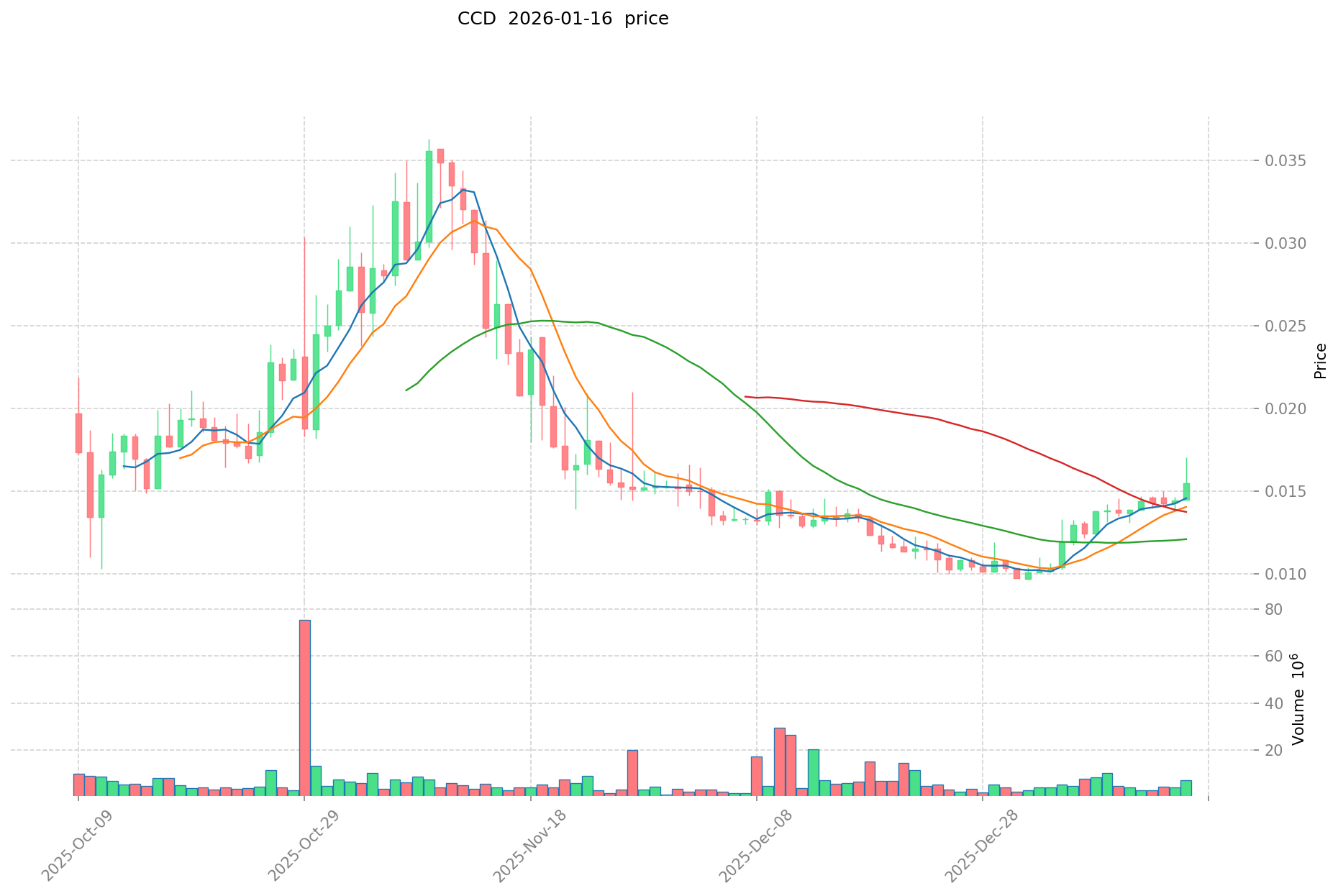
Concordium (CCD) represents a notable asset in the cryptocurrency sector, having been launched in 2022 with a focus on building digital trust infrastructure. As of January 16, 2026, Concordium maintains a market capitalization of approximately $186.03 million, with a circulating supply of around 11.81 billion tokens and a current price of $0.01575. Positioned as a Layer-1 blockchain emphasizing trust, privacy, and compliance through its "Smart Money" concept, CCD has attracted attention among investors exploring digital assets in the regulatory-compliant blockchain space. Over the past year, the token has shown considerable price movement, with changes reflecting broader market dynamics. This article provides a comprehensive analysis of Concordium's investment characteristics, historical price trends, future price outlook, and associated investment risks, offering reference information for investors evaluating "Is Concordium (CCD) a good investment?"
I. Concordium (CCD) Price History Review and Current Investment Value
- 2024-2025: Price volatility reflected broader market dynamics → Investors experienced periods of both growth and correction
- 2024: Token demonstrated notable gains with a 351.7% increase over one-year period → CCD price showed substantial upward momentum
- 2024: Market cycles brought fluctuations → Price moved between lower ranges around $0.0146 and peaks near $0.0171
Current CCD Investment Market Status (January 2026)
- CCD current price: $0.01575
- Market sentiment (Fear & Greed Index): Data indicates positive momentum with recent 7-day gain of 12.47% (neutral to optimistic)
- 24-hour trading volume: $109,541.93
- Institutional investor positions: CCD is listed on 5 exchanges with circulating supply of 11.81 billion tokens
Click to view real-time CCD market price
II. Core Factors Influencing Whether CCD is a Good Investment (Is Concordium(CCD) a Good Investment)
Supply Mechanism and Scarcity (CCD investment scarcity)
- Supply mechanism → Influences price and investment value
- Based on available data, Concordium has a maximum supply of 13,094,191,218 CCD tokens, with approximately 90.21% already in circulation (11,811,641,830.91 CCD as of January 16, 2026). This relatively high circulation ratio suggests limited future supply expansion, which may contribute to price stability considerations.
- Investment significance: The supply structure with a defined maximum cap represents a fundamental characteristic that investors may consider when evaluating long-term holding strategies.
Institutional Investment and Mainstream Adoption (Institutional investment in CCD)
- Exchange presence: As of the reference period, CCD is listed on 5 exchanges, including a notable Kraken listing in late August that reportedly coincided with significant trading volume increases.
- Adoption indicators: Concordium's protocol-level focus on compliance, identity verification, and regulatory certainty through its "Smart Money" framework may position it for potential enterprise and institutional consideration.
- Market positioning: The project's emphasis on embedding trust, privacy, and compliance at the infrastructure level reflects a design orientation toward regulated environments and institutional requirements.
Macroeconomic Environment's Impact on CCD Investment
- Market dynamics: CCD demonstrated substantial price appreciation over the past year, with reported increases of approximately 351.7% year-over-year and 360% over three months during the reference period, outpacing broader market trends according to available data.
- Trading activity: 24-hour trading volume of approximately $109,541.93 as of January 16, 2026, provides context for market liquidity considerations.
- Market conditions: The cryptocurrency market's sensitivity to broader economic factors, including monetary policy shifts and geopolitical developments, continues to influence trading patterns across digital assets including CCD.
Technology and Ecosystem Development (Technology & Ecosystem for CCD investment)
- Core technology: Concordium operates as a Layer-1 blockchain incorporating protocol-level identity, policy controls, and compliance features within its architecture.
- Technical characteristics: The platform's design integrates what it describes as "Smart Money"—programmable digital assets with embedded identity and compliance mechanisms.
- Ecosystem focus: Concordium's infrastructure approach emphasizes security, automation, and regulatory considerations, which may influence its adoption trajectory in specific use cases requiring compliance frameworks.
- Development timeline: Founded in 2018 with mainnet launch in February 2022, the project has established its technical foundation and continues ecosystem development.
III. CCD Future Investment Forecast and Price Outlook (Is Concordium(CCD) worth investing in 2026-2031)
Short-term Investment Forecast (2026, short-term CCD investment outlook)
Based on available projections, CCD may experience varied performance in 2026. Conservative estimates suggest a price range around $0.012046 to $0.015444, reflecting cautious market sentiment. Neutral forecasts point to an average price near $0.015444, aligning with moderate growth expectations. Optimistic scenarios anticipate potential highs reaching approximately $0.018533, contingent on favorable market dynamics and ecosystem developments.
Mid-term Investment Outlook (2027-2029, mid-term Concordium(CCD) investment forecast)
- Market Phase Expectation: The mid-term period may witness gradual maturation of Concordium's ecosystem, with potential growth driven by protocol enhancements and increased adoption.
- Investment Return Forecast:
- 2027: Projected price range between $0.015290 and $0.018347, representing approximately 7% growth.
- 2028: Estimated range of $0.011131 to $0.019081, indicating potential volatility alongside a 12% increase.
- 2029: Anticipated range from $0.014883 to $0.025908, with growth potential reaching 16%.
- Key Catalysts: Factors influencing mid-term performance may include technical upgrades, strategic partnerships, regulatory developments, and broader blockchain adoption trends.
Long-term Investment Outlook (Is CCD a good long-term investment?)
- Baseline Scenario: $0.015306 - $0.024688 (assuming steady ecosystem growth and moderate market conditions through 2031)
- Optimistic Scenario: $0.022141 - $0.027234 (contingent on accelerated adoption, favorable regulatory environment, and successful protocol implementations by 2030-2031)
- Risk Scenario: Prices may face downward pressure if market conditions deteriorate, adoption lags, or competitive challenges emerge.
For detailed CCD long-term investment analysis and price predictions, visit: Price Prediction
2026-2031 Long-term Outlook
- Base Case: $0.012046 - $0.024688 (corresponding to steady progress and gradual mainstream application growth)
- Optimistic Case: $0.022141 - $0.027234 (corresponding to large-scale adoption and favorable market environment)
- Transformational Case: Above $0.027234 (in scenarios where ecosystem achieves breakthrough developments and mainstream penetration)
- 2031-12-31 Projected High: $0.027234 (based on optimistic development assumptions with approximately 56% growth potential)
Disclaimer: Price predictions are subject to significant uncertainty and should not be construed as investment advice. Actual results may differ materially due to market volatility, regulatory changes, technological developments, and other unforeseen factors. Investors should conduct thorough research and consider their risk tolerance before making investment decisions.
| Year |
Predicted High Price |
Predicted Average Price |
Predicted Low Price |
Price Change |
| 2026 |
0.0185328 |
0.015444 |
0.01204632 |
-1 |
| 2027 |
0.018347472 |
0.0169884 |
0.01528956 |
7 |
| 2028 |
0.01908137088 |
0.017667936 |
0.01113079968 |
12 |
| 2029 |
0.0259082613504 |
0.01837465344 |
0.0148834692864 |
16 |
| 2030 |
0.027233992596096 |
0.0221414573952 |
0.01549902017664 |
40 |
| 2031 |
0.02592211124543 |
0.024687724995648 |
0.015306389497301 |
56 |
IV. Concordium Investment Strategy and Risk Management (How to invest in Layer-1 blockchain)
Investment Methodology (Concordium investment strategy)
Long-term Holding (HODL Concordium): This approach may suit conservative investors who believe in the fundamental value proposition of Concordium's identity-embedded blockchain infrastructure. Given CCD's considerable price movement over the past year (up 351.7% year-over-year as of January 16, 2026), long-term holders would need to evaluate whether the protocol's focus on digital trust, privacy, and compliance can sustain demand over extended periods. This strategy typically involves acquiring CCD tokens during market corrections and holding through volatility cycles.
Active Trading: Traders utilizing technical analysis and swing trading strategies should note CCD's 24-hour volatility, with prices ranging between $0.014609 and $0.017058. The token has demonstrated significant price swings, trading at $0.0015 (all-time low on June 14, 2024) and reaching $0.036307 (all-time high on November 9, 2025). Active traders may capitalize on these price movements through chart pattern analysis, volume indicators, and momentum strategies, though such approaches require continuous market monitoring and disciplined execution.
Risk Management (Risk management for Concordium investment)
Asset Allocation Ratios: Investment positioning should reflect individual risk tolerance and portfolio objectives:
- Conservative investors: Consider limiting Layer-1 blockchain exposure to 1-5% of total portfolio, with CCD representing a smaller fraction within crypto holdings
- Moderate investors: May allocate 5-15% to blockchain infrastructure projects, with selective positioning in compliance-focused networks like Concordium
- Professional investors: Could deploy larger allocations (15-30% of crypto portfolio) based on thorough due diligence of protocol fundamentals and market positioning
Risk Hedging Approaches: Diversification across multiple asset classes remains a fundamental risk mitigation strategy. Investors might consider:
- Multi-asset portfolios combining established cryptocurrencies with emerging Layer-1 projects
- Correlation analysis to identify assets with low correlation to CCD price movements
- Periodic rebalancing to maintain target allocation percentages
Secure Storage: Proper custody solutions are essential for protecting CCD holdings:
- Cold wallets (offline storage) for long-term holdings provide enhanced security against online threats
- Hot wallets (online) for active trading positions, though these carry higher security risks
- Hardware wallet solutions offer a balance between accessibility and security for medium-term holdings
V. Concordium Investment Risks and Challenges (Risks of investing in Layer-1 blockchain)
Market Risks: CCD exhibits significant price volatility, with 24-hour price changes reaching 5.92% and weekly fluctuations of 12.47%. The token's historical price range from $0.0015 to $0.036307 illustrates substantial price movement potential. Market participants should be aware that lower market capitalization assets (CCD ranks #250 with approximately $186 million in circulating market cap) may experience sharper price swings compared to more established cryptocurrencies. Trading volume of approximately $109,541 over 24 hours suggests moderate liquidity, which could impact execution during large transactions.
Regulatory Risks: Concordium's emphasis on compliance and identity integration positions it uniquely within regulatory frameworks, though this also creates specific risks. Different jurisdictions maintain varying stances on blockchain networks that embed identity verification at the protocol level. Regulatory developments regarding privacy, data protection, and financial compliance could materially impact Concordium's adoption trajectory. Policy uncertainty across major markets may affect institutional adoption rates and overall network growth.
Technical Risks: As a Layer-1 blockchain infrastructure, Concordium faces inherent technical challenges:
- Network security vulnerabilities could emerge as the protocol scales
- Protocol upgrades carry execution risks that might temporarily affect network stability
- Smart contract bugs or exploits could undermine confidence in the platform
- Competition from other compliance-focused blockchain solutions may impact market share
VI. Conclusion: Is Layer-1 blockchain a Good Investment?
Investment Value Summary: Concordium presents a specialized value proposition within the Layer-1 blockchain space, focusing on digital trust, privacy, and regulatory compliance through its Smart Money framework. The protocol's year-over-year price appreciation of 351.7% reflects growing market interest, though short-term price volatility remains pronounced with weekly fluctuations exceeding 12%. The circulating supply represents approximately 90.21% of maximum supply, suggesting limited additional token inflation pressure.
Investor Recommendations:
✅ Beginners: Consider dollar-cost averaging strategies to mitigate timing risk, combined with secure cold wallet storage for long-term holdings. Start with modest position sizes to understand CCD's price behavior patterns.
✅ Experienced Investors: May employ swing trading strategies during volatility cycles while maintaining core long-term positions. Portfolio diversification across multiple Layer-1 protocols can reduce concentration risk.
✅ Institutional Investors: Strategic long-term allocation decisions should incorporate thorough evaluation of Concordium's competitive positioning in compliance-focused blockchain infrastructure, regulatory alignment, and adoption metrics.
⚠️ Disclaimer: Cryptocurrency investments carry substantial risk, including potential loss of principal. This content serves informational purposes only and does not constitute investment advice. Investors should conduct independent research and consult qualified financial advisors before making investment decisions.
VII. FAQ
Q1: What makes Concordium (CCD) different from other Layer-1 blockchains?
Concordium distinguishes itself through protocol-level identity verification and compliance features embedded within its "Smart Money" framework. Unlike traditional Layer-1 blockchains that offer pseudonymity, Concordium integrates identity and policy controls directly into its infrastructure, positioning it for regulated environments and institutional adoption. This compliance-first approach addresses regulatory requirements while maintaining privacy through selective disclosure mechanisms, making it particularly relevant for enterprises and applications requiring embedded trust and accountability.
Q2: How volatile is CCD compared to established cryptocurrencies?
CCD exhibits considerable volatility typical of lower market capitalization assets. The token has demonstrated weekly price fluctuations of 12.47% and 24-hour changes reaching 5.92%. Its historical price range spans from an all-time low of $0.0015 (June 14, 2024) to an all-time high of $0.036307 (November 9, 2025), representing approximately 24-fold variation. This volatility exceeds that of major cryptocurrencies and reflects CCD's ranking at #250 by market capitalization with approximately $186 million in circulating value. Investors should anticipate sharper price swings and potentially challenging liquidity conditions during large transactions.
Q3: What allocation percentage should investors consider for CCD in their portfolio?
Portfolio allocation depends on individual risk tolerance and investment objectives. Conservative investors might limit Layer-1 blockchain exposure to 1-5% of total portfolio, with CCD representing a smaller fraction within that allocation. Moderate investors may allocate 5-15% to blockchain infrastructure projects, including selective positioning in compliance-focused networks. Professional investors with higher risk tolerance could deploy 15-30% of their crypto portfolio based on thorough due diligence. These recommendations assume diversified holdings across multiple asset classes to mitigate concentration risk.
Q4: Is Concordium suitable for long-term holding (HODL) strategy?
Concordium may appeal to long-term investors who believe in the fundamental value of identity-embedded blockchain infrastructure for regulated environments. The token's 351.7% year-over-year price appreciation through January 2026 reflects growing market interest, though this historical performance does not guarantee future results. Long-term holding strategies require conviction in Concordium's ability to achieve sustained adoption among enterprises and institutional users requiring compliance features. The relatively high circulation ratio (90.21% of maximum supply) suggests limited future token inflation, which may support price stability. However, investors should prepare for extended volatility cycles and maintain secure cold wallet storage for holdings.
Q5: What are the primary risks when investing in Concordium?
CCD investment carries multiple risk categories. Market risks include significant price volatility and moderate liquidity with approximately $109,541 in 24-hour trading volume, which may impact execution during large transactions. Regulatory risks stem from varying jurisdictional stances on identity-embedded blockchain protocols, with policy uncertainty potentially affecting institutional adoption rates. Technical risks encompass network security vulnerabilities, protocol upgrade execution challenges, smart contract exploit potential, and competition from alternative compliance-focused blockchain solutions. Additionally, Concordium's specialized positioning creates concentration risk if the compliance-oriented blockchain segment underperforms broader market trends.
Q6: What price performance can investors reasonably expect through 2026-2031?
Price projections suggest varied scenarios across timeframes. For 2026, conservative estimates indicate a range of $0.012046 to $0.015444, while optimistic scenarios anticipate potential highs near $0.018533. Mid-term projections (2027-2029) show gradual maturation with 2029 estimates ranging from $0.014883 to $0.025908, representing approximately 16% annual growth. Long-term forecasts through 2031 present a base case of $0.015306 to $0.024688, with optimistic scenarios reaching $0.022141 to $0.027234, suggesting potential 56% growth from current levels. These projections carry significant uncertainty and depend on ecosystem development, regulatory environment, adoption rates, and broader market conditions. Investors should treat these forecasts as reference points rather than guaranteed outcomes.
Q7: How does Concordium's circulating supply affect investment potential?
Concordium's circulating supply of approximately 11.81 billion tokens represents 90.21% of the maximum supply of 13.09 billion tokens as of January 16, 2026. This high circulation ratio indicates limited future token inflation pressure, which may contribute to price stability considerations. The relatively low remaining supply expansion potential (approximately 1.28 billion tokens, or 9.79%) reduces concerns about significant dilution affecting token value. This supply structure represents a fundamental characteristic that may support long-term holding strategies, though it should be evaluated alongside adoption metrics, network growth, and competitive positioning when assessing overall investment potential.
Q8: What trading strategies work best for CCD given its volatility profile?
CCD's significant price movements (ranging between $0.014609 and $0.017058 within 24 hours) create opportunities for both active trading and long-term holding approaches. Active traders may capitalize on volatility through technical analysis, identifying support and resistance levels, volume patterns, and momentum indicators. Swing trading strategies could target price fluctuations within weekly and monthly cycles, though this requires continuous market monitoring and disciplined execution. Conservative investors might employ dollar-cost averaging to mitigate timing risk, accumulating positions during market corrections. Both approaches benefit from secure storage solutions—cold wallets for long-term holdings and hot wallets for active trading positions—while maintaining diversification across multiple assets to manage concentration risk.
* The information is not intended to be and does not constitute financial advice or any other recommendation of any sort offered or endorsed by Gate.