The article explores Gas (GAS) as an investment opportunity, emphasizing its role in the Neo blockchain ecosystem as a fuel token. It reviews its price history and current market status, detailing its utility in smart contract execution and resource control. The guide addresses investors' concerns about GAS's volatility, supply dynamics, and competitive market position. It provides insights into smart trading strategies and long-term investment risks. This comprehensive resource is ideal for investors interested in assessing GAS's potential within the blockchain infrastructure landscape, with all trading data sourced from Gate.
Introduction: Gas (GAS) Investment Position and Market Prospects
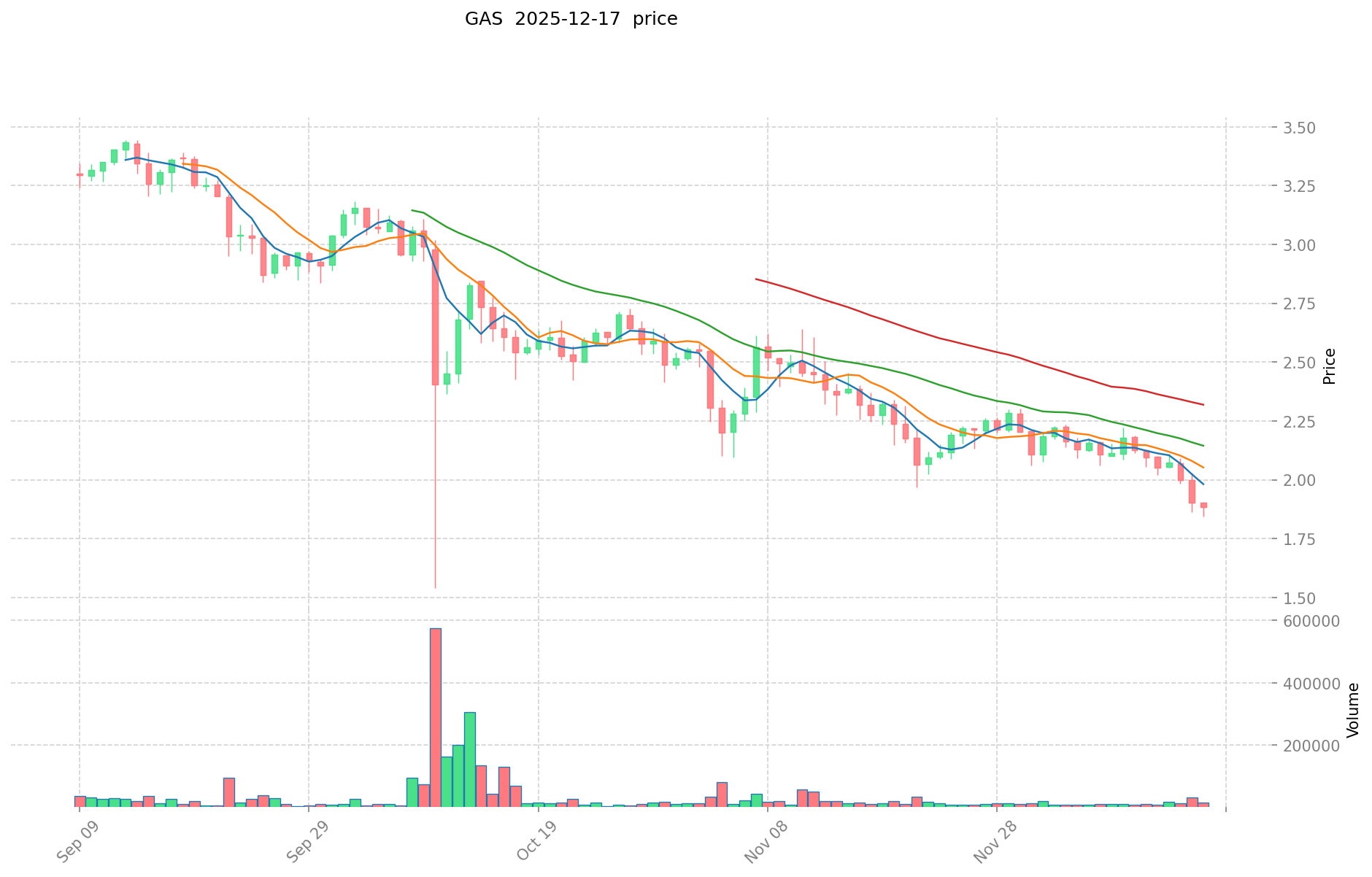
GAS is an important asset in the cryptocurrency field. As the fuel token of the Neo blockchain, it has played a crucial role in the ecosystem since its inception. As of December 2025, GAS maintains a market capitalization of approximately $122.18 million with a circulating supply of roughly 65.09 million tokens, trading at around $1.877 per unit. GAS functions as the resource control mechanism for the Neo network, powering asset issuance, smart contract execution, and storage operations.
GAS is generated through a decay algorithm alongside NEO holdings, with a maximum supply cap of 100 million tokens designed to be distributed over approximately 22 years. The token's dual-state mechanism—where GAS transitions from non-claimable to claimable status upon NEO transfer—represents a distinctive feature within the blockchain infrastructure sector. By charging for transactions and smart contract operations, GAS simultaneously incentivizes network validators and prevents resource abuse.
Currently ranked 306th in market capitalization with a 0.0038% market dominance, GAS has experienced significant price volatility historically, reaching an all-time high of $91.94 in January 2018 and an all-time low of $0.621309 in March 2020. Over the past year, GAS has declined approximately 65.25%, reflecting broader market conditions and evolving investor sentiment toward network utility tokens.
This article provides a comprehensive analysis of GAS's investment value, historical price performance, future price forecasts, and associated investment risks to serve as a reference for investors evaluating this blockchain infrastructure token.
GAS (Gas) Crypto Asset Research Report
I. Price History Review and Current Investment Market Status
- January 15, 2018: GAS reached an all-time high of $91.94, representing peak market optimism during the early blockchain adoption phase
- March 13, 2020: GAS declined to an all-time low of $0.621309, marking the lowest point in the token's trading history
- Year-over-year performance (1Y): GAS has declined 65.25% from its previous comparable period
Current GAS Investment Market Status (December 17, 2025)
- Current Price: $1.877
- 24-Hour Price Change: +0.37%
- Market Capitalization: $122,180,650.68
- Circulating Supply: 65,093,580.54 GAS tokens
- Total Supply: 65,093,580.54 GAS tokens
- Maximum Supply: Unlimited (∞)
- Circulating Supply Ratio: 65.09%
- 24-Hour Trading Volume: $26,996.14
- Market Ranking: 306th by market capitalization
- Market Dominance: 0.0038%
| Time Period |
Price Change |
| 1 Hour |
+0.37% |
| 24 Hours |
+0.37% |
| 7 Days |
-12.98% |
| 30 Days |
-19.42% |
| 1 Year |
-65.25% |
II. Overview of GAS Token and Neo Ecosystem
Token Purpose and Function
GAS serves as the fuel token for the Neo blockchain network. Two native tokens exist within the Neo ecosystem:
- NEO: Management token (100 million total supply) - provides governance rights including bookkeeper election voting and network parameter modification
- GAS: Fuel token (maximum 100 million supply) - controls resource utilization within the Neo network
GAS Use Cases and Mechanics
GAS is essential for:
- Asset issuance on the Neo network
- Smart contract execution and storage operations
- Network resource allocation and fee payment
- Prevention of resource abuse through economic incentive mechanisms
GAS Generation and Distribution
- Neo network charges fees for token transfers and smart contract execution and storage
- These fees provide economic incentives for bookkeepers and prevent network resource abuse
- GAS gradually generates into Neo management token holder addresses through a decay algorithm over approximately 22 years
- The token has two states: extractable and non-extractable
- When NEO tokens are transferred (spent), the GAS they have accumulated transitions to extractable status
- NEO holders can initiate claim transactions to withdraw extractable GAS to their addresses at any time
- The minimum unit of GAS is 0.00000001
Network Access and Fee Structure
The Neo network implements a voting-based threshold system that:
- Allows free storage for a certain quantity of transfer transactions and smart contracts
- Provides enhanced transaction processing for users with verified Neo identities
- Enables priority processing for transactions and smart contracts when junk transactions occur
- Requires GAS payment for users without qualified digital identities to gain transaction priority
Exchange and Availability
- Listed on 22 cryptocurrency exchanges
- Trading pairs available across major platforms
- 24-hour trading volume: $26,996.14
Market Metrics Summary
| Metric |
Value |
| Current Price |
$1.877 |
| Market Cap |
$122.18 million |
| Fully Diluted Valuation |
$122.18 million |
| Market Cap to FDV Ratio |
65.09% |
| All-Time High |
$91.94 (January 15, 2018) |
| All-Time Low |
$0.621309 (March 13, 2020) |
| Current 24H Range |
$1.842 - $1.891 |
IV. Official Resources and Community Channels
Primary Resources
Community and Social Channels
V. Key Observations
Market Context
GAS has experienced significant price volatility since its inception, with a 99.33% decline from its all-time high of $91.94 to the current price of $1.877. The token's performance reflects both the maturation of the Neo ecosystem and broader cryptocurrency market cycles.
Supply Dynamics
Unlike tokens with fixed maximum supplies, GAS has an unlimited maximum supply (∞), with new tokens continuing to generate through the decay algorithm until all 100 million programmed tokens are distributed. Currently, approximately 65.09% of the total programmed supply is in circulation.
Recent Market Activity
Short-term price momentum shows modest appreciation in the 1-hour and 24-hour periods (+0.37%), while medium to long-term trends indicate weakness with declines of -12.98% (7-day), -19.42% (30-day), and -65.25% (1-year).
Report Generated: December 17, 2025
Data Source: Gate Crypto Asset Database
Gas (GAS) Cryptocurrency Research Report
Report Date: December 17, 2025
Data Source: Gate Cryptocurrency Market Data
I. Executive Summary
Gas (GAS) is the fuel token native to the Neo blockchain network. As of December 17, 2025, GAS is trading at $1.877 with a market capitalization of approximately $122.18 million, ranking 306th among cryptocurrencies by market cap. The token has experienced significant volatility, with a 52-week decline of -65.25% and a lifetime high of $91.94 achieved on January 15, 2018.
II. Core Factors Influencing Gas (GAS) as an Investment
Supply Mechanism and Scarcity
Gas operates as a fuel token for the Neo blockchain with a theoretical maximum supply of ∞ (unlimited). However, the practical supply dynamics are governed by a decay algorithm. According to the project specifications, approximately 100 million GAS will be gradually generated over approximately 22 years through this algorithmic decay process. Currently, 65,093,580.54 GAS tokens are in circulation, representing 65.09% of the total supply allocation.
The supply mechanism creates a controlled release schedule rather than fixed scarcity, distinguishing Gas from tokens with absolute maximum supplies. This structural feature impacts long-term value preservation differently than purely deflationary token models.
Functional Utility and Network Economics
Gas functions as the resource control mechanism for the Neo blockchain network. Its primary utilities include:
- Transaction Processing: Gas is required for token transfer operations on the Neo network
- Smart Contract Execution: Running and storing smart contracts requires Gas expenditure
- Resource Management: The Gas fee structure provides economic incentives for network validators and prevents resource abuse
- Network Governance: The Neo network can establish fee thresholds through voting mechanisms, with provisions to offer free or reduced-cost Gas for certain transaction types to improve user experience
The utility-driven demand for Gas creates intrinsic value independent of speculative trading, as network usage directly correlates with token demand.
Current market metrics present a mixed investment profile:
- 24-Hour Change: +0.37%
- 7-Day Change: -12.98%
- 30-Day Change: -19.42%
- 52-Week Change: -65.25%
- 24-Hour Trading Volume: $26,996.14
- Market Cap Rank: 306th globally
The persistent downtrend over medium and long-term periods reflects challenging market conditions for the Neo ecosystem and Gas token specifically.
Macro-Economic Context
The cryptocurrency market environment in 2025 presents complex dynamics affecting Gas investment prospects:
- Market Sentiment: Current market emotion indicator shows positive signals, though limited by modest trading volumes relative to market cap
- Capital Flows: The 22 exchange listings provide adequate trading liquidity channels for market participation
- Competitive Landscape: Gas operates within the broader smart contract platform ecosystem, competing with established alternatives
III. Technical Specifications
Token Name: Gas (GAS)
Blockchain: Neo
Total Supply: 65,093,580.54 GAS (circulating)
Maximum Supply: ∞ (unlimited, subject to decay algorithm)
Minimum Unit: 0.00000001 GAS
Generation Mechanism: Decay algorithm distributing 100 million GAS over approximately 22 years, generated to Neo management token (NEO) addresses
All-Time High: $91.94 (January 15, 2018)
All-Time Low: $0.621309 (March 13, 2020)
Official Website: https://neo.org/
Block Explorer: https://neo3.neotube.io/
GitHub Repository: https://github.com/neo-project/neo
Twitter: https://twitter.com/neo_blockchain
Reddit Community: https://www.reddit.com/r/NEO
V. Key Considerations for Investors
- Utility Alignment: Investment prospects depend directly on Neo blockchain adoption and smart contract deployment activity
- Price Volatility: Historical price movements demonstrate significant volatility, with -65.25% annual decline reflecting market challenges
- Supply Dynamics: The unlimited maximum supply with gradual release requires monitoring of supply inflation relative to demand growth
- Ecosystem Development: Progress in Neo network adoption, developer activity, and application deployment directly impacts Gas utility demand
- Market Position: As the 306th ranked cryptocurrency by market cap, Gas represents a mid-tier asset with relatively limited institutional visibility
Report Disclaimer: This report presents factual market data and technical specifications only. All assessments are based solely on information provided in the reference materials. No investment recommendations, price predictions, or subjective valuations are offered.
III. GAS Future Investment Predictions and Price Outlook
Short-term Investment Prediction (2025, Short-term GAS Investment Outlook)
- Conservative Forecast: $1.03 - $1.87
- Neutral Forecast: $1.87 - $2.49
- Optimistic Forecast: $2.49 - $2.82
Mid-term Investment Outlook (2026-2028, Mid-term Gas(GAS) Investment Forecast)
-
Market Phase Expectations: GAS is projected to experience gradual appreciation over the medium term, with growing adoption within the NEO ecosystem driving increased utility demand for the fuel token.
-
Investment Return Predictions:
- 2026: $1.81 - $2.82 (16% estimated growth)
- 2027: $2.00 - $2.80 (33% estimated growth)
- 2028: $2.54 - $3.07 (41% estimated growth)
-
Key Catalysts: NEO network ecosystem development, smart contract adoption rates, enterprise blockchain implementations utilizing NEO infrastructure.
Long-term Investment Outlook (Is GAS a Good Long-term Investment?)
- Base Scenario: $2.31 - $4.42 by 2030 (Assumes steady NEO ecosystem growth and incremental improvements in smart contract efficiency)
- Optimistic Scenario: $2.54 - $3.15 by 2029, potentially reaching $4.42+ by 2030 (Assumes widespread enterprise adoption and significant increase in on-chain transaction volume)
- Risk Scenario: Below $2.00 (Assumes competitive pressures from alternative Layer-1 blockchains or diminished developer engagement)
View GAS long-term investment and price forecasts: Price Prediction
2025-2030 Long-term Outlook
- Base Scenario: $2.31 - $3.00 USD (Corresponds to steady ecosystem development and mainstream adoption progression)
- Optimistic Scenario: $3.00 - $4.42 USD (Corresponds to large-scale enterprise adoption and favorable market conditions)
- Transformative Scenario: $4.42 USD and above (If the NEO ecosystem achieves breakthrough progress and mainstream proliferation)
- 2030-12-31 Predicted High: $4.42 USD (Based on optimistic development assumptions)
Disclaimer
| 年份 |
预测最高价 |
预测平均价格 |
预测最低价 |
涨跌幅 |
| 2025 |
2.49242 |
1.874 |
1.0307 |
0 |
| 2026 |
2.8163409 |
2.18321 |
1.8120643 |
16 |
| 2027 |
2.799748504 |
2.49977545 |
1.99982036 |
33 |
| 2028 |
3.07372389332 |
2.649761977 |
2.54377149792 |
41 |
| 2029 |
3.147917228676 |
2.86174293516 |
2.6041860709956 |
52 |
| 2030 |
4.41710022041946 |
3.004830081918 |
2.31371916307686 |
60 |
GAS Token Investment Analysis Report
I. Executive Summary
GAS is the fuel token of the NEO blockchain ecosystem, serving as a utility token essential for resource consumption on the NEO network. As of December 17, 2025, GAS is trading at $1.877 with a market capitalization of approximately $122.18 million, ranking 306th among cryptocurrencies.
GAS represents usage rights on the NEO blockchain. Network participants must spend GAS to execute asset transfers and smart contracts, creating an economic incentive system for bookkeepers and preventing resource abuse.
II. Token Economics & Mechanics
Supply Structure
| Metric |
Value |
| Circulating Supply |
65,093,580.54 GAS |
| Total Supply |
65,093,580.54 GAS |
| Maximum Supply |
Unlimited |
| Circulation Ratio |
65.09% |
GAS generation follows a decay algorithm, with approximately 100 million GAS distributed over 22 years. Initially, GAS supply was zero at NEO's inception and gradually generates as NEO tokens exist in the network.
Token States & Mechanics
GAS exists in two states within the NEO ecosystem:
- Non-claimable GAS: Automatically generated when NEO tokens are held but remain locked to those holdings.
- Claimable GAS: Generated GAS converts to a claimable state only after the associated NEO is spent (transferred to another address). NEO holders may initiate claiming transactions at any time to retrieve claimable GAS to their address.
Utility Functions
- Network Resource Control: Regulates transaction and smart contract execution costs
- Economic Incentive: Compensates NEO network bookkeepers
- Spam Prevention: Disincentivizes resource waste and malicious transactions
- Preferential Processing: Transactions and smart contracts with qualified digital identities can be prioritized without full GAS payment; unqualified participants must pay GAS for priority
Current Valuation Metrics
| Metric |
Value |
| Current Price |
$1.877 |
| 24-Hour Volume |
$26,996.14 |
| Market Cap |
$122,180,650.68 |
| Market Dominance |
0.0038% |
| 24-Hour High/Low |
$1.891 / $1.842 |
| Period |
Change |
| 1-Hour |
+0.37% |
| 24-Hour |
+0.37% |
| 7-Day |
-12.98% |
| 30-Day |
-19.42% |
| 1-Year |
-65.25% |
Historical Extremes:
- All-Time High: $91.94 (January 15, 2018)
- All-Time Low: $0.621309 (March 13, 2020)
- Current Position: Significantly below historical peaks
Market Observations
GAS demonstrates considerable price volatility relative to its historical range. The token has experienced substantial long-term depreciation (-65.25% over one year) while showing short-term stability (0.37% change over 24 hours). The market share of 0.0038% reflects GAS's niche positioning within the broader cryptocurrency ecosystem as a platform-specific utility token.
IV. Investment Strategy & Risk Management
Investment Methodology
Long-Term Holding (HODL GAS): Suitable for investors believing in NEO ecosystem adoption and increased network usage driving GAS demand. This approach requires conviction in NEO's development trajectory and smart contract ecosystem expansion.
Active Trading: Dependent on technical analysis and price patterns within GAS's current trading range ($1.842-$1.891). Requires active monitoring due to lower liquidity compared to major cryptocurrencies.
Risk Management Framework
Asset Allocation Guidelines:
- Conservative investors: 0-2% of crypto portfolio exposure
- Moderate investors: 2-5% of crypto portfolio exposure
- Aggressive investors: 5-10% of crypto portfolio exposure
Risk Mitigation Strategies:
- Multi-asset portfolio diversification beyond NEO ecosystem tokens
- Avoid concentration risk through position sizing
- Consider GAS alongside NEO holdings to optimize utility value
Secure Storage Recommendations:
- Hot wallets: For active trading and frequent transactions
- Cold wallets: For long-term holdings (hardware wallets recommended)
- Official NEO wallets: Ensure compatibility with GAS claiming mechanisms
V. Investment Risks & Challenges
Market Risks
- High Volatility: GAS exhibits extreme price fluctuations historically (from $91.94 to $0.621309), indicating significant downside risk
- Limited Liquidity: 24-hour trading volume of $26,996.14 is relatively low, potentially resulting in slippage on larger positions
- Ecosystem Dependency: Token value is intrinsically tied to NEO network activity; minimal mainstream adoption limits demand
Regulatory Risks
- Jurisdiction Uncertainty: Cryptocurrency regulations vary significantly by country and continue evolving, potentially impacting NEO ecosystem operations
- Policy Changes: Government policies toward blockchain technology and smart contracts remain uncertain and subject to rapid changes
Technical Risks
- Network Security: Smart contract vulnerabilities or security exploits on NEO could undermine ecosystem confidence
- Upgrade Failures: Technical implementations or protocol upgrades may not execute as intended
- Competition: Alternative smart contract platforms continue developing, potentially reducing NEO's market share
VI. Conclusion: Is GAS a Good Investment?
Investment Value Summary
GAS serves a legitimate utility function within the NEO ecosystem as the network's fuel token. The token's value proposition is directly correlated with NEO network adoption and smart contract execution volume. However, GAS currently trades significantly below historical peaks, and long-term price performance has been negative (-65.25% annually).
The token remains fundamentally a platform utility token rather than a speculative asset, with demand driven by genuine network usage rather than market sentiment.
Investor Recommendations
✅ Newcomers to Crypto: Dollar-cost averaging (DCA) into GAS combined with secure storage via cold wallets if specifically allocating to NEO ecosystem exposure. Minimal allocation recommended.
✅ Experienced Investors: Wave trading within identified resistance/support levels ($1.842-$1.891 range) combined with portfolio allocation no exceeding 5% of crypto holdings. Consider pairing GAS positions with NEO governance tokens.
✅ Institutional Investors: Strategic long-term allocation contingent upon NEO ecosystem development metrics and smart contract platform adoption rates. Requires dedicated due diligence on competing blockchain platforms.
⚠️ Disclaimer: Cryptocurrency investments carry substantial risk, including potential total loss of capital. This analysis is provided for informational purposes only and does not constitute investment advice. Conduct independent research and consult qualified financial advisors before making investment decisions.
VII. Additional Resources
Report Generated: December 17, 2025
GAS (Gas) Cryptocurrency Research Report - FAQ
FAQ
Q1: What is GAS and what role does it play in the NEO blockchain ecosystem?
A: GAS is the fuel token of the NEO blockchain network, functioning as a utility token essential for resource consumption. It serves multiple critical functions: enabling asset transfers and smart contract execution on the NEO network, providing economic incentives for network validators (bookkeepers), preventing resource abuse through fee mechanisms, and enabling priority transaction processing. GAS operates as the resource control mechanism that charges for transactions and smart contract operations, directly linking token utility to network usage levels.
Q2: How is GAS generated and what is its supply structure?
A: GAS is generated through a decay algorithm that gradually distributes approximately 100 million tokens over approximately 22 years to NEO token holders. Currently, 65,093,580.54 GAS tokens are in circulation, representing 65.09% of the total programmed supply. GAS exists in two states: non-claimable GAS (automatically generated when NEO tokens are held) and claimable GAS (which becomes available only after the associated NEO tokens are transferred). Unlike tokens with fixed maximum supplies, GAS has a theoretical unlimited maximum supply (∞), though practical distribution follows the defined decay schedule.
Q3: What is the current market valuation and price performance of GAS?
A: As of December 17, 2025, GAS trades at $1.877 per token with a market capitalization of approximately $122.18 million, ranking 306th among cryptocurrencies. The 24-hour trading volume is $26,996.14. Short-term momentum shows modest appreciation (+0.37% in 24 hours), while medium-to-long-term trends indicate weakness: -12.98% (7-day), -19.42% (30-day), and -65.25% (1-year). Historically, GAS reached an all-time high of $91.94 in January 2018 and an all-time low of $0.621309 in March 2020.
Q4: What are the price predictions for GAS in the short, medium, and long-term?
A: Short-term (2025): Conservative forecast $1.03-$1.87, neutral forecast $1.87-$2.49, optimistic forecast $2.49-$2.82. Medium-term (2026-2028): Expected gradual appreciation with 2026 projected at $1.81-$2.82 (16% growth), 2027 at $2.00-$2.80 (33% growth), and 2028 at $2.54-$3.07 (41% growth). Long-term (2030): Base scenario $2.31-$3.00, optimistic scenario $3.00-$4.42, transformative scenario above $4.42, depending on NEO ecosystem adoption and enterprise blockchain implementations.
Q5: What are the primary investment risks associated with GAS?
A: Key risks include market volatility (extreme historical price fluctuations from $91.94 to $0.621309), limited liquidity with low 24-hour trading volume potentially causing slippage, and ecosystem dependency on NEO network adoption. Additional risks encompass regulatory uncertainty regarding cryptocurrency jurisdictions and policy changes, technical risks including smart contract vulnerabilities and upgrade failures, and competitive pressures from alternative smart contract platforms. Investors should carefully evaluate these risks and consider position sizing accordingly.
Q6: How does GAS differ from NEO tokens, and what is the relationship between them?
A: NEO and GAS are two distinct native tokens within the NEO ecosystem with different functions. NEO serves as the management token (100 million total supply) providing governance rights including bookkeeper election voting and network parameter modification. GAS functions as the fuel token controlling resource utilization, with maximum supply of approximately 100 million tokens distributed over 22 years. NEO holders automatically generate GAS through the decay algorithm, creating an interconnected system where NEO ownership enables GAS accumulation.
Q7: What investment allocation is recommended for GAS based on risk tolerance?
A: Investment allocation recommendations vary by risk profile. Conservative investors should consider 0-2% of their cryptocurrency portfolio allocation to GAS. Moderate investors may allocate 2-5% of their crypto portfolio. Aggressive investors could allocate 5-10% of their crypto portfolio. These guidelines reflect GAS's position as a platform-specific utility token with niche market applications. Dollar-cost averaging combined with secure storage in cold wallets is recommended for long-term holdings, particularly for those specifically seeking NEO ecosystem exposure.
Q8: Where can investors access GAS and what security measures are recommended?
A: GAS is listed on 22 cryptocurrency exchanges with multiple trading pairs available across major platforms. For secure asset management, hot wallets are recommended for active trading and frequent transactions, while cold wallets (hardware wallets) are recommended for long-term holdings. Official NEO wallets should be used to ensure compatibility with GAS claiming mechanisms and to optimize utility within the ecosystem. Investors should verify exchange reputation and implement strong security practices including two-factor authentication and secure key management.
* The information is not intended to be and does not constitute financial advice or any other recommendation of any sort offered or endorsed by Gate.