This comprehensive analysis examines whether Giza (GIZA) represents a viable investment opportunity. As of February 2026, GIZA trades at $0.0362 with a $2.44 million market capitalization, operating on the BASE blockchain as an agent-driven financial protocol. The article evaluates GIZA's investment characteristics through multiple dimensions: historical price movements from its $0.50471 peak in June 2025 to current levels, tokenomics with 6.73% circulation ratio, institutional adoption metrics showing 76,447 holders across 5 exchanges including Gate, and macroeconomic influences on volatility. The analysis presents price outlooks through 2031, outlines strategic investment approaches for different investor profiles, identifies significant risks including 50.52% year-long decline and regulatory uncertainties, and provides actionable recommendations balancing early-stage opportunity against substantial market risks.
Introduction: Giza (GIZA) Investment Position and Market Outlook
Giza (GIZA) represents a notable asset within the cryptocurrency sector, designed to power agent-driven financial markets through the Giza Protocol. As of February 1, 2026, GIZA maintains a market capitalization of approximately $2.44 million, with a circulating supply of 67.3 million tokens out of a total supply of 1 billion. The current trading price stands at around $0.0362, reflecting recent market dynamics. With its focus on enabling financial infrastructure that extends beyond traditional cognitive constraints, GIZA has attracted attention from participants exploring emerging blockchain applications. The token is accessible across 5 exchanges and holds a holder base of approximately 76,447 addresses. This analysis examines GIZA's investment characteristics, historical price performance, future outlook considerations, and associated risk factors to provide a comprehensive reference for market participants evaluating the question "Is Giza (GIZA) a good investment?"
I. Giza (GIZA) Price History Review and Current Investment Value
- 2025: Token Launch and Initial Trading → The token was published on January 19, 2025, establishing its initial market presence with early trading activity across multiple exchanges.
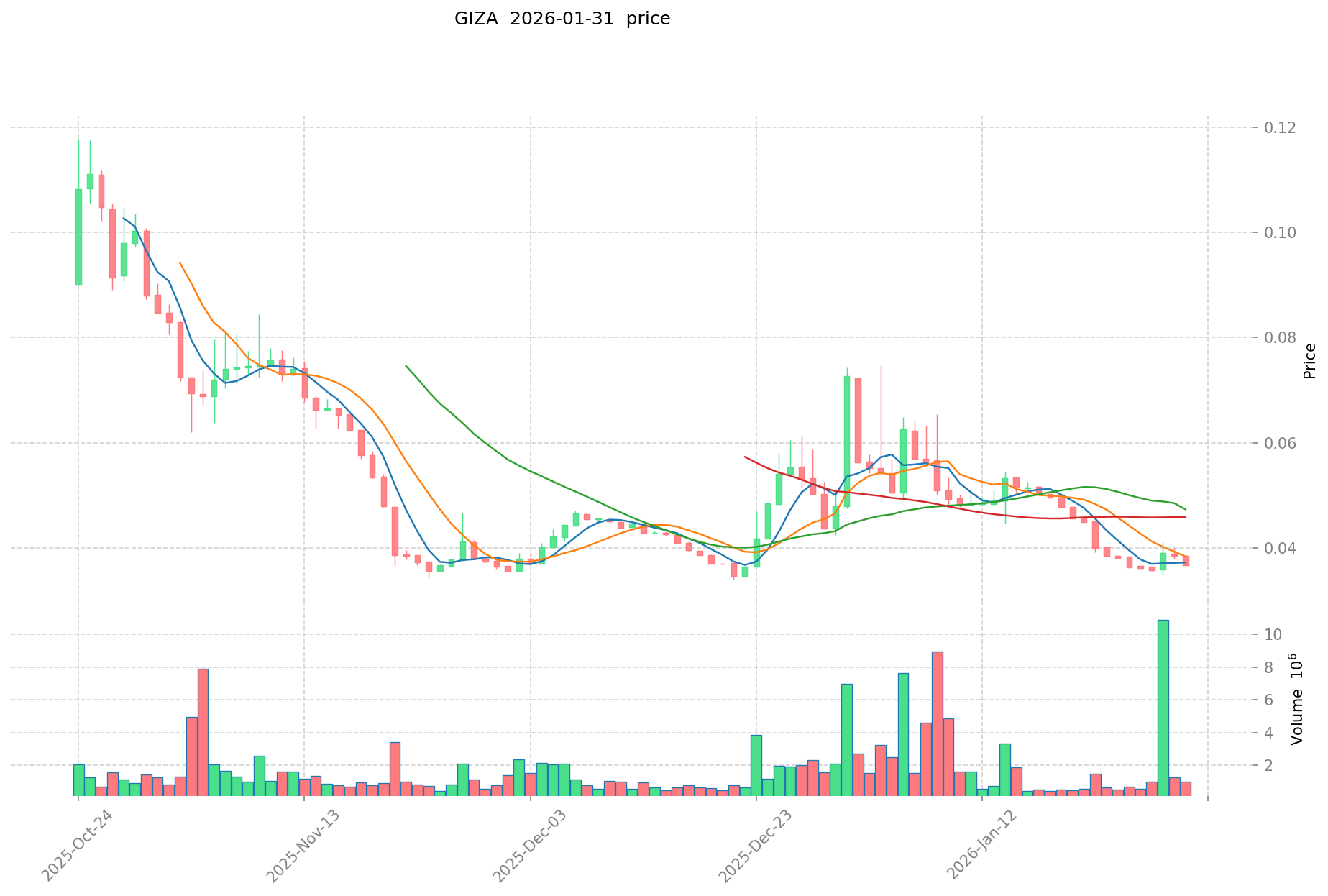
- June 2025: Price Peak Period → GIZA reached a notable price level of $0.50471 on June 8, 2025, reflecting strong early market interest during its initial months of circulation.
- December 2025: Market Correction Phase → The token experienced significant downward pressure, declining to $0.03396 on December 21, 2025, representing a substantial retracement from earlier levels.
Current GIZA Investment Market Status (February 2026)
- Current GIZA Price: $0.0362 (as of February 1, 2026)
- Market Performance: The token shows a declining trend across multiple timeframes, with a 24-hour decrease of 3.52%, a 7-day decline of 5.77%, and a 30-day drop of 39.31%.
- 24-Hour Trading Volume: $41,846.02
- Market Capitalization: $2.44 million with a fully diluted valuation of $36.2 million
- Token Holder Base: 76,447 holders across the ecosystem
- Exchange Coverage: Available on 5 trading platforms
Click to view real-time GIZA market price
II. Core Factors Influencing Whether GIZA is a Good Investment
Supply Mechanism and Scarcity (GIZA Investment Scarcity)
- GIZA has a maximum supply of 1,000,000,000 tokens, with a current circulating supply of 67,300,000 tokens, representing approximately 6.73% of the total supply.
- The token's circulating supply ratio indicates a relatively low proportion of tokens currently in circulation, which may influence price dynamics as additional tokens enter the market over time.
- The current market capitalization stands at approximately $2.44 million, with a fully diluted valuation of $36.2 million, suggesting potential dilution effects as more tokens become available.
- Investment consideration: The large gap between circulating supply and maximum supply may impact long-term scarcity perception and price stability.
Institutional Investment and Mainstream Adoption (Institutional Investment in GIZA)
- GIZA currently has 76,447 holders according to available data, indicating a moderate level of adoption within the cryptocurrency community.
- The token is listed on 5 exchanges, suggesting limited mainstream exchange availability compared to more established cryptocurrencies.
- Market share represents 0.0012% of the total cryptocurrency market capitalization, reflecting an early-stage investment profile.
- No specific institutional investment data or notable enterprise adoption information is currently available in the reference materials.
Macroeconomic Environment's Impact on GIZA Investment
- As a cryptocurrency asset, GIZA's investment appeal may be influenced by broader monetary policy trends and interest rate environments that affect risk appetite in digital asset markets.
- Market performance data shows GIZA experienced a 30-day decline of 39.31% and a 1-year decline of 50.52%, reflecting sensitivity to market conditions.
- The token's price volatility, with a 24-hour range between $0.03599 and $0.03796, indicates exposure to short-term market fluctuations.
- Trading volume of approximately $41,846 over 24 hours suggests moderate liquidity conditions that may be affected by broader market sentiment.
Technology and Ecosystem Development (Technology & Ecosystem for GIZA Investment)
- According to the project description, Giza Protocol is designed to power agent-driven financial markets that aim to transcend traditional cognitive limitations.
- The token operates on the BASE blockchain infrastructure, as indicated by its contract address on BASEEVM.
- The project's focus on agent-driven financial applications positions it within the emerging intersection of artificial intelligence and decentralized finance.
- Current ecosystem development details, specific technological upgrades, or application adoption metrics are not extensively documented in the available reference materials.
III. GIZA Future Investment Predictions and Price Outlook (Is Giza(GIZA) worth investing in 2026-2031)
Short-term Investment Prediction (2026, short-term GIZA investment outlook)
- Conservative Estimate: $0.0297 - $0.0362
- Neutral Estimate: $0.0362 - $0.0419
- Optimistic Estimate: $0.0419 - $0.0478
Mid-term Investment Outlook (2027-2029, mid-term Giza(GIZA) investment forecast)
-
Market Phase Expectation: The token may experience gradual recovery as the agent-driven financial market concept gains traction. Price movements could reflect broader adoption patterns and technological developments within the ecosystem.
-
Investment Return Prediction:
- 2027: $0.0277 - $0.0504
- 2028: $0.0406 - $0.0660
- 2029: $0.0421 - $0.0746
-
Key Catalysts: Expansion of agent-driven financial applications, enhanced protocol functionality, strategic partnerships, and overall cryptocurrency market sentiment.
Long-term Investment Outlook (Is GIZA a good long-term investment?)
- Base Scenario: $0.0532 - $0.0889 (assuming steady ecosystem development and moderate market conditions through 2030-2031)
- Optimistic Scenario: $0.0771 - $0.1026 (assuming accelerated adoption of agent-driven financial solutions and favorable regulatory environment)
- Risk Scenario: Below $0.0297 (under adverse market conditions, technology setbacks, or prolonged market downturn)
Click to view GIZA long-term investment and price predictions: Price Prediction
2026-2031 Long-term Outlook
- Base Scenario: $0.0532 - $0.0889 (corresponding to steady progress and gradual mainstream application adoption)
- Optimistic Scenario: $0.0771 - $0.1026 (corresponding to large-scale adoption and favorable market environment)
- Transformative Scenario: Above $0.1026 (if ecosystem achieves breakthrough developments and mainstream popularization)
- 2031-12-31 Predicted High: $0.1026 (based on optimistic development assumptions)
Disclaimer: These predictions are based on historical data and market analysis models. Cryptocurrency investments carry substantial risk, and actual prices may vary significantly from predictions due to market volatility, regulatory changes, technological developments, and other unforeseen factors. This information should not be construed as financial advice.
| Year |
Predicted High Price |
Predicted Average Price |
Predicted Low Price |
Price Change |
| 2026 |
0.0477708 |
0.03619 |
0.0296758 |
0 |
| 2027 |
0.05037648 |
0.0419804 |
0.027707064 |
15 |
| 2028 |
0.0660351692 |
0.04617844 |
0.0406370272 |
27 |
| 2029 |
0.074622050118 |
0.0561068046 |
0.04208010345 |
54 |
| 2030 |
0.08889562120824 |
0.065364427359 |
0.05294518616079 |
80 |
| 2031 |
0.102582932297214 |
0.07713002428362 |
0.053219716755697 |
113 |
IV. Giza Investment Strategy and Risk Management (How to invest in Giza)
Investment Methodology (Giza investment strategy)
Long-term Holding (HODL Giza): This approach suits conservative investors who believe in the long-term vision of agent-driven financial markets. Given Giza's relatively early stage with only 6.73% of tokens in circulation, long-term holders may benefit from potential future token unlocks and ecosystem development. However, investors should carefully monitor the token release schedule and project milestones.
Active Trading: For traders utilizing technical analysis and swing trading strategies, Giza presents certain opportunities due to its price volatility. The 24-hour trading range between $0.03599 and $0.03796 indicates intraday price movements. However, the limited exchange availability (5 exchanges) and moderate trading volume ($41,846) may present liquidity constraints for larger position sizes.
Risk Management (Risk management for Giza investment)
Asset Allocation Ratios:
- Conservative investors: Consider allocating no more than 1-2% of crypto portfolio to Giza, given its early-stage nature and limited market presence
- Aggressive investors: May allocate 3-5% while maintaining diversification across multiple asset classes
- Professional investors: Should conduct thorough due diligence on tokenomics, team credentials, and technological infrastructure before determining appropriate position sizing
Risk Hedging Strategies: Implement a diversified portfolio approach combining established cryptocurrencies with emerging projects like Giza. Consider maintaining stable assets or traditional financial instruments as hedging tools to mitigate overall portfolio volatility.
Secure Storage:
- Hot wallets: Suitable for active trading positions on supported exchanges
- Cold wallets: Recommended for long-term holdings, particularly hardware wallets that support BASE chain tokens
- Multi-signature solutions: Consider for larger holdings to enhance security
V. Giza Investment Risks and Challenges (Risks of investing in Giza)
Market Risks: Giza demonstrates significant price volatility, with a 39.31% decline over 30 days and 50.52% over one year from its historical peak. The token reached an all-time high of $0.50471 on June 8, 2025, and subsequently declined to an all-time low of $0.03396 on December 21, 2025. This substantial price fluctuation reflects the inherent volatility associated with emerging crypto assets. Additionally, with a relatively modest market capitalization of approximately $2.44 million and limited exchange presence, the token may be susceptible to price manipulation or significant price impacts from large transactions.
Regulatory Risks: As an agent-driven financial protocol operating in the decentralized finance space, Giza may face evolving regulatory scrutiny across different jurisdictions. The regulatory landscape for AI-integrated financial services and autonomous agent protocols remains uncertain in many regions. Changes in regulatory frameworks could materially impact the project's operations, token utility, or market accessibility.
Technical Risks: The protocol's reliance on agent-driven systems introduces unique technical considerations. Potential vulnerabilities in smart contract architecture, agent coordination mechanisms, or integration points with external systems could pose security risks. The BASE chain deployment requires continuous monitoring for network-specific issues. Furthermore, with only 6.73% token circulation against a maximum supply of 1 billion tokens, future token unlock events could create additional market pressure.
VI. Conclusion: Is Giza a Good Investment?
Investment Value Summary: Giza represents an emerging project in the agent-driven financial markets sector, presenting both opportunities and considerable risks. The protocol's vision of transcending human cognitive limitations through autonomous agents addresses an innovative niche. However, the investment profile shows substantial price volatility, with significant declines observed across multiple timeframes. The limited market capitalization ($2.44 million), modest trading volume, and low circulation ratio (6.73%) indicate an early-stage project with uncertain trajectory.
Investor Recommendations:
✅ Beginners: Consider a dollar-cost averaging approach with very small position sizes, ensuring proper understanding of BASE chain wallet management and secure storage practices. New investors should prioritize education about the project's fundamentals and agent-driven finance concepts before committing capital.
✅ Experienced Investors: May explore tactical trading opportunities while maintaining strict risk management protocols. Position sizing should reflect the project's early stage and limited liquidity. Diversification across multiple crypto assets remains essential.
✅ Institutional Investors: Should conduct comprehensive technical and fundamental analysis, including team background verification, technology audit assessment, and tokenomics modeling. Consider pilot positions while monitoring project development milestones and market adoption metrics.
⚠️ Disclaimer: Cryptocurrency investments carry substantial risk, including potential total loss of capital. This analysis serves informational purposes only and does not constitute investment advice. Investors should conduct independent research and consult financial professionals before making investment decisions.
VII. FAQ
Q1: What is the current price and market capitalization of Giza (GIZA)?
As of February 1, 2026, GIZA trades at approximately $0.0362 with a market capitalization of $2.44 million. The token has experienced significant volatility, declining 3.52% in 24 hours, 5.77% over 7 days, and 39.31% over 30 days. With a fully diluted valuation of $36.2 million and only 67.3 million tokens in circulation (6.73% of the 1 billion total supply), the token demonstrates early-stage characteristics. The 24-hour trading volume stands at approximately $41,846, indicating moderate liquidity across 5 exchanges.
Q2: What are the key risks associated with investing in Giza?
The primary risks include substantial price volatility (50.52% decline over one year from its peak), limited market presence with only $2.44 million market capitalization, restricted exchange availability (5 platforms), and low liquidity conditions. Technical risks encompass smart contract vulnerabilities, agent coordination mechanisms, and BASE chain infrastructure dependencies. Regulatory uncertainty surrounding AI-integrated financial services presents additional challenges. Furthermore, the large gap between circulating supply (6.73%) and maximum supply creates potential dilution concerns as tokens unlock.
Q3: How does Giza's tokenomics structure affect its investment potential?
GIZA has a maximum supply of 1 billion tokens with only 67.3 million currently circulating, representing 6.73% of total supply. This low circulation ratio suggests significant future token releases that could create downward price pressure through dilution effects. The gap between the current market cap ($2.44 million) and fully diluted valuation ($36.2 million) indicates potential value dilution of approximately 93% as remaining tokens enter circulation. Investors should carefully monitor the token release schedule and vesting mechanisms to understand future supply dynamics.
Q4: What is the long-term price outlook for Giza through 2031?
Based on analytical models, conservative estimates suggest GIZA could reach $0.0532-$0.0889 by 2030-2031 under steady development conditions. Optimistic scenarios project $0.0771-$0.1026 with accelerated adoption of agent-driven financial solutions. Short-term predictions for 2026 range between $0.0297-$0.0478. However, these projections carry significant uncertainty given the project's early stage, market volatility, and evolving regulatory environment. Price predictions should be viewed as analytical frameworks rather than guaranteed outcomes.
Q5: What investment strategy is most appropriate for Giza?
Conservative investors should consider allocating no more than 1-2% of their crypto portfolio to GIZA, utilizing dollar-cost averaging to manage volatility risk. Long-term holders (HODL strategy) should maintain secure cold storage using hardware wallets supporting BASE chain tokens. Active traders may explore swing trading opportunities within the $0.0360-$0.0380 range, though limited liquidity presents constraints. Regardless of strategy, strict risk management protocols, portfolio diversification, and continuous monitoring of project development milestones remain essential for all investor profiles.
Q6: How does Giza compare to other agent-driven financial protocols?
Giza positions itself within the emerging intersection of artificial intelligence and decentralized finance, focusing on agent-driven financial markets that aim to transcend traditional cognitive limitations. Operating on the BASE blockchain infrastructure, the protocol targets autonomous financial operations. However, with a market share of only 0.0012% of total cryptocurrency market capitalization and 76,447 holders, GIZA remains in early adoption stages compared to established DeFi protocols. Limited exchange availability and modest trading volumes differentiate it from more mature projects with broader institutional support and liquidity.
* The information is not intended to be and does not constitute financial advice or any other recommendation of any sort offered or endorsed by Gate.